

Microsoft said on May 22, 2026, that Forrester named it a Leader in The Forrester Wave: Workforce Identity Security Platforms, Q2 2026, with Microsoft Entra receiving the highest scores in the report’s current offering and strategy categories, according to the company’s security blog. The announcement is less interesting as a trophy case entry than as a marker of where enterprise security is moving. Microsoft is arguing that identity is no longer an authentication checkpoint but the operating layer for risk. That claim is self-serving, but it is also increasingly difficult for IT departments to ignore.
The old identity story was simple enough to explain to a board: users sign in, policies decide whether they get access, logs prove what happened later. That model still exists, but it no longer describes the environment most organizations are actually trying to secure. Employees work across cloud apps, legacy systems, unmanaged networks, partner tenants, developer platforms, and AI services that can act on behalf of people or processes.
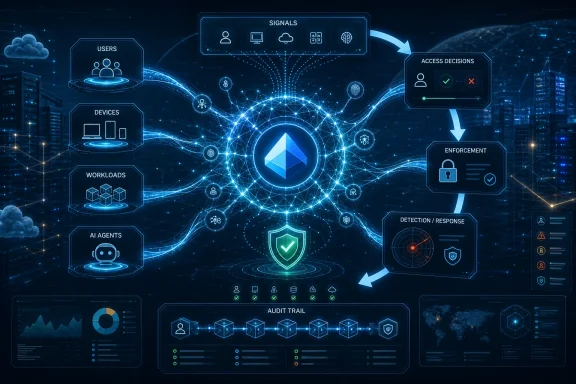
Microsoft’s Entra pitch is that this sprawl cannot be governed by stitching together separate identity, access, governance, and response tools after the fact. The company wants customers to see Entra as an Access Fabric, a continuous system where identity signals feed policy decisions, policy decisions trigger enforcement, and enforcement events flow back into detection and response. In that telling, identity becomes less like a login screen and more like a security nervous system.
That is why the Forrester recognition matters strategically. Analyst rankings are not neutral reality, and Forrester itself warns that its reports are not endorsements. But market categories have power. When a major research firm evaluates “workforce identity security platforms,” it validates the idea that buyers should be shopping for a platform rather than a bundle of identity features.
For Microsoft, that is home turf. The company already owns the productivity suite, the endpoint story, the cloud control plane, and a large share of enterprise directory infrastructure. Entra gives Microsoft a way to bind those assets together under the language of Zero Trust, risk, and now AI-era identity.
Credential phishing, token theft, consent abuse, legacy authentication, overprivileged service principals, stale accounts, and help desk social engineering are all identity problems, but they do not all look like password problems. The industry’s move toward phishing-resistant authentication has raised the bar, especially where passkeys, certificate-based authentication, and hardware-backed credentials are deployed. Yet attackers adapt to the gaps between systems, policies, and teams.
That is the fragmentation Microsoft is targeting. In many enterprises, identity protection flags risk in one console, endpoint detection sees suspicious activity in another, governance workflows live somewhere else, and access reviews arrive as compliance theater weeks after the actual risk has changed. The result is a security program that can know many useful things but struggle to act on them quickly.
Microsoft’s argument is that workforce identity security should compress that distance. If a sign-in looks risky, if a device falls out of compliance, if a role assignment becomes anomalous, or if an AI agent starts touching data it should not, the platform should not merely generate an alert. It should be able to change access in near real time.
That is a high bar, and it should invite skepticism. Security vendors have promised unified control planes for decades, and many of those promises collapsed into dashboard sprawl with better branding. The difference now is that identity has become so central to cloud and SaaS operations that the control plane is no longer optional. Someone will own it. Microsoft is betting that its installed base gives it the inside track.
This is where the identity conversation changes from scale to structure. Enterprises already had non-human identities: service accounts, managed identities, API keys, automation scripts, workload identities, bots, and certificates. Many of those were poorly governed, but they were at least familiar. AI agents add a more ambiguous actor: software that can interpret instructions, call tools, access systems, and make decisions at machine speed.
That creates a practical problem for Windows and Microsoft 365 administrators. If an agent books meetings, summarizes documents, triages tickets, updates CRM records, or queries security telemetry, whose authority is it using? Is it acting as the user, as an application, as a service principal, or as a distinct entity with its own lifecycle and audit trail?
The wrong answer is “it depends, and nobody can tell from the logs.” That is the nightmare scenario for security teams. AI agents without clear identities become a new form of shadow access, harder to review than a user account and more flexible than a traditional script.
Microsoft Entra Agent ID is meant to address that gap by giving AI agents a managed identity framework. The strategic aim is obvious: if agents are going to operate across Microsoft 365, Azure, third-party apps, and security tooling, Microsoft wants their identity, authorization, and governance model to run through Entra. That would make Entra not just a workforce identity platform but a gatekeeper for the agentic workplace Microsoft is busily selling.
AI agents intensify the same tension. A human user can be challenged for MFA, trained about phishing, questioned by a manager, or locked out after suspicious behavior. An agent may run continuously, act through APIs, and chain actions across multiple systems in seconds. The security model has to be less theatrical and more deterministic.
That means policy needs to follow the actor, not merely the front door. If an agent can access sensitive HR data, create tickets, read mailboxes, call Graph APIs, or trigger workflows, administrators need to know what it is allowed to do, why it has that access, who approved it, and when that access should expire. The same questions apply to human users, but the speed and opacity of agent behavior make weak governance more dangerous.
Microsoft’s Access Fabric language is designed to make that sound like one fabric rather than many seams. The company wants identity signals, access policies, threat detection, governance workflows, and response mechanisms to reinforce one another. In the best case, that reduces the lag between detecting risk and changing access.
In the worst case, it produces another dependency on a platform whose complexity becomes its own operational risk. Microsoft customers know this pattern well. Entra’s breadth is an advantage, but it also means identity teams must understand a fast-moving product family with licensing boundaries, preview features, policy interactions, and administrative roles that can be difficult to reason about under pressure.
That gravity can produce real benefits. Conditional Access policies can reflect device compliance. Identity Protection risk signals can influence sign-in behavior. Privileged Identity Management can reduce standing administrative access. Governance workflows can manage access reviews and lifecycle events. Defender and Sentinel can consume identity events as part of broader detection and response.
The appeal is not that every component is automatically best in class. It is that the components can share context. In security operations, context is time. The fewer joins an analyst has to perform manually across tools, the better the chance of catching a compromise before it becomes an incident report.
But platform gravity also creates lock-in. A company standardized on Entra may find that the cleanest security architecture assumes more Microsoft everywhere: more Defender, more Intune, more Sentinel, more Purview, more Copilot, more Azure. That is not inherently bad; many IT teams prefer fewer vendors when the integration is real. But it narrows the range of future choices.
Okta, CyberArk, Ping, SailPoint, and other identity and access players are not standing still. Some have deeper histories in heterogeneous identity environments, privileged access, governance, or customer identity. For organizations that are proudly multi-cloud, deeply invested in non-Microsoft SaaS, or wary of vendor concentration, Microsoft’s platform story may look as much like a containment strategy as a security strategy.
That fatigue is visible in the way Microsoft frames the problem. Identity signals in one place, access policies in another, response workflows somewhere else: this is not an abstract complaint. It is the daily operational drag of security work. The handoff between identity administration and security operations is often where the attacker’s dwell time grows.
The platform answer is tempting because it promises continuity. A user changes roles, a device becomes risky, an app requests new permissions, a service account shows unusual behavior, and the system adjusts without a committee meeting. That is the ideal. The real world still involves exceptions, broken apps, business pressure, and incomplete telemetry.
Forrester’s recognition gives Microsoft a marketing proof point, but it also raises expectations. If Entra is a leader in workforce identity security platforms, customers will expect more than reliable sign-on. They will expect coherent governance for human and non-human identities, explainable risk decisions, consistent enforcement across environments, and integrations that reduce toil rather than merely shift it into new consoles.
The danger for Microsoft is overclaiming the maturity of the model. AI agents, in particular, are moving faster than enterprise governance practices. Treating them as identities is the right conceptual move. Making that manageable for a Fortune 500 tenant with years of accumulated permissions is the harder part.
Conditional Access will keep becoming a more central security boundary. Device compliance, location, authentication strength, sign-in risk, user risk, session controls, and workload context will matter more. The traditional separation between “Windows management” and “identity management” will continue to erode, especially in Microsoft 365 environments where Intune, Entra, and Defender are already intertwined.
Help desks will also feel the change. Stronger identity security usually means fewer easy resets and more scrutiny around account recovery. That is good security, but it changes user support workflows. Phishing-resistant authentication and tighter privileged access controls reduce some attack paths while increasing the need for better onboarding, device provisioning, and break-glass planning.
Developers and automation owners will face their own reckoning. Scripts, service principals, app registrations, and automation accounts that once lived in the shadows are increasingly part of the identity risk picture. AI agents will accelerate that review. If an automated process can access business data, it needs ownership, permissions, monitoring, and a retirement plan.
This is where Microsoft’s message becomes most concrete. Identity security is not just a CISO program; it is an operations discipline. The organizations that benefit most from Entra’s platform approach will be the ones willing to clean up identity debt, not merely license another layer of intelligence on top of it.
If an AI agent deletes a record, approves an expense, changes a configuration, shares a document, or queries a restricted dataset, the audit trail must answer more than “a process did it.” It needs to show which agent acted, under what authorization, on whose behalf if applicable, through which policy, and with what controls in force at the time. Without that chain, AI becomes a compliance blind spot.
Microsoft’s framing of AI-powered identities as core participants in identity strategy is therefore more than a technical detail. It is a governance requirement. The identity layer becomes the place where an organization proves that automation did not become unaccountable authority.
That proof will matter for regulated industries first, but it will spread. Finance, healthcare, government, legal services, and critical infrastructure will not be able to wave away agent activity as “just automation.” They will need retention, review, revocation, and incident response processes that treat agent actions as security-relevant events.
The broader implication is that identity platforms are becoming systems of record for trust. Not trust in the sentimental sense, but trust as a ledger of who or what had access, why that access existed, and how risk was evaluated. Microsoft wants Entra to be that ledger.
That distinction matters. A tenant with years of accumulated exceptions, global administrators, stale guest accounts, weak app consent controls, unmanaged devices, and undocumented service principals is not transformed by a Forrester ranking. The platform can expose risk and enforce policy, but only if the organization has the will to define ownership and remove unsafe convenience.
Identity security programs often fail in the space between tooling and authority. Security teams may recommend least privilege, but business owners resist losing access. Administrators may want to disable legacy authentication, but old applications still depend on it. Governance teams may schedule access reviews, but reviewers rubber-stamp permissions because they do not understand the consequences.
AI agents will make that gap less tolerable. An overprivileged human account is dangerous. An overprivileged agent that can run continuously and act across systems is a different class of problem. The governance model must be explicit before the agents become ubiquitous.
Microsoft’s platform strategy can help by making policy enforcement more consistent. It cannot decide what the business is willing to stop doing. That remains a human problem, and no analyst chart will solve it.
Those arguments will resonate in different environments. A Microsoft-heavy enterprise may see Entra as the path of least resistance. A company with substantial Google Workspace, AWS, Salesforce, Workday, ServiceNow, custom apps, and multiple clouds may be more skeptical of a Microsoft-centered access fabric. The more diverse the estate, the more important it becomes to test whether “unified” means genuinely cross-platform or merely best inside the vendor’s own garden.
This is where buyers should be clear-eyed. Microsoft’s advantage is ecosystem reach, not magic. Its products can be powerful and still require careful architecture. Its AI agent identity story can be directionally right and still immature in implementation details. Its integration can reduce operational burden and still increase dependency on Microsoft licensing and administrative models.
The Forrester recognition gives Microsoft credibility in the category. It does not end the category. If anything, it signals that workforce identity security is now a primary battleground for enterprise security budgets.
That actor might be an employee. It might be a contractor, a partner, a device, a workload, an app, a script, or an AI agent. It might be a user sitting at a Windows laptop or an autonomous process calling an API at 2:13 a.m. The security system has to decide whether the action is allowed, not merely whether a password was correct.
This is why the workforce identity security platform category matters. Workforce no longer means only people in an org chart. It increasingly includes the software entities that support, extend, or imitate human work. The identity platform has to understand that mixed workforce without collapsing everything into generic accounts and opaque permissions.
Microsoft’s Entra strategy is built for that world. It is also a bet that enterprises will prefer consolidation over best-of-breed complexity. Given the staffing realities in many IT departments, that is not a foolish bet.
 Microsoft Wants Identity to Become the Control Plane
The old identity story was simple enough to explain to a board: users sign in, policies decide whether they get access, logs prove what happened later. That model still exists, but it no longer describes the environment most organizations are actually trying to secure. Employees work across cloud apps, legacy systems, unmanaged networks, partner tenants, developer platforms, and AI services that can act on behalf of people or processes.Microsoft’s Entra pitch is that this sprawl cannot be governed by stitching together separate identity, access, governance, and response tools after the fact. The company wants customers to see Entra as an Access Fabric, a continuous system where identity signals feed policy decisions, policy decisions trigger enforcement, and enforcement events flow back into detection and response. In that telling, identity becomes less like a login screen and more like a security nervous system.
That is why the Forrester recognition matters strategically. Analyst rankings are not neutral reality, and Forrester itself warns that its reports are not endorsements. But market categories have power. When a major research firm evaluates “workforce identity security platforms,” it validates the idea that buyers should be shopping for a platform rather than a bundle of identity features.
For Microsoft, that is home turf. The company already owns the productivity suite, the endpoint story, the cloud control plane, and a large share of enterprise directory infrastructure. Entra gives Microsoft a way to bind those assets together under the language of Zero Trust, risk, and now AI-era identity.
The Passwordless Future Still Has a Credential Problem
Microsoft’s announcement leans heavily on a familiar but stubborn reality: identity remains one of the most targeted attack surfaces in enterprise security. That is not because identity teams failed to preach multifactor authentication loudly enough. It is because access is the shortest path from an attacker’s foothold to an organization’s crown jewels.Credential phishing, token theft, consent abuse, legacy authentication, overprivileged service principals, stale accounts, and help desk social engineering are all identity problems, but they do not all look like password problems. The industry’s move toward phishing-resistant authentication has raised the bar, especially where passkeys, certificate-based authentication, and hardware-backed credentials are deployed. Yet attackers adapt to the gaps between systems, policies, and teams.
That is the fragmentation Microsoft is targeting. In many enterprises, identity protection flags risk in one console, endpoint detection sees suspicious activity in another, governance workflows live somewhere else, and access reviews arrive as compliance theater weeks after the actual risk has changed. The result is a security program that can know many useful things but struggle to act on them quickly.
Microsoft’s argument is that workforce identity security should compress that distance. If a sign-in looks risky, if a device falls out of compliance, if a role assignment becomes anomalous, or if an AI agent starts touching data it should not, the platform should not merely generate an alert. It should be able to change access in near real time.
That is a high bar, and it should invite skepticism. Security vendors have promised unified control planes for decades, and many of those promises collapsed into dashboard sprawl with better branding. The difference now is that identity has become so central to cloud and SaaS operations that the control plane is no longer optional. Someone will own it. Microsoft is betting that its installed base gives it the inside track.
AI Agents Turn Identity Sprawl Into a Structural Problem
The most important part of Microsoft’s announcement is not the Forrester badge. It is the company’s insistence that AI agents must be treated as first-class identities.This is where the identity conversation changes from scale to structure. Enterprises already had non-human identities: service accounts, managed identities, API keys, automation scripts, workload identities, bots, and certificates. Many of those were poorly governed, but they were at least familiar. AI agents add a more ambiguous actor: software that can interpret instructions, call tools, access systems, and make decisions at machine speed.
That creates a practical problem for Windows and Microsoft 365 administrators. If an agent books meetings, summarizes documents, triages tickets, updates CRM records, or queries security telemetry, whose authority is it using? Is it acting as the user, as an application, as a service principal, or as a distinct entity with its own lifecycle and audit trail?
The wrong answer is “it depends, and nobody can tell from the logs.” That is the nightmare scenario for security teams. AI agents without clear identities become a new form of shadow access, harder to review than a user account and more flexible than a traditional script.
Microsoft Entra Agent ID is meant to address that gap by giving AI agents a managed identity framework. The strategic aim is obvious: if agents are going to operate across Microsoft 365, Azure, third-party apps, and security tooling, Microsoft wants their identity, authorization, and governance model to run through Entra. That would make Entra not just a workforce identity platform but a gatekeeper for the agentic workplace Microsoft is busily selling.
Zero Trust Gets Harder When the Worker Is Software
Zero Trust has always sounded cleaner in architecture diagrams than in production. “Never trust, always verify” is easy to endorse and difficult to operationalize when users hate friction, executives demand exceptions, legacy applications cannot handle modern authentication, and business units procure SaaS faster than IT can govern it.AI agents intensify the same tension. A human user can be challenged for MFA, trained about phishing, questioned by a manager, or locked out after suspicious behavior. An agent may run continuously, act through APIs, and chain actions across multiple systems in seconds. The security model has to be less theatrical and more deterministic.
That means policy needs to follow the actor, not merely the front door. If an agent can access sensitive HR data, create tickets, read mailboxes, call Graph APIs, or trigger workflows, administrators need to know what it is allowed to do, why it has that access, who approved it, and when that access should expire. The same questions apply to human users, but the speed and opacity of agent behavior make weak governance more dangerous.
Microsoft’s Access Fabric language is designed to make that sound like one fabric rather than many seams. The company wants identity signals, access policies, threat detection, governance workflows, and response mechanisms to reinforce one another. In the best case, that reduces the lag between detecting risk and changing access.
In the worst case, it produces another dependency on a platform whose complexity becomes its own operational risk. Microsoft customers know this pattern well. Entra’s breadth is an advantage, but it also means identity teams must understand a fast-moving product family with licensing boundaries, preview features, policy interactions, and administrative roles that can be difficult to reason about under pressure.
The Platform Advantage Cuts Both Ways
Microsoft’s strongest argument is integration. Entra sits in the path of Microsoft 365, Azure, Windows, Defender, Purview, Intune, and a vast ecosystem of enterprise applications. For many organizations, choosing Microsoft for workforce identity security is less a procurement decision than an acknowledgment of gravity.That gravity can produce real benefits. Conditional Access policies can reflect device compliance. Identity Protection risk signals can influence sign-in behavior. Privileged Identity Management can reduce standing administrative access. Governance workflows can manage access reviews and lifecycle events. Defender and Sentinel can consume identity events as part of broader detection and response.
The appeal is not that every component is automatically best in class. It is that the components can share context. In security operations, context is time. The fewer joins an analyst has to perform manually across tools, the better the chance of catching a compromise before it becomes an incident report.
But platform gravity also creates lock-in. A company standardized on Entra may find that the cleanest security architecture assumes more Microsoft everywhere: more Defender, more Intune, more Sentinel, more Purview, more Copilot, more Azure. That is not inherently bad; many IT teams prefer fewer vendors when the integration is real. But it narrows the range of future choices.
Okta, CyberArk, Ping, SailPoint, and other identity and access players are not standing still. Some have deeper histories in heterogeneous identity environments, privileged access, governance, or customer identity. For organizations that are proudly multi-cloud, deeply invested in non-Microsoft SaaS, or wary of vendor concentration, Microsoft’s platform story may look as much like a containment strategy as a security strategy.
Forrester’s Category Shift Reflects Buyer Fatigue
The move from identity and access management to workforce identity security platform is not just analyst wordsmithing. It reflects buyer fatigue with fragmented controls. Enterprises have spent years buying authentication, single sign-on, governance, privileged access, risk analytics, endpoint management, and security information tools from overlapping vendors, then asking overworked teams to make them behave like a system.That fatigue is visible in the way Microsoft frames the problem. Identity signals in one place, access policies in another, response workflows somewhere else: this is not an abstract complaint. It is the daily operational drag of security work. The handoff between identity administration and security operations is often where the attacker’s dwell time grows.
The platform answer is tempting because it promises continuity. A user changes roles, a device becomes risky, an app requests new permissions, a service account shows unusual behavior, and the system adjusts without a committee meeting. That is the ideal. The real world still involves exceptions, broken apps, business pressure, and incomplete telemetry.
Forrester’s recognition gives Microsoft a marketing proof point, but it also raises expectations. If Entra is a leader in workforce identity security platforms, customers will expect more than reliable sign-on. They will expect coherent governance for human and non-human identities, explainable risk decisions, consistent enforcement across environments, and integrations that reduce toil rather than merely shift it into new consoles.
The danger for Microsoft is overclaiming the maturity of the model. AI agents, in particular, are moving faster than enterprise governance practices. Treating them as identities is the right conceptual move. Making that manageable for a Fortune 500 tenant with years of accumulated permissions is the harder part.
Windows Admins Will Feel This in the Boring Places First
For WindowsForum readers, the practical impact will not arrive as a single dramatic switch. It will show up in the ordinary administrative places where identity policy touches endpoints, apps, and users.Conditional Access will keep becoming a more central security boundary. Device compliance, location, authentication strength, sign-in risk, user risk, session controls, and workload context will matter more. The traditional separation between “Windows management” and “identity management” will continue to erode, especially in Microsoft 365 environments where Intune, Entra, and Defender are already intertwined.
Help desks will also feel the change. Stronger identity security usually means fewer easy resets and more scrutiny around account recovery. That is good security, but it changes user support workflows. Phishing-resistant authentication and tighter privileged access controls reduce some attack paths while increasing the need for better onboarding, device provisioning, and break-glass planning.
Developers and automation owners will face their own reckoning. Scripts, service principals, app registrations, and automation accounts that once lived in the shadows are increasingly part of the identity risk picture. AI agents will accelerate that review. If an automated process can access business data, it needs ownership, permissions, monitoring, and a retirement plan.
This is where Microsoft’s message becomes most concrete. Identity security is not just a CISO program; it is an operations discipline. The organizations that benefit most from Entra’s platform approach will be the ones willing to clean up identity debt, not merely license another layer of intelligence on top of it.
The AI Security Story Is Really an Audit Story
Vendors love to talk about AI in terms of acceleration. Security teams should talk about it in terms of accountability.If an AI agent deletes a record, approves an expense, changes a configuration, shares a document, or queries a restricted dataset, the audit trail must answer more than “a process did it.” It needs to show which agent acted, under what authorization, on whose behalf if applicable, through which policy, and with what controls in force at the time. Without that chain, AI becomes a compliance blind spot.
Microsoft’s framing of AI-powered identities as core participants in identity strategy is therefore more than a technical detail. It is a governance requirement. The identity layer becomes the place where an organization proves that automation did not become unaccountable authority.
That proof will matter for regulated industries first, but it will spread. Finance, healthcare, government, legal services, and critical infrastructure will not be able to wave away agent activity as “just automation.” They will need retention, review, revocation, and incident response processes that treat agent actions as security-relevant events.
The broader implication is that identity platforms are becoming systems of record for trust. Not trust in the sentimental sense, but trust as a ledger of who or what had access, why that access existed, and how risk was evaluated. Microsoft wants Entra to be that ledger.
The Hard Part Is Not Buying Entra, It Is Governing It
Microsoft’s recognition comes at a moment when many organizations already have Entra in some form. The question is not whether they use Microsoft identity. It is whether they use it well enough for the role Microsoft now wants it to play.That distinction matters. A tenant with years of accumulated exceptions, global administrators, stale guest accounts, weak app consent controls, unmanaged devices, and undocumented service principals is not transformed by a Forrester ranking. The platform can expose risk and enforce policy, but only if the organization has the will to define ownership and remove unsafe convenience.
Identity security programs often fail in the space between tooling and authority. Security teams may recommend least privilege, but business owners resist losing access. Administrators may want to disable legacy authentication, but old applications still depend on it. Governance teams may schedule access reviews, but reviewers rubber-stamp permissions because they do not understand the consequences.
AI agents will make that gap less tolerable. An overprivileged human account is dangerous. An overprivileged agent that can run continuously and act across systems is a different class of problem. The governance model must be explicit before the agents become ubiquitous.
Microsoft’s platform strategy can help by making policy enforcement more consistent. It cannot decide what the business is willing to stop doing. That remains a human problem, and no analyst chart will solve it.
Competitors Will Attack the Microsoft Default
The identity market is not going to concede the AI-era control plane to Microsoft. Okta has been pushing its own identity security fabric narrative, particularly for heterogeneous environments and non-human identities. CyberArk continues to argue from the privileged access and secrets-management side of the house. Governance specialists will claim that identity security without deep lifecycle and access intelligence is merely authentication with better branding.Those arguments will resonate in different environments. A Microsoft-heavy enterprise may see Entra as the path of least resistance. A company with substantial Google Workspace, AWS, Salesforce, Workday, ServiceNow, custom apps, and multiple clouds may be more skeptical of a Microsoft-centered access fabric. The more diverse the estate, the more important it becomes to test whether “unified” means genuinely cross-platform or merely best inside the vendor’s own garden.
This is where buyers should be clear-eyed. Microsoft’s advantage is ecosystem reach, not magic. Its products can be powerful and still require careful architecture. Its AI agent identity story can be directionally right and still immature in implementation details. Its integration can reduce operational burden and still increase dependency on Microsoft licensing and administrative models.
The Forrester recognition gives Microsoft credibility in the category. It does not end the category. If anything, it signals that workforce identity security is now a primary battleground for enterprise security budgets.
The New Identity Perimeter Has No Edge
For years, security leaders have said identity is the new perimeter. The phrase became so common that it lost some of its force. Microsoft’s announcement restores the sharper version of the argument: identity is not just the perimeter because networks dissolved; identity is the perimeter because every meaningful action in a digital business now needs an accountable actor.That actor might be an employee. It might be a contractor, a partner, a device, a workload, an app, a script, or an AI agent. It might be a user sitting at a Windows laptop or an autonomous process calling an API at 2:13 a.m. The security system has to decide whether the action is allowed, not merely whether a password was correct.
This is why the workforce identity security platform category matters. Workforce no longer means only people in an org chart. It increasingly includes the software entities that support, extend, or imitate human work. The identity platform has to understand that mixed workforce without collapsing everything into generic accounts and opaque permissions.
Microsoft’s Entra strategy is built for that world. It is also a bet that enterprises will prefer consolidation over best-of-breed complexity. Given the staffing realities in many IT departments, that is not a foolish bet.
The Entra Win Puts a Deadline on Identity Debt
Microsoft’s Forrester moment should be read less as a victory lap and more as a warning to organizations that still treat identity as plumbing. The platform era rewards tenants with clean governance, strong authentication, and clear ownership. It punishes environments where years of exceptions have become indistinguishable from policy.- Microsoft’s recognition strengthens Entra’s position as a central workforce identity security platform, not merely a directory or sign-on service.
- The strategic shift is toward continuous access control, where identity signals, policy enforcement, and response workflows operate as a loop.
- AI agents are forcing enterprises to treat non-human actors as governable identities with their own permissions, audit trails, and lifecycle controls.
- Windows and Microsoft 365 administrators should expect identity policy, endpoint compliance, and security operations to become more tightly coupled.
- The biggest implementation risk is not the absence of features but the persistence of identity debt, including stale permissions, weak recovery processes, and unmanaged automation.
- Microsoft’s platform advantage is real, but buyers should test cross-platform coverage, licensing implications, and operational complexity before assuming consolidation equals simplicity.
References
- Primary source: Microsoft
Published: Fri, 22 May 2026 17:00:00 GMT
Microsoft recognized as a Leader in The Forrester Wave™ for Workforce Identity Security Platforms | Microsoft Security Blog
Microsoft has been recognized as a Leader in The Forrester Wave™: Workforce Identity Security Platforms, Q2 2026, receiving the highest scores in both the current offering and strategy categories.www.microsoft.com - Related coverage: forrester.com
The Forrester Wave™: Workforce Identity Security Platforms, Q2 2026 | Forrester
In our evaluation of workforce identity security platform providers, we researched, analyzed, and scored the most significant ones.www.forrester.com - Official source: learn.microsoft.com
Microsoft Entra security for AI overview - Microsoft Entra Agent ID | Microsoft Learn
Learn how Microsoft Entra provides identity-based security controls for AI agents, applications, and services through authentication, governance, and Zero Trust policy enforcement.learn.microsoft.com - Official source: techcommunity.microsoft.com
Conditional Access for Agent Identities in Microsoft Entra | Microsoft Community Hub
AI agents are rapidly becoming part of everyday enterprise operations summarizing incidents, analyzing logs, orchestrating workflows, or even acting as... techcommunity.microsoft.com
- Official source: adoption.microsoft.com
Microsoft Entra – Microsoft Adoption
Leverage guidance, assistance, and learning options for your organization's adoption and deployment of Microsoft Entra identity and network access solutions.adoption.microsoft.com - Related coverage: okta.com
- Related coverage: techintelpro.com
BigID Named a Leader in 2026 Forrester Wave for Data Discovery
BigID achieves Leader status in the Q2 2026 Forrester Wave for Sensitive Data Discovery and Classification, scoring 5/5 in eleven key criteria.techintelpro.com
- Related coverage: techradar.com
"AI security is identity security" - how Okta is weaving agents into the security fabric | TechRadar
‘Okta secures AI’ is the new standard for secure deploymentwww.techradar.com - Related coverage: itpro.com
Microsoft opens up Entra Agent ID preview with new AI features | IT Pro
Microsoft Entra Agent ID aims to help manage influx of AI agents using existing toolswww.itpro.com - Official source: cdn-dynmedia-1.microsoft.com
Microsoft Entra Workload Identities
World-leading identity security capabilities for apps and servicescdn-dynmedia-1.microsoft.com
