

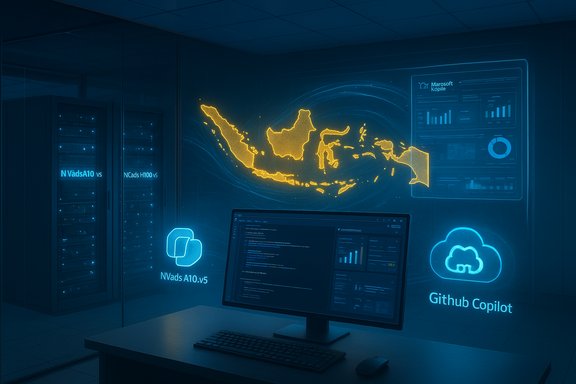
Microsoft’s announcement that a broader set of cloud and AI services are now available in the Indonesia Central region marks a practical turning point for organisations that want to build production-grade AI inside the country rather than relying on overseas data centres. This update — revealed at the Cloud & AI Innovation Summit in Jakarta and framed by Microsoft executives as a push from experimentation toward full-scale, locally hosted AI — combines GPU‑accelerated VM options, on‑country residency for Microsoft 365 Copilot, GitHub Copilot support, and Microsoft Fabric for unified data and analytics.
Background / Overview
Six months after Microsoft first opened an Azure region in Indonesia, the company has expanded the services available inside that region to include AI‑ready compute, resident productivity AI, and a unified data platform. The Indonesia Central region launched earlier in 2025 to deliver low‑latency cloud access, in‑country data residency, and enterprise‑grade security; Microsoft’s ongoing investment in the country has been tied to a broader US$1.7 billion commitment covering infrastructure, partner development, and skills programs. Microsoft framed the November announcements as the next phase: enabling organisations to move from proofs‑of‑concept to reliable production systems that keep sensitive data within national borders, reduce latency for inference, and simplify compliance with local rules. This positioning was repeated at the Cloud & AI Innovation Summit in Jakarta, where company leaders urged businesses and public institutions to build AI solutions “for Indonesia” using the new local capabilities.What’s now available in Indonesia Central
AI‑ready virtual machines and GPU capacity
Microsoft says the Indonesia Central region now offers GPU‑accelerated VM families intended for both inference and heavier model training — notably the NVadsA10_v5 and NCads_H100_v5 series. These VM SKUs are purpose‑built for AI workloads and are documented in Microsoft’s product listings as options for applied training, inference, and high‑performance compute. Organisations that need low‑latency inference endpoints or on‑country training cycles can now provision these VM types from the local region. Important technical caveat: the public announcements and region‑availability pages list SKUs and families but do not publish a per‑region GPU inventory, guaranteed counts, or detailed multi‑node cluster capacity. That means large model training that depends on deterministic GPU quotas (for example, multi‑node H100 clusters sustained over weeks) should be planned with direct account‑level validation: request quota levels, reservation options, and written capacity commitments from Microsoft before scheduling extensive training runs.Microsoft 365 Copilot and developer tooling
Microsoft 365 Copilot is now offered with data‑at‑rest residency options in the Indonesia Central region, enabling organisations to apply Copilot productivity features while keeping customer and business data inside Indonesia. GitHub Copilot — the developer‑focused code assistant — is also highlighted as part of the local developer stack, giving software teams shorter feedback loops and faster feature delivery when paired with local cloud compute. Both services aim to reduce friction when moving from experimentation toward integrated, production workflows.Microsoft Fabric: unified data + analytics in‑country
To tackle fragmented data estates, Microsoft has made Microsoft Fabric available for Indonesian tenants. Fabric is positioned as a single environment that combines data engineering, warehousing, integration, analytics, and Power BI, with Copilot features built in to accelerate data preparation and insight creation. Fabric’s availability in Indonesia Central is a notable step: it reduces the engineering overhead of stitching together multiple tools and simplifies governance and lineage for retrieval‑augmented generation (RAG) and agentic AI patterns.Azure OpenAI and production agent examples
Local customers and digital‑native companies are already building agentic AI and conversational assistants on Azure OpenAI Service hosted in region. One concrete example Microsoft references is tiket.com’s travel assistant, which uses conversational AI to handle passenger requests such as rebooking, add‑ons, flight updates, and refunds — processes that benefit from low latency and local data governance. Other enterprises cited include Petrosea and Vale Indonesia, which are using local infrastructure to modernise legacy systems and strengthen data control.Why this matters: practical business and technical benefits
Bringing GPU‑accelerated compute, Copilot residency and Fabric to Indonesia Central delivers several concrete advantages for organisations building AI systems.- Data residency and compliance: Regulated industries (finance, healthcare, public sector) often require that certain classes of data remain inside national borders. Local hosting of Microsoft 365 and Azure services reduces legal and procurement barriers tied to cross‑border data transfer.
- Lower latency for inference: Deploying inference endpoints close to users reduces round‑trip times and improves responsiveness for customer‑facing agents and Copilot integrations — critical when sub‑100ms interactions materially affect user experience.
- Simplified data foundation: Fabric lets teams bring scattered data into one governed environment, shortening the time from raw data to production‑ready RAG retrieval indices and BI dashboards. This reduces operational friction for MLOps and model governance.
- Faster developer productivity: GitHub Copilot and locally hosted developer tooling shrink iteration cycles because code and models can be tested against regionally‑provisioned services and data. This is especially valuable for Frontier Firms that treat AI as foundational to their operations.
- Talent pipeline and skilling: Microsoft’s local skilling program — Microsoft Elevate (previously elevAIte) — reports over 1.2 million learners and a goal to certify 500,000 AI talents by 2026, a move designed to increase the pool of practitioners who can operate and maintain AI systems on local cloud stacks.
Early adopters and real‑world use cases
tiket.com — conversational travel assistant
tiket.com has publicly experimented with conversational AI built on Azure OpenAI Service to make travel booking and post‑booking interactions more natural and efficient. The assistant handles tasks such as checking flight status, adding services to bookings, and initiating refunds — workflows where the combination of generative AI and transactional back‑end logic must be reliable and timely. Hosting these services in‑country reduces latency and simplifies compliance for customer data.Mining and heavy industry customers
Firms like Petrosea and Vale Indonesia are cited as customers using Indonesia Central to modernise records, centralise analytics, and apply AI where regulatory or operational constraints make onshore data storage desirable. In sectors that handle geological, personnel, or financial records, local cloud services can be the difference between a pilot and a regulated production deployment.Public services and transportation
Indonesia’s public sector and transport operators have previously piloted Azure‑based AI assistants; PT Kereta Api’s Nilam virtual assistant (built on Azure OpenAI and cognitive services) is an example of how conversational AI can augment front‑line service delivery. Local region availability reduces compliance friction and provides a path to scale these kinds of citizen‑facing systems.Critical analysis: strengths, unanswered questions, and operational risks
Strengths
- End‑to‑end vendor stack: Microsoft’s combined offering — GPU compute, data platform (Fabric), productivity AI (Microsoft 365 Copilot), developer tooling (GitHub Copilot) and Azure OpenAI — reduces integration overhead for teams already invested in Microsoft technologies. That coherence speeds movement from experimental models to production applications.
- Aligned with regulatory priorities: Data residency and Multi‑Geo options for Microsoft 365 make it easier for CIOs and legal teams to argue for localised cloud adoption while preserving the benefits of managed AI services.
- Visible commercial momentum: Public customer references and a sustained local skilling program create an ecosystem effect — events like GitHub Universe Jakarta aim to catalyse developer collaboration and accelerate local solution maturity.
Gaps and operational caveats
- Capacity transparency and SKU parity: Public region pages list VM SKUs but rarely disclose per‑region GPU inventories, power envelopes, or guaranteed availability for multi‑node H100 clusters. For deterministic training capacity, customers must secure quota commitments and reservations through account teams. This is a standard pattern with any new region rollout and should be treated as a procurement step, not an assumption.
- Supply‑chain and export controls: High‑end accelerators (NVIDIA H100 and variants) are subject to global supply dynamics and export rules that can constrain deliveries to new regions. Customers planning aggressive training schedules should factor lead times into timelines.
- Cost and governance for inference: Agentic systems and Copilot integrations produce variable and often unpredictable inference costs. Without careful model selection, caching, and budget controls, inference can become the largest line item in production AI spend. Organisations must implement usage limits, rate‑limiting, and performance/cost telemetry to stay in control.
- Sustainability and local utilities: Hyperscale data centres consume significant power and sometimes water. Microsoft states sustainability goals and design principles for new regions, but enterprise customers should request site‑level energy mix, water usage, and emissions data to ensure vendor sustainability claims align with corporate targets and procurement policies.
- Skilling vs placement: Microsoft Elevate’s headline numbers (over 1.2 million reached; target to certify 500,000 by 2026) show scale in awareness and training but are not a guarantee of immediate hiring or operational readiness. Organisations should validate competencies and demand targeted certifications when hiring for AI operations roles.
Practical checklist for IT leaders evaluating Indonesia Central for AI workloads
- Confirm exact SKU and quota availability
- Ask for a service inventory for indonesiacentral: exact VM sizes, GPU counts per AZ, current quotas, and reservation products. Request written quotas or reservation confirmations for high‑importance workloads.
- Validate data residency and compliance controls
- Review Advanced Data Residency (ADR) and Multi‑Geo applicability for the Microsoft 365 features you use (Exchange, SharePoint, Teams, Copilot). Include audit and logging requirements in contracts.
- Pilot representative workloads
- Run an end‑to‑end pilot that mirrors expected inference traffic, dataset sizes, and failure modes. Measure latency, throughput, and cost‑per‑inference under production‑like conditions.
- Design cost governance
- Implement monitoring for inference token usage, model choices, RAG retrieval costs, and set hard budget alerts or throttles to prevent runaway spend. Consider cheaper on‑prem/off‑peak SKUs for non‑critical workloads.
- Design hybrid and multi‑region resilience
- Use Availability Zones and test cross‑region failover. Keep a multi‑region evacuation plan if quotas are exhausted or in response to geopolitical supply shifts.
- Engage local partners early
- Evaluate local SIs, managed service providers and telcos for Fabric deployments, ExpressRoute provisioning, and MLOps. Confirm partner experience with Azure Fabric and Azure OpenAI integrations.
- Request sustainability and operations metrics
- For large commitments, ask for site‑level energy mix, water‑use effectiveness (WUE), and scope emissions reporting to include in vendor assessments.
Developer and Windows ecosystem implications
For developers and organisations operating in the Windows ecosystem, these changes matter in practical ways:- Shorter dev‑test cycles: GitHub Copilot plus in‑region Azure resources speed iterations when apps interact with local data. This reduces the friction of shipping integrated AI features in Windows‑centric applications and enterprise services.
- Copilot in productivity workflows: With Microsoft 365 Copilot residency, organisations can prototype more aggressive automation inside familiar Windows and Office workflows while staying within regional compliance boundaries. This lowers the barrier to introducing generative features in corporate productivity contexts.
- MLOps and Fabric: Fabric’s unified approach reduces the number of moving parts for teams that need to build retrieval indices, orchestrate feature pipelines, and serve models to Windows‑hosted front ends or web apps. For Windows devs, that means fewer integration headaches and faster time to production.
Competitive and strategic context
Microsoft’s strategy in Indonesia follows a broader pattern in Southeast Asia where hyperscalers compete to localise AI compute and services. The US$1.7 billion commitment for Indonesia complements similar investments in neighbouring countries and forms part of a wider competition between major cloud providers to secure long‑term enterprise relationships, developer mindshare, and national digital transformation contracts. Reuters and other outlets reported on Microsoft’s $1.7 billion commitment and the strategic conversations between Microsoft’s leadership and Indonesian authorities during the 2024–2025 period. Localising services generates political and commercial value: governments gain stronger oversight and job opportunities; vendors lock in customers who prefer local data residency; and local ecosystems get access to managed services and skilling. However, it also raises strategic questions on vendor lock‑in, national infrastructure dependency, and whether governments should mandate multi‑vendor architectures for resilience.Long‑term ecosystem building: talent, events and partnerships
Infrastructure alone does not guarantee outcomes. Microsoft’s parallel investment in skilling (Microsoft Elevate), developer events (GitHub Universe Jakarta on 3 December 2025), and local partnerships are designed to create an ecosystem where infrastructure, skills, and market demand reinforce each other. The Elevate programme reports more than 1.2 million participants and a goal to certify 500,000 individuals by 2026, while GitHub Universe Jakarta is positioned to bring developers, startups, and researchers together to accelerate adoption and build open reference implementations. These efforts are significant because supply‑side skilling and demand‑side pilot customers are both necessary to sustain an AI ecosystem at scale.Risks to monitor over the next 12–24 months
- Inventory and capacity mismatch: If demand outpaces local GPU supply, organisations may face delays or be forced to use other regions, increasing latency and complicating compliance. Secure quotas and reservation pathways now.
- Cost unpredictability: Agentic systems and multi‑model RAG solutions can generate high inference costs. Implement governance, caching and cost‑aware architecture patterns early.
- Vendor concentration and lock‑in: The convenience of a single‑vendor, integrated stack must be balanced against multi‑cloud and escape‑plan considerations for critical workloads. Design abstractions and exportable artifacts for long‑term flexibility.
- Skills gap translation to hires: Training throughput is promising, but hiring and competency validation remain essential. Treat certification numbers as an input, not a guarantee.
- Environmental and resource considerations: For high‑intensity workloads, request per‑site sustainability metrics to ensure deployments align with corporate ESG policies.
Final assessment and recommended next steps
Microsoft’s expansion of services in the Indonesia Central region is a substantial, pragmatic move toward enabling on‑country AI production at scale. By combining GPU‑capable VMs, Microsoft 365 Copilot residency, GitHub Copilot, Microsoft Fabric and Azure OpenAI Service, the region now offers a coherent platform that materially lowers the barrier to production for latency‑sensitive, regulated and customer‑facing AI workloads. Early customers and a major skilling program add momentum, but operational prudence remains essential.For CIOs, cloud architects and development leads planning AI initiatives in Indonesia, the recommended sequence is:
- Run representative pilots that measure latency, resilience and cost under expected production loads.
- Secure written capacity and quota commitments for GPU SKUs and test multi‑node behaviour if your models require it.
- Implement cost governance and model governance processes before scaling.
- Validate partner and SRE readiness for Fabric, Azure OpenAI, and Copilot integrations.
- Treat local skilling outputs as part of a wider talent strategy — demand competency evidence in hiring and create internal certification pathways.
Microsoft’s public materials and regional product pages confirm the availability and positioning of these services; however, where operational details — like exact GPU counts per region, MW capacity, or guaranteed multi‑node H100 cluster availability — are material to procurement or technical design, organisations should treat public announcements as indicative and request written service level and capacity commitments through their Microsoft account teams.
The expansion of Indonesia Central is not just a lines‑of‑code or hardware story: it’s an invitation to Indonesian organisations to build AI solutions that respect local laws, improve user experience through lower latency, and cultivate home‑grown innovation backed by an ecosystem of training and developer events. Whether that promise turns into sustained economic and social value will depend on careful capacity planning, robust governance, and the ability of public and private actors to turn skilling into lasting, operational capability.
Source: AI News https://www.artificialintelligence-...updates-support-indonesia-long-term-ai-goals/
