

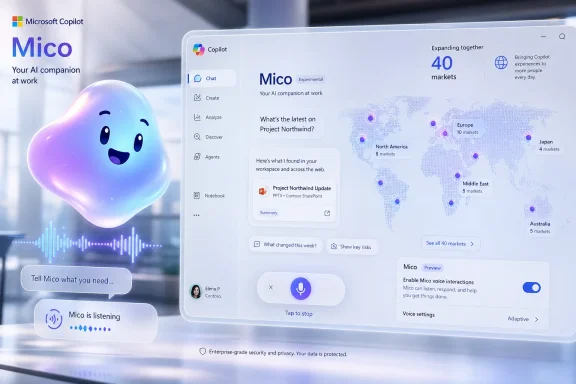
Microsoft is expanding Mico, the animated face of Copilot voice interactions, from its original United States rollout in October 2025 to 40 markets including Canada, the United Kingdom, Japan, Australia, New Zealand, much of Europe, Israel, Saudi Arabia, and the United Arab Emirates. The move looks small if you treat Mico as a mascot and much larger if you treat it as Microsoft’s latest attempt to make AI feel less like software and more like a relationship. That is the real story here: Microsoft is not merely shipping another interface flourish. It is testing whether users will accept Copilot as a persistent companion before the company folds more chat, work, coding, health, and agentic functions into one increasingly central app.
Mico is easy to mock because it arrives with the visual language of a soft toy: a floating, emotive blob that reacts as users speak to Copilot. Microsoft says the character is optional, expressive, and designed to make voice conversations feel more natural. The name itself is a shortening of Microsoft Copilot, which tells you exactly how carefully the company wants to bind the character to the larger product.
But avatars are rarely just avatars in platform strategy. A face gives software continuity. It turns a set of features into a character that can be recognized, remembered, and eventually trusted — or resented.
That matters because Copilot has spent the last few years being everywhere and nowhere at once. It appears in Windows, Edge, Microsoft 365, Bing, GitHub, mobile apps, and web experiences, but the user’s mental model of “what Copilot is” remains blurry. Mico is an attempt to reduce that blur by giving Copilot a body, however abstract.
The global expansion to 40 countries is therefore not a cosmetic patch note. It is Microsoft widening the test surface for a new interface paradigm: less command line, less search box, less empty chat window, and more animated presence.
That distinction cuts both ways. Mico can be more useful than Clippy because the underlying technology is vastly more capable. It can also be more intrusive because modern AI assistants sit closer to personal data, work documents, calendars, health information, and identity.
Clippy was annoying because it interrupted you. Mico’s risk is subtler: it may make the user more comfortable with a system whose boundaries are still being negotiated.
Microsoft’s “human-centered AI” framing is designed to soothe that concern. The company wants Copilot to feel supportive, not predatory; warm, not manipulative; useful, not uncanny. Yet the more an assistant resembles a companion, the more important it becomes to ask who benefits from that emotional design.
The practical answer for readers is straightforward: if you are in one of the listed markets and using a supported Copilot experience, you may have access to Mico now or soon, depending on rollout timing, app version, account type, and Microsoft’s usual staged deployment patterns. If you are outside the list, Microsoft says availability is continuing to expand over time.
That caveat is important because Copilot features rarely arrive in one clean global switch. Microsoft often gates functionality by region, language, account, platform, compliance requirements, and server-side flags. Two users in the same country can have different experiences on the same day.
For WindowsForum readers, the region list is useful, but it is not the whole deployment map. The more relevant question is whether Mico appears in the Copilot surface you actually use — web, Windows, mobile, or another app — and whether your Microsoft account is eligible for the feature at that moment.
This is not a trivial design problem. Voice assistants have historically struggled with latency, turn-taking, and user confidence. If the system is silent for two seconds, users wonder whether it heard them. If it talks over them, they feel interrupted. If it shows no state, they lose trust.
An animated avatar can solve some of that by making waiting visible. Color changes, motion, and expression become a kind of status indicator. In the best case, Mico functions less like a cartoon friend and more like a conversational progress bar.
The danger is that emotional feedback can be mistaken for understanding. A system that looks attentive is not necessarily more reliable. A system that appears empathetic is not necessarily safe to trust with sensitive decisions.
That makes Mico more than a cute companion for casual chats. If Microsoft succeeds, Mico could become the recognizable front end for a much larger environment: a place where users ask questions, coordinate work, generate code, plan tasks, and summon agents that operate across documents and services.
The super app idea is not new in consumer tech, but it is still uncomfortable in enterprise software. Microsoft already owns the operating system, the office suite, the identity layer, the browser foothold, the developer platform, and much of the cloud back end. A unified Copilot experience could be convenient, but it also increases Microsoft’s leverage over the daily workflow.
This is where the face matters. A friendly companion can make consolidation feel less like lock-in and more like assistance. That is good design if the product earns trust. It is dangerous design if the product outruns governance.
The consumer Copilot experience and Microsoft 365 Copilot are not the same thing, but users often collapse them mentally. That creates support friction. An employee who sees Mico in one Copilot context may assume the same assistant can or should operate across corporate data, even when tenant policy says otherwise.
Administrators will also care about regional availability because geography intersects with compliance. A feature available in 40 countries still may not satisfy the risk posture of a regulated organization. Data residency, health-related claims, memory features, and agentic actions all require more scrutiny than an animated character suggests.
Microsoft has spent years telling enterprises that Copilot can be secured through existing Microsoft 365 controls. That argument may be technically true in many contexts, but the user experience is increasingly consumer-friendly. The more human Copilot feels, the more admins will need to explain where the human-like interface stops and the compliance boundary begins.
Health is not like summarizing a meeting or drafting an email. Users bring anxiety, urgency, and personal vulnerability to medical questions. A friendly avatar can make the experience less intimidating, but it can also make advice feel more authoritative than it is.
Microsoft is hardly alone in moving AI toward health information. The entire industry sees medical guidance, symptom triage, wellness coaching, and benefits navigation as enormous markets. But when a general-purpose assistant gains an emotive face and begins appearing next to health features, regulators and users should pay attention.
The right framing is not that Mico makes Copilot Health unsafe. The right framing is that interface design affects trust, and trust affects behavior. A smiling AI companion in a health-adjacent product is not neutral decoration.
But “human-centered” also serves a commercial purpose. Microsoft needs Copilot to become a habit, not a feature users try once after an update and then forget. Habits form more easily around recognizable rituals and consistent cues. Mico gives Copilot one.
That is why this rollout matters even if many power users immediately turn it off. The target audience is not only the Windows enthusiast who prefers a clean interface. It is the broader population that may be more willing to talk to a friendly companion than type a prompt into a blank pane.
The company is betting that emotional affordances can help normalize AI usage across everyday computing. If that works, the payoff is enormous: more engagement, more data exhaust, more subscription value, and more reason to keep users inside Microsoft’s ecosystem.
Still, optional features can reveal mandatory strategy. Windows users have already watched Copilot move from sidebar experiment to keyboard key, from web chatbot to app, from productivity layer to cross-product brand. Mico is another brick in that wall.
The most important shift is that AI is becoming less like a tool you open and more like a presence that waits. Microsoft wants Copilot to be available, contextual, and eventually proactive. The avatar is simply the most visible expression of that ambition.
For users, this means the real control surface is not whether Mico smiles. It is whether Copilot can remember, act, integrate, and surface itself across the places where you work. Turning off the face may not turn off the architecture.
But dismissing Mico entirely would miss the signal. Microsoft is trying to change how users emotionally relate to Copilot before it asks them to trust Copilot with more consequential tasks. The order is not accidental.
The company’s AI strategy has moved from “Copilot can answer questions” to “Copilot can participate in work.” The next step is “Copilot can coordinate work.” A companion interface makes that transition feel smoother because users are already conditioned to treat the assistant as an entity rather than a command surface.
That is precisely why Windows power users should watch the rollout closely. Not because everyone needs a blob on their screen, but because the blob is a preview of how Microsoft wants AI to inhabit Windows and the broader Microsoft stack.
That creates a bigger feedback loop. Microsoft will learn where users engage, where they disable the feature, where voice interaction grows, and where companion design creates friction. Those lessons will likely shape the Copilot super app and future AI experiences in Windows and Microsoft 365.
For readers trying to decide what this means in practice, the answer is less dramatic than the marketing and more important than the mascot jokes:
 Microsoft Puts a Face on the Copilot Land Grab
Mico is easy to mock because it arrives with the visual language of a soft toy: a floating, emotive blob that reacts as users speak to Copilot. Microsoft says the character is optional, expressive, and designed to make voice conversations feel more natural. The name itself is a shortening of Microsoft Copilot, which tells you exactly how carefully the company wants to bind the character to the larger product.But avatars are rarely just avatars in platform strategy. A face gives software continuity. It turns a set of features into a character that can be recognized, remembered, and eventually trusted — or resented.
That matters because Copilot has spent the last few years being everywhere and nowhere at once. It appears in Windows, Edge, Microsoft 365, Bing, GitHub, mobile apps, and web experiences, but the user’s mental model of “what Copilot is” remains blurry. Mico is an attempt to reduce that blur by giving Copilot a body, however abstract.
The global expansion to 40 countries is therefore not a cosmetic patch note. It is Microsoft widening the test surface for a new interface paradigm: less command line, less search box, less empty chat window, and more animated presence.
The Clippy Comparison Is Obvious, but Too Easy
Every Microsoft assistant with a face lives under Clippy’s shadow. Microsoft knows this, which is why the company has leaned into the joke with a hidden Clippy-style easter egg rather than pretending the comparison does not exist. The difference is that Clippy was bolted onto a productivity suite as a help mechanism, while Mico is being attached to a general-purpose AI system that can speak, remember, summarize, search, reason, and eventually act.That distinction cuts both ways. Mico can be more useful than Clippy because the underlying technology is vastly more capable. It can also be more intrusive because modern AI assistants sit closer to personal data, work documents, calendars, health information, and identity.
Clippy was annoying because it interrupted you. Mico’s risk is subtler: it may make the user more comfortable with a system whose boundaries are still being negotiated.
Microsoft’s “human-centered AI” framing is designed to soothe that concern. The company wants Copilot to feel supportive, not predatory; warm, not manipulative; useful, not uncanny. Yet the more an assistant resembles a companion, the more important it becomes to ask who benefits from that emotional design.
Availability Is the Product Test Microsoft Actually Cares About
The newly reported country list gives Microsoft a much broader audience across North America, Europe, the Middle East, and parts of Asia-Pacific. The United States remains on the list, but the expansion now includes Canada, the United Kingdom, Australia, New Zealand, Japan, Ireland, France, Germany, Italy, Spain, the Netherlands, Poland, Sweden, Norway, Switzerland, and many others. Puerto Rico is also listed separately, which is notable for users trying to map feature availability against Microsoft’s regional licensing and service boundaries.The practical answer for readers is straightforward: if you are in one of the listed markets and using a supported Copilot experience, you may have access to Mico now or soon, depending on rollout timing, app version, account type, and Microsoft’s usual staged deployment patterns. If you are outside the list, Microsoft says availability is continuing to expand over time.
That caveat is important because Copilot features rarely arrive in one clean global switch. Microsoft often gates functionality by region, language, account, platform, compliance requirements, and server-side flags. Two users in the same country can have different experiences on the same day.
For WindowsForum readers, the region list is useful, but it is not the whole deployment map. The more relevant question is whether Mico appears in the Copilot surface you actually use — web, Windows, mobile, or another app — and whether your Microsoft account is eligible for the feature at that moment.
Voice Is Where the Avatar Makes the Most Sense
Mico is most coherent when paired with Copilot voice. A blank screen can make spoken interaction feel awkward, especially when the system is listening, thinking, or preparing a response. A reactive visual presence gives the user feedback that the conversation is alive.This is not a trivial design problem. Voice assistants have historically struggled with latency, turn-taking, and user confidence. If the system is silent for two seconds, users wonder whether it heard them. If it talks over them, they feel interrupted. If it shows no state, they lose trust.
An animated avatar can solve some of that by making waiting visible. Color changes, motion, and expression become a kind of status indicator. In the best case, Mico functions less like a cartoon friend and more like a conversational progress bar.
The danger is that emotional feedback can be mistaken for understanding. A system that looks attentive is not necessarily more reliable. A system that appears empathetic is not necessarily safe to trust with sensitive decisions.
Microsoft Is Building Toward a Copilot Super App
Mico’s expansion lands at an awkward but revealing moment. Microsoft is reportedly preparing a broader Copilot “super app” strategy that would bring chat, coworking, coding, and agentic workflows into a more unified experience. Satya Nadella has publicly framed the direction as bringing Chat, Cowork, and Code together in Copilot.That makes Mico more than a cute companion for casual chats. If Microsoft succeeds, Mico could become the recognizable front end for a much larger environment: a place where users ask questions, coordinate work, generate code, plan tasks, and summon agents that operate across documents and services.
The super app idea is not new in consumer tech, but it is still uncomfortable in enterprise software. Microsoft already owns the operating system, the office suite, the identity layer, the browser foothold, the developer platform, and much of the cloud back end. A unified Copilot experience could be convenient, but it also increases Microsoft’s leverage over the daily workflow.
This is where the face matters. A friendly companion can make consolidation feel less like lock-in and more like assistance. That is good design if the product earns trust. It is dangerous design if the product outruns governance.
Enterprise IT Will See the Blob and Think About Policy
For home users, Mico may be a novelty: fun for five minutes, ignored after ten, beloved by a few, disabled by others. For IT administrators, it is another reminder that AI features are arriving as living services rather than traditional software releases. The question is not merely whether Mico is enabled, but whether Copilot’s behavior, data access, logging, retention, and connected capabilities are clearly governed.The consumer Copilot experience and Microsoft 365 Copilot are not the same thing, but users often collapse them mentally. That creates support friction. An employee who sees Mico in one Copilot context may assume the same assistant can or should operate across corporate data, even when tenant policy says otherwise.
Administrators will also care about regional availability because geography intersects with compliance. A feature available in 40 countries still may not satisfy the risk posture of a regulated organization. Data residency, health-related claims, memory features, and agentic actions all require more scrutiny than an animated character suggests.
Microsoft has spent years telling enterprises that Copilot can be secured through existing Microsoft 365 controls. That argument may be technically true in many contexts, but the user experience is increasingly consumer-friendly. The more human Copilot feels, the more admins will need to explain where the human-like interface stops and the compliance boundary begins.
Health Features Raise the Stakes Beyond Productivity
The same wave of Copilot messaging that includes Mico also points toward Copilot Health, currently described as a beta experience in supported contexts. Microsoft is positioning it as a helpful health companion, which is precisely the kind of language that invites both interest and alarm.Health is not like summarizing a meeting or drafting an email. Users bring anxiety, urgency, and personal vulnerability to medical questions. A friendly avatar can make the experience less intimidating, but it can also make advice feel more authoritative than it is.
Microsoft is hardly alone in moving AI toward health information. The entire industry sees medical guidance, symptom triage, wellness coaching, and benefits navigation as enormous markets. But when a general-purpose assistant gains an emotive face and begins appearing next to health features, regulators and users should pay attention.
The right framing is not that Mico makes Copilot Health unsafe. The right framing is that interface design affects trust, and trust affects behavior. A smiling AI companion in a health-adjacent product is not neutral decoration.
The Human-Centered Pitch Hides a Hard Commercial Bet
Microsoft’s language around Mico emphasizes warmth, personality, and human-centered design. That is plausible at the level of product design. Many users do find AI chatboxes sterile, and a responsive avatar may make voice interaction more approachable.But “human-centered” also serves a commercial purpose. Microsoft needs Copilot to become a habit, not a feature users try once after an update and then forget. Habits form more easily around recognizable rituals and consistent cues. Mico gives Copilot one.
That is why this rollout matters even if many power users immediately turn it off. The target audience is not only the Windows enthusiast who prefers a clean interface. It is the broader population that may be more willing to talk to a friendly companion than type a prompt into a blank pane.
The company is betting that emotional affordances can help normalize AI usage across everyday computing. If that works, the payoff is enormous: more engagement, more data exhaust, more subscription value, and more reason to keep users inside Microsoft’s ecosystem.
The Feature Is Optional, but the Direction Is Not
Microsoft can fairly say that Mico is optional. Users who dislike animated assistants should not be forced to stare at one. The company has also learned enough from Clippy, Cortana, and Windows’ long history of unwanted prompts to know that compulsion would backfire.Still, optional features can reveal mandatory strategy. Windows users have already watched Copilot move from sidebar experiment to keyboard key, from web chatbot to app, from productivity layer to cross-product brand. Mico is another brick in that wall.
The most important shift is that AI is becoming less like a tool you open and more like a presence that waits. Microsoft wants Copilot to be available, contextual, and eventually proactive. The avatar is simply the most visible expression of that ambition.
For users, this means the real control surface is not whether Mico smiles. It is whether Copilot can remember, act, integrate, and surface itself across the places where you work. Turning off the face may not turn off the architecture.
Windows Users Should Treat Mico as a Signal, Not a Toy
There is a tendency in enthusiast circles to dismiss features like Mico as marketing fluff. Sometimes that instinct is correct. Software companies love mascots because mascots are cheaper than solving hard product problems.But dismissing Mico entirely would miss the signal. Microsoft is trying to change how users emotionally relate to Copilot before it asks them to trust Copilot with more consequential tasks. The order is not accidental.
The company’s AI strategy has moved from “Copilot can answer questions” to “Copilot can participate in work.” The next step is “Copilot can coordinate work.” A companion interface makes that transition feel smoother because users are already conditioned to treat the assistant as an entity rather than a command surface.
That is precisely why Windows power users should watch the rollout closely. Not because everyone needs a blob on their screen, but because the blob is a preview of how Microsoft wants AI to inhabit Windows and the broader Microsoft stack.
The 40-Country Rollout Turns Mico From Experiment Into Infrastructure
The most concrete takeaway from this expansion is that Mico is no longer just a U.S. experiment. Microsoft is putting it in front of a much wider audience, across countries with different languages, privacy expectations, accessibility needs, and cultural attitudes toward anthropomorphic software.That creates a bigger feedback loop. Microsoft will learn where users engage, where they disable the feature, where voice interaction grows, and where companion design creates friction. Those lessons will likely shape the Copilot super app and future AI experiences in Windows and Microsoft 365.
For readers trying to decide what this means in practice, the answer is less dramatic than the marketing and more important than the mascot jokes:
- Mico is now reported as available across 40 markets, but staged rollouts mean some eligible users may not see it immediately.
- The feature matters most in voice interactions, where an animated presence can provide feedback and make Copilot feel more conversational.
- The Clippy comparison is historically useful, but Mico is attached to a far more capable and more deeply integrated AI platform.
- Enterprise administrators should focus less on the avatar and more on Copilot policy, data access, memory, regional availability, and user expectations.
- The upcoming Copilot super app strategy makes Mico look like an early interface layer for a broader consolidation of chat, work, code, and agents.
- Users who dislike anthropomorphic AI should check their Copilot settings, but they should also recognize that disabling the face does not necessarily change Microsoft’s larger AI direction.
References
- Primary source: PC Guide
Published: 2026-06-11T10:08:07.488869
Loading…
www.pcguide.com - Official source: microsoft.com
Loading…
www.microsoft.com - Related coverage: arstechnica.com
Loading…
arstechnica.com - Related coverage: windowscentral.com
Loading…
www.windowscentral.com - Related coverage: geekwire.com
Mary Jo Foley: No Copilot 'Super App' at Microsoft Build, but plenty of agentic fodder – GeekWire
Microsoft teased its rumored Copilot "Super App" at Build but didn't demo it. Longtime Microsoft watcher Mary Jo Foley assesses the no-show, explains why the initiative matters, and considers what the company actually did announce.www.geekwire.com - Related coverage: letsdatascience.com
Loading…
letsdatascience.com
- Related coverage: winbuzzer.com
Loading…
winbuzzer.com - Related coverage: business-standard.com
Loading…
www.business-standard.com - Related coverage: axios.com
Loading…
www.axios.com - Related coverage: fortune.com

Exclusive: Microsoft is building a super app that combines coding, chat, and other Copilot AI tools | Fortune
The project is being spearheaded by new Copilot chief Jacob Andreou, as Microsoft seeks to streamline its lineup of AI tools amid competition from Google, OpenAI, and Anthropic.fortune.com
- Related coverage: tomsguide.com
Forget Clippy — meet Mico, Microsoft's friendlier face for Copilot's Fall Release | Tom's Guide
Microsoft is rolling out roughly a dozen new features for Copilot across Edge, Windows and the Copilot iOS app. Here's what they'll let you do, from learning new languages to planning group trips.www.tomsguide.com - Official source: blogs.microsoft.com

Announcing Copilot leadership update - The Official Microsoft Blog
Satya Nadella, Chairman and CEO, and Mustafa Suleyman, Executive Vice President and CEO of Microsoft AI, shared the below communications with Microsoft employees this morning. SATYA NADELLA MESSAGE I want to share two org changes we’re making to our Copilot org and superintelligence effort. It’s... blogs.microsoft.com
- Related coverage: windowsreport.com
Loading…
windowsreport.com - Related coverage: techradar.com

Microsoft Confirms Automatic Copilot Installation on 365 Clients This October
Microsoft is pushing the Copilot app on more userswww.techradar.com
- Related coverage: windowsforum.com

Microsoft Copilot Super App: One AI Workspace to End Fragmentation
Microsoft is reportedly building a unified “super app” for Copilot that would combine coding assistance, workplace chat, collaborative agents, and internal automation tools into one product experience, with elements potentially referenced around Build and a launch target by the end of summer... windowsforum.com
- Official source: microsoft.ai
- Related coverage: nasa.gov
Loading…
www.nasa.gov - Official source: fpc.microsoft.com
Loading…
fpc.microsoft.com