

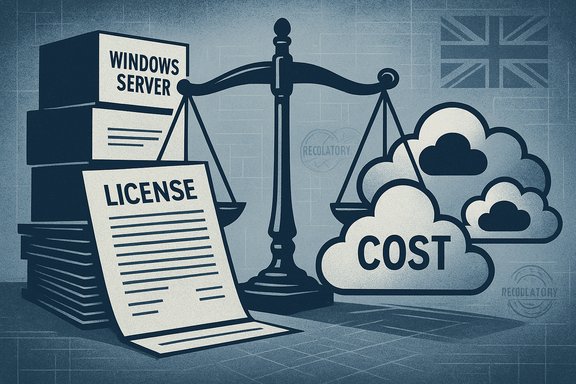
Microsoft is defending itself against a sweeping £2.1 billion class claim in the UK that accuses the company of deliberately making it more expensive and operationally awkward for thousands of British businesses to run Windows Server on rival cloud platforms such as Amazon Web Services (AWS), Google Cloud Platform (GCP) and Alibaba Cloud — an allegation that, if certified by the Competition Appeal Tribunal, could reshape cloud licensing economics across Europe and beyond.
The claim was brought by competition lawyer Dr. Maria Luisa Stasi as an opt‑out Collective Proceedings Order (CPO) application before the UK Competition Appeal Tribunal (CAT). The proposed class reportedly covers tens of thousands of UK organisations and seeks aggregated damages estimated in public filings and press reporting at roughly £1.7–£2.1 billion. The alleged time window and precise class definition vary across pleadings and press summaries, but the core accusation is consistent: that Microsoft’s licensing terms and product configuration treated non‑Azure cloud destinations less favourably, producing higher costs and inferior operational experience for customers who chose competitors.
This legal action sits inside a much wider regulatory and political frame. The UK’s Competition and Markets Authority (CMA) has published provisional findings in a market investigation that flagged Microsoft’s licensing and related practices as potentially harmful to switching and competition in public cloud markets. Similar concerns have been raised by the European Commission and reported complaints from rival cloud providers. Those regulatory threads strengthen the contextual backdrop for the class claim, even though the tribunal’s CPO decision will be governed by distinct legal thresholds focused on manageability, common issues and damages methodology — not on substantive guilt or innocence.
For IT leaders and procurement teams, the immediate operational takeaway is pragmatic: organisations should document licensing positions carefully, understand the mechanics of BYOL, AHB and host requirements, and quantify migration costs when comparing multi‑cloud architectures. From a policy perspective, the case crystallises a central tension of the cloud era — how to preserve competition and portability when dominant software vendors package product advantages and economic incentives inside integrated cloud ecosystems.
Finally, it is important to emphasise caution: much of the public monetary figure is an estimate and the allegations remain unproven. Any business‑level exposure or remedy will depend on the tribunal’s procedural rulings, discovery results, and potentially protracted appeals. Readers should treat headline numbers and regulatory commentary as informative context rather than final adjudication.
This dispute will remain a key signal for how competition law adapts to cloud economics. The CAT’s upcoming decisions and parallel regulator activity will be watched closely by enterprises, cloud rivals and policymakers because the outcome could recalibrate how software is priced, bundled and migrated across the cloud.
Source: Sharecafe Microsoft Faces £2.1 Billion Cloud Computing Lawsuit - Sharecafe
 Background
The claim was brought by competition lawyer Dr. Maria Luisa Stasi as an opt‑out Collective Proceedings Order (CPO) application before the UK Competition Appeal Tribunal (CAT). The proposed class reportedly covers tens of thousands of UK organisations and seeks aggregated damages estimated in public filings and press reporting at roughly £1.7–£2.1 billion. The alleged time window and precise class definition vary across pleadings and press summaries, but the core accusation is consistent: that Microsoft’s licensing terms and product configuration treated non‑Azure cloud destinations less favourably, producing higher costs and inferior operational experience for customers who chose competitors.This legal action sits inside a much wider regulatory and political frame. The UK’s Competition and Markets Authority (CMA) has published provisional findings in a market investigation that flagged Microsoft’s licensing and related practices as potentially harmful to switching and competition in public cloud markets. Similar concerns have been raised by the European Commission and reported complaints from rival cloud providers. Those regulatory threads strengthen the contextual backdrop for the class claim, even though the tribunal’s CPO decision will be governed by distinct legal thresholds focused on manageability, common issues and damages methodology — not on substantive guilt or innocence.
What the claim alleges
The core theories of harm
At a technical and commercial level the claim advances several interlocking allegations:- Price discrimination by destination. The claim contends Microsoft priced Windows Server — either directly through its own offers or via Service Provider License Agreements (SPLAs) and re‑licensing paths — so it was materially cheaper to run Windows Server on Azure than on listed third‑party providers. Claimants argue that this cost differential acted as an economic penalty for choosing rivals.
- Operational differentiation and tied features. Beyond headline pricing, the case asserts Microsoft has provided Azure‑only operational conveniences (for example, integrated patching, optimised management tooling or support pathways) that are either unavailable or slower on other clouds, making Azure comparatively more attractive on non‑price grounds. The claim frames these as part of an “abusive strategy” to leverage Windows Server market strength into cloud share.
- Foreclosure through licensing design. The complaint differentiates between at‑scale wholesale terms for cloud providers, Bring‑Your‑Own‑License (BYOL) rules, and other relicensing mechanisms. It asserts Microsoft’s contractual architecture raised rivals’ wholesale costs or imposed constraints that impeded competitive pricing and innovation.
Microsoft’s legal and factual defences
Microsoft’s response is twofold: procedural and commercial.- Procedurally, Microsoft argues the claim lacks a workable, class‑wide method to identify which businesses suffered loss and by how much. The company emphasises the heterogeneity of contracts, deployment patterns, licence holdings and commercial negotiations across thousands of organisations — factors the defence says make a single aggregate damages model unworkable. If the CAT accepts Microsoft’s manageability and methodology objections, the claim can be dismissed at the CPO stage.
- On substance, Microsoft defends the vertical integration of producing Windows Server while offering Azure, arguing that making software available across multiple clouds and maintaining a mixed licensing approach ultimately promotes choice and competition. Microsoft also says the cloud market is “dynamic and competitive,” with rapid AI-driven innovation and continuing investments that belie any claim of foreclosure. That rhetorical and factual posture is consistent with Microsoft’s public responses to earlier regulatory scrutiny.
Regulatory context: CMA, EU and U.S. scrutiny
This case cannot be separated from contemporaneous policy work in the UK, EU and U.S.- The UK Competition and Markets Authority (CMA) published provisional findings in January–July 2025 that flagged the cloud infrastructure market as concentrated and identified licensing practices — including Microsoft’s treatment of Windows Server licensing — as a potential barrier to switching. The CMA suggested that such practices could contribute to “lock‑in” and recommended further investigation under new UK digital markets powers.
- The European Commission and EU bodies have been active as well, launching inquiries and receiving formal complaints from other cloud providers about restrictive licensing and portability constraints. These actions are exploratory but signal political appetite for interventions where gatekeeper behaviour is suspected.
- In the United States, federal enforcement attention — including inquiries by the Federal Trade Commission and broader antitrust probes — adds another layer of reputational and compliance risk for Microsoft and other hyperscalers. While U.S. investigations follow different legal standards and timelines, coordinated scrutiny across major jurisdictions amplifies the regulatory cost of any adverse findings.
The technical plumbing: licensing constructs that matter
To understand the dispute, a few Microsoft licensing constructs are crucial.- Azure Hybrid Benefit (AHB). A longstanding Microsoft program that allows qualifying customers to apply existing Windows Server licences with active Software Assurance or subscription entitlements to Azure VMs, often reducing the compute portion to rates comparable with Linux instances. AHB is an explicit migration incentive and a structural reason Azure can appear cheaper for Windows‑heavy workloads.
- SPLA and Service Provider Agreements. Microsoft’s wholesale licensing terms for hosting partners and other cloud providers can differ materially from retail or Azure‑native pricing. The claim points to disparities in SPLA pricing and pass‑through that could inflate rival clouds’ costs.
- BYOL constraints and dedicated host rules. Some BYOL scenarios require customers to meet specific host or tenancy requirements (for example, dedicated hosts or certain entitlement tracking), which can increase cost and complexity on third‑party clouds while being smoother on Azure. The complaint highlights such commercial friction as a competitive lever.
- Feature parity and management tooling. Beyond raw licence fees, integrated management, hotpatching, or other Azure‑native optimisations can reduce operational overhead for Windows Server workloads on Azure versus other clouds. Claimants argue that these differences are not incidental but productised advantages that influence migration decisions.
Why the certification stage matters — and the legal hurdles
A Collective Proceedings Order is not a merits ruling. The tribunal’s certification analysis has several gatekeeping tests:- Commonality and coherence: Are there core issues of fact or law that apply across the putative class?
- Ascertainability: Can the class be clearly defined and identified without endless individualized inquiry?
- Manageability of damages: Is there a credible, reliable methodology to estimate aggregate loss and apportion awards if liability is established?
- Appropriateness of collective procedure: Is an opt‑out mass claim the right procedural vehicle, or are individual actions required?
Strengths of the claimant’s case
- Regulatory corroboration. The CMA’s provisional findings and related EU inquiries create a contemporaneous record that licensing practices can affect switching and competition — evidence a tribunal may view as supportive of the claimants’ contention of systemic effects. Using regulator findings as factual backdrop strengthens the argument that common issues exist.
- Concentrated market structure. Market share data and industry reports repeatedly show that a small set of hyperscalers dominate IaaS spending, increasing the plausibility that conduct by one major provider could have industry‑wide effects. That concentrated structure makes collective proof of harm more plausible than in atomised markets.
- Clear, replicable contractual levers. The existence of explicit programs like Azure Hybrid Benefit and documented differences in SPLA and BYOL rules provide concrete, documentable mechanisms through which a price or feature difference could arise, rather than relying on vague assertions. Those mechanistic links support a damages model that is not purely speculative.
Weaknesses and risks for the claimant
- Heterogeneity of customer arrangements. Cloud contracts, licence holdings, migration histories and optimisation choices vary widely across organisations. Demonstrating a single pattern of overcharge with class‑wide quantification is legally and technically difficult and is precisely the vulnerability Microsoft emphasises.
- Data availability and proof. Central evidentiary points will be proprietary commercial data (provider billing, licence pass‑through records, customer negotiations). If essential evidence is held by Microsoft or cloud providers and is contested or redacted, calculating aggregate loss with high confidence becomes challenging.
- Causation and pass‑through questions. Even where price differences exist at the wholesale level, translating those into end‑user overcharges is legally complex: purchasers might have negotiated discounts, used alternative licensing routes, or absorbed differences in other ways, complicating the causal chain. Microsoft will probe these issues at certification.
- Regulatory nuance vs. legal thresholds. CMA findings are powerful politically and evidentially, but the tribunal’s legal tests for certification and liability are distinct. Provisional regulatory observations do not automatically satisfy the stricter commonality and damages standards the CAT requires.
Practical implications for businesses and procurement
If the case is certified and ultimately successful — or if regulators impose remedies — the commercial impact could be broad:- Potential financial compensation to eligible UK businesses, though subject to the court’s final determination and apportionment rules.
- Changes to Microsoft licensing architecture: plain‑language commercial rules, clearer BYOL paths, or revised SPLA pricing could appear as either court‑ordered remedies or commercial settlements.
- Short‑term procurement disruption as large enterprise buyers reassess vendor lock‑in risks and price parity when architecting multi‑cloud strategies.
- Upstream ripple effects: cloud providers may alter commercial offers, reduce reliance on bundled licensing advantages, or accelerate technical parity projects to blunt future antitrust claims.
Probable timelines and next legal steps
Key procedural milestones typically include:- CPO decision at the CAT. The tribunal will determine whether to certify the collective action. A grant sends the case to full disclosure and trial phases; a refusal will force claimants into fragmented individual suits.
- Disclosure and expert evidence. If certified, both sides will exchange detailed commercial data and commissioning of expert damages models, cost pass‑through analyses, and market structure assessments.
- Trial and rulings or settlement. Trials in complex competition matters can be multi‑year undertakings. Alternatively, large commercial settlements are common if discovery substantially increases Microsoft’s exposure or reputational risk.
What to watch next — indicators of where the case is heading
- Tribunal’s view on the damages methodology: a negative ruling here would likely kill the collective claim; a positive certification would signal the CAT sees sufficient commonality to permit a classwide adjudication.
- Disclosure outcomes and the availability of provider billing data: if claimants gain access to detailed pass‑through and wholesale pricing data, their damages model will strengthen significantly.
- Regulatory action by the CMA or the European Commission: concurrent regulator decisions, remedies or designations (for example, Strategic Market Status) could accelerate settlement pressure or change litigation leverage.
- Market responses from AWS, Google Cloud and other platforms: moves to adjust commercial offers or public statements can reveal whether rivals see practical business risk from Microsoft’s licensing constructs and may influence public and political sentiment.
Conclusion — stakes, balance, and broader significance
This litigation is a high‑stakes test of how modern competition law and collective private enforcement mechanisms handle disputes that are simultaneously technical, commercial and systemic. On one hand, the claim leverages concrete commercial constructs — Azure Hybrid Benefit, SPLA terms, BYOL constraints — and sits within an active regulatory narrative that the cloud market exhibits lock‑in risks. That creates a plausible factual foundation for a class action seeking aggregated relief. On the other hand, the legal challenge of proving commonality and a reliable, class‑wide damages model over thousands of diverse commercial arrangements is substantial. Microsoft’s procedural defence is tailored to exploit precisely those difficulties. The CAT’s certification decision will therefore be pivotal: it will either open the doors to a landmark mass trial with potential multi‑billion‑pound exposure and regulatory fallout, or it will narrow the path to relief to individualized contractual claims and regulatory tools.For IT leaders and procurement teams, the immediate operational takeaway is pragmatic: organisations should document licensing positions carefully, understand the mechanics of BYOL, AHB and host requirements, and quantify migration costs when comparing multi‑cloud architectures. From a policy perspective, the case crystallises a central tension of the cloud era — how to preserve competition and portability when dominant software vendors package product advantages and economic incentives inside integrated cloud ecosystems.
Finally, it is important to emphasise caution: much of the public monetary figure is an estimate and the allegations remain unproven. Any business‑level exposure or remedy will depend on the tribunal’s procedural rulings, discovery results, and potentially protracted appeals. Readers should treat headline numbers and regulatory commentary as informative context rather than final adjudication.
This dispute will remain a key signal for how competition law adapts to cloud economics. The CAT’s upcoming decisions and parallel regulator activity will be watched closely by enterprises, cloud rivals and policymakers because the outcome could recalibrate how software is priced, bundled and migrated across the cloud.
Source: Sharecafe Microsoft Faces £2.1 Billion Cloud Computing Lawsuit - Sharecafe
