

Microsoft’s announcement that it has signed a new five‑year Volume Sourcing Arrangement (VSA) with the Commonwealth marks an unmistakable bid to accelerate the next phase of Australia’s digital government — promising simplified procurement, volume pricing, security assurances and a structured pathway for responsible AI adoption across federal agencies.
Australia’s digital government story has shifted fast over the last three years: after a mid‑decade dip in international technology rankings, the country now sits among the global leaders in digital government capability. The Digital Transformation Agency (DTA) and the OECD’s latest Digital Government Index place Australia second overall — a rise the DTA attributes to stronger governance, shared platforms and user‑centred design.
That wider context matters because the practical value of AI and cloud in government hinges on a modern, secure platform layer. Economists working with Microsoft and Mandala Partners estimated a potential “productivity dividend” of roughly A$1.4 billion per year through the 2030s simply by replacing legacy systems with modern cloud and AI‑enabled platforms — a headline number that helps explain private sector appetite for whole‑of‑government deals.
At the same time, Canberra’s policy architecture has evolved to make that modernisation possible. In December 2025 the Australian Government released a Whole‑of‑Government Cloud Computing Policy and a National AI Plan that together tighten expectations on security, transparency and capability building — creating a clearer runway for agencies to take services into cloud and to trial generative AI responsibly.
Caveat and verification: Microsoft’s own write‑up is the primary public source describing the deal’s five‑year term and the $1.55 million training fund. At the time of writing (26 February 2026) a formal, matching DTA press release describing the same five‑year VSA was not located in the DTA media stream; earlier reporting and procurement context show the DTA previously extended a Microsoft VSA through 30 June 2026. Readers should treat the full contractual details and agency uptake as subject to standard public‑sector publication and confirmation cycles.
There is also a reputational dimension. As recent Australian regulatory action demonstrates, AI and platform shifts attract consumer and competition scrutiny. The ACCC’s Federal Court proceedings against Microsoft over consumer communications and Copilot‑related pricing (filed October 2025) show how customer‑facing choices by the same vendor can become a material political and regulatory issue — an important reminder that public trust is not automatic when private platforms are used for public services.
That alignment is necessary but not sufficient. Translating headline productivity estimates into durable public value requires transparent contracting, hard technical work on portability and interoperability, genuinely independent assurance of security and AI safety, and a balanced procurement approach that nurtures local partners and protects long‑term competition. The Microsoft VSA can be a powerful enabler — if it arrives on a foundation of rigorous governance, public transparency and measurable outcomes.
What Canberra must now do is simple in concept and hard in execution: turn the promise of modern platforms and generative AI into accountable, measured improvements in services that Australians rely on every day, while preserving the public interest, choice and systemic resilience that a modern democratic state requires.
Source: Microsoft Source Enabling the next phase of digital government in Australia - Source Asia
 Background / Overview
Australia’s digital government story has shifted fast over the last three years: after a mid‑decade dip in international technology rankings, the country now sits among the global leaders in digital government capability. The Digital Transformation Agency (DTA) and the OECD’s latest Digital Government Index place Australia second overall — a rise the DTA attributes to stronger governance, shared platforms and user‑centred design.That wider context matters because the practical value of AI and cloud in government hinges on a modern, secure platform layer. Economists working with Microsoft and Mandala Partners estimated a potential “productivity dividend” of roughly A$1.4 billion per year through the 2030s simply by replacing legacy systems with modern cloud and AI‑enabled platforms — a headline number that helps explain private sector appetite for whole‑of‑government deals.
At the same time, Canberra’s policy architecture has evolved to make that modernisation possible. In December 2025 the Australian Government released a Whole‑of‑Government Cloud Computing Policy and a National AI Plan that together tighten expectations on security, transparency and capability building — creating a clearer runway for agencies to take services into cloud and to trial generative AI responsibly.
What Microsoft announced — the Volume Sourcing Arrangement (VSA)
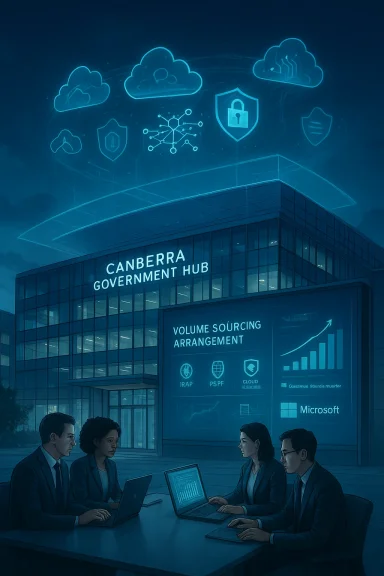
Microsoft’s Source article from 26 February 2026 sets out the core elements of the new agreement: a five‑year VSA led by the DTA that, Microsoft says, will provide Commonwealth agencies with:- Volume pricing and simplified licensing across Microsoft 365, Azure, Dynamics 365 and associated security and identity services.
- A strengthened Governance Framework to coordinate strategy, procurement optimisation and skilling.
- Continued alignment with Australian compliance regimes (including IRAP commitments and references to the Protective Security Policy Framework, Cloud Hosting Certification Framework and the ASD’s Information Security Manual).
- Explicit provisions to support responsible and resilient AI, including whole‑of‑government Copilot adoption following the 2024 trial.
- A targeted $1.55 million training fund to deliver ethical AI and skills programs for the Australian Public Service.
Caveat and verification: Microsoft’s own write‑up is the primary public source describing the deal’s five‑year term and the $1.55 million training fund. At the time of writing (26 February 2026) a formal, matching DTA press release describing the same five‑year VSA was not located in the DTA media stream; earlier reporting and procurement context show the DTA previously extended a Microsoft VSA through 30 June 2026. Readers should treat the full contractual details and agency uptake as subject to standard public‑sector publication and confirmation cycles.
Why this matters: the operational argument for cloud + AI in government
Modern cloud platforms and generative AI are not ends in themselves; their value shows up when they solve concrete, recurring government problems:- Time‑consuming drafting and summarisation tasks — the Australian whole‑of‑government Copilot trial (early 2024) found participants perceived time‑savings of up to about an hour per day on activities like summarising information and preparing first drafts. The trial’s evaluation demonstrates how generative AI can reduce friction in knowledge work and free APS staff for higher‑value tasks.
- Faster operational response to harm — when APIs and machine learning models are deployed on modern cloud stacks with the right tooling, agencies can scale detection and response capabilities (for example, identifying online exploitation or triaging large volumes of reports) at machine speed rather than human pace. Microsoft emphasises these operational efficiencies as part of the rationale for the VSA.
- Lower total cost of ownership — Mandala Partners’ modelling suggests agency IT budgets could fall by between 7% and 28% through 2035 under a deliberate cloud modernisation pathway, delivering an aggregate productivity dividend in the order of A$1.4 billion per year if scaled. This is the economic case often used to justify central cloud procurement vehicles that reduce duplication and accelerate standard architectures.
Evidence from the Copilot trial — measured gains and realistic caveats
The Copilot trial remains the most visible government‑scale test of generative AI for office productivity in Australia. Key, evidence‑based takeaways include:- Trial participants reported increased efficiency on a small set of high‑volume tasks — notably summarisation, preparing initial drafts and information searches — with respondents citing up to one hour per day saved for those activities in aggregate. The digital.gov.au evaluation cautions these are task‑specific upper‑bound estimates and that editing and oversight were often still required.
- Perceived quality gains were present but more muted than speed improvements. Users commonly needed to validate or tailor outputs for audience and context, which reduced net efficiency on some tasks. The evaluation explicitly notes that quality uplift lagged raw speed gains.
- Reallocation of time to higher‑value activities was significant for a meaningful minority (about 40% of respondents), indicating potential downstream organisational benefits in mentoring, stakeholder engagement and problem solving.
Policy alignment: Cloud policy and the National AI Plan
The timing of Microsoft’s announcement is notable: the VSA lands amid two major policy moves from Canberra.- The DTA’s Whole‑of‑Government Cloud Computing Policy (released December 2025, effective 1 July 2026) formalises expectations for agencies to prioritise cloud, embed cloud thinking into investment governance and strengthen security, cost transparency and workforce planning. That policy creates a policy corridor in which central sourcing arrangements can accelerate agency acquisition while aligning to mandatory requirements.
- The National AI Plan (December 2025) sets out a national approach to capability, infrastructure and safety. It pushes agencies toward common governance practices — publishing AI guidance, boosting compute and data infrastructure, and appointing Chief AI Officers across APS agencies — which in turn raises the value of centrally negotiated platforms that can offer spec‑compliant tooling and support.
Security, compliance and the public trust ledger
A deal at the scale Microsoft is proposing cannot succeed without defensible security and privacy claims. Microsoft’s announcement stresses ongoing compliance with Australian frameworks (IRAP, PSPF, the ASD Information Security Manual and Cloud Hosting Certification) and recommits to alignment with the Security of Critical Infrastructure regime. Those commitments are central to agency acceptance, but they also invite independent scrutiny: governments and watchdogs must validate that vendor controls meet the detailed requirements of each framework before mission‑critical services are migrated.There is also a reputational dimension. As recent Australian regulatory action demonstrates, AI and platform shifts attract consumer and competition scrutiny. The ACCC’s Federal Court proceedings against Microsoft over consumer communications and Copilot‑related pricing (filed October 2025) show how customer‑facing choices by the same vendor can become a material political and regulatory issue — an important reminder that public trust is not automatic when private platforms are used for public services.
Commercial and competitive risks: vendor lock‑in, procurement, and the partner ecosystem
Large central arrangements can deliver faster adoption and lower near‑term cost, but they carry long‑term commercial trade‑offs:- Vendor lock‑in risk — deep integration with one cloud and productivity stack increases migration costs later. Government should insist on data portability, open standards and exportable artefacts to preserve strategic options.
- Market concentration and competition policy — central purchasing power can compress competition in delivery markets; careful supplier strategies and a viva‑voce partner ecosystem are needed to ensure small and medium local IT firms can participate as integrators and innovators. Microsoft’s announcement explicitly signals partner‑ecosystem benefits; independent procurement oversight should ensure those local benefits are realised.
- Commercial transparency — to retain public trust and fiscal accountability, agencies should publish expected TCO changes, measurable KPIs for adoption and independent post‑implementation evaluations.
Governance and accountability — what “responsible AI” must mean in practice
Announcing “responsible AI” capabilities is a start; operationalising them is where outcomes are decided. Practical governance steps that agencies and the DTA should insist on include:- Mandatory AI Impact Assessments (AIAs) and publication of transparency statements for any agency AI tool used in service delivery.
- Independent third‑party or government‑run assurance programs for model safety, bias testing, red‑team adversarial assessment and privacy impact analysis.
- Clear human‑in‑the‑loop rules for decision thresholds where automated outputs influence citizens’ rights or entitlements.
- Regular public dashboards reporting which services use generative AI, the scope of use and remediation pathways for errors.
- Skills and change programs for staff — including the Microsoft‑announced training fund — aligned to role‑based competency standards.
Practical recommendations for policymakers and technology leaders
To convert potential into durable public value, the following practical steps should guide implementation:- Prioritise modular procurement clauses that require data export, service portability and open APIs to limit lock‑in.
- Require independent, published assurance statements against IRAP/PSPF/Cloud Hosting standards before production migration.
- Embed mandatory AI Impact Assessments and publish redacted examples to build public understanding.
- Fund a national skills pipeline beyond vendor training: align the Microsoft training fund with government‑led micro‑credentials and APS capability frameworks to avoid fragmentation.
- Use the VSA to catalyse multi‑vendor labs and interoperability sandboxes so agencies can compare outcomes rather than be forced into a single stack.
- Commission independent, post‑implementation evaluations against the Mandala modelling assumptions to validate fiscal payoffs transparently.
Where the evidence is strongest — and where caution is still required
Strengths and positives- Australia’s rise to second in the OECD’s Digital Government Index is verifiable and reflects real improvements in governance and user‑design. That external validation reduces policy risk for scaling modern platforms.
- The Copilot trial produced measurable, credible signals that generative AI can save staff time on repeatable knowledge tasks. When combined with cloud platforms, these tools can accelerate workflow automation and responsiveness.
- Mandala Partners’ modelling provides an evidence‑based fiscal case to modernise legacy estate — the A$1.4 billion productivity dividend is not fantasy accounting but a scenario anchored in labour and infrastructure efficiency assumptions. Policymakers should treat it as a planning input, not a guaranteed outcome.
- The exact contracting details and level of DTA endorsement for Microsoft’s five‑year VSA were set out in Microsoft’s own announcement; public, independent confirmation of the contract’s terms and the DTA’s published procurement documentation matching Microsoft’s description were not found in the DTA media releases as of 26 February 2026. That means agencies and watchdogs should seek full transparency and publish the VSA’s terms and associated compliance evidence.
- Realising the Mandala dividend depends on disciplined migration plans, workforce transition and robust change management. Without those, legacy technical debt, shadow IT and poorly managed rollouts will blunt the expected savings.
- Reputational and regulatory risks are non‑trivial: the ACCC’s action over consumer communication and Copilot pricing illustrates how decisions made in consumer markets can spill over into government partnerships and public trust debates. Government leaders must proactively manage transparency and remedy mechanisms to avoid similar political headwinds in the public domain.
The partner ecosystem, jobs and skills: what success looks like on the ground
Microsoft’s announcement promises easier government access for local partners and integrators. For this to become an economic win, public procurement must:- Ensure small and medium Australian technology firms are able to bid as systems integrators and services providers under the VSA.
- Link the Microsoft training fund to publicly accredited micro‑credentials and apprenticeships so capability building produces portable skills for employees, not vendor‑locked certifications.
- Track supplier diversity and local value‑add in procurement reporting to measure actual local benefits, not just theoretical opportunities.
Conclusion
Microsoft’s new VSA announcement is a consequential commercial move at a consequential policy moment. Australia’s performance in the OECD Digital Government Index, the DTA’s cloud and AI policy work, Mandala Partners’ economic modelling, and the operational signals from the Copilot trial together create an unusually favourable alignment for accelerating public sector modernisation.That alignment is necessary but not sufficient. Translating headline productivity estimates into durable public value requires transparent contracting, hard technical work on portability and interoperability, genuinely independent assurance of security and AI safety, and a balanced procurement approach that nurtures local partners and protects long‑term competition. The Microsoft VSA can be a powerful enabler — if it arrives on a foundation of rigorous governance, public transparency and measurable outcomes.
What Canberra must now do is simple in concept and hard in execution: turn the promise of modern platforms and generative AI into accountable, measured improvements in services that Australians rely on every day, while preserving the public interest, choice and systemic resilience that a modern democratic state requires.
Source: Microsoft Source Enabling the next phase of digital government in Australia - Source Asia
