

Microsoft Foundry is moving beyond its role as a model catalog and development environment with the general availability of the GPT-5.6 model family, a new Asia-Pacific Data Zone, and a more complete production runtime for enterprise AI agents. The release brings together the ingredients many organizations have struggled to assemble independently: frontier reasoning models, hosted execution, enterprise knowledge grounding, governed tool access, observability, deployment controls, and delivery through Microsoft Teams and Microsoft 365 Copilot.
The significance is not simply that another generation of GPT models has reached Azure. Microsoft is positioning Foundry as a unified platform for the entire agent lifecycle, from a developer’s first prompt in Visual Studio Code to a governed agent operating inside a private network and ultimately appearing in the collaboration apps employees already use. For Windows, Azure, and Microsoft 365 shops, that integration could reduce the friction of moving AI projects from proof of concept to supported production service.
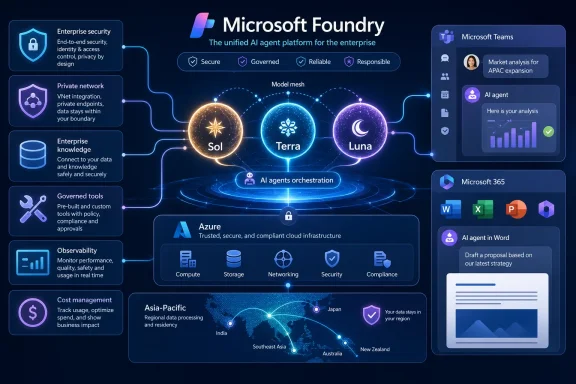
The headline feature is GPT-5.6, delivered in three workload-oriented variants: GPT-5.6 Sol, GPT-5.6 Terra, and GPT-5.6 Luna. Sol targets the most difficult reasoning and coding jobs, Terra is the middle ground for broad enterprise deployment, and Luna is tuned for faster, high-volume work at a lower token cost. That tiered structure is arguably more important than a single benchmark-leading model because real AI systems rarely have a single performance requirement.
Microsoft Foundry is now being framed as an end-to-end environment for building, running, governing, and distributing AI agents. The ambition is broad: developers can choose models and frameworks, connect their agents to company knowledge and tools, host the runtime, monitor behavior, control costs, and publish the result into Microsoft 365.
That is a substantial expansion from the familiar pattern of deploying a chat model behind an API. A production AI agent needs more than an endpoint. It needs identity controls, tool permissions, network isolation, durable state, evaluation, traceability, and a reliable place for users to interact with it.
Foundry’s current platform story rests on three connected layers:
Microsoft Foundry aims to make those pieces feel native to Azure. The benefit is strongest for organizations already invested in Microsoft Entra ID, Azure Virtual Network, Microsoft 365, GitHub, Visual Studio Code, Microsoft Fabric, and the wider Azure security stack.
Instead of presenting one model as the universal answer, Foundry offers three distinct deployment choices.
This is the variant that makes sense for work such as:
For many organizations, Terra could be the most important GPT-5.6 option. It is suited to applications that need strong quality but operate at enough scale that premium-model pricing would become difficult to justify.
Common Terra scenarios include:
This is the likely fit for:
This three-model design also opens the door to more disciplined routing. Rather than deciding that a particular application uses one model forever, teams can create a policy in which Luna handles routine requests, Terra handles standard professional work, and Sol receives escalations requiring deeper reasoning or advanced coding support.
The output-token premium is particularly important. Agent systems can generate far more output than a simple chat exchange because they may create plans, call tools, retain conversational context, generate structured results, and perform iterative reasoning loops. A model that appears affordable in a short demo can become expensive quickly once it runs continuously across thousands of tasks.
The gap between Sol and Luna is large enough that a poorly designed routing policy can undermine the business case for an otherwise useful AI initiative. An agent that uses Sol to classify routine requests may deliver strong answers, but it may also spend five times as much as necessary on inference.
Every design choice affects token usage:
For many enterprises, especially those in regulated industries, location is not an afterthought. Financial services, healthcare, public-sector organizations, and multinational businesses frequently need to assess where AI data is processed, which policies govern that activity, and whether their chosen deployment model aligns with contractual and regulatory obligations.
Foundry now presents three broad deployment approaches:
In other words, data residency is one control among many.
Organizations should still validate:
That flexibility matters because enterprise AI development is not settling around one framework. Teams have different language preferences, orchestration models, existing investments, and requirements for state management or tool use. A platform that insists on a single agent framework risks becoming restrictive. A platform that can host several approaches has a better chance of becoming the operational center of gravity.
The security advantage is clear: an agent does not need unrestricted public-network access simply because it uses a large language model. Enterprises can place it within an architecture that aligns with existing Azure networking practices.
However, private networking also introduces operational work. Teams will need to plan private endpoints, DNS resolution, firewall rules, outbound dependencies, ingress controls, reverse proxies, and publishing paths. “Hosted” does not mean “security design completed.”
Foundry’s resilient task support, currently in private preview, is intended to help agents survive such interruptions. The platform maintains the execution environment, while the agent harness is expected to support checkpointing so work can resume after a restart.
This matters because autonomous and semi-autonomous workflows are fundamentally different from simple request-response chat. An agent processing an invoice exception, provisioning request, service incident, or supply-chain event may need to pause, call several tools, wait for a human approval, and then continue safely.
The feature should not be viewed as a substitute for sound application design. Developers still need:
A built-in knowledge layer can dramatically reduce setup time. It can also create a more consistent governance model compared with ad hoc retrieval stacks scattered across departments.
The caution is that better retrieval does not automatically guarantee correct answers. Agents can still misinterpret retrieved material, use stale records, combine incompatible sources, or expose information that users should not see if permissions are poorly configured. Retrieval quality, access control, evaluation, and data lifecycle management remain essential.
Large agents may have dozens or hundreds of potential actions. Passing every tool definition to the model on every request wastes tokens, increases latency, and makes tool selection less predictable. Toolboxes dynamically choose the relevant tool for a task, reducing the amount of tool metadata placed into the prompt.
The advantage is both economic and operational:
This is where AI agents become more than interactive assistants. An agent can operate without waiting for a user to type a prompt.
That can create genuine business value. A monitoring agent might investigate a recurring alert. A finance agent might review exceptions on a schedule. A service agent might classify and route new tickets immediately. A supply-chain agent might react to an updated inventory feed.
But persistent memory and event-driven autonomy also increase risk. The agent must know what it is allowed to remember, how long it can retain information, which events are trustworthy, and when human confirmation is mandatory. Organizations should begin with narrow, observable routines rather than immediately granting broad authority to act.
This distribution channel can accelerate adoption. Instead of asking users to visit a new internal portal, enterprises can bring role-specific agents to familiar Microsoft interfaces with organizational identity, permissions, and policies flowing through the environment.
Typical opportunities include:
For production support, tracing is indispensable. If an agent gives a poor answer or performs an unwanted action, teams need to know whether the problem came from:
That approach aligns with the GPT-5.6 family. Organizations can use Sol as a benchmark for difficult tasks, then determine whether Terra or Luna can produce acceptable outcomes under real operating conditions.
The risk is over-optimization around narrow test sets. An agent optimized for a static collection of internal examples can appear highly efficient while failing on unusual, adversarial, or newly emerging cases. Evaluation data must represent the diversity and messiness of actual production work.
A useful ROI system should help answer questions such as:
For organizations already operating in the Microsoft ecosystem, Foundry can simplify several difficult transitions:
The platform’s openness to multiple frameworks is equally significant. Enterprises rarely standardize perfectly, and developers will continue to use different languages, SDKs, and orchestration patterns. Foundry has a stronger chance of succeeding as an operational platform if it remains compatible with that reality.
Teams must still make difficult decisions around:
Another concern is model churn. GPT-5.6 is the latest family in this release, but AI model platforms evolve quickly. Organizations should avoid hard-coding assumptions about model behavior, price, latency, context limits, or tool-use reliability. A robust agent architecture should make it possible to test and swap models without rebuilding the entire application.
A sensible adoption sequence looks like this:
For Microsoft-centric enterprises, the opportunity is substantial: AI agents can be built where developers work, run in an Azure environment aligned with enterprise security practices, and reach users in the Microsoft applications they use every day. The organizations that benefit most will not be those that simply choose the largest model. They will be the ones that match the right model to the right task, keep agents observable and constrained, and prove that automation delivers more value than it costs.
The significance is not simply that another generation of GPT models has reached Azure. Microsoft is positioning Foundry as a unified platform for the entire agent lifecycle, from a developer’s first prompt in Visual Studio Code to a governed agent operating inside a private network and ultimately appearing in the collaboration apps employees already use. For Windows, Azure, and Microsoft 365 shops, that integration could reduce the friction of moving AI projects from proof of concept to supported production service.
The headline feature is GPT-5.6, delivered in three workload-oriented variants: GPT-5.6 Sol, GPT-5.6 Terra, and GPT-5.6 Luna. Sol targets the most difficult reasoning and coding jobs, Terra is the middle ground for broad enterprise deployment, and Luna is tuned for faster, high-volume work at a lower token cost. That tiered structure is arguably more important than a single benchmark-leading model because real AI systems rarely have a single performance requirement.
 Overview: Microsoft Foundry Becomes an Agent Platform
Microsoft Foundry is now being framed as an end-to-end environment for building, running, governing, and distributing AI agents. The ambition is broad: developers can choose models and frameworks, connect their agents to company knowledge and tools, host the runtime, monitor behavior, control costs, and publish the result into Microsoft 365.That is a substantial expansion from the familiar pattern of deploying a chat model behind an API. A production AI agent needs more than an endpoint. It needs identity controls, tool permissions, network isolation, durable state, evaluation, traceability, and a reliable place for users to interact with it.
Foundry’s current platform story rests on three connected layers:
- Build: Model access, framework flexibility, coding tools, deployment integration, and developer workflows.
- Generate: Enterprise knowledge, tool use, memory, events, hosted runtimes, and user-facing channels.
- Govern: Security boundaries, monitoring, evaluations, optimization, cost controls, and return-on-investment measurement.
Microsoft Foundry aims to make those pieces feel native to Azure. The benefit is strongest for organizations already invested in Microsoft Entra ID, Azure Virtual Network, Microsoft 365, GitHub, Visual Studio Code, Microsoft Fabric, and the wider Azure security stack.
GPT-5.6 Arrives in Three Tiers
The GPT-5.6 family is designed around an increasingly practical principle: not every request should use the most capable and expensive available model. A document classification task, a support-agent reply, a complex software debugging workflow, and a multi-step planning agent have radically different demands for reasoning depth, latency, and cost.Instead of presenting one model as the universal answer, Foundry offers three distinct deployment choices.
GPT-5.6 Sol: For Deep Reasoning and Demanding Agent Work
GPT-5.6 Sol is the premium tier. It is intended for extended reasoning, sophisticated agent workflows, complex coding tasks, and high-stakes enterprise scenarios where accuracy and multi-step execution matter more than raw response speed.This is the variant that makes sense for work such as:
- Investigating complicated incidents across multiple systems
- Assisting developers with large codebases and multi-file changes
- Planning and executing multi-stage business workflows
- Analyzing lengthy technical, legal, or operational material
- Coordinating tools that require conditional reasoning and approvals
- Producing structured outputs where a failed step can have downstream consequences
GPT-5.6 Terra: The Enterprise Workhorse
GPT-5.6 Terra occupies the middle ground. It is positioned as a balanced model for daily enterprise workloads, delivering capability comparable to the previous GPT-5.5 generation at a lower cost.For many organizations, Terra could be the most important GPT-5.6 option. It is suited to applications that need strong quality but operate at enough scale that premium-model pricing would become difficult to justify.
Common Terra scenarios include:
- Internal knowledge assistants
- Business process copilots
- Document summarization and extraction
- Customer service assistance
- Sales, operations, and HR workflow support
- Content drafting with enterprise grounding
- Moderate-complexity tool calling and agent orchestration
GPT-5.6 Luna: Speed and Volume at Lower Cost
GPT-5.6 Luna is the fastest and least expensive member of the family. It targets latency-sensitive, high-throughput workloads where response speed and unit economics matter more than maximum reasoning depth.This is the likely fit for:
- High-volume classification
- Routing and triage
- Short-form extraction
- FAQ-style agent responses
- Real-time application assistance
- Lightweight workflow automation
- First-pass analysis before escalation to Terra or Sol
- Large-scale customer-facing interactions
This three-model design also opens the door to more disciplined routing. Rather than deciding that a particular application uses one model forever, teams can create a policy in which Luna handles routine requests, Terra handles standard professional work, and Sol receives escalations requiring deeper reasoning or advanced coding support.
GPT-5.6 Pricing: The Cost Difference Matters
Microsoft Foundry lists the following Standard Global token pricing for the GPT-5.6 models, measured in U.S. dollars per million tokens:| Model | Input price | Output price |
|---|---|---|
| GPT-5.6 Sol | $5.00 | $30.00 |
| GPT-5.6 Terra | $2.50 | $15.00 |
| GPT-5.6 Luna | $1.00 | $6.00 |
A Simple Cost Illustration
Consider an application that consumes one million input tokens and produces one million output tokens.- GPT-5.6 Sol would cost roughly $35
- GPT-5.6 Terra would cost roughly $17.50
- GPT-5.6 Luna would cost roughly $7
The gap between Sol and Luna is large enough that a poorly designed routing policy can undermine the business case for an otherwise useful AI initiative. An agent that uses Sol to classify routine requests may deliver strong answers, but it may also spend five times as much as necessary on inference.
Token Economics Are Now an Architecture Decision
In the early chatbot era, model choice could be a configuration detail. In the agentic era, it is an architecture decision.Every design choice affects token usage:
- How much conversation history is included in every request
- Whether long documents are passed directly or retrieved selectively
- How many tool definitions are exposed to the model
- Whether the agent repeats system instructions
- How often multi-step reasoning loops run
- Whether requests are routed to an expensive model by default
- How much telemetry and trace content is retained
- Whether cached prompts are used where appropriate
Regional Processing Expands with the Asia-Pacific Data Zone
The other major infrastructure development is the general availability of the Asia-Pacific Data Zone for Microsoft Foundry. It gives organizations in the region an option to process supported frontier OpenAI model workloads within Asia-Pacific locations rather than relying on a global deployment path.For many enterprises, especially those in regulated industries, location is not an afterthought. Financial services, healthcare, public-sector organizations, and multinational businesses frequently need to assess where AI data is processed, which policies govern that activity, and whether their chosen deployment model aligns with contractual and regulatory obligations.
Foundry now presents three broad deployment approaches:
- Global deployments, built for broad availability and scale
- Data Zone deployments, designed to keep processing within a defined geographic zone
- Regional deployments, which provide more specific location control where available
What a Data Zone Does — and Does Not — Solve
A regional data-processing option is valuable, but it should not be mistaken for automatic compliance. Keeping inference processing in an Asia-Pacific data zone can help satisfy location-related requirements, yet compliance still depends on the organization’s own configuration, data classification, identity controls, retention approach, logging policy, contractual obligations, and jurisdictional requirements.In other words, data residency is one control among many.
Organizations should still validate:
- Which data enters prompts, tool calls, and retrieved context.
- Whether logs and traces contain sensitive content.
- How user identities and permissions are enforced.
- Where supporting services such as storage, search, databases, and monitoring are located.
- Whether external tools, web grounding, or connectors introduce separate data flows.
- Which model deployment type is used in production, testing, and disaster recovery.
Hosted Agents Shift Foundry from Build Environment to Runtime
The model release may draw the most attention, but the platform implications of hosted agents in Foundry Agent Service are arguably more significant. Hosted agents provide a managed runtime for agents built with different frameworks and harnesses, including Microsoft Agent Framework, GitHub Copilot SDK, LangGraph, and other compatible approaches.That flexibility matters because enterprise AI development is not settling around one framework. Teams have different language preferences, orchestration models, existing investments, and requirements for state management or tool use. A platform that insists on a single agent framework risks becoming restrictive. A platform that can host several approaches has a better chance of becoming the operational center of gravity.
Network Isolation for Enterprise Deployments
Hosted agents support Azure Virtual Network integration, allowing organizations to keep agent traffic within a protected network boundary. This is a critical production feature for agents that access internal APIs, private data stores, line-of-business systems, or confidential operational environments.The security advantage is clear: an agent does not need unrestricted public-network access simply because it uses a large language model. Enterprises can place it within an architecture that aligns with existing Azure networking practices.
However, private networking also introduces operational work. Teams will need to plan private endpoints, DNS resolution, firewall rules, outbound dependencies, ingress controls, reverse proxies, and publishing paths. “Hosted” does not mean “security design completed.”
Resilient Tasks Address a Real Agent Problem
Long-running agents are vulnerable to interruptions. A process may fail during a multi-step tool chain, a container may restart, a network dependency may be temporarily unavailable, or an approval may take longer than the original execution window.Foundry’s resilient task support, currently in private preview, is intended to help agents survive such interruptions. The platform maintains the execution environment, while the agent harness is expected to support checkpointing so work can resume after a restart.
This matters because autonomous and semi-autonomous workflows are fundamentally different from simple request-response chat. An agent processing an invoice exception, provisioning request, service incident, or supply-chain event may need to pause, call several tools, wait for a human approval, and then continue safely.
The feature should not be viewed as a substitute for sound application design. Developers still need:
- Idempotent operations where possible
- Explicit checkpoints
- Retry strategies
- Audit-friendly state transitions
- Timeouts and cancellation logic
- Human escalation paths
- Safe handling of partially completed work
Knowledge, Tools, Memory, and Events Become Native Capabilities
The release fills out the practical capabilities required for a useful production agent.Foundry IQ and Enterprise Grounding
Foundry IQ is now positioned as the knowledge layer behind Foundry agents. It brings together several sources of context:- Work IQ for Microsoft 365 awareness
- Fabric IQ for structured enterprise data
- Web IQ for live web grounding
- Foundry IQ as the unified retrieval and knowledge experience
A built-in knowledge layer can dramatically reduce setup time. It can also create a more consistent governance model compared with ad hoc retrieval stacks scattered across departments.
The caution is that better retrieval does not automatically guarantee correct answers. Agents can still misinterpret retrieved material, use stale records, combine incompatible sources, or expose information that users should not see if permissions are poorly configured. Retrieval quality, access control, evaluation, and data lifecycle management remain essential.
Toolboxes Reduce Context Bloat
Toolboxes in Foundry are generally available and address a less glamorous but very real agent problem: tool overload.Large agents may have dozens or hundreds of potential actions. Passing every tool definition to the model on every request wastes tokens, increases latency, and makes tool selection less predictable. Toolboxes dynamically choose the relevant tool for a task, reducing the amount of tool metadata placed into the prompt.
The advantage is both economic and operational:
- Fewer tokens consumed by unused tool schemas
- Less prompt complexity
- More curated tool access
- Easier governance over which tools are exposed
- Reduced likelihood of an agent selecting an irrelevant capability
Memory and Routines Add Persistent Behavior
Memory and routines are available in public preview. Memory can retain procedural, user, and session context across interactions, while routines can run agents on a timer or schedule. Event-based triggers can also activate agents when connected systems report changes, such as a support ticket arriving, a file being added to storage, or a workflow finishing.This is where AI agents become more than interactive assistants. An agent can operate without waiting for a user to type a prompt.
That can create genuine business value. A monitoring agent might investigate a recurring alert. A finance agent might review exceptions on a schedule. A service agent might classify and route new tickets immediately. A supply-chain agent might react to an updated inventory feed.
But persistent memory and event-driven autonomy also increase risk. The agent must know what it is allowed to remember, how long it can retain information, which events are trustworthy, and when human confirmation is mandatory. Organizations should begin with narrow, observable routines rather than immediately granting broad authority to act.
Microsoft Teams and Microsoft 365 Copilot Publishing
The ability to publish Foundry agents into Microsoft Teams and Microsoft 365 Copilot is one of the clearest connections to everyday user productivity. For many employees, a successful AI tool is not the one with the strongest model; it is the one available in the workspace where they already spend their day.This distribution channel can accelerate adoption. Instead of asking users to visit a new internal portal, enterprises can bring role-specific agents to familiar Microsoft interfaces with organizational identity, permissions, and policies flowing through the environment.
Typical opportunities include:
- IT service desk and self-service agents in Teams
- Employee policy assistants in Microsoft 365 Copilot
- Sales enablement agents with customer and product context
- Project coordination agents that summarize work and track actions
- Operations agents that surface alerts, exceptions, and recommended next steps
- Department-specific copilots for finance, legal, HR, and procurement
Observability, Optimization, and ROI Move to Center Stage
The most mature part of the Foundry strategy may be its focus on post-deployment operations. AI agents should not be judged only by whether they generate plausible output. They need to be evaluated by behavior, reliability, safety, cost, and measurable business value.Tracing and Evaluation
Tracing and evaluation for hosted agents are generally available. These capabilities allow teams to inspect what the agent did, which tools it called, how it reached an outcome, and where a workflow failed.For production support, tracing is indispensable. If an agent gives a poor answer or performs an unwanted action, teams need to know whether the problem came from:
- The user prompt
- The system instructions
- Retrieved knowledge
- A malformed tool response
- An incorrect model decision
- A missing approval checkpoint
- An application bug
- An external system failure
Agent Optimizer and the Smaller-Model Opportunity
The agent optimizer is in public preview and aims to test prompts, skills, tools, and models together to identify stronger configurations. The appealing outcome is not always “use a larger model.” In many cases, the best result may be a tighter prompt, fewer unnecessary tools, improved retrieval, or a lower-cost model that meets the task’s quality threshold.That approach aligns with the GPT-5.6 family. Organizations can use Sol as a benchmark for difficult tasks, then determine whether Terra or Luna can produce acceptable outcomes under real operating conditions.
The risk is over-optimization around narrow test sets. An agent optimized for a static collection of internal examples can appear highly efficient while failing on unusual, adversarial, or newly emerging cases. Evaluation data must represent the diversity and messiness of actual production work.
ROI for Agents Is Promising but Not a Shortcut
The private-preview ROI for agents capability connects operational cost, usage data, business-value evaluations, and traces into a unified view. That is a welcome direction because AI projects often quantify cost precisely while describing value vaguely.A useful ROI system should help answer questions such as:
- How many hours of manual work did the agent actually remove?
- Did it reduce ticket resolution time?
- Did it improve first-contact resolution?
- Did it reduce rework or error rates?
- Did it create measurable revenue, retention, or compliance benefits?
- Which departments are receiving value relative to consumption?
- Where is the agent consuming more than it returns?
The Real Strength: A Coherent Microsoft-Centric Stack
The strongest case for Microsoft Foundry is not any individual feature. It is the integration of models, Azure infrastructure, enterprise identity, governance, productivity apps, and development tooling.For organizations already operating in the Microsoft ecosystem, Foundry can simplify several difficult transitions:
- From local prototype to managed cloud deployment
- From public API experimentation to private networking
- From static chatbot to tool-using agent
- From isolated app to Microsoft 365 distribution
- From informal prompt tuning to structured evaluation
- From unpredictable token use to model routing and cost optimization
- From a pilot’s anecdotal success to operational measurement
The platform’s openness to multiple frameworks is equally significant. Enterprises rarely standardize perfectly, and developers will continue to use different languages, SDKs, and orchestration patterns. Foundry has a stronger chance of succeeding as an operational platform if it remains compatible with that reality.
The Risks: Complexity Does Not Disappear
Microsoft Foundry reduces integration work, but it does not eliminate complexity. In some cases, a unified platform can make complexity less visible until a project reaches production.Teams must still make difficult decisions around:
- Data classification and retention
- Prompt injection and tool safety
- Identity and authorization boundaries
- Model selection and cost routing
- Evaluation criteria
- Human approvals
- Network topology
- Incident response
- Change management
- Vendor dependency
- User training and adoption
Another concern is model churn. GPT-5.6 is the latest family in this release, but AI model platforms evolve quickly. Organizations should avoid hard-coding assumptions about model behavior, price, latency, context limits, or tool-use reliability. A robust agent architecture should make it possible to test and swap models without rebuilding the entire application.
What Organizations Should Do Next
The right response to this release is not to deploy autonomous agents everywhere. It is to use the new capabilities to establish a more disciplined production path.A sensible adoption sequence looks like this:
- Choose a narrow business workflow with a measurable outcome, clear owner, and manageable risk.
- Start with a read-oriented agent before enabling high-impact actions or write access to enterprise systems.
- Test GPT-5.6 Luna, Terra, and Sol against the same evaluation set rather than selecting based on marketing position alone.
- Use toolboxes and least-privilege access so agents receive only the tools they need.
- Place sensitive workloads behind appropriate network and identity controls, including VNet integration where required.
- Define human approval points for financial, customer-impacting, security-sensitive, or irreversible actions.
- Instrument tracing and evaluations from the beginning, not after the first incident.
- Monitor token costs by workflow, model tier, tool usage, and department.
- Treat memory and event triggers cautiously, with clear retention rules and limited autonomous scope.
- Measure outcomes against a baseline, including accuracy, speed, resolution rates, costs, and human rework.
For Microsoft-centric enterprises, the opportunity is substantial: AI agents can be built where developers work, run in an Azure environment aligned with enterprise security practices, and reach users in the Microsoft applications they use every day. The organizations that benefit most will not be those that simply choose the largest model. They will be the ones that match the right model to the right task, keep agents observable and constrained, and prove that automation delivers more value than it costs.