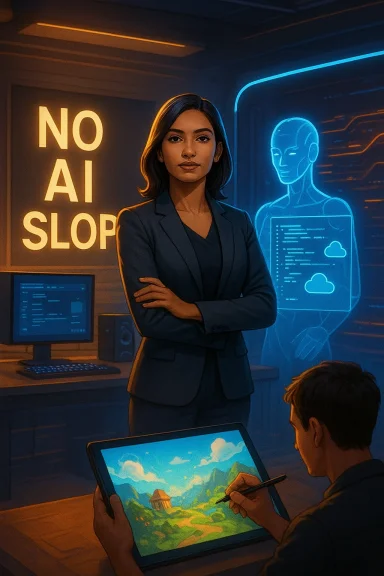
Microsoft’s gaming organization entered a consequential new chapter on February 20, 2026, when long‑time Xbox leader Phil Spencer announced his retirement and Satya Nadella installed Asha Sharma — a senior Microsoft AI executive — as the new CEO of Microsoft Gaming, a leadership change that promises to accelerate the company’s embrace of artificial intelligence while explicitly rejecting what Sharma called “soulless AI slop.”
Microsoft’s Xbox and broader gaming business has been one of the company’s most visible growth engines of the last decade. Under Phil Spencer’s stewardship, Xbox expanded across consoles, PC, cloud, and subscriptions, completed high‑profile studio acquisitions, and made Game Pass the company’s marquee consumer offering. Spencer’s departure after 38 years at Microsoft marks both an end of an era and a pivot point: the incoming CEO is a product leader from Microsoft’s CoreAI organization rather than a traditional games industry executive.
The leadership transition also includes the promotion of Matt Booty — a long‑time industry veteran — to Executive Vice President and Chief Content Officer to oversee studios and first‑party game development, and the departure of Xbox President and COO Sarah Bond. In her first memo to Microsoft Gaming employees, Asha Sharma laid out three priorities: recommit to making great games, revitalize the Xbox brand and platform, and shape the “future of play” — all while making clear she sees AI as a tool that must be used carefully and creatively, not as a substitute for human artistry.
Those words matter precisely because Sharma joins Microsoft Gaming from a leadership role in the company’s CoreAI products group — the team responsible for building the underlying AI services and models Microsoft sells to enterprises and integrates across Windows and Office. Her phrasing acknowledges both the promise and the danger of generative AI in entertainment: the potential to scale content creation and player experiences, and the risk of cheapening craft through low‑quality, automated output.
This article draws on public memos and contemporaneous reporting to summarize Sharma’s language and to analyze what it implies for the future of Xbox, Game Pass, and studio autonomy.
A leadership change that places a senior AI product executive in charge of Microsoft Gaming signals a few non‑mutually exclusive intentions:
Key strengths she brings to Microsoft Gaming:
What that buys Microsoft:
The appointment splits platform and creative leadership in a way that could let Microsoft exploit its AI and cloud advantages without sacrificing the human artistry that defines memorable games. But that outcome is far from guaranteed. The next 12–18 months will be the proving ground: how Microsoft operationalizes provenance, how studios balance creative control with new tooling, and whether the company can align commercial incentives with long‑term player value.
For players and developers watching nervously, Sharma’s words are a hopeful first step. The real test will be whether Microsoft’s products — the next wave of Game Pass releases, cloud gaming improvements, and first‑party titles — actually demonstrate the thoughtful, artist‑first application of AI she promised on February 20, 2026.
Source: TechPowerUp Microsoft Gaming's New CEO Wants To Embrace AI Without "Soulless AI Slop"
 Background
Microsoft’s Xbox and broader gaming business has been one of the company’s most visible growth engines of the last decade. Under Phil Spencer’s stewardship, Xbox expanded across consoles, PC, cloud, and subscriptions, completed high‑profile studio acquisitions, and made Game Pass the company’s marquee consumer offering. Spencer’s departure after 38 years at Microsoft marks both an end of an era and a pivot point: the incoming CEO is a product leader from Microsoft’s CoreAI organization rather than a traditional games industry executive.The leadership transition also includes the promotion of Matt Booty — a long‑time industry veteran — to Executive Vice President and Chief Content Officer to oversee studios and first‑party game development, and the departure of Xbox President and COO Sarah Bond. In her first memo to Microsoft Gaming employees, Asha Sharma laid out three priorities: recommit to making great games, revitalize the Xbox brand and platform, and shape the “future of play” — all while making clear she sees AI as a tool that must be used carefully and creatively, not as a substitute for human artistry.
What Sharma actually said: context and verbatim
In an internal message to staff and in public comments summarized by multiple news outlets on February 20–21, 2026, Sharma set the tone bluntly. Paraphrasing her note: as monetization and AI evolve, Microsoft Gaming “will not chase short‑term efficiency or flood our ecosystem with soulless AI slop. Games are and always will be art, crafted by humans, and created with the most innovative technology provided by us.”Those words matter precisely because Sharma joins Microsoft Gaming from a leadership role in the company’s CoreAI products group — the team responsible for building the underlying AI services and models Microsoft sells to enterprises and integrates across Windows and Office. Her phrasing acknowledges both the promise and the danger of generative AI in entertainment: the potential to scale content creation and player experiences, and the risk of cheapening craft through low‑quality, automated output.
This article draws on public memos and contemporaneous reporting to summarize Sharma’s language and to analyze what it implies for the future of Xbox, Game Pass, and studio autonomy.
Why this matters: AI meets games at scale
AI is already embedded in modern game development and player experience in many ways: procedural level generation, NPC behaviors, player matchmaking, analytics, and localized content. Over the last three years AI’s presence has moved from niche tooling and research experiments into product features — from in‑game assistants and dynamic narrative systems to studio‑side automation in QA and asset pipelines.A leadership change that places a senior AI product executive in charge of Microsoft Gaming signals a few non‑mutually exclusive intentions:
- Microsoft sees AI as a foundational technology that should be deeply integrated into products and platforms, not only used peripherally by a few studios.
- The company wants to standardize AI tooling, guardrails, and commercial models across studios, Game Pass, and Xbox ecosystems to both accelerate production and protect IP and quality.
- Satya Nadella and Microsoft’s executive team are betting that the next phase of gaming growth will depend on combining cloud scale, models and services, and creative studio expertise.
Asha Sharma: profile, strengths, and credibility
Asha Sharma’s resume is not a traditional Xbox pedigree, and that fact has stirred debate among developers and players alike. Her background highlights include leadership within Microsoft’s CoreAI product organization, senior roles at major consumer tech companies, and operational experience that spans product, engineering, and platform strategy.Key strengths she brings to Microsoft Gaming:
- Deep familiarity with AI product development and platform thinking — critical for building shared developer tooling, cloud services, and scalable systems.
- Operational experience running large engineering organizations — helpful for aligning multiple studios and cloud investments.
- A platform mindset that can bridge first‑party content, third‑party developer needs, and underlying services such as Azure and Copilot for Gaming.
The immediate organizational moves: content and platform separation
The dual appointments — Sharma as CEO of Microsoft Gaming and Matt Booty as Chief Content Officer — telegraph a deliberate separation of responsibilities.- Sharma will steer platform strategy, AI integration, monetization frameworks, and the “Xbox Everywhere” vision across console, PC, cloud, and mobile.
- Booty will run studios and first‑party content creation, responsible for creative quality, production pipelines, and studio roadmaps.
What that buys Microsoft:
- Studios get a clear advocate for creative quality (Booty) while the company can still leverage AI and cloud investments under unified product governance (Sharma).
- Developers gain standardized tooling and guardrails that could reduce reinventing the wheel and speed up iterative workflows.
- The company reduces single‑leader dependency by splitting strategy and content — a hedge if the technology or business environment shifts.
Strengths of Sharma’s stated approach
- Protecting creative integrity
- By rejecting “soulless AI slop,” Sharma signals a commitment to artistic standards. That will be welcomed by many creators worried about low‑cost content harvesting.
- Bringing AI tooling to studios at scale
- With CoreAI experience, Sharma is well placed to fund and ship shared services: model hosting, content‑safety pipelines, latency‑optimized inference for cloud gaming, and developer SDKs that integrate into existing engines.
- Risk‑aware adoption
- Her language suggests a preference for measured, product‑driven deployments over hype cycles — an approach consistent with what many enterprise customers now prefer.
- Platform leverage
- Microsoft can cross‑sell AI improvements across Azure, Windows, Game Pass, and Xbox hardware. The organizational change makes that a priority rather than an afterthought.
Risks, unanswered questions, and potential pitfalls
- Perception gap with core gamers
- Moving an AI executive into the gaming CEO role risks fueling a perception that Microsoft will prioritize automation and efficiency over player‑centric experiences. Messaging alone won’t bridge that trust gap; demonstrable creative outcomes will be required.
- Creative autonomy vs. platform standardization
- Standardized AI tooling can accelerate development, but if applied as rigid templates, it can produce homogenized experiences. Studios must retain authority to opt out or customize tooling where creativity demands it.
- Monetization pressure
- The industry has structural pressures to monetize live games aggressively. “No soulless AI slop” is a mission statement, but commercial incentives may still push for AI‑driven content farms or low‑cost expansions unless governance and KPIs are realigned accordingly.
- IP, provenance, and legal exposure
- Integrating generative models into game development raises thorny questions: training data provenance, asset licensing, and derivative work claims. Microsoft must deploy rigorous provenance and rights management systems to avoid legal risk.
- Studio morale and talent fit
- Studios historically attract talent motivated by creative craft. Leadership perceived as too engineering‑ or efficiency‑oriented can cause attrition among creatives. Microsoft will need to show respect for craft and invest in the long tail of creative R&D.
- Technical complexity
- Realizing the promise of AI in games requires low‑latency inference, multimodal models tuned for interactivity, and tooling that fits into diverse engines (Unity, Unreal, proprietary). Delivering this without disrupting live services is nontrivial.
How AI could be implemented responsibly in games — practical guardrails
Sharma’s statement implies a values‑based approach. Operationalizing that requires concrete guardrails and tooling:- Quality thresholds: AI outputs used in shipped content must meet studio‑defined quality checks and player testing metrics before release.
- Human‑in‑the‑loop workflows: Maintain human oversight for core creative decisions and for any AI‑generated narrative or character content.
- Provenance tracking: Tag AI‑generated assets with metadata describing model, dataset provenance, and generation parameters to enable transparency and rights management.
- Opt‑in mechanics for players: Where AI affects game behavior or narrative, players should have the option to enable/disable AI features to preserve preferred experiences.
- Monetization alignment: Tie studio KPIs and compensation to measures of long‑term player engagement and satisfaction, not short‑term monetization lifts from repetitive content drops.
- Security and moderation pipelines: Establish automated detection for hallucinations, toxic outputs, or exploitative behaviors tied to AI agents.
What this means for Game Pass, cloud gaming, and platform strategy
Microsoft’s gaming strategy is not just studios and consoles; it’s a multi‑modal platform that includes Game Pass subscriptions, xCloud streaming, and PC integration. AI can influence each layer:- Game Pass personalization: Smarter recommendations and curated discovery can increase retention, but must avoid overpersonalization that narrows exposure to new work.
- Cloud optimization: AI‑driven codecs, frame interpolation, and predictive prefetching can materially improve cloud gaming quality — an area where Microsoft’s cloud scale offers a competitive advantage.
- Developer tooling: Standardized AI pipelines could reduce cost and time to ship, unlocking more frequent updates and creative experiments for live titles.
Studio and developer perspective — incentives and control
For Microsoft’s studios and external partners, the central questions will be:- Who owns creative decisions when AI is used?
- How will revenue and IP be shared with creators using AI‑assisted workflows?
- What level of control will third‑party developers have over Microsoft’s shared AI services?
- Technical autonomy to choose their tooling stack and to run models locally if needed.
- Clear contractual terms for IP and model usage, with revenue and rights protection baked into platform agreements.
- Incentives aligned to long‑term creative quality, such as bonuses tied to player‑driven metrics like retention and satisfaction rather than only short‑term monetization lifts.
Consumer and community management — trust is a fragile asset
Gamers are vocal and organized; platform leaders ignore that reality at their peril. To preserve trust:- Be transparent about where AI is used, especially in narrative, character behavior, or in monetized content.
- Publish clear policies on AI‑generated content and the provenance of in‑game assets.
- Involve community testing groups in pre‑release trials for AI features so player feedback can shape the final product.
- Keep a pledge to creative craft visible across marketing and developer diaries; rhetoric must match product output.
Regulatory and legal landscape: a looming layer of complexity
Across jurisdictions, regulators are increasingly focused on AI transparency, safety, and IP. Game companies using generative tools must prepare for:- Data‑provenance audits that verify training datasets are used lawfully.
- Consumer‑protection scrutiny if AI is used in ways that might manipulate children or vulnerable players, particularly in monetized systems.
- Copyright disputes over generated assets, music, or narrative text that closely replicate existing works.
Short‑term signals to watch
- Studio roadmaps and public dev diaries: Will first‑party titles released under the new leadership explicitly show AI‑assisted workflows? Are there visible quality improvements or regressions?
- Game Developers Conference (GDC) and Xbox showcases: Expect clearer statements and demos of platform tools or AI features within weeks, as these industry events are natural venues for unveiling developer tooling and content roadmaps.
- Developer SDKs and Azure integration: Watch for published SDKs, model hosting, and developer documentation that make it easy to adopt Microsoft’s AI services without locking studios into low‑quality templates.
- Monetization experiments: Any rapid proliferation of AI‑driven live content (e.g., procedurally generated cosmetics or micro‑events) will test Sharma’s “no slop” commitment.
- Legal filings and policy updates: Signals that Microsoft is rolling out provenance, attribution, and rights management systems should appear in developer agreements and platform policy pages.
Long‑term scenarios: conservative, balanced, and reckless
- Conservative adoption (low risk)
- Microsoft treats AI as a developer productivity tool, focusing on QA automation, localization, and backend services. Creative decisions remain human‑led. Outcome: steady productivity gains, minimal community backlash.
- Balanced integration (moderate risk)
- Microsoft deploys AI to augment content creation, introduce new player experiences (like AI‑driven side characters), and to personalize Game Pass. Heavy governance and transparency reduce legal exposure. Outcome: higher engagement, new monetization models, some debate about authenticity.
- Reckless monetization (high risk)
- Pressure for short‑term revenue leads to mass‑produced, AI‑generated content and low‑quality live experiences. Community trust erodes, legal disputes over IP multiply, and brand reputation suffers. Outcome: churn, regulatory scrutiny, and higher long‑term costs.
Practical recommendations for Microsoft (if the goal is to avoid “soulless AI slop”)
- Publish a public AI‑use framework for game development that includes provenance, human oversight, and quality metrics.
- Fund internal artist‑AI research labs that pair senior narrative and design talent with model engineers to prototype high‑quality uses.
- Launch a developer grant program that rewards creative, experimental uses of AI that meaningfully improve player experiences.
- Implement mandatory provenance metadata for any AI‑generated asset shipped to consumers, visible to players who opt to view it.
- Rework commercial incentives so studio bonuses and KPIs reflect long‑term retention and critical reception, not just monetization velocity.
Conclusion
Asha Sharma’s arrival at Microsoft Gaming marks a clear strategic inflection point: Microsoft intends to accelerate AI adoption across its gaming platform while publicly committing to preserve creative craft. Her terse phrase about not flooding the ecosystem with “soulless AI slop” is more than rhetoric — it’s a promise that must be translated into real policy, tooling, and cultural practices across dozens of studios and millions of players.The appointment splits platform and creative leadership in a way that could let Microsoft exploit its AI and cloud advantages without sacrificing the human artistry that defines memorable games. But that outcome is far from guaranteed. The next 12–18 months will be the proving ground: how Microsoft operationalizes provenance, how studios balance creative control with new tooling, and whether the company can align commercial incentives with long‑term player value.
For players and developers watching nervously, Sharma’s words are a hopeful first step. The real test will be whether Microsoft’s products — the next wave of Game Pass releases, cloud gaming improvements, and first‑party titles — actually demonstrate the thoughtful, artist‑first application of AI she promised on February 20, 2026.
Source: TechPowerUp Microsoft Gaming's New CEO Wants To Embrace AI Without "Soulless AI Slop"