

Microsoft has quietly folded Osmos — a small Seattle startup that built an AI-assisted, agentic data engineering stack — into the Fabric team, embedding its autonomous data-wrangling and ETL automation directly inside OneLake and Microsoft Fabric's Spark ecosystem.
Microsoft Fabric launched in late 2023 as an integrated data and analytics platform designed to unify data engineering, data science, analytics and BI under a single control plane. At the platform’s core is OneLake, a unified data lake intended to simplify governance and storage across Fabric workloads. Fabric has leaned heavily on established open-source components such as Apache Spark and widely used table formats, while also building features like mirroring to bring external databases into OneLake in Delta Lake format.
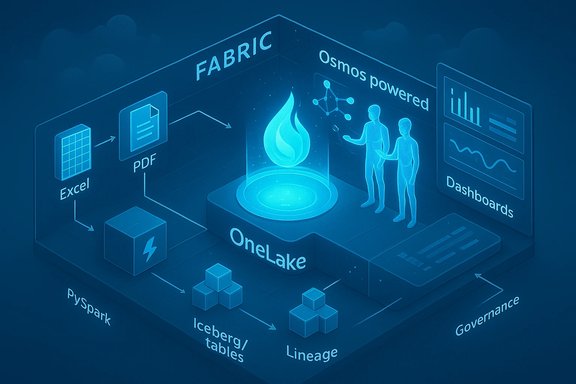
Osmos was founded in 2019 and positioned itself to address the perennial, underappreciated bottleneck in analytics workflows: data preparation. The company developed an AI Data Wrangler and a set of agentic AI Data Engineers that automatically interpret, clean, transform and produce production-ready pipelines from messy, semi-structured inputs — Excel dumps, PDFs, fixed-width files, API exports and the like. Over the past year Osmos offered its tools as a native partner workload on Microsoft Fabric, producing automated PySpark notebooks and Iceberg-format table outputs that could be consumed by Fabric workloads.
Microsoft’s stated rationale for the acquisition is straightforward: convert time-consuming, manual ETL work into more automated, AI-driven processes that reduce operational overhead and get organizations to analytics- and AI-ready datasets faster. The Osmos team will join Fabric’s engineering organization to integrate agentic AI workflows directly into the platform.
This has practical consequences:
The acquisition does not eliminate Delta support, but it does shift attention toward reinforcing Fabric’s ability to host multiple open table formats and translate metadata as needed. That technical flexibility is essential because many enterprises use different engines and expect cross-platform interoperability (e.g., Snowflake, Databricks, other Iceberg-based systems).
However, change comes with trade-offs. Relying on automated agents for schema mapping and transformation increases the need for rigorous testing, validation, and observability systems. Generated PySpark notebooks can be a powerful productivity multiplier, but they also carry the same risks as hand-coded pipelines: silent assumptions, edge-case mishandling, and performance surprises in production.
Partners that previously sold complementary capabilities may feel squeezed or targeted. The broader ecosystem will likely adapt — some vendors will specialize, some will integrate at deeper technical layers, and some will pursue multi-cloud neutrality.
For the market:
However, the benefits are conditional. Agentic automation can amplify productivity but it also amplifies errors if not governed properly. The acquisition tightens Microsoft’s grip on a critical data-platform layer, altering the partner landscape and shifting competitive dynamics. Customers should treat Osmos-enhanced Fabric features as powerful tools that require disciplined governance, testing and cost management.
Enterprises should prepare a measured adoption path: pilot, validate, govern, and then scale, while maintaining exportable artifacts and escape hatches. Platform teams should demand transparent provenance, human-in-the-loop approvals for production promotion, and robust observability for agent actions.
The Osmos acquisition underscores a larger truth: the next wave of productivity in analytics will come less from faster chips and more from smarter orchestration — software that reasons about data engineering in the way humans do, at scale. Whether that promise becomes a broadly reliable reality depends less on flashy demos and more on the hard work of integrating agentic behavior with governance, auditability and operational rigor.
Source: theregister.com Microsoft acquires Osmos for AI-powered data engineering
 Background
Microsoft Fabric launched in late 2023 as an integrated data and analytics platform designed to unify data engineering, data science, analytics and BI under a single control plane. At the platform’s core is OneLake, a unified data lake intended to simplify governance and storage across Fabric workloads. Fabric has leaned heavily on established open-source components such as Apache Spark and widely used table formats, while also building features like mirroring to bring external databases into OneLake in Delta Lake format.Osmos was founded in 2019 and positioned itself to address the perennial, underappreciated bottleneck in analytics workflows: data preparation. The company developed an AI Data Wrangler and a set of agentic AI Data Engineers that automatically interpret, clean, transform and produce production-ready pipelines from messy, semi-structured inputs — Excel dumps, PDFs, fixed-width files, API exports and the like. Over the past year Osmos offered its tools as a native partner workload on Microsoft Fabric, producing automated PySpark notebooks and Iceberg-format table outputs that could be consumed by Fabric workloads.
Microsoft’s stated rationale for the acquisition is straightforward: convert time-consuming, manual ETL work into more automated, AI-driven processes that reduce operational overhead and get organizations to analytics- and AI-ready datasets faster. The Osmos team will join Fabric’s engineering organization to integrate agentic AI workflows directly into the platform.
What Microsoft bought — product and people
Osmos’ capabilities and how they fit Fabric
Osmos built a set of products that map closely to the most tedious parts of data engineering:- Autonomous data ingestion from disparate sources, removing brittle hand-coded parsers.
- Schema inference and reconciliation, including merging disparate tables and resolving inconsistent field types.
- Automatic code generation of execution-ready PySpark notebooks for production pipelines.
- Automated conversion and publishing of cleaned assets into table formats (the company highlighted Iceberg tables for OneLake).
- Agent-based orchestration, where AI agents can plan multi-step tasks, iterate on outputs and be supervised by engineers.
Personnel and scale
Osmos is small by enterprise-acquisition standards. The startup remained under 20 employees and had raised a modest venture round. Microsoft is acquiring the team and intellectual property; financial terms were not disclosed. The integration is framed as both a product consolidation (sunsetting standalone Osmos offerings) and a capability infusion for Fabric.Why this matters: strategic and technical impacts
1) A new layer of "agentic AI" inside the platform
Microsoft’s messaging emphasizes "agentic AI" — autonomous agents that plan and act across multiple steps — rather than surface-level generative assistants. Embedding agentic ETL directly into Fabric means data engineers can expect AI artifacts that do more than propose a SQL snippet: they can design a pipeline, generate production-grade Spark notebooks, test them, and iterate under human supervision.This has practical consequences:
- Fewer manual handoffs between data producers and engineering teams.
- Potentially faster onboarding for business analysts who need clean, SQL-ready datasets.
- Greater runtime automation — scheduling, observability and auto-remediation wiring can be generated alongside logic.
2) A competitive squeeze on partners
By moving Osmos in-house, Microsoft converts a partner capability into a first-party feature. That changes dynamics for third parties who offered ETL and data-wrangling on Azure or Fabric.- Databricks historically shared ecosystem alignment with Microsoft on Spark; it also sells automated ETL and workflow automation. Bringing an AI-first ETL capability into Fabric tightens Microsoft’s vertical integration and requires Databricks to compete more directly inside Azure.
- Independent ISVs that monetized premade connectors or wrangling tools for Fabric must reassess value propositions. Some partners may accelerate specialized domain features; others might struggle if Microsoft replicates core functionality.
3) Format politics: Iceberg vs Delta and interoperability
Osmos emphasizes producing Iceberg tables in OneLake as part of its Fabric integration, while Microsoft’s mirroring features have historically used Delta Lake as the mirrored storage format. Fabric today supports both Delta and Iceberg through metadata virtualization in OneLake, enabling interchange between formats for read/write compatibility.The acquisition does not eliminate Delta support, but it does shift attention toward reinforcing Fabric’s ability to host multiple open table formats and translate metadata as needed. That technical flexibility is essential because many enterprises use different engines and expect cross-platform interoperability (e.g., Snowflake, Databricks, other Iceberg-based systems).
4) Developer and operational impact
If Osmos’ claims about cutting developer and maintenance time hold true in broader deployments, organizations stand to reduce the cost and time of preparing datasets — particularly for complex unstructured or semi-structured inputs. That could change staff allocation: fewer repetitive cleaning tasks and more focus on modeling, governance and instrumentation.However, change comes with trade-offs. Relying on automated agents for schema mapping and transformation increases the need for rigorous testing, validation, and observability systems. Generated PySpark notebooks can be a powerful productivity multiplier, but they also carry the same risks as hand-coded pipelines: silent assumptions, edge-case mishandling, and performance surprises in production.
Strengths and potential benefits
- Reduced friction for messy data: The biggest practical win is turning irregular enterprise inputs into structured, analytics-ready assets with minimal manual effort. This is especially valuable in organizations with a lot of legacy exports or external partner data.
- Faster time to value: Automating the repetitive parts of pipeline building shortens the path from raw tosses of data to usable tables, speeding analytics and ML projects.
- Integration with storage and governance: Putting agentic ETL inside Fabric allows tighter coupling with OneLake’s security, catalog and governance controls, which should simplify compliance.
- Standardized, production-ready artifacts: Automated generation of Spark notebooks and table definitions can enforce consistent patterns and reduce “works on my machine” problems.
- Platform lever for AI readiness: Fabric’s pitch as a unified platform for analytics and AI gains credibility if it can consistently deliver high-quality, curated datasets for models and BI.
Risks, blind spots and realistic caveats
Model correctness and hallucination
Generative systems are prone to confidently producing incorrect interpretations. When agents parse complex, ambiguous documents (invoices, OCRed PDFs or competitor CSVs), there’s a nonzero chance that the generated schema or transformation logic will be subtly wrong. Small errors in data transformations can cascade into significant analytical mistakes.- Organizations must implement systematic validation (unit tests, data checks, provenance) when accepting agent-generated artifacts.
- Never treat agentic outputs as production-ready without human-reviewed validation stages and robust monitoring.
Governance, provenance and auditability
Automated transformation introduces challenges for compliance and explainability. When a dataset’s lineage and transformation logic are generated by an agent, auditors will require clear, accessible records of:- The transformation decisions taken.
- Versioning of generated notebooks and models.
- Who reviewed and approved each pipeline.
Vendor lock-in and partner displacement
Consolidating Osmos into Fabric strengthens Microsoft’s vertically integrated story, but it also increases dependence on Microsoft for one more layer of the data stack. Organizations that value a heterogeneous ecosystem may perceive greater vendor lock-in risk, especially if Microsoft shifts feature availability or pricing to favor first-party integrations.Partners that previously sold complementary capabilities may feel squeezed or targeted. The broader ecosystem will likely adapt — some vendors will specialize, some will integrate at deeper technical layers, and some will pursue multi-cloud neutrality.
Performance and cost unpredictability
Automatically generated Spark notebooks can be efficient, but they can also create suboptimal jobs that consume large compute resources. Without proper cost estimators and guardrails, it's possible to accidentally trigger expensive runs or inefficient cluster utilization.- Cost transparency, execution previews and simulated cost estimates are important safeguards.
Security and data privacy
Agentic systems often rely on models trained on broad datasets, potentially raising concerns about how sensitive schemas or PII are processed, logged or used for model training. Enterprises must ensure:- Any external LLM usage complies with data residency and privacy policies.
- Logs and generated artifacts do not leak sensitive information.
- Model fine-tuning or prompts do not expose confidential details.
Practical guidance for IT and data teams
The arrival of agentic data engineering inside Fabric is not a binary choice — it’s a platform capability that should be evaluated and governed. Recommended steps for teams planning to adopt or evaluate Osmos-driven Fabric features:- Start small and instrument everything.
- Pilot with non-critical datasets and introduce systematic tests and validations before moving to production.
- Define acceptance criteria for agent outputs.
- Require unit tests, row-level checks, and schema-compatibility gates before promoting any generated notebook or table.
- Enforce provenance, versioning and human sign-offs.
- Store generated notebooks in version control, require code reviews, and keep a tamper-proof lineage of transformation decisions.
- Implement cost and performance guardrails.
- Set resource quotas, preflight cost estimations, and run jobs in isolated capacities during testing.
- Audit data residency and security implications.
- Verify that any LLM calls or agent logic comply with internal and regulatory data handling rules.
- Maintain fallbacks and portability.
- Keep raw ingestion scripts or specification documents so you can rebuild pipelines outside of Fabric if needed.
What this means for Databricks and the wider market
The Osmos acquisition tightens the competitive tussle between Microsoft and platform partners that previously sold complementary ETL capabilities on Azure. Databricks and other independent players will continue to push their own automation features, but Microsoft owning a native agentic ETL capability makes Fabric a more compelling one-stop option for customers who prioritize a single-vendor experience.For the market:
- Expect Databricks and other vendors to accelerate their own agentic and automation efforts, emphasizing portability and multi-cloud support as counterpoints to platform lock-in.
- ISVs with niche domain expertise will double down on vertical differentiation rather than generic ETL capabilities.
- Customers with existing multi-platform deployments will reassess architectures to balance convenience against flexibility.
Technical reality check and unverifiable elements
Several claims and numbers associated with the acquisition require cautious handling:- Customer-specific efficiency claims (e.g., "50% reduction in dev and maintenance") come from early Osmos-Fabric deployments and promotional statements. While those gains are plausible for some workflows, results will vary widely by dataset complexity, incumbent engineering practices and governance processes.
- The timeline for full integration — when Osmos features will be available as first‑class features across all Fabric tenants — depends on Microsoft’s internal roadmap and internal testing cycles. Customers should not assume immediate parity between the Osmos workload and a fully integrated Fabric-native feature set without checking Microsoft’s official release schedule.
- The acquisition price was not disclosed publicly, and estimates would be speculative.
Longer-term implications: agentic AI as infrastructure
Microsoft’s move is an explicit bet that agentic AI will shift from point tools to infrastructure-level primitives. If successful, agentic capabilities become indistinguishable from the platform itself — like storage, compute or query engines. That changes product economics and user expectations:- Users expect less manual housekeeping and more out-of-the-box intelligence.
- Platform providers must build robust governance and observability layers around autonomous agents.
- Enterprises will need to evolve processes for validating and certifying AI-generated artifacts, much like software supply-chain checks.
Closing analysis: balanced view and recommendations
The integration of Osmos into Microsoft Fabric is a logical step for a platform vendor committed to making data more accessible and AI-ready. On the positive side, it promises to reduce the tedium of data preparation, accelerate analytics projects and create a more unified developer experience inside OneLake.However, the benefits are conditional. Agentic automation can amplify productivity but it also amplifies errors if not governed properly. The acquisition tightens Microsoft’s grip on a critical data-platform layer, altering the partner landscape and shifting competitive dynamics. Customers should treat Osmos-enhanced Fabric features as powerful tools that require disciplined governance, testing and cost management.
Enterprises should prepare a measured adoption path: pilot, validate, govern, and then scale, while maintaining exportable artifacts and escape hatches. Platform teams should demand transparent provenance, human-in-the-loop approvals for production promotion, and robust observability for agent actions.
The Osmos acquisition underscores a larger truth: the next wave of productivity in analytics will come less from faster chips and more from smarter orchestration — software that reasons about data engineering in the way humans do, at scale. Whether that promise becomes a broadly reliable reality depends less on flashy demos and more on the hard work of integrating agentic behavior with governance, auditability and operational rigor.
Source: theregister.com Microsoft acquires Osmos for AI-powered data engineering
