Microsoft Launches MAI Superintelligence Team for Humanist AI Guardrails

  • Thread Author
Microsoft has quietly — and decisively — created a new research and engineering unit inside its AI division called the MAI Superintelligence Team, led by Microsoft AI CEO Mustafa Suleyman, and set its north star on what the company calls “humanist superintelligence” — advanced, domain‑targeted AI that is explicitly designed to remain controllable, auditable and firmly in service of people.

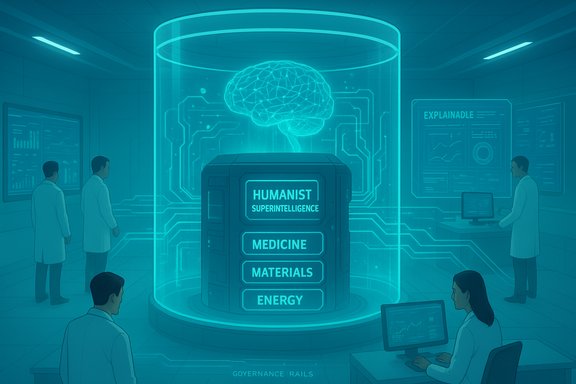
Microsoft MAI Superintelligence Team examines security and analytics on a holographic display.Background​

Microsoft’s announcement is more than a rebrand or a PR exercise: it signals a strategic pivot toward building first‑party frontier models for highly regulated, high‑impact domains while insisting the work be bounded by strong safety and governance commitments. The company frames the effort as a contrast to an unconstrained race for general artificial general intelligence; instead Microsoft proposes Humanist Superintelligence (HSI) — systems that aim for superhuman performance in specific problems without becoming open‑ended, autonomous agents. Mustafa Suleyman, who now runs Microsoft AI, laid out the approach in a public essay and accompanying announcement that described HSI as “problem‑oriented and domain‑specific” with an emphasis on containment, alignment and human control. Karén Simonyan is named as the team’s chief scientist, and Microsoft says the team will include model researchers already working across Microsoft AI. The company has not published final headcount targets for the new group.

Why this matters now​

  • Microsoft has rapidly embedded advanced generative models across Windows, Microsoft 365 and Copilot experiences. Those product integrations give Microsoft both the scale to influence design norms and the responsibility to manage safety defaults at scale.
  • The commercial and cloud context changed during 2025 as OpenAI restructured and broadened cloud relationships, creating incentives for Microsoft to regain optionality on latency, cost and data governance by building in‑house capabilities.

What Microsoft announced — the essentials​

Microsoft’s public messaging and independent reporting converge on several concrete commitments:
  • Formation of the MAI Superintelligence Team inside Microsoft AI, led by Mustafa Suleyman.
  • Public framing of the project as Humanist Superintelligence (HSI) — advanced AI systems optimized to serve human and societal priorities with constrained autonomy, auditable behavior, and explicit limits.
  • An early, stated focus on medical diagnostics and scientific domains (materials, battery chemistry, molecule discovery, fusion) where domain‑specific superhuman performance could produce measurable public benefit.
  • Karén Simonyan as chief scientist and staffing drawn from existing Microsoft AI model teams plus external recruits consistent with major lab hiring trends. Microsoft has not disclosed the team’s full scale.
These are not small product initiatives. Microsoft executives and reporting indicate an expectation of substantial investment and multi‑year timelines to deliver robust, auditable systems suitable for regulated deployments.

Technical aims: what “humanist superintelligence” looks like in practice​

Microsoft’s HSI concept emphasizes architectures and product designs that are:
  • Domain‑specialist: models trained and evaluated to deliver superhuman performance on narrowly specified scientific or clinical tasks rather than an all‑purpose intelligence.
  • Containable and interpretable: designs that favor traceable decision paths, robust failure modes, and the ability to restrict or shut down capabilities when necessary.
  • Auditable by design: engineering and governance practices that allow independent inspection of datasets, training procedures, red‑team results and real‑world performance metrics.
  • Integrated into safety‑forward product defaults: for consumer Copilot and enterprise integrations, Microsoft is doubling down on explicit memory controls, opt‑in personas and clear labeling to avoid creating systems that seem conscious. This is consistent with Suleyman’s recent public arguments about Seemingly Conscious AI (SCAI) and the “psychosis risk.”

Early target: medical superintelligence​

Microsoft has highlighted medical diagnostics as an initial domain where HSI could deliver immediate public benefit — for instance, earlier detection of preventable disease and decision support that materially improves clinical outcomes. Reporting references internal tests and a “line of sight” toward clinically relevant systems, but those performance claims are explicitly provisional: they require peer‑review, clearly documented datasets and regulatory pathways before deployment in clinical settings.

Strategy and commercial rationale​

The MAI Superintelligence Team serves at least three strategic functions for Microsoft:
  • Regain operational optionality: Build first‑party MAI models so Microsoft can route queries to models according to latency, cost and governance needs rather than rely exclusively on external providers. This reduces exposure to partner pricing or cloud selection decisions.
  • Compete where regulation matters: Offer enterprise customers models with contractual guarantees, sovereign hosting options and traceability that are attractive for regulated industries such as healthcare, finance and government.
  • Shape norms and defaults at scale: Because Microsoft powers Windows, Office and enterprise infrastructure, the company can institutionalize product choices — memory defaults, persona gating, and UI transparency — so HSI design values propagate across billions of users.
Those strategic choices come with tradeoffs: first‑party model building is capital and expertise intensive. Microsoft will need to sustain massive compute budgets, recruit specialized talent, and manage continuous model lifecycle costs to keep pace with open research and competitor releases.

Safety, governance and the “humanist” framing​

The novelty of Microsoft’s public position is not the ambition but the ethical framing. Humanist superintelligence intentionally ties capability scope to normative limits — a design stance that explicitly prioritizes human welfare and institutional accountability.
Key safety principles Microsoft emphasizes:
  • Non‑autonomy by default — do not enable open‑ended agency or unsupervised self‑improvement.
  • Clear boundaries and shutdown controls — design models and deployments with technical kill switches and provable containment guarantees where possible.
  • Transparent evaluation — publish robust evaluation protocols and enable external auditors to validate safety claims.
Suleyman has also been vocal in public about the risks of designing systems that appear conscious (SCAI). He calls for conservative defaults — opt‑in memory, non‑personified avatars, and explicit labeling — to reduce the social harms of anthropomorphism and the so‑called psychosis risk. Those product choices have direct implications for Windows Copilot UX and Microsoft’s broader product roadmap.

Why independent verification matters​

Microsoft’s promise of HSI raises a practical verification problem: claims such as “models outperform clinician groups” or “medical superintelligence is within two to three years” are consequential and time‑sensitive. They must be backed by:
  • Peer‑reviewed publications or third‑party replication studies.
  • Transparent data provenance and the ability for regulators to audit training data.
  • Published safety and failure‑mode testing results, not just internal red‑team summaries.
Until those items are public, performance claims should be treated as promising but provisional. The reporting ecosystem has already flagged this caveat.

Risks and challenges — what could derail HSI ambitions​

Building useful, safe and trustworthy HSI is technically feasible in some domains, but not without major obstacles. Key risks include:
  • Technical gaps in provable containment: current provable‑safety and verification methods are limited for large neural models; containment remains an active research frontier.
  • Regulatory uncertainty: medical diagnostics, drug discovery and other target domains fall under strict regulatory regimes. Achieving certification will require reproducible evidence, clinical trials and liability frameworks.
  • Talent and competition: rival labs (Meta, Anthropic, OpenAI and specialized startups) are aggressively recruiting frontier researchers, often with lucrative packages and research autonomy. Microsoft will need competitive structures to attract and retain top talent.
  • Cost and infrastructure: training domain‑leading models at industrial scale demands massive GPU fleets, cloud capacity and ongoing inferencing costs — a long‑term investment with uncertain near‑term ROI.
  • Market fragmentation and customer complexity: customers will face choices among OpenAI, MAI, and other providers — increasing integration work and potential lock‑in tradeoffs.
  • Social and ethical hazards from anthropomorphism: even with conservative defaults, products that incorporate voice, memory and avatars risk creating attachment and misuse among vulnerable users. Suleyman’s SCAI diagnosis is a practical attempt to surface this risk.

What it means for Windows users and enterprise customers​

For Windows and Microsoft 365 users, the new MAI work will be felt across product choices and safety defaults rather than as a single product reveal.
  • Copilot integrations may increasingly route sensitive queries to MAI‑class models when governance and provenance are required. This could improve privacy and reduce latency for enterprise deployments.
  • Expect clearer memory controls, persona gating and labeling in consumer copilots as Microsoft tries to operationalize HSI principles. These defaults will matter for classrooms, families and workplaces.
  • Enterprises operating in regulated sectors might get tailored MAI offerings with contractual SLAs, on‑prem or sovereign cloud options, and audit guarantees — but those will likely carry premium pricing and integration overhead.

Competitive landscape — how MAI shifts the field​

Microsoft’s announcement is part of an escalating industry sprint where multiple players define their own terms for “superintelligence.”
  • OpenAI continues to push toward broad AGI‑class capabilities and remains a strategic partner for Microsoft in many products even as Microsoft builds first‑party options. The corporate relationship has evolved but remains commercially central.
  • Meta, Anthropic, Safe Superintelligence labs and deep tech startups are also pursuing high‑end model research; some prioritize unconstrained capability, others explicit safety. Microsoft’s “humanist” label is a strategic differentiator meant to appeal to governments, healthcare providers and large enterprises.
This positioning creates a hybrid competitive/cooperative market: Microsoft can remain a partner to OpenAI while simultaneously building MAI models to serve specific enterprise and safety‑sensitive use cases. That split posture buys Microsoft optionality but also amplifies engineering complexity.

A practical checklist Microsoft and regulators should follow​

To turn the humanist rhetoric into durable, verifiable practice, three technical and three governance actions are essential.
  • Publish independent evaluation protocols and invite external audits for MAI models.
  • Release clinical validation data for any medical claims into peer‑reviewed literature and working registries.
  • Implement provable containment benchmarks and make red‑team results auditable by qualified third parties.
  • Create a public governance board including external safety researchers, ethicists and domain advocates to review deployments.
  • Default to opt‑in memory and persona features in consumer facing copilots; make deletion and export easy and transparent.
  • Offer sovereign cloud and on‑prem hosting options for regulated customers with explicit contractual assurances on telemetry, data retention and provenance.
These are practical, measurable steps that align with Microsoft’s stated intent and are consistent with academic and policy best practice. They also map directly to the gaps flagged by independent reporting.

Verification, caveats and what remains unverified​

Multiple high‑quality outlets and Microsoft’s own announcement corroborate the team formation, leadership and HSI framing. The key points — Suleyman’s MAI team, Karén Simonyan’s chief scientist role, the focus on medical superintelligence and the humanist design constraints — are documented in the Microsoft AI essay and independently reported by Reuters, GeekWire, The Verge and others. That said, several load‑bearing claims remain unverifiable in public at the time of the announcement:
  • Internal test results suggesting models have outperformed clinician groups are cited by Microsoft reporting but have not been published in peer‑reviewed journals or made available for independent replication. Those performance claims must be treated as provisional until published with full methodology and datasets.
  • Exact team size, budget and engineering timelines are not disclosed. The statement that Microsoft will invest “a lot of money” is plausible given the company’s scale, but precise financial commitments and ROI timelines are not publicly specified.
Where claims are currently unverifiable, the correct stance is skeptical optimism: the technical building blocks for domain‑specialist superhuman systems exist and are advancing rapidly, but independent validation and regulatory clearance are the real gates that determine whether HSI can safely move into clinical practice or other high‑stakes domains.

Conclusion​

Microsoft’s formation of the MAI Superintelligence Team and its public commitment to humanist superintelligence represents a consequential, high‑stakes bet: pursue superhuman capability where it measurably helps people, but make containment, auditability and human control non‑negotiable design requirements. That framing is novel at scale and, if operationalized, could set practical industry standards for safety‑forward advanced AI.
Success will depend on converting rhetoric into verifiable practice: publish independent evaluations, subject medical claims to peer review and regulatory processes, build auditable containment mechanisms, and sustain an open, multidisciplinary governance posture. Without those hard proofs, humanist superintelligence risks becoming a strategic positioning exercise rather than a durable model for safe, societally beneficial AI. The announcement changes the stakes for Windows users, enterprises, policymakers and competitors alike. It also raises the bar for transparency: Microsoft has set an expectation for what responsible, high‑capability AI should look like — now it must demonstrate it in the open.

Source: GeekWire Microsoft forms Superintelligence team to pursue ‘humanist’ AI under Mustafa Suleyman

 

Microsoft’s AI leadership has quietly but decisively reorganized its strategy: the company has formed an MAI Superintelligence Team, led by Mustafa Suleyman, to pursue what it calls humanist superintelligence—a program meant to deliver superhuman performance in narrowly defined domains while reducing operational dependence on external frontier models and emphasizing containment, auditability, and human control.

A futuristic lab shows a glowing brain in a cylinder labeled HUMANIST SUPERINTELLIGENCE, with scientists nearby.Background​

Microsoft AI (MAI) announced the formation of a dedicated Superintelligence Team in a public essay by Mustafa Suleyman that frames the work as Humanist Superintelligence (HSI)—advanced, domain‑specific systems designed to serve human priorities without unbounded autonomy. The announcement names medical diagnostics, materials and molecule discovery, and clean‑energy science as early priority areas and positions the new team as an intentional move toward first‑party AI capability and operational optionality. This shift is being communicated as both strategic and ethical: strategic because building significant in‑house models and dedicated training infrastructure reduces Microsoft’s dependency on any single external model provider; ethical because the company explicitly insists that the superintelligence it pursues must be containable, auditable, and aligned to human welfare. Those dual themes—self‑sufficiency and humanist guardrails—are the framing Microsoft is using to explain why it is investing heavily now.

What Microsoft actually announced​

  • Formation of the MAI Superintelligence Team inside Microsoft AI, led by Mustafa Suleyman.
  • Public adoption of the term Humanist Superintelligence (HSI) to describe the team’s mission: domain‑specialist, auditable, and contained systems.
  • Early, explicit focus on medical diagnostics and other regulated scientific tasks as areas where superhuman performance can produce measurable public benefit.
  • Naming Karén Simonyan (listed by Microsoft reporting as Karén Simonyan / Karen Simonyan) as a core scientific lead and a staffing plan drawing on existing Microsoft model teams plus external recruits.
  • Continued partnership posture toward external labs (including OpenAI) while building the internal capability to route critical workloads to MAI models for governance, latency, or cost reasons.
These announcements are corroborated by Microsoft’s public essay and multiple independent outlets; the core commitments are clear on paper, though many operational details remain undisclosed.

Why self‑sufficiency now? Strategic rationale explained​

Microsoft’s move toward greater in‑house model capability is driven by several intersecting pressures:
  • Cost and latency: Running high‑end third‑party models at Copilot scale becomes expensive and can introduce latency that degrades interactive user experiences. First‑party models can be tuned, optimized and hosted with Microsoft’s own infrastructure tradeoffs in mind.
  • Governance and data control: Regulated industries require contractible guarantees about data residency, telemetry, and auditability that are easier to deliver when models and infrastructure are directly managed by the vendor. Microsoft positions MAI as a way to offer those assurances.
  • Competitive optionality: Microsoft remains an investor and partner with OpenAI, but expanding cloud relationships and industry dynamics have made exclusive reliance risky. Building first‑party capabilities creates bargaining power and product flexibility.
  • Product leadership in regulated domains: Domains like healthcare and finance award outsized commercial and reputational value to systems that can be contractually verified to meet safety and compliance standards. Microsoft wants to own that value chain.
This is not merely a marketing move—substantial compute and recruitment commitments are required to sustain first‑party foundation models at the scale Microsoft envisions. The company’s public messaging explicitly links those investments to a bid for practical self‑sufficiency.

The technical posture: what “humanist superintelligence” means in practice​

Domain‑first, not generalist​

Microsoft’s HSI concept is deliberately domain‑specialist: the team will optimize for superhuman performance on tightly defined, regulatory‑friendly problems rather than an open‑ended AGI that generalizes across all tasks. This mirrors past industry successes where constraining the problem made breakthroughs tractable (for example, protein folding).

Containment by design​

Containment is presented as a non‑negotiable: HSI systems should be engineered with explicit runtime controls—kill switches, throttles, audit logs—and designed so outputs and decision steps are traceable and explainable to humans. Microsoft frames this as sacrificing some raw efficiency to gain interpretability and control.

Auditable pipelines and human‑centered interfaces​

The promise includes designing systems that can be externally audited and that produce human‑interpretable reasoning artifacts rather than inscrutable vector activations. Microsoft also signals product defaults—memory off by default, persona gating, and transparent labeling—aimed at reducing anthropomorphism and legal exposure.

Medical superintelligence: the big promise and the necessary caveats​

Microsoft explicitly highlights medical diagnosis as among the first domains for HSI work. The company claims internal progress in systems that can meaningfully augment diagnostic workflows—sometimes citing performance advantages in controlled tests—and insists these systems require rigorous peer review and regulatory pathways before clinical deployment. Independent reporting and press coverage have amplified a specific internal project often referenced as MAI‑DxO or an orchestrator for diagnostic reasoning. Published reports list dramatic comparative performance on curated case sets: for example, Microsoft researchers reported high accuracy on NEJM case vignettes in preprint and internal writeups discussed in media. Those findings are impressive but must be treated as provisional until they pass independent replication, peer review, and regulatory scrutiny. Key caveats for medical claims:
  • Benchmark context matters: performance on curated case sets or simulated patient vignettes does not automatically translate into safe real‑world performance across diverse hospital populations.
  • Transparency needs: for trust in clinical settings, full dataset provenance, training details, and red‑team results must be published and independently evaluated.
  • Regulatory and liability paths: medical deployment requires approvals (FDA, EMA, other regional bodies), clinical trials, and explicit liability frameworks—none of which are trivial to obtain.
Microsoft’s public messaging acknowledges these steps, but independent verification remains essential before any system can be trusted in clinical care.

Cross‑checking the claims: what’s verified and what’s provisional​

  • Verified: Microsoft has publicly announced the MAI Superintelligence Team and published a rationale for Humanist Superintelligence in a Microsoft AI blog post authored by Mustafa Suleyman. Independent outlets (Reuters, Business Insider, GeekWire, The Verge) have reported on the formation and the stated priorities.
  • Reported and plausible: Microsoft claims internal models and early projects targeting diagnostics and scientific discovery; outlets report internal tests and line‑of‑sight claims. These are plausible given recent faster progress in reasoning and multimodal AI, but they require independent replication.
  • Unverifiable or risky until published: Any statement suggesting clinical readiness or broad outperformance of clinicians should be treated as provisional until peer‑reviewed studies and regulatory clearances are visible. Microsoft’s blog emphasizes the need for external validation, which is the correct posture; however, timelines for safe deployment are uncertain.

Governance, transparency and the trust problem​

Microsoft’s “humanist” label is a meaningful attempt to place ethical constraints at the center of high‑capability AI development. But claiming ethical constraints is not the same as delivering independent oversight.
Key governance questions that will determine whether HSI is credible:
  • Will Microsoft publish rigorous evaluation protocols, red‑team results, and data provenance?
  • Will audits be third‑party and independent (academia, regulators, civil society) with meaningful access to training logs and failure modes?
  • Can Microsoft create contractual guarantees for enterprise customers and patients that are legally enforceable and technically verifiable?
  • Will product defaults (memory, persona, multimodal avatars) favor safety over engagement metrics?
The company’s public statements commit to many of these steps in principle; the practical test will be whether Microsoft invites—and sustains—independent verification at scale. Without that, “humanist” risks becoming branding rather than a durable governance practice.

Financial and operational realities: compute, talent, and tradeoffs​

Building and sustaining MAI class models at scale is capital‑intensive:
  • Compute and infrastructure: Large model training requires sustained GPU/accelerator capacity, colocated storage, and finely tuned orchestration software. Microsoft already operates massive Azure investments, but first‑party model training and inference at Copilot scale still represents a large new operational bill.
  • Talent competition: Recruiting research scientists, safety engineers, and product specialists is fiercely contested; Microsoft will need to offer not just cash, but research independence and publication opportunities to attract top talent.
  • Ongoing maintenance: First‑party models require continuous lifecycle costs—retraining to avoid drift, security patches, and operational monitoring—that compound over time.
  • Opportunity cost: Money and engineering focus allocated to MAI may slow other projects or internal partnerships; Microsoft must manage this balancing act carefully.
Those realities make transparency important: building trust with regulators and customers reduces friction and accelerates commercial pathways, which can in turn justify the heavy upfront investment.

Risks and failure modes​

  • Control and emergent behavior: There is no proven engineering technique that guarantees high‑capability models cannot develop unexpected or exploitable behaviors. Containment promises are necessary but not sufficient.
  • Regulatory blowback: Premature deployment in sensitive domains like healthcare could invite regulatory sanctions, litigation, and reputational damage if failures occur. Microsoft must avoid rushing products into clinical use without exhaustive validation.
  • Transparency vs. secrecy: Competitive pressures incentivize secrecy about training data and architectures. Excessive secrecy will erode public trust and make independent verification impossible.
  • Fragmentation for customers: A multi‑model ecosystem (OpenAI models vs. MAI models vs. third‑party models) can create complexity for enterprise customers who must choose integration and compliance routes, potentially increasing integration costs and vendor lock‑in.
  • Talent and culture frictions: Rapid hiring, poaching, or reorganizations can disrupt research productivity and create public controversies that distract from technical work.
These risks are manageable only through deliberate governance, publication of evaluation data, and staged deployment strategies that prioritize independent oversight.

What Microsoft should publish and implement—an operational checklist​

To convert its humanist rhetoric into credible practice, Microsoft should prioritize:
  • Publish reproducible evaluation protocols and release (or enable access to) benchmark datasets and red‑team results for MAI models.
  • Commission external audits by independent safety researchers, ethicists, and domain specialists (e.g., clinicians for medical applications).
  • Release peer‑reviewed clinical validation studies before any clinical deployment; engage regulators early and transparently.
  • Offer verifiable hosting options for regulated customers (sovereign cloud, on‑prem), with contract terms that lock in telemetry, retention, and audit promises.
  • Invest in formal verification and containment research and publish results, including failure mode analyses and mitigation steps.
  • Create a durable, independent governance board with real authority and a public charter to review and gate deployments.
These steps map directly to the core promises of HSI and would materially increase public trust and commercial uptake.

What this means for Windows users, enterprises, and the startup ecosystem​

  • For Windows and Microsoft 365 customers: Expect to see increased integration of first‑party MAI capabilities over time—faster Copilot responses, tighter on‑device or Azure‑hosted model routing for privacy‑sensitive tasks, and new vertical features targeted at regulated industries. However, consumers should watch default privacy settings for persistent memory and persona features.
  • For enterprises: MAI promises choices—OpenAI‑powered features where frontier capability is needed, and Microsoft‑hosted MAI models where governance, latency or cost matter. Enterprises should negotiate explicit SLAs, data controls, and audit rights before adopting high‑stakes workflows.
  • For startups and partners: Microsoft’s self‑sufficiency push will increase demand for complementary tools—data curation, interpretability tools, and regulatory compliance services. There will also be commercial opportunities for specialized model providers and federated solutions that work with MAI models.

How to read the timeline: ambition vs. deliverables​

Microsoft’s announcement sets a clear ambition: build first‑party superintelligence systems that are domain‑specialist, auditable, and human‑centric. Ambition and investment can accelerate progress, but timelines for truly trustworthy medical superintelligence or similarly sensitive products will necessarily be conservative because of validation, legal, and ethical constraints.
Short term (6–18 months): internal model training and limited pilot studies in lab settings; publication of evaluation protocols and red‑team results is plausible.
Medium term (18–36 months): peer‑reviewed clinical studies, regulatory submissions, and selective enterprise pilots if validation supports safety and efficacy claims.
Long term (3+ years): broader commercial deployments in regulated sectors if independent audits and regulators sign off.
Microsoft’s public language sometimes reads as optimistic about pace; readers should treat concrete deployment claims with a demand for published evidence first.

Conclusion​

Microsoft’s creation of the MAI Superintelligence Team and its explicit turn toward humanist superintelligence represent a consequential strategic pivot: the company is blending a bid for greater technical self‑sufficiency with an ethical framing intended to make advanced capabilities governable and societally useful. The move is sensible from a product, governance, and competitive perspective—Microsoft has the reach and resources to attempt this transition.
Yet rhetoric is not proof. The benefits Microsoft promises—medical superintelligence, auditable decision trails, and controlled deployment—will only become credible if matched by independent validation, transparent publication of datasets and evaluation protocols, and meaningful regulatory engagement. Without those steps, “humanist” risks becoming a branding exercise that paper‑covers the same secrecy and market incentives that have shaped other parts of the AI industry.
For practitioners, enterprise buyers, and regulators, the healthy posture is one of guarded optimism: applaud the explicit commitment to containment and human‑centered defaults, demand concrete evidence (peer review, audits, and regulatory approvals), and insist on contractual and technical guarantees before adopting MAI systems for high‑stakes work. Microsoft has set an expectation for what responsible, high‑capability AI should look like—now the company must show that it can meet that standard in practice.
Source: Startup Ecosystem Canada https://www.startupecosystem.ca/new...intelligence-team-to-pursue-self-sufficiency/
 

Back
Top