

Microsoft’s move to build and deploy its own large-scale AI systems marks a deliberate pivot: after years of deep product integration with OpenAI, the company has begun rolling out MAI-Voice-1 and MAI‑1‑preview as part of a broader plan to cut operational costs, increase product control, and diversify the model supply powering Copilot and other consumer experiences. The launches — first revealed publicly in late August 2025 — are concrete evidence that Microsoft intends to be both partner and competitor in the generative-AI era, and they raise immediate questions about cost, performance, governance, and the future balance between in‑house models and third‑party suppliers.
At scale, however, the arrangement exposed Microsoft to: higher per‑inference costs, vendor concentration risk, and limited ability to finely tune model behavior for tightly scoped, latency‑sensitive enterprise tasks. Those pressures, combined with a broader industry shift to multi‑model strategies, have prompted Microsoft to accelerate investment in internal model development and a multi‑supplier architecture. This strategic rethink appears intended to protect product economics and product roadmaps while preserving access to frontier capabilities where OpenAI or other labs remain best‑in‑class.
We should, however, resist two narratives. First, this is not an overnight replacement of OpenAI in Microsoft products — the company is explicit about a blended approach. Second, vendor performance claims are meaningful but incomplete without open, reproducible evaluations; independent benchmarking and careful governance will decide whether MAI models can deliver on their promises at Microsoft scale.
Community commentary and forum threads already show both excitement and caution, mirroring the balanced view the technology itself deserves: this is a long game. Microsoft’s ambitions are real, and the first MAI releases are an important step — but success will be measured in durable, verifiable outcomes for users, not in vendor press releases.
Source: Windows Report https://windowsreport.com/microsoft-moves-to-reduce-openai-reliance-with-in-house-ai-push/
 Background
A decade of partnership turned strategic tension
Microsoft’s relationship with OpenAI has been one of the defining strategic bets of the cloud era: heavy investment, commercial licensing, and product integrations that elevated Microsoft 365, Bing, GitHub, and developer tools with state‑of‑the‑art LLM capabilities. Over time that alliance created deep technical and commercial coupling: Copilot and Bing Chat relied heavily on OpenAI’s frontier models, even as Microsoft supplied the cloud compute and distribution channels that made those models product‑grade.At scale, however, the arrangement exposed Microsoft to: higher per‑inference costs, vendor concentration risk, and limited ability to finely tune model behavior for tightly scoped, latency‑sensitive enterprise tasks. Those pressures, combined with a broader industry shift to multi‑model strategies, have prompted Microsoft to accelerate investment in internal model development and a multi‑supplier architecture. This strategic rethink appears intended to protect product economics and product roadmaps while preserving access to frontier capabilities where OpenAI or other labs remain best‑in‑class.
The announcement and timing
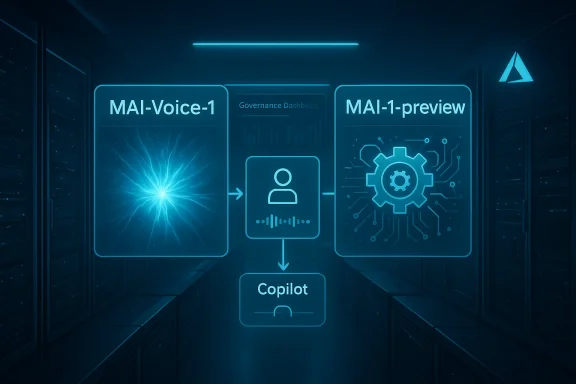
In August 2025 Microsoft publicly introduced two in‑house models: MAI‑Voice‑1, a highly efficient speech generation model already used in features such as Copilot Daily and podcast‑style explanations; and MAI‑1‑preview, a text foundation model designed for instruction following and consumer‑facing Copilot interactions. Microsoft published these as part of the emerging “MAI” family under the Microsoft AI organization led by Mustafa Suleyman. The company framed the releases not as an immediate replacement for OpenAI across the board, but as the opening moves in a long‑term plan to orchestrate specialized systems across use cases.What Microsoft announced — the technical claims
MAI‑Voice‑1: speech at GPU speed
Microsoft claims MAI‑Voice‑1 can synthesize a full minute of high‑fidelity audio in under one second on a single GPU, a benchmark that emphasizes inference efficiency for audio generation tasks. The model is already in limited product use within Copilot features and exposed to users through Copilot Labs for experimentation. Multiple outlets corroborated this specific performance claim, which Microsoft itself highlighted in public materials.MAI‑1‑preview: a foundation model trained at scale
The company said MAI‑1‑preview was trained on approximately 15,000 Nvidia H100 GPUs, a substantial but deliberately smaller training footprint than certain rivals’ headline numbers. Microsoft described MAI‑1‑preview as an instruction‑following model optimized for consumer Copilot scenarios; it has been made available for public benchmarking on platforms such as LMArena and was reported to rank around the mid‑teens in LMArena’s text leaderboards at initial release. Several independent reports and machine‑learning observers confirmed the 15,000‑H100 training figure and the LMArena placement, giving the claim cross‑validation across industry press.Cross‑checking the claims
- The 15,000 H100 figure appears in Microsoft’s public descriptions and was repeated by technical reporters at Ars Technica and Engadget; those articles cross‑referenced LMArena evaluations.
- The “1 minute of audio in <1 second on one GPU” metric for MAI‑Voice‑1 is likewise reported by major outlets including The Verge and Ars Technica. While this is an impressive latency/throughput claim, it is worth noting that such numbers depend heavily on prompt length, bitrate, sample rate, GPU generation, model size, and measurement methodology; those fine details were not exhaustively published with the announcement. Readers should therefore treat the metric as a vendor‑reported performance figure rather than a fully auditable benchmark.
Why Microsoft is doing this: strategy and economics
The business case
Microsoft’s pivot toward in‑house models is driven by a stack of interlocking commercial imperatives:- Cost control: Running tens of millions of enterprise inference calls on frontier LLMs is expensive. Smaller, task‑tuned models can deliver most of the day‑to‑day value for Copilot at far lower cost per request.
- Product control and customization: Owning the models allows Microsoft to tune outputs to Office workflows, enterprise security standards, and localized compliance requirements.
- Resilience and negotiating leverage: A diversified supplier base — internal models plus Anthropic, OpenAI, and others hosted through Azure — reduces single‑vendor risk and improves Microsoft’s bargaining position.
- Latency and scale: Models designed specifically for narrow productivity tasks can be engineered to meet service‑level expectations at scale.
A staged approach, not an immediate divorce
Crucially, Microsoft has not signaled an immediate severing of ties with OpenAI. Instead, the company appears to be complementing its existing access to frontier models with internal models tailored to high‑volume, cost‑sensitive use cases. This blended approach allows Microsoft to preserve access to the most capable external models for the hardest problems while shifting routine workloads to cheaper, faster in‑house systems. That nuance matters for product continuity and regulatory optics.Product implications: Copilot, Windows, Azure and enterprise customers
Copilot becomes multi‑model and multi‑tiered
Expect Copilot to evolve into a multi‑model orchestration layer: calls that require the highest reasoning or creativity will continue to route to the most capable frontier models (including OpenAI where it remains best‑in‑class), while routine summarization, formatting, code completion, or speech generation work will often be handled by MAI family members or specialty models. For enterprise IT admins, that means more configuration choices — and new policy surface for governance.Azure’s pricing and competitive positioning
If Microsoft can repeatedly demonstrate significantly lower cost‑per‑inference using internal models, Azure customers could see total cost of ownership benefits when building AI‑enabled apps. At the same time, Microsoft’s ability to host third‑party weight files and models continues to be a selling point: customers can pick models that trade off price, latency, and capability as they choose. This positions Azure as both a model marketplace and a vertically integrated platform.Developer and partner impacts
Independent developers and ISVs will need to design for a heterogeneous model environment. That raises engineering complexity (model selection, API compatibility, version drift), but it also opens opportunities: developers can target cheaper on‑prem or Azure‑hosted MAI endpoints for high‑volume tasks while falling back to frontier APIs for premium features.Strengths of the in‑house push
- Cost efficiency: Smaller task‑tuned models frequently deliver most of the business value of a general‑purpose LLM at a fraction of the compute cost.
- Product fit: Microsoft can optimize models for Office workflows, multilingual enterprise needs, and specific latency/throughput targets.
- Data control and compliance: Processing sensitive corporate data inside Microsoft’s stack reduces third‑party data‑sharing concerns for regulated industries.
- Supply‑chain resilience: Diversifying away from a single external supplier lowers operational and geopolitical risks.
Risks, unknowns and governance concerns
Technical and model quality risks
- Capability gap: Frontier models trained by specialist labs still lead on many hard benchmarks. Reaching parity across the full spectrum of tasks — creative writing, multi‑step reasoning, and advanced code synthesis — will take time and may not always be economical. Microsoft’s early LMArena placement for MAI‑1‑preview sits in the mid‑tier initially, which is credible evidence both of progress and of remaining gaps.
- Evaluation opacity: Vendor‑reported metrics and selective benchmarks are useful but insufficient. Precise evaluation methodology (datasets, prompt suites, temperature settings) matters enormously when judging cross‑model claims; Microsoft’s public statements did not publish full reproducible benchmark details at announcement time. Treat product claims cautiously until independent researchers publish reproducible evaluations.
Business and partner risk
- Partner friction: Microsoft’s pivot could strain its commercial relationship with OpenAI over time. The two firms remain closely aligned today, but competition in overlapping product segments is a nontrivial strategic tension. Some industry observers have already noted this dynamic.
- Pricing and customer confusion: Customers may face complexity configuring which model family they want for given workloads — and inconsistent quality across model classes may produce uneven user experiences. Microsoft must make orchestration seamless to win broad adoption.
Safety, privacy, and regulatory exposure
- Provenance and auditing: When Microsoft runs a mix of internal and third‑party models, maintaining consistent provenance metadata and audit trails across calls is difficult but necessary for compliance. Enterprises want to know which model produced an output, what data it saw, and whether it retained user content. Microsoft must adapt Copilot’s administration surface to provide that transparency.
- Model governance: Smaller, specialized models can be easier to constrain, but they can still hallucinate, leak proprietary training data, or exhibit bias. Microsoft will need strong evaluation suites, red‑team testing, and post‑training mitigations — the company has acknowledged these needs but has not published exhaustive technical details for MAI at launch.
Community reaction and enterprise chatter
Windows‑focused communities and enterprise IT forums reacted swiftly, with many administrators welcoming the potential for lower Copilot costs and tighter data controls, while others cautioned that the transition will be uneven and that Microsoft must avoid a multi‑model maze that complicates administration. Community threads highlight practical questions — migration paths, admin controls, and how licensing/pricing will change for customers currently paying for Copilot features. These community conversations underscore an important reality: product announcements matter, but adoption will hinge on documentation, tooling, and predictable economics.What to watch next (practical checklist for IT leaders and product teams)
- Track Microsoft’s staged rollouts for MAI models into Copilot features; initial deployments will likely be selective and conservative.
- Demand reproducible benchmarks and third‑party evaluations before committing mission‑critical workloads to a new model family.
- Insist on model provenance and audit logs in admin consoles to support compliance reviews and incident response.
- Pilot mixed‑model designs: route routine summarization to cheaper in‑house models and reserve high‑stakes calls for frontier partners.
- Negotiate flexible licensing: ensure contracts allow switching models or changing routing rules as Microsoft’s MAI family evolves.
Regulatory and competitive implications
Antitrust and market concentration dynamics
Microsoft’s dual role as cloud provider, model developer, and integrator changes the competitive landscape. Regulators may look at whether in‑house models plus platform distribution give Microsoft an unfair advantage over rivals that must license external weights or build heavier infra stacks. Conversely, Microsoft’s push could be framed as healthy competition that reduces concentration around any single model supplier.Geopolitics and data sovereignty
Having in‑house models that can be hosted regionally gives Microsoft more flexibility for customers with strict data‑residency requirements. But it also raises questions about cross‑border model training, data lineage, and export controls for advanced AI capabilities.Verdict: pragmatic independence more than dramatic break
Microsoft’s MAI announcements are consequential but not abrupt. They signal a deliberate, pragmatic shift toward building a layered, multi‑model product architecture — one that favors internal economics and product fit for routine tasks while preserving access to frontier capabilities where required. For enterprises and developers, the near future will be defined by experimentation: testing cost/performance tradeoffs, reworking orchestration layers, and demanding stronger model governance from vendors.We should, however, resist two narratives. First, this is not an overnight replacement of OpenAI in Microsoft products — the company is explicit about a blended approach. Second, vendor performance claims are meaningful but incomplete without open, reproducible evaluations; independent benchmarking and careful governance will decide whether MAI models can deliver on their promises at Microsoft scale.
Conclusion
Microsoft’s launch of MAI‑Voice‑1 and MAI‑1‑preview marks an important, inevitable chapter in the evolution of corporate AI strategy: platform owners are moving to own more of the model stack to optimize cost, control product behavior, and offer differentiated value to customers. That shift brings tangible benefits — lower operational cost, better product tuning, and improved data locality — but it also introduces new technical and governance responsibilities. For CIOs, product leads, and administrators, the ruling question is simple: will Microsoft make multi‑model orchestration straightforward, auditable, and predictable? If it does, the market will gain a more resilient set of AI options. If it doesn’t, Microsoft risks replacing one set of complexities with another.Community commentary and forum threads already show both excitement and caution, mirroring the balanced view the technology itself deserves: this is a long game. Microsoft’s ambitions are real, and the first MAI releases are an important step — but success will be measured in durable, verifiable outcomes for users, not in vendor press releases.
Source: Windows Report https://windowsreport.com/microsoft-moves-to-reduce-openai-reliance-with-in-house-ai-push/
