Microsoft Leadership Shift: Rajesh Jha Retirement and AI First Reorg

  • Thread Author
Rajesh Jha’s announced departure — described in an internal memo circulating this morning — marks what would be one of the most consequential leadership transitions in Microsoft’s modern history: after 35 years at the company, the executive who presided over Office, Windows, Surface and the company’s device strategy is said to be retiring effective July 1, 2026, and the change is being used as the lever for a broad reorganization designed to accelerate AI-first execution across Windows, Microsoft 365 and Surface hardware.

Four professionals stand around a neon AI brain hologram with Copilot and Surface logos.Background / Overview​

Rajesh Jha rose through Microsoft’s ranks over a multi‑decade career that touched many of the company’s most strategic product lines. As Executive Vice President of Experiences + Devices, Jha has been the executive glue between Windows, Office (Microsoft 365), collaboration services and device engineering — a grouping that once again puts the user experience at the center of Microsoft’s product priorities. That cross‑product span made Jha one of the most influential operating executives under CEO Satya Nadella.
The memo obtained by the reporting that first surfaced this morning proposes a flatter leadership structure: four leaders who previously reported into Jha’s organization would report directly to Nadella, and a set of internal promotions would create new EVP and President roles intended to speed AI integration across Microsoft’s core client surfaces. The reported transition window runs through June 2026, with Jha staying on in an advisory capacity after his formal retirement date.
This article summarizes the reported changes, cross‑checks what can be independently validated, analyzes the strategic reasoning behind the move, and outlines the business, product and operational risks that lie ahead if Microsoft executes on the plan described in the memo.

What the internal memo reportedly says​

  • Rajesh Jha will retire effective July 1, 2026, and remain available as an advisor for a transition period.
  • Microsoft will reorganize the Experiences + Devices leadership so that four leaders — Perry Clarke, Charles Lamanna, Pavan Davuluri, and Ryan Roslansky — report directly to CEO Satya Nadella rather than through Jha’s organization.
  • The company is promoting from within: Jeff Teper is elevated to Executive Vice President (role focused on collaboration and productivity platforms) while Sumit Chauhan and Kirk Koenigsbauer are promoted to President roles responsible for specific product groups.
  • The transition will run through June and include a full cascade of operational details: clarified decision ownership, aligned operating rhythms, and restructured teams ahead of fiscal year 2027.
  • The stated purpose: to push decision‑making closer to the CEO and accelerate integration of AI capabilities across Windows, Office and Surface hardware.
Those are the core claims reported in the memo. Where possible, the specifics above are cross‑checked against publicly available signals and Microsoft’s recent strategic moves; when a claim cannot be corroborated by multiple independent outlets or official Microsoft communications, it is explicitly noted as unverified below.

Why Microsoft would do this now: strategy and timing​

The AI imperative is reshaping Microsoft’s product structure​

Microsoft’s public roadmap for 2024–2026 has been dominated by one theme: putting large language models, on‑device neural processing and contextual AI into the products customers use every day. From Copilot/365 Copilot features in Office to Copilot+ PCs with NPUs and surface‑level AI experiences in Windows, Microsoft has invested heavily in blurring the lines between cloud AI and device intelligence.
A flatter org that brings Windows, Office and Surface decision‑makers closer to the CEO shortens the chain of execution for cross‑product AI initiatives. When product features depend on co‑engineering across silicon partners, OEMs, the Windows platform and cloud‑hosted models, central coordination becomes less an administrative nicety and more a strategic necessity.

Faster decisions, tighter co‑engineering with chip and OEM partners​

The last two years have shown that successful AI features often require synchronized releases across hardware, firmware, drivers, OS subsystems and cloud models. Microsoft’s collaboration with chip vendors to ship Copilot+ PCs (NPU‑driven machines with on‑device inference) is a prime example: product timelines, performance tuning and security claims hinge on intimate coordination between Microsoft and silicon vendors. Flattening reporting may be intended to reduce friction in those co‑engineering cycles.

A leadership signal about revenue focus and product bets​

Elevating leaders from the collaboration and productivity side — notably Jeff Teper in the reported memo — signals where Microsoft expects growth and margin expansion: enterprise collaboration, Teams, SharePoint and the Microsoft 365 Copilot experience remain massive, recurring revenue engines. Making collaboration platforms a central strategic pillar aligns incentives for product integration, licensing, and commercial motion.

What is verifiable today — and what remains unconfirmed​

What we can verify with confidence:
  • Microsoft has been actively embedding AI across Windows, Microsoft 365 and Surface devices. The company’s Copilot initiatives, Copilot+ PC partnerships with silicon vendors, and Windows on‑device AI efforts are publicly documented and reflect a multi‑year investment to bring on‑device and cloud AI together.
  • Pavan Davuluri has a visible leadership role tied to Windows + Devices and has been the public face for Copilot+ PC and Windows AI experiences. The consolidation of Windows engineering and hardware teams under a single Windows + Devices leader has been a recurring theme for Microsoft in recent years.
  • Ryan Roslansky — LinkedIn’s CEO — has previously been given product responsibilities that touch Microsoft’s productivity suite in past reorganizations; larger role expansions in 2025‑style shuffles have precedent.
  • Jeff Teper currently heads Microsoft’s collaborative product portfolio (Teams, SharePoint, OneDrive) and is widely recognized as a core leader on collaboration products.
What is not independently confirmed as of this writing:
  • The memo’s central factual claim that Rajesh Jha will retire effective July 1, 2026 is not yet corroborated by an official Microsoft press release or widespread coverage across major outlets at the time of publication. The primary source for this claim appears to be the internal memo cited by the initial report.
  • The precise personnel moves and titles described — for example, Jeff Teper’s elevation to Executive Vice President, and Sumit Chauhan and Kirk Koenigsbauer’s promotions to President roles — have not been broadly confirmed through company announcements or regulatory filings available today.
  • The claim that Perry Clarke, Charles Lamanna, Pavan Davuluri, and Ryan Roslansky will all report directly to Satya Nadella — while plausible in the context of a flattening — remains a reported memo detail rather than an independently verifiable corporate governance filing.
Because major corporate leadership changes at Microsoft typically generate press releases, SEC filings or multiple independent reports, the absence of broad confirmation suggests either the memo is very new and still circulating internally or some details are tentative. The responsible reader should treat the reported memo as a credible internal leak until Microsoft confirms the changes publicly.

Tactical and product implications if the reported reorg is real​

For Windows and Surface hardware​

  • Expect an accelerated timeline for Copilot‑centric Windows features that require tight hardware dependencies (speech, Recall‑like features, visual search, NPU offload). With Windows and device engineering reporting closer to the CEO, resource prioritization could favor features that showcase on‑device AI.
  • OEM OEM/OEM partner relationships may be re‑negotiated or re‑prioritized to favor devices that hit Microsoft’s NPU and telemetry standards for Copilot+ experiences.
  • Firmware, driver and Windows servicing timelines could compress: higher‑level alignment reduces the number of internal approval gates that previously slowed coordinated releases.

For Microsoft 365, Teams and productivity​

  • Elevating collaboration leaders (if Jeff Teper’s promotion is finalized) would likely intensify product work to integrate AI features into Teams, SharePoint and the core Office apps, accompanied by new enterprise licensing and Copilot monetization strategies.
  • A closer relationship between LinkedIn and Office under a common leadership umbrella — if Ryan Roslansky’s expanded role persists — would create product integration opportunities (contextual profiles, recruiter workflows, professional insights inside Office), but also raises questions about focus and bandwidth for LinkedIn’s standalone roadmap.

For enterprise customers and IT administrators​

  • Expect more enterprise features tied to Copilot licensing and device hardware classes. IT procurement cycles may need to consider Copilot+ hardware compatibility, NPU availability and licensing implications when planning refreshes for FY27 budgets.
  • Admin tooling, security policies and privacy controls will need to evolve as on‑device AI features proliferate; customers should demand clarity on data residency, telemetry, and model governance.

People and culture: who’s well‑placed and where the gaps show up​

  • Jeff Teper brings deep institutional knowledge of collaboration services and productized cloud features; his track record on Teams and SharePoint gives him credibility to lead a monetization push around collaboration and Copilot features.
  • Pavan Davuluri is positioned to shepherd the Windows + Devices roadmap; his hardware experience and public role in Copilot+ PC initiatives make him the natural choice to unify hardware, OS and on‑device inference.
  • Ryan Roslansky’s dual responsibilities (if continued) create both opportunity and friction. His LinkedIn background is product heavy, but running LinkedIn while taking on full Office oversight raises questions about operational bandwidth and potential conflicts between LinkedIn’s platform strategy and Office product priorities.
  • Sumit Chauhan and Kirk Koenigsbauer (if promoted to President roles) are seen inside Microsoft as technical operators who can drive product execution; however, the elevation of more presidents within a single product cluster increases the need for clear role boundaries to prevent duplication and internal turf battles.
Culturally, any rapid flattening of senior leadership can produce ambiguity in the middle layers. The memo claims the company will “minimize changes” and preserve momentum, but practical realities — reporting line reshuffles, reassigned direct reports, and new operating rhythms — will require disciplined communication and change management to avoid churn.

Strategic risks and regulatory considerations​

  • Execution risk: reorganizations at scale often introduce short‑term productivity drops. Engineering teams spend cycles adjusting to new leaders and priorities; in the short term, feature velocity can dip while alignment ramps back up.
  • Product quality and trust: Microsoft’s recent AI‑first rollouts have already encountered user pushback on reliability and privacy. Pushing faster without restoring trust fundamentals (performance, update stability, privacy guarantees) could erode enterprise goodwill.
  • Dual‑role conflicts: executives with dual responsibilities (for example, LinkedIn + Office) increase the likelihood of resource conflicts and strategic tradeoffs that are not always visible to customers or investors.
  • Regulatory scrutiny: deeper coupling between LinkedIn, Office and AI features invites regulatory attention around data sharing, antitrust concerns and digital sovereignty — especially in jurisdictions with strict data protection regimes.
  • Dependency on external models and capital: Microsoft’s AI pivot depends on significant compute infrastructure, partnerships with OpenAI and other model vendors, and chip ecosystem cooperation. Any disruption in those dependencies — technical, commercial or diplomatic — will have outsized impact on the product plans that the new org is expected to deliver.

What this means for Microsoft’s competitors and the market​

  • A concentrated push to integrate AI across client surfaces could intensify competition with Google and Apple on the desktop and productivity front. Both rivals are also betting heavily on AI for productivity and user assistance, making rapid execution on Microsoft’s part necessary to maintain its lead in enterprise install base.
  • Hardware differentiation matters again: if Microsoft uses Surface and Copilot+ certification as a lever to define the premium AI experience on Windows, OEMs that can meet the NPU and firmware expectations will capture more enterprise refresh cycles.
  • For enterprise buyers, the tradeoff will become clearer: pay for Copilot‑enabled experiences and newer hardware for greater productivity vs. stable, well‑tested platforms that delay AI features for reliability.

Practical guidance for IT leaders, developers and OEM partners​

  • IT leaders: start inventorying devices for Copilot+ compatibility and NPU presence. Build a migration plan that balances the productivity upside of AI features against potential stability and privacy concerns.
  • Developers: anticipate deeper integration points (on‑device APIs, Copilot runtime, and AI‑enabled Office extensibility). Plan for test harnesses that measure determinism, latency and privacy constraints for user‑facing AI features.
  • OEMs and silicon partners: prioritize reliable NPU drivers, firmware‑level security, and deterministic performance for on‑device inferencing. Close coordination windows with Microsoft will likely tighten; be ready to accelerate co‑engineering timelines.
  • Security and compliance teams: insist on clear telemetry contracts, local data processing guarantees and opt‑out pathways for sensitive workloads. The privacy posture of on‑device agents must be auditable and configurable for regulated industries.

A cautious, evidence‑based take​

If the memo’s claims are accurate, Microsoft is staging a deliberate succession that simultaneously simplifies reporting and concentrates AI product authority closer to Satya Nadella. That tradeoff — faster strategic alignment at the cost of more centralized decision control — makes sense given the technical complexity of delivering integrated AI experiences across cloud, OS and silicon.
However, the most important caveat is this: critical details in the memo remain unconfirmed through independent public channels at the time this article was prepared. Major corporate moves at firms the size of Microsoft typically generate multiple public notices, regulatory filings or corroborating reporting from independent outlets. The absence of those signals means readers should treat the memo as a plausible internal roadmap rather than a final, corporate fact.

What to watch next (timeline and indicators)​

  • Official Microsoft statement: a formal company announcement or a post on Microsoft’s corporate blog would convert the memo from an internal plan to public fact.
  • SEC/filing updates: executive role changes that affect compensation or governance sometimes trigger disclosures; investors will scrutinize filings for evidence of permanent restructurings.
  • Leadership communications: internal emails or public posts from the named executives (Teper, Davuluri, Roslansky, Jha) frequently appear on personal channels and will clarify intentions and role scope.
  • Product cadence signals: watch the Windows Insider channels, Microsoft 365 roadmap, and OEM press kits for accelerated or aligned feature timelines that reflect tighter cross‑product execution.
  • Partner briefings: chip vendors and OEMs will update their press material if the reorg materially changes co‑engineering expectations for Copilot+ devices.

Final assessment​

This reported transition — if executed as described — is more than a personnel change. It is an organizational bet that centralized strategic control, reduced managerial layers and elevated collaboration leadership will accelerate Microsoft’s ability to ship AI‑first features across Windows, Office and Surface. That bet follows logically from how AI features are engineered: they require cross‑discipline work between models, platform code, drivers and hardware.
But organizational bets carry the well‑known twin risks of execution drag and cultural fallout; Microsoft will need to guard against both by keeping product quality, security, and enterprise trust front and center. For customers, partners and employees, the near term will be about watching how the company converts memo language into concrete product and operational changes — and whether the promised benefits show up in day‑to‑day stability, security and usefulness.
Finally, because the most consequential factual claim in the memo — Rajesh Jha’s retirement effective July 1, 2026 — is not yet fully corroborated by public Microsoft communications at the time of writing, readers should monitor official company channels for confirmation before treating the reported promotions and reporting lines as finalized. If confirmed, this will be one of the most significant leadership reorganizations in Microsoft’s recent era and will materially shape the company’s AI‑driven product strategy heading into fiscal year 2027.

Source: The Tech Buzz https://www.techbuzz.ai/articles/microsoft-evp-rajesh-jha-retires-after-35-years/
 

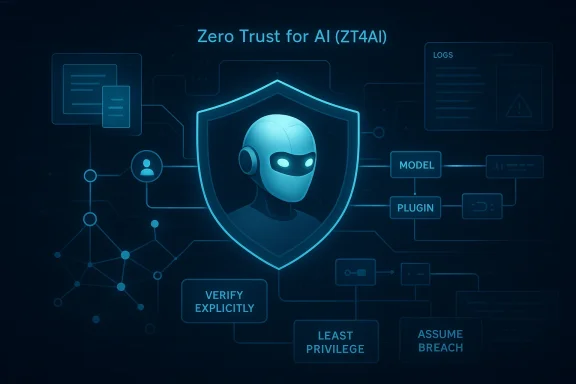
Over the past year, Microsoft has been quietly but steadily reframing Zero Trust for an AI-first world, and the company’s new guidance makes that shift explicit. With Zero Trust for AI (ZT4AI), Microsoft is extending familiar security doctrine into the messy reality of models, agents, prompts, plugins, data pipelines, and autonomous workflows. The message is simple but consequential: if AI systems are now making decisions, touching sensitive data, and acting on behalf of users, then they must be governed as rigorously as any other privileged workload.

Cybersecurity graphic showing a masked AI inside a shield with “Zero Trust for AI (ZT4AI)” text.Background​

Zero Trust has long been one of the most durable ideas in enterprise security because it replaces implicit confidence with continuous verification. Microsoft’s own Zero Trust workshop originally centered on the classic secure access pillars—identity, devices, and data—before expanding in mid-2025 to include networking, infrastructure, and SecOps. That expansion signaled an important shift: Zero Trust was no longer just about access control at the perimeter, but about the full operating model of a modern security program. (microsoft.com)
The new AI announcement builds directly on that foundation. Microsoft is not inventing a separate security philosophy for AI so much as arguing that AI changes the surface area of every existing Zero Trust question. Who is asking for access? What is being accessed? Can the request be trusted? What happens if the request is malicious, manipulated, or simply too broad? Those questions become more urgent when the “user” may be an agent, the “action” may be autonomous, and the “resource” may be a model-connected system with production privileges.
That framing fits Microsoft’s broader security narrative in 2026. In January, the company’s identity and network access guidance already urged customers to manage, govern, and protect AI and agents, and to extend Zero Trust “everywhere” through a more integrated access fabric. In other words, ZT4AI is not a one-off marketing overlay; it is the next step in a longer attempt to unify identity, network, data, and operational controls under a single policy model. (microsoft.com)
It also fits Microsoft’s Secure Future Initiative, which launched in November 2023 as a multiyear effort to secure the way Microsoft designs, builds, tests, and operates its products and services. Microsoft Learn describes SFI as a program that applies security principles across engineering pillars through processes, standards, and continuous improvement. The new AI guidance borrows that same operational logic: don’t just tell people to be careful with AI; give them a structured way to evaluate, implement, and measure the controls. (learn.microsoft.com)
The timing matters, too. Microsoft is unveiling ZT4AI just days before RSAC 2026, where the company is already scheduled to lead multiple AI security sessions focused on agentic AI, visibility, governance, and threat acceleration. That suggests Microsoft sees AI security as a mainstream boardroom issue, not an experimental side topic. It also means the company is trying to shape the market conversation before competitors and customers settle on their own AI governance patterns. (microsoft.com)

What Microsoft is actually announcing​

The core of the announcement is not a single product but a bundle of tools and guidance. Microsoft is adding an AI pillar to the Zero Trust Workshop, expanding the Zero Trust Assessment tool with new Data and Networking pillars, introducing a Zero Trust reference architecture for AI, and publishing practical patterns and practices for securing AI at scale. In plain English, Microsoft is trying to turn “Zero Trust for AI” from a slogan into an operational playbook.
What stands out is the emphasis on sequencing. Microsoft is not merely asking customers to buy new software. It is presenting a path from strategy → assessment → implementation, which is often the hardest part of any security transformation. That matters because AI adoption is frequently happening faster than governance can keep up, and many organizations still struggle to answer basic questions like which AI services are in use, who owns them, and what data they are allowed to touch.

The new AI pillar in the workshop​

Microsoft says the workshop now covers 700 security controls across 116 logical groups and 33 functional swim lanes. Those numbers matter less for their own sake than for what they imply: the company is treating AI security as a broad program spanning access, monitoring, data protection, compliance, and incident response rather than a narrow model-hardening exercise. The AI pillar evaluates how organizations secure AI access and agent identities, protect sensitive data used by and generated through AI, monitor AI usage and behavior, and govern AI responsibly.
The workshop remains scenario-based and prescriptive, which is the right design choice for a topic this fluid. Security teams do not need more theory about why AI can be risky; they need concrete, staged guidance that maps to actual deployments. By positioning the workshop as a bridge between assessment and execution, Microsoft is acknowledging that the hardest problem is not awareness but execution at enterprise scale.

Data and Networking in the assessment tool​

The assessment side of the announcement is equally important. Microsoft is adding Data and Networking pillars to the Zero Trust Assessment, which previously centered on identity and devices. That is a notable change because AI security failures often involve data leakage or control-plane blind spots rather than a simple compromised login. If an agent can retrieve sensitive records, send them over a network path, or act on a manipulated prompt, then identity-only controls are obviously insufficient.
Microsoft says the assessment is informed by NIST, CISA, CIS, its own Secure Future Initiative learnings, and customer implementation experience. That mix is smart because it gives the tool credibility while keeping it grounded in field reality. The company also says a dedicated AI pillar for the assessment is in development and expected in summer 2026, which suggests this release is a staging point rather than the final destination.
  • The assessment is being widened from access-centric controls to data and network resilience.
  • Microsoft is using industry standards and its own SFI experience to shape the control set.
  • A future AI-specific assessment pillar is already on the roadmap.
  • The goal is to reduce manual, error-prone review work for security teams.

Why Zero Trust needs an AI-specific extension​

AI systems introduce trust problems that traditional infrastructure did not have to solve in the same way. A human user can be challenged with MFA, conditional access, device compliance, and role-based permissions. An agent, however, may request access dynamically, carry context across tasks, invoke tools, and make decisions at machine speed. That changes the security posture from “who is logged in?” to “what is this system allowed to do right now, and how do we know it is still behaving properly?”
Microsoft’s framing around verify explicitly, apply least privilege, and assume breach is sensible precisely because it applies to these new realities without inventing a separate doctrine. The company is arguing that the old principles still work, but only if they are enforced against agents, prompts, plugins, model endpoints, and data sources as well as humans. That is a subtle but important shift.

Verify explicitly in AI environments​

The first principle, verify explicitly, becomes more complicated with AI because “identity” is no longer a simple user login. Security teams now need to evaluate the identity and behavior of AI agents, workloads, services, and the humans who orchestrate them. A well-authenticated agent can still be dangerous if it is misconfigured, over-scoped, or tricked by a malicious prompt.
This is where continuous evaluation matters. A one-time approval at deployment is not enough when the system’s behavior can change due to new tools, new data, or new instructions. Microsoft’s guidance implies that AI trust must be dynamic, not static, which is exactly the sort of operational nuance that many governance programs miss on the first pass.

Least privilege for agents and tools​

The second principle, least privilege, is the one most organizations will struggle to implement well. AI systems tend to be designed for convenience, and convenience usually pushes teams toward broad permissions so the assistant “just works.” But broad permissions become dangerous fast when the assistant can read mail, query databases, summarize documents, or trigger workflows. The announcement’s insistence on restricting access to prompts, plugins, and data sources is therefore not cosmetic; it is a direct response to overprivileged automation.
A healthy AI security posture will almost certainly require permission boundaries that are finer than traditional app roles. That may mean separate scopes for retrieval, execution, export, and escalation. It may also mean explicit approval flows for higher-risk actions. In practice, least privilege for AI will likely become more operationally demanding than least privilege for humans.

Assume breach in a prompt-driven world​

The third principle, assume breach, is especially relevant for prompt injection, data poisoning, and lateral movement. AI systems ingest more content from more places than conventional applications, which means the attack surface is partly semantic, not just technical. An attacker may not need to compromise an endpoint if they can influence the instructions, data, or context fed into the agent.
That is why Microsoft’s language about resilience is so important. The goal is not perfect prevention; it is to make AI systems harder to manipulate, easier to contain, and more observable when something goes wrong. In other words, the security model must assume the model can be fooled.
  • Verify explicitly must include agent identity and runtime behavior.
  • Least privilege must extend to tools, prompts, and connected data.
  • Assume breach means planning for prompt injection and poisoned inputs.
  • AI trust should be continuous, not only at onboarding.

The reference architecture and why it matters​

Reference architectures often sound dry, but they are one of the most useful things vendors can publish when a technology is moving quickly. Microsoft’s Zero Trust for AI reference architecture is meant to show how policy-driven access controls, continuous verification, monitoring, and governance fit together around AI systems. That matters because many organizations are still trying to stitch these controls together from disconnected teams and products.
The value here is the shared mental model. Security, IT, and engineering teams rarely fail because they all disagree on the concept of security; they fail because they interpret the system differently. One team sees access control, another sees data flow, and a third sees application logic. A good reference architecture forces those views into one map.

A shared model for policy and trust boundaries​

The biggest contribution of the architecture is probably its emphasis on trust boundaries. AI systems create new boundaries between humans and agents, agents and models, models and data, and internal systems and external services. If those boundaries are not identified clearly, policy enforcement becomes inconsistent and the organization ends up with security by exception rather than security by design.
That is why policy-driven controls are so central. In an AI environment, the more decisions that can be standardized and enforced centrally, the less risk of drift across teams. It is a boring but powerful point: enterprise security wins when the architecture makes the secure choice the easy choice.

Defense in depth for agentic workloads​

Microsoft is also right to emphasize defense in depth. AI systems are not just one control plane or one application tier; they are a chain of components that can fail independently. If identity is sound but data access is weak, the system leaks. If data is well governed but tool permissions are broad, the system can still do damage. If all of that is correct but monitoring is absent, incidents may not be visible until the impact is severe.
That multi-layered view is especially relevant for agentic workloads because the risk is not merely output quality but action quality. An agent that behaves incorrectly inside a business workflow can create downstream consequences very quickly. The architecture’s real usefulness is that it treats AI as an operational system, not just a chatbot.

Why enterprises will care more than consumers​

For consumers, AI security guidance is usually abstract unless a product is obviously compromised. For enterprises, the stakes are much higher because AI touches regulated data, internal knowledge bases, workflows, and permissions. That makes the architecture particularly valuable in environments where compliance, auditability, and incident response all matter.
Enterprises will also appreciate that Microsoft is trying to connect architecture to implementation. A diagram is only useful if it leads to policy, logging, and ownership. The company’s challenge is to ensure this remains more than a conceptual framework.

Practical patterns and why teams need them​

Microsoft’s inclusion of patterns and practices is one of the smarter parts of the announcement because AI security is full of recurring design problems. Software teams already understand patterns as reusable solutions to common engineering challenges, and security teams can benefit from the same idea. The harder the environment, the more valuable repeatable guidance becomes.
This is especially true at AI scale. Every team can invent its own way to handle retrieval, prompt filtering, approvals, and monitoring, but that tends to create inconsistency and operational debt. Patterns are a way to standardize the hard parts without freezing innovation.

Reusable solutions for repeat problems​

The practical value of patterns lies in reducing decision fatigue. Teams need help deciding when to isolate a model, when to require human approval, when to log a prompt, when to block an action, and when to treat a request as suspicious. Those decisions recur across use cases, so the organization should not have to invent a new answer every time.
Microsoft’s approach suggests that the company wants to normalize these patterns into repeatable enterprise practice. That could help security teams move faster, especially when business units are pressuring them to approve new AI use cases quickly. It is a governance accelerant if implemented well.

Mapping patterns to real deployments​

The best pattern libraries are the ones that translate directly into deployment choices. A pattern for securing an internal knowledge assistant should not look the same as one for a customer-facing autonomous support agent or a code-generation workflow. The controls may overlap, but the risks are different.
That distinction matters because AI risk is contextual. A pattern that is safe in a sandbox may be weak in production, and a control that is sufficient for summarization may be inadequate for agentic action. Microsoft’s guidance will be most useful if it helps teams distinguish those situations rather than applying one-size-fits-all rules.

What this means for operational teams​

For security operations, patterns should improve detection and response because they define what normal behavior looks like. For IT, they should simplify approval and configuration. For engineering, they should reduce ambiguity about what secure AI design looks like. If the patterns are good, they can become the language that all three groups use to coordinate.
That coordination is not trivial. AI governance often fails because the security team speaks in controls, the business speaks in outcomes, and the engineering team speaks in features. Patterns can bridge that gap.

How this changes the Zero Trust conversation​

The most interesting strategic implication of ZT4AI is that it broadens Zero Trust from an access-control framework into a full-cycle governance model for intelligent systems. That is a meaningful evolution. It suggests that Zero Trust is no longer limited to entry points and segmentation; it now covers what systems do once they are trusted enough to operate.
This is also a competitive move. Microsoft has an obvious incentive to define the standard because the company has products across identity, data, endpoint, cloud, collaboration, and security operations. The more AI security can be described in terms of Zero Trust, the more Microsoft can connect its portfolio into one story.

From access control to behavior control​

Classic Zero Trust asks whether a request should be allowed. AI security adds another question: if the request is allowed, can we trust the behavior that follows? That is a richer problem because the system may be legitimate but still act in unintended ways. The policy model has to account for runtime behavior, not just authentication.
That is where monitoring, governance, and agent behavior controls become central. Security teams increasingly need to manage not only who can use AI but how AI behaves after authorization. It is a shift from access governance to action governance.

The market signal to competitors​

Microsoft’s announcement also sends a market signal to rivals: AI security is now a platform category, not just a feature set. Competitors can offer model scanners, guardrails, or agent frameworks, but Microsoft is positioning itself around the management layer that ties these pieces together. That could be attractive to enterprise customers who prefer fewer vendors and more integrated policy control.
At the same time, this raises the bar for everyone else. If Microsoft is packaging AI security into Zero Trust language, then rivals will need to explain how their controls map to identity, data, network, and operations. Purely model-centric security tools may start to look incomplete.

Why the timing matters for CISOs​

CISOs do not need another abstract AI manifesto. They need a way to make AI adoption governable without freezing innovation. Microsoft is trying to answer that need by giving them architecture, assessment, and workshop tools in one motion.
The message is also psychologically useful: it tells security leaders they do not have to invent a new discipline from scratch. They can extend a framework they already understand. That lowers the barrier to action, which is often the real obstacle.
  • Zero Trust is expanding from who can connect to what AI can do.
  • Microsoft is turning AI governance into an enterprise architecture issue.
  • Competitors will need to show equivalent depth across identity, data, network, and operations.
  • CISOs may find this easier to adopt because it reuses familiar security language.

Enterprise impact: what changes in practice​

For enterprise customers, the most immediate effect of the announcement will be more structure. Security teams now have a workshop path, an assessment path, and a reference architecture path that can be aligned to AI projects. That makes it easier to talk about governance in concrete terms rather than as a vague aspiration.
The other major impact is prioritization. If the Zero Trust Assessment can surface gaps in data and networking, organizations may finally have a more disciplined way to decide where to invest first. That can prevent the common mistake of overinvesting in flashy AI controls while underinvesting in the fundamentals.

Security operations and policy enforcement​

Security operations teams should see value in the emphasis on visibility and response. AI systems that are not logged, monitored, or behaviorally baselined are hard to defend, especially when agents can perform actions that look normal until they do not. Microsoft’s workshop and architecture both push teams toward the kind of operational awareness that makes incident response feasible.
Policy enforcement will also become more granular. Enterprises should expect more emphasis on conditional access, data sensitivity labels, monitoring, and usage governance. That is not a trivial change; it means AI security is becoming a cross-domain policy problem rather than an isolated app team responsibility.

Compliance and audit readiness​

From a compliance perspective, the new guidance should help organizations document controls more systematically. Auditors increasingly want to know how AI use is governed, where sensitive data goes, and what oversight exists for automated actions. A structured Zero Trust approach gives compliance teams a more defensible narrative.
That said, governance only helps if it is actually implemented. A policy on paper is not the same as a control in production. The value of Microsoft’s framework will depend on whether customers can translate it into enforceable practice.

The likely adoption path​

In many enterprises, adoption will probably follow a familiar sequence. First, teams will use the workshop to align stakeholders. Next, they will use the assessment to identify gaps. Then they will apply the reference architecture to standardize controls around the highest-risk AI use cases.
That sequence is sensible because it mirrors how large organizations actually change. They do not flip a switch; they move through education, measurement, and enforcement.
  • Align stakeholders on what AI risk looks like.
  • Measure current posture and identify weak points.
  • Apply reference controls to the most sensitive workloads.
  • Expand governance to more AI services over time.
  • Reassess as agent behavior and tooling evolve.

Consumer impact: smaller, but not irrelevant​

Consumers are not the direct audience for this announcement, but they will still feel some downstream effects. As Microsoft bakes Zero Trust thinking into its AI products and services, end users may benefit from better access controls, safer defaults, and fewer opportunities for accidental data exposure. The changes may not be visible, but they can shape the reliability of the tools people use every day.
The more important consumer implication is trust. When a major platform vendor publicly treats AI security as a first-class concern, it helps normalize the expectation that AI tools should be governed, monitored, and constrained. That is good for everyone, even if the mechanics are hidden behind the scenes.

Safer defaults and better guardrails​

Consumers generally want AI tools to be useful without being creepy, leaky, or overly permissive. Zero Trust principles can support that by limiting unnecessary access and making systems less likely to overreach. If implemented properly, this can reduce the chances that an assistant exposes private information or executes a risky action without good reason.
However, consumer trust depends on transparency. If AI security controls are too opaque, people may not understand what the system can or cannot do. Good safety is not enough; it has to be comprehensible enough to inspire confidence.

Privacy, data handling, and expectations​

A lot of consumer unease around AI comes down to data handling. People want to know what information is being used, where it goes, and who can see it. Microsoft’s Zero Trust framing implicitly supports stronger data governance, which could improve the privacy posture of AI-enabled experiences if it is enforced consistently.
The caveat is that consumer products move faster and are often less configurable than enterprise systems. That means the benefits of ZT4AI will depend on how much of the guidance is actually embedded into product design rather than left as optional policy.
  • Consumers may see safer defaults rather than visible new controls.
  • Better data governance can improve privacy expectations.
  • Trust will depend on whether controls are understandable, not just strict.
  • Product design matters more in consumer environments because users rarely tune policies themselves.

Strengths and Opportunities​

Microsoft’s announcement is strong because it treats AI security as an operational discipline instead of a buzzword. The real opportunity is to help enterprises govern AI with the same seriousness they already apply to identity, data, endpoints, and cloud operations. It also gives Microsoft a coherent way to connect its security portfolio to the AI wave without pretending the underlying risks are simple.
  • Clear framework: It extends a familiar security model into AI without starting from scratch.
  • Practical structure: The workshop, assessment, and architecture form a usable path.
  • Enterprise relevance: It speaks directly to the pain points of CISOs and platform teams.
  • Cross-functional value: Security, IT, and engineering can work from the same model.
  • Better prioritization: Organizations can identify where AI risk is actually concentrated.
  • Scalable governance: The guidance is designed for repeated use, not one-off reviews.
  • Market leadership: Microsoft is shaping the language of AI security before it fragments.

Risks and Concerns​

The biggest risk is that organizations will treat the framework as a checklist rather than a living control model. AI systems evolve quickly, and static governance can fall behind almost immediately. There is also a danger that teams will focus on workshop completion or assessment scores instead of the harder work of enforcing controls in production.
  • Checklist behavior: Teams may confuse framework adoption with actual risk reduction.
  • Implementation drag: Large organizations can struggle to operationalize guidance quickly.
  • Overconfidence: Good architecture does not guarantee safe behavior in production.
  • Tool sprawl: More guidance can sometimes create more process, not more security.
  • Agent complexity: Autonomous systems are harder to govern than traditional apps.
  • Semantic attacks: Prompt injection and poisoned inputs remain difficult to neutralize.
  • Vendor gravity: Customers may overalign to one vendor’s model when a broader approach is needed.
A second concern is interoperability. Microsoft’s language is compelling, but most enterprises run heterogeneous environments. The real test will be whether ZT4AI works well across mixed clouds, third-party models, open-source tools, and custom agent frameworks. If it only fits neatly inside Microsoft-centric estates, adoption may be uneven.

Looking Ahead​

The most important thing to watch is whether Microsoft turns this announcement into a genuinely usable operating model over the next 12 months. The roadmap for an AI assessment pillar in summer 2026 will be a key milestone, especially if it includes controls that are specific enough to matter but flexible enough for real-world deployments. The deeper question is whether the framework stays current as AI agents become more autonomous and more deeply embedded in business processes.
RSAC 2026 will likely serve as an early proving ground for the message. Microsoft is already lining up sessions around agentic AI, visibility, governance, and attack-surface expansion, which suggests it wants the industry to see ZT4AI as part of a broader security strategy rather than a standalone campaign. That makes sense, because the real future of AI security is not one control or one tool; it is the combination of identity, data, network, operations, and behavior management. (microsoft.com)
  • Watch for the AI assessment pillar expected in summer 2026.
  • Watch how Microsoft updates the workshop as agentic AI grows more common.
  • Watch whether customers can apply the guidance in mixed-vendor environments.
  • Watch for tighter integration between identity, network, and AI policy.
  • Watch how Microsoft and competitors frame AI governance at RSAC and beyond.
Microsoft’s Zero Trust for AI push is best understood as a signal that the security industry has crossed a threshold: AI is no longer an experimental workload bolted onto the side of enterprise IT. It is becoming a privileged operating layer that can act, decide, and move data at scale, which means it must be governed accordingly. If Microsoft can help customers operationalize that reality without burying them in complexity, ZT4AI may become one of the more consequential security frameworks of 2026.

Source: Microsoft New tools and guidance: Announcing Zero Trust for AI | Microsoft Security Blog
 

Back
Top