
Microsoft is being framed in a June 2026 Benzinga peer comparison as a lower-leverage, cheaper-looking software giant than four unnamed industry rivals, with a debt-to-equity ratio of 0.14 and strong operating scale offset by weaker relative ROE and slower revenue growth. That is the useful headline, but it is not the whole story. The more interesting reading is that Microsoft no longer fits neatly inside the old “software company” bucket investors still use to compare it. Redmond is now a cloud infrastructure operator, an AI capital spender, an enterprise annuity machine, a Windows platform steward, and a consumer ecosystem owner all at once.
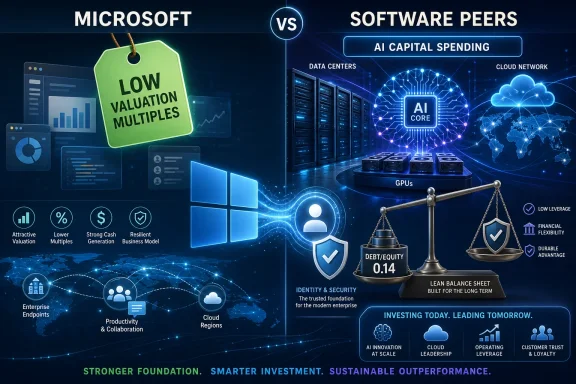
The Benzinga comparison lands on a familiar conclusion: Microsoft’s price-to-earnings, price-to-book, and price-to-sales ratios are low versus its selected software peers, suggesting possible undervaluation. That sounds counterintuitive for a company with a market capitalization measured in the trillions, but peer-relative valuation often produces strange optics when the peer group includes faster-growing, narrower, or more speculative software names.
A lower multiple does not automatically mean a stock is cheap. It can also mean investors are discounting slower growth, heavier capital spending, regulatory exposure, or the simple arithmetic of scale. Microsoft’s business is so large that even excellent growth can look pedestrian beside smaller software firms that are earlier in their expansion curves.
That is why the article’s most important tension is not “Microsoft is undervalued.” It is that Microsoft is being valued as both a durable software compounder and a capital-hungry AI infrastructure company. Those two identities can coexist, but they do not deserve the same multiples forever.
The company’s balance sheet gives it room to try. A debt-to-equity ratio of 0.14 signals that Microsoft is not leaning heavily on borrowed money to fund its ambitions. In a period when AI infrastructure, cloud data centers, and custom silicon are becoming strategic weapons, that conservative leverage profile matters more than it would have in a simpler SaaS comparison.
That matters because AI is not cheap. The industry’s current competitive race is not just about model quality, productivity features, or clever user interfaces. It is about data-center capacity, GPUs, networking gear, power contracts, and the ability to place enormous capital bets before the revenue curve is fully visible.
Microsoft’s relatively low leverage gives it a strategic cushion. The company can keep funding Azure buildouts, Copilot integration, security products, and enterprise platform work without looking like it is financing a moonshot with fragile debt. In practical terms, that gives Microsoft more patience than many rivals.
For IT buyers, this is not an abstract Wall Street ratio. A vendor with a stronger balance sheet is more likely to keep investing in product roadmaps, support obligations, compliance programs, and long-term platform maintenance. That does not guarantee better software, but it reduces one class of risk that enterprise customers care about deeply.
A pure software peer may have better revenue growth because it is selling into a narrower, faster-expanding market. A cybersecurity company may command a higher price-to-sales ratio because investors are pricing in urgent demand and specialized growth. A cloud infrastructure rival may look less profitable today because it is spending aggressively to capture tomorrow’s workloads.
Microsoft contains pieces of all of those businesses. Azure competes with Amazon Web Services and Google Cloud. Microsoft 365 competes with Google Workspace and a long tail of collaboration tools. GitHub competes for developer mindshare. Defender and Sentinel compete in security. Windows remains a platform with its own OEM, commercial licensing, and management ecosystem.
So when a comparison says Microsoft’s valuation ratios are low versus peers, the right response is not to nod along. The right response is to ask which Microsoft is being compared: the Windows company, the Office company, the Azure company, the AI platform company, or the whole conglomerate.
For Microsoft, the interpretation is complicated. A company sitting on enormous retained earnings and funding massive infrastructure investments may show a different ROE profile than an asset-light software firm with fewer physical demands. The AI era is pulling Microsoft away from the cleanest version of the old software model, where incremental revenue could flow through with minimal capital intensity.
That does not make the low ROE irrelevant. It means investors and customers should treat it as a clue. Microsoft’s next phase depends on whether its AI and cloud investments can produce enough durable, high-margin revenue to justify the capital going in.
The risk is not that Microsoft suddenly becomes a bad business. The risk is more subtle: the market may discover that the new Microsoft deserves a different valuation framework than the old one. If AI infrastructure behaves more like telecom or cloud utility spending than classic software licensing, the multiple investors assign to future earnings could change.
That breadth is a strategic advantage. Microsoft does not need every product line to behave like a hypergrowth startup. It needs the portfolio to reinforce itself: Windows endpoints managed through Intune, identity through Entra, productivity through Microsoft 365, data through Fabric, cloud workloads through Azure, and AI interfaces through Copilot.
The WindowsForum audience knows this flywheel from the inside. Microsoft’s strength is not just that it sells software. It sells default infrastructure for organizations that want one accountable vendor across endpoints, identity, productivity, compliance, and cloud.
That default status is extremely hard to dislodge. Users may complain about Windows changes, admins may grumble about licensing complexity, and developers may roll their eyes at branding churn. But the Microsoft stack keeps expanding because its products are woven into procurement, security policy, directory services, device management, and office workflows.
Still, the market does not give infinite credit for size. If Microsoft is spending heavily to win the AI platform era, investors will expect visible growth from that spending. The company has repeatedly emphasized cloud and AI demand, but the burden of proof rises as capital expenditures rise.
The problem is that AI monetization is still messy. Copilot revenue, Azure AI consumption, GitHub productivity gains, enterprise automation, and model-hosting demand all flow through different parts of the company. Some value may show up as direct subscription revenue. Some may appear as Azure usage. Some may simply defend existing Microsoft 365 renewals rather than create obvious new line items.
That makes revenue growth a more ambiguous signal than it used to be. Microsoft may be strengthening its moat even when growth looks merely solid. But if the market cannot separate defensive bundling from genuinely incremental AI revenue, skepticism will grow.
Windows 11, Windows 365, Azure Virtual Desktop, Intune, Defender, Entra, and Microsoft 365 are increasingly parts of one enterprise operating environment. The PC is still the user’s daily interface, but the money is in management, security, identity, compliance, and cloud services wrapped around that interface.
This is why Microsoft can afford to make Windows feel less like a standalone product and more like a delivery surface. Copilot integration, cloud account nudges, Edge promotion, OneDrive defaults, and Microsoft account pressure are not random annoyances. They are symptoms of a company using Windows to reinforce the rest of the stack.
That strategy creates tension with power users. The more Windows becomes a storefront and policy endpoint for Microsoft’s services, the less it feels like a neutral operating system. But from a business standpoint, the logic is clear: Windows remains one of Microsoft’s strongest distribution advantages.
Microsoft is better positioned than almost anyone to absorb those costs. It has Azure, enterprise distribution, deep cash generation, and a massive installed base. But the economics still matter.
If Copilot becomes a high-margin subscription layer across Microsoft 365, Windows, Dynamics, GitHub, and security, the strategy looks brilliant. If AI features become expensive table stakes that customers expect but resist paying much extra for, the picture becomes less flattering. The company may still win strategically while earning less attractive returns than the market hoped.
That is why the low debt-to-equity ratio is important but not sufficient. Balance-sheet strength lets Microsoft play the AI game. It does not prove the game will produce software-like returns.
In cloud, Azure must keep winning workloads while managing capacity constraints and margin pressure. In productivity, Microsoft 365 must justify price increases and AI add-ons against Google and specialized collaboration tools. In security, Microsoft’s bundling advantage is powerful, but best-of-breed vendors keep arguing that integration is not the same as excellence.
In developer tools, GitHub gives Microsoft a privileged position, but developers remain allergic to lock-in when better workflows emerge elsewhere. In operating systems, Windows still dominates enterprise desktops, but the strategic center of gravity is shifting toward identity, browser-based apps, virtualization, and device management.
This is why a simple peer comparison can understate Microsoft’s challenge. The company does not have to lose to one rival to feel pressure. It can lose margin in cloud, pricing power in productivity, trust in Windows, and credibility in AI at the same time if execution slips.
Trust affects adoption. Enterprises may stay with Microsoft because the integration is too valuable to abandon, but that does not mean they grant the company unlimited goodwill. Every confusing admin center, every half-baked Copilot placement, every Windows default reset, and every licensing bundle adds friction to the relationship.
This matters financially because Microsoft’s growth increasingly depends on upsell. The company wants customers to adopt premium security SKUs, AI subscriptions, cloud services, endpoint management tools, and data platforms. Upsell works best when customers believe the vendor is reducing complexity rather than monetizing it.
Microsoft’s challenge is that its greatest strength can become its greatest liability. The stack is comprehensive, but comprehensive can feel coercive. Integration is valuable, but integration can blur into lock-in.
But Microsoft requires more than a snapshot. The company’s financial profile is being reshaped by AI infrastructure, cloud demand, enterprise bundling, and a Windows strategy that increasingly serves the broader Microsoft ecosystem. Those dynamics do not fit cleanly into a table of P/E, P/B, P/S, ROE, EBITDA, gross profit, revenue growth, and debt-to-equity.
The danger of automated financial content is not that it is wrong. The danger is that it can make the obvious feel complete. A ratio table can say Microsoft looks undervalued relative to peers, but it cannot tell you whether the market is correctly repricing the company for a more capital-intensive future.
That distinction matters. Microsoft may be both financially stronger than many software peers and less purely “software-like” than investors want to believe. Both can be true at once.
Those announcements matter, but they are not the whole story. The deeper question is whether Microsoft can convert its spending into durable platform control without alienating the users and administrators who live inside its products every day.
For IT pros, the financial story becomes practical in several places. If Microsoft is under pressure to justify AI spending, expect more bundling, more premium tiers, and more attempts to attach AI features to existing enterprise agreements. If cloud infrastructure remains expensive, expect capacity, pricing, and regional availability to become strategic issues rather than background details.
For Windows users, the same pressure may show up as deeper service integration. Windows is likely to keep becoming a front door for Microsoft accounts, Copilot, OneDrive, Edge, Defender, and subscription services. Whether that feels helpful or intrusive will depend on execution.
 Microsoft Looks Cheap Only If You Ignore What It Has Become
The Benzinga comparison lands on a familiar conclusion: Microsoft’s price-to-earnings, price-to-book, and price-to-sales ratios are low versus its selected software peers, suggesting possible undervaluation. That sounds counterintuitive for a company with a market capitalization measured in the trillions, but peer-relative valuation often produces strange optics when the peer group includes faster-growing, narrower, or more speculative software names.A lower multiple does not automatically mean a stock is cheap. It can also mean investors are discounting slower growth, heavier capital spending, regulatory exposure, or the simple arithmetic of scale. Microsoft’s business is so large that even excellent growth can look pedestrian beside smaller software firms that are earlier in their expansion curves.
That is why the article’s most important tension is not “Microsoft is undervalued.” It is that Microsoft is being valued as both a durable software compounder and a capital-hungry AI infrastructure company. Those two identities can coexist, but they do not deserve the same multiples forever.
The company’s balance sheet gives it room to try. A debt-to-equity ratio of 0.14 signals that Microsoft is not leaning heavily on borrowed money to fund its ambitions. In a period when AI infrastructure, cloud data centers, and custom silicon are becoming strategic weapons, that conservative leverage profile matters more than it would have in a simpler SaaS comparison.
The Debt Number Is the Quiet Power Move
Debt-to-equity is not glamorous, but in 2026 it may be one of the cleanest ways to separate Microsoft from many of its software peers. A low D/E ratio means Microsoft has more flexibility to absorb investment cycles, interest-rate pressure, and competitive shocks without turning every strategic bet into a balance-sheet stress test.That matters because AI is not cheap. The industry’s current competitive race is not just about model quality, productivity features, or clever user interfaces. It is about data-center capacity, GPUs, networking gear, power contracts, and the ability to place enormous capital bets before the revenue curve is fully visible.
Microsoft’s relatively low leverage gives it a strategic cushion. The company can keep funding Azure buildouts, Copilot integration, security products, and enterprise platform work without looking like it is financing a moonshot with fragile debt. In practical terms, that gives Microsoft more patience than many rivals.
For IT buyers, this is not an abstract Wall Street ratio. A vendor with a stronger balance sheet is more likely to keep investing in product roadmaps, support obligations, compliance programs, and long-term platform maintenance. That does not guarantee better software, but it reduces one class of risk that enterprise customers care about deeply.
The Peer Group Flatters and Distorts at the Same Time
The weakness in any automated peer comparison is the peer group. “Software” is too broad a label to carry much analytical weight on its own. Microsoft competes with cloud hyperscalers, cybersecurity firms, productivity-suite vendors, database providers, AI platform companies, gaming businesses, developer-tool vendors, and traditional enterprise software companies.A pure software peer may have better revenue growth because it is selling into a narrower, faster-expanding market. A cybersecurity company may command a higher price-to-sales ratio because investors are pricing in urgent demand and specialized growth. A cloud infrastructure rival may look less profitable today because it is spending aggressively to capture tomorrow’s workloads.
Microsoft contains pieces of all of those businesses. Azure competes with Amazon Web Services and Google Cloud. Microsoft 365 competes with Google Workspace and a long tail of collaboration tools. GitHub competes for developer mindshare. Defender and Sentinel compete in security. Windows remains a platform with its own OEM, commercial licensing, and management ecosystem.
So when a comparison says Microsoft’s valuation ratios are low versus peers, the right response is not to nod along. The right response is to ask which Microsoft is being compared: the Windows company, the Office company, the Azure company, the AI platform company, or the whole conglomerate.
Low ROE Is a Warning, Not a Verdict
Benzinga’s summary flags Microsoft’s low return on equity relative to competitors. That deserves attention because ROE is one of the classic measures of how efficiently a company turns shareholder equity into profit. A lower ROE can suggest weaker profitability, inefficient capital use, or simply a larger equity base that makes the ratio harder to impress.For Microsoft, the interpretation is complicated. A company sitting on enormous retained earnings and funding massive infrastructure investments may show a different ROE profile than an asset-light software firm with fewer physical demands. The AI era is pulling Microsoft away from the cleanest version of the old software model, where incremental revenue could flow through with minimal capital intensity.
That does not make the low ROE irrelevant. It means investors and customers should treat it as a clue. Microsoft’s next phase depends on whether its AI and cloud investments can produce enough durable, high-margin revenue to justify the capital going in.
The risk is not that Microsoft suddenly becomes a bad business. The risk is more subtle: the market may discover that the new Microsoft deserves a different valuation framework than the old one. If AI infrastructure behaves more like telecom or cloud utility spending than classic software licensing, the multiple investors assign to future earnings could change.
EBITDA and Gross Profit Show the Machine Still Works
The bullish counterweight is operating scale. Benzinga’s summary points to high EBITDA and gross profit, and Microsoft’s recent earnings trajectory supports the broader idea that this is still one of the most powerful operating machines in technology. The company can generate enormous gross profit while simultaneously funding Windows, Office, Azure, gaming, security, LinkedIn, developer tools, and AI initiatives.That breadth is a strategic advantage. Microsoft does not need every product line to behave like a hypergrowth startup. It needs the portfolio to reinforce itself: Windows endpoints managed through Intune, identity through Entra, productivity through Microsoft 365, data through Fabric, cloud workloads through Azure, and AI interfaces through Copilot.
The WindowsForum audience knows this flywheel from the inside. Microsoft’s strength is not just that it sells software. It sells default infrastructure for organizations that want one accountable vendor across endpoints, identity, productivity, compliance, and cloud.
That default status is extremely hard to dislodge. Users may complain about Windows changes, admins may grumble about licensing complexity, and developers may roll their eyes at branding churn. But the Microsoft stack keeps expanding because its products are woven into procurement, security policy, directory services, device management, and office workflows.
Revenue Growth Is the Part Microsoft Cannot Hand-Wave Away
The Benzinga summary also notes low revenue growth compared with peers. This is the other side of Microsoft’s scale advantage. The bigger the revenue base becomes, the harder it is to produce eye-popping percentage growth.Still, the market does not give infinite credit for size. If Microsoft is spending heavily to win the AI platform era, investors will expect visible growth from that spending. The company has repeatedly emphasized cloud and AI demand, but the burden of proof rises as capital expenditures rise.
The problem is that AI monetization is still messy. Copilot revenue, Azure AI consumption, GitHub productivity gains, enterprise automation, and model-hosting demand all flow through different parts of the company. Some value may show up as direct subscription revenue. Some may appear as Azure usage. Some may simply defend existing Microsoft 365 renewals rather than create obvious new line items.
That makes revenue growth a more ambiguous signal than it used to be. Microsoft may be strengthening its moat even when growth looks merely solid. But if the market cannot separate defensive bundling from genuinely incremental AI revenue, skepticism will grow.
Windows Is No Longer the Growth Engine, but It Still Sets the Table
For Windows enthusiasts, the key point is that Microsoft’s financial story is no longer centered on Windows licensing. That does not make Windows unimportant. It makes Windows part of a broader control plane.Windows 11, Windows 365, Azure Virtual Desktop, Intune, Defender, Entra, and Microsoft 365 are increasingly parts of one enterprise operating environment. The PC is still the user’s daily interface, but the money is in management, security, identity, compliance, and cloud services wrapped around that interface.
This is why Microsoft can afford to make Windows feel less like a standalone product and more like a delivery surface. Copilot integration, cloud account nudges, Edge promotion, OneDrive defaults, and Microsoft account pressure are not random annoyances. They are symptoms of a company using Windows to reinforce the rest of the stack.
That strategy creates tension with power users. The more Windows becomes a storefront and policy endpoint for Microsoft’s services, the less it feels like a neutral operating system. But from a business standpoint, the logic is clear: Windows remains one of Microsoft’s strongest distribution advantages.
AI Spending Turns Microsoft Into a Different Kind of Software Company
The classic software dream is beautiful: write code once, sell it many times, and enjoy margins that industrial companies can only envy. AI complicates that dream because the marginal cost of intelligence is not zero. Inference, training, model orchestration, data-center expansion, and energy all impose costs that look much more physical than the old software model.Microsoft is better positioned than almost anyone to absorb those costs. It has Azure, enterprise distribution, deep cash generation, and a massive installed base. But the economics still matter.
If Copilot becomes a high-margin subscription layer across Microsoft 365, Windows, Dynamics, GitHub, and security, the strategy looks brilliant. If AI features become expensive table stakes that customers expect but resist paying much extra for, the picture becomes less flattering. The company may still win strategically while earning less attractive returns than the market hoped.
That is why the low debt-to-equity ratio is important but not sufficient. Balance-sheet strength lets Microsoft play the AI game. It does not prove the game will produce software-like returns.
The Competitive Threat Is Not One Rival, but a Stack of Pressures
Microsoft’s competitive space is often described through named rivals: Google, Amazon, Apple, Salesforce, Oracle, Adobe, ServiceNow, CrowdStrike, Palo Alto Networks, and others. That framing is useful but incomplete. Microsoft’s real competitive pressure comes from overlapping stack battles.In cloud, Azure must keep winning workloads while managing capacity constraints and margin pressure. In productivity, Microsoft 365 must justify price increases and AI add-ons against Google and specialized collaboration tools. In security, Microsoft’s bundling advantage is powerful, but best-of-breed vendors keep arguing that integration is not the same as excellence.
In developer tools, GitHub gives Microsoft a privileged position, but developers remain allergic to lock-in when better workflows emerge elsewhere. In operating systems, Windows still dominates enterprise desktops, but the strategic center of gravity is shifting toward identity, browser-based apps, virtualization, and device management.
This is why a simple peer comparison can understate Microsoft’s challenge. The company does not have to lose to one rival to feel pressure. It can lose margin in cloud, pricing power in productivity, trust in Windows, and credibility in AI at the same time if execution slips.
Valuation Ratios Cannot Capture Trust
For WindowsForum readers, one missing metric looms large: trust. Microsoft’s financial ratios may look attractive, but product trust is a different ledger. Admins remember forced upgrades, confusing licensing, telemetry controversies, quality-control regressions, control panel migrations, and sudden product renames.Trust affects adoption. Enterprises may stay with Microsoft because the integration is too valuable to abandon, but that does not mean they grant the company unlimited goodwill. Every confusing admin center, every half-baked Copilot placement, every Windows default reset, and every licensing bundle adds friction to the relationship.
This matters financially because Microsoft’s growth increasingly depends on upsell. The company wants customers to adopt premium security SKUs, AI subscriptions, cloud services, endpoint management tools, and data platforms. Upsell works best when customers believe the vendor is reducing complexity rather than monetizing it.
Microsoft’s challenge is that its greatest strength can become its greatest liability. The stack is comprehensive, but comprehensive can feel coercive. Integration is valuable, but integration can blur into lock-in.
The Automated Article Gets the Numbers Right and the Story Half Right
Benzinga’s automated framing is useful because it captures a real financial contrast: Microsoft has low leverage, large profits, and peer-relative valuation ratios that do not look stretched by some measures. It also notes real caveats around ROE and revenue growth. As a snapshot, that is valuable.But Microsoft requires more than a snapshot. The company’s financial profile is being reshaped by AI infrastructure, cloud demand, enterprise bundling, and a Windows strategy that increasingly serves the broader Microsoft ecosystem. Those dynamics do not fit cleanly into a table of P/E, P/B, P/S, ROE, EBITDA, gross profit, revenue growth, and debt-to-equity.
The danger of automated financial content is not that it is wrong. The danger is that it can make the obvious feel complete. A ratio table can say Microsoft looks undervalued relative to peers, but it cannot tell you whether the market is correctly repricing the company for a more capital-intensive future.
That distinction matters. Microsoft may be both financially stronger than many software peers and less purely “software-like” than investors want to believe. Both can be true at once.
The Windows Crowd Should Watch the Capital Cycle, Not Just the Feature Demos
The next few years of Microsoft coverage will be full of product announcements. There will be Copilot updates, Windows changes, Azure AI services, security bundles, Arm PC pushes, developer tooling, and probably another round of branding exercises that make old product names disappear into new suites.Those announcements matter, but they are not the whole story. The deeper question is whether Microsoft can convert its spending into durable platform control without alienating the users and administrators who live inside its products every day.
For IT pros, the financial story becomes practical in several places. If Microsoft is under pressure to justify AI spending, expect more bundling, more premium tiers, and more attempts to attach AI features to existing enterprise agreements. If cloud infrastructure remains expensive, expect capacity, pricing, and regional availability to become strategic issues rather than background details.
For Windows users, the same pressure may show up as deeper service integration. Windows is likely to keep becoming a front door for Microsoft accounts, Copilot, OneDrive, Edge, Defender, and subscription services. Whether that feels helpful or intrusive will depend on execution.
Redmond’s Balance Sheet Buys Time, but Not Immunity
Microsoft’s peer comparison is best read as a map of strengths and stress points rather than a verdict on the stock. The company has the financial room to compete aggressively, but the AI era is making that competition more expensive and more visible.- Microsoft’s low debt-to-equity ratio suggests it has more financial flexibility than many software peers as AI infrastructure spending rises.
- Low peer-relative valuation ratios may indicate undervaluation, but they may also reflect investor concern about scale, growth, and capital intensity.
- High EBITDA and gross profit show that Microsoft’s operating engine remains exceptionally strong.
- Lower relative ROE deserves scrutiny because AI and cloud infrastructure can make Microsoft less asset-light than traditional software companies.
- Slower revenue growth is partly a function of Microsoft’s size, but the company still needs to prove that AI spending produces durable incremental revenue.
- Windows remains strategically important less as a standalone growth engine and more as a distribution layer for Microsoft’s wider enterprise stack.
References
- Primary source: Benzinga
Published: 2026-06-25T09:59:07.697464
Loading…
www.benzinga.com - Official source: microsoft.com
FY26 Q3 - Performance - Investor Relations - Microsoft
FY26 Q3 - Performance - Investor Relations - Microsoftwww.microsoft.com
- Related coverage: cdn4.benzinga.com
Evaluating Microsoft Against Peers In Software Industry
In the ever-changing and fiercely competitive business landscape, conducting thorough company analysis is crucial for investors and industry experts. In ...cdn4.benzinga.com
- Related coverage: sahmcapital.com
Loading…
www.sahmcapital.com - Related coverage: windowscentral.com
Everyone has an opinion on Microsoft’s spending, but the real story is what the numbers say about its position | Windows Central
Microsoft beat expectations again, but investors want proof that rising AI spending will deliver real profit down the road.www.windowscentral.com