

Microsoft’s AI team has formally declared a new ambition: build a controlled, auditable form of “superintelligence” that is explicitly designed to serve people — and it has put Mustafa Suleyman, the company’s AI chief, in charge of the effort. The MAI Superintelligence Team will pursue what Suleyman calls Humanist Superintelligence (HSI) — domain-specialist, high-impact systems (with medical diagnostics as an early priority) trained and deployed under strict containment, explainability and governance constraints. This pivot follows a reworking of Microsoft’s relationship with OpenAI and a strategic push for first-party model development, dedicated compute, and tighter operational control across Copilot, Windows and Microsoft 365 experiences.
Microsoft’s MAI Superintelligence announcement arrives at a moment when several major AI labs are explicitly framing their work as a step beyond conventional AGI talk — employing the language of “superintelligence” to describe ambitions for systems that can outperform human experts in narrowly defined, societally valuable domains. Microsoft’s public rationale is twofold: regain optionality and control after years of leaning on external frontier models, and set a distinct safety-focused posture that contrasts with rival framings that emphasize raw capability. The company’s public post frames this as a long-term, problem-first program rather than an unconstrained race.
But some crucial questions remain:
The critical test for MAI will be transparency: publishable benchmarks, independent audits, and documented regulatory progress that convert the humanist promise into verifiable practice. Without that, the rhetoric of “humanist superintelligence” will be difficult to distinguish from industry marketing. With it, Microsoft could show a viable way to accelerate high‑capability AI while keeping the guardrails that protect people, institutions and public trust.
Source: AOL.com Microsoft, freed from relying on OpenAI, joins the race for ‘superintelligence’—and AI chief Mustafa Suleyman wants to ensure it serves humanity
 Background / Overview
Microsoft’s MAI Superintelligence announcement arrives at a moment when several major AI labs are explicitly framing their work as a step beyond conventional AGI talk — employing the language of “superintelligence” to describe ambitions for systems that can outperform human experts in narrowly defined, societally valuable domains. Microsoft’s public rationale is twofold: regain optionality and control after years of leaning on external frontier models, and set a distinct safety-focused posture that contrasts with rival framings that emphasize raw capability. The company’s public post frames this as a long-term, problem-first program rather than an unconstrained race. - What changed: a reworked Microsoft–OpenAI relationship that relaxed earlier contractual limitations, clarified IP and commercialization windows, and introduced independent verification mechanisms for any AGI declaration — creating the legal room for Microsoft to train larger, first-party models while maintaining a cooperative relationship with OpenAI.
- What’s new: the MAI Superintelligence Team (internal name: MAI) will be led by Mustafa Suleyman with Karén Simonyan named as chief scientist; the team is explicitly tasked with building Humanist Superintelligence and recruiting talent from across the industry.
What Microsoft Says “Humanist Superintelligence” Means
A definition with guardrails
Microsoft defines Humanist Superintelligence as “advanced AI designed to remain controllable, aligned, and firmly in service to humanity.” The core engineering and product principles the company highlights are:- Domain specificity — pursue superhuman performance on narrowly defined, high-impact tasks (medical diagnostics, materials/battery chemistry, molecule discovery, fusion-related science, education).
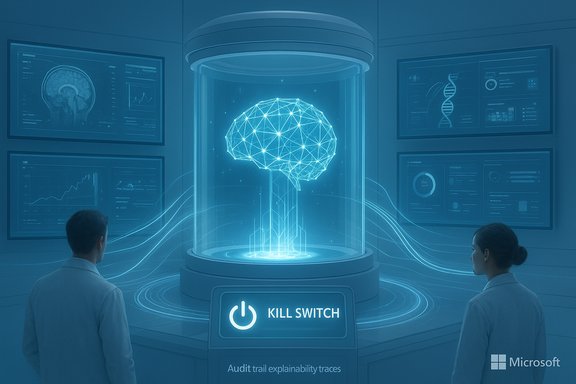
- Containment & control — design runtime safety features (throttles, kill switches, strong human-in-the-loop defaults) so systems cannot act as open-ended, self-directed agents.
- Auditability & interpretability — build models and pipelines that produce inspectable reasoning traces, provenance and clear evaluation artifacts for third-party verification.
- Human-centric objectives — prioritize measurable improvements in health, energy, education and other public goods rather than chasing universal, general-purpose cognition.
Why medical diagnostics is first
Microsoft has signaled medical diagnosis as an early area of focus. The company argues that diagnostic tasks combine high social value with structured datasets, existing regulatory pathways and measurable outcomes — making them a plausible early domain to demonstrate superhuman performance and benefit. Suleyman has stated Microsoft has a “line of sight” to medical superintelligence within a short horizon, but he and Microsoft stress that clinical deployment would require regulatory approval, peer-reviewed evidence and external audits. That optimism is echoed in public reporting, but the timeline and the meaning of “line of sight” are industry claims that require empirical verification.The Strategic Rationale: Self-sufficiency, Cost, and Control
Microsoft’s business incentives to build a first-party frontier capability are straightforward:- Operational optionality: Hosting and controlling your own frontier models reduces latency and inference cost for products like Copilot and Windows Copilot, where responsiveness and scale matter.
- Data governance and enterprise SLAs: Regulated customers (healthcare, finance, government) demand provable data residency, telemetry and auditable behavior that are easier to guarantee with first-party models and data pipelines.
- Commercial leverage: Owning core capabilities buys negotiating power in a landscape where cloud-provider and partner choices can shift quickly; it also safeguards Microsoft’s ability to place models where its customers demand them.
Where MAI Sits in a Crowded “Superintelligence” Landscape
Microsoft is not alone in adopting the language of superintelligence. Over the past 18 months:- Meta reorganized and rebranded its advanced AI work as Meta Superintelligence Labs and signaled accelerated hiring and investment into larger models and talent — a move covered widely in June 2025 reporting.
- Safe Superintelligence (SSI), a startup founded by former OpenAI chief scientist Ilya Sutskever, explicitly uses “superintelligence” in its name and mission, and positions safety research as core to its product strategy. SSI’s emergence illustrates a strand of research-first entities trying to marry capability and safety goals.
- Anthropic and other labs maintain active research streams into “superalignment” and governance for hypothetical future superhuman systems.
Technical Feasibility: What’s Plausible — and What’s Not
Domain specialists vs universal AGI
The industry has demonstrated repeatedly that domain-specific specialization can produce dramatic gains (see protein folding and other scientific breakthroughs). Constraining scope lowers the bar for both capability and verification. Building an HSI that outperforms human clinicians on narrowly defined diagnostic tasks is plausible with the right dataset, multimodal architecture and extensive validation pipelines. Microsoft’s claim of a “line of sight” to medical superintelligence in a few years is optimistic but not impossible — provided the company publishes peer-reviewed benchmarks and submits to independent clinical validation. What remains far less certain is the creation of a general-purpose superintelligence using current architectures alone. Many researchers argue that emergent capabilities result from scaling, data quality and architectural innovation — but there is no consensus that simply throwing compute (FLOPS) at extant transformer-based systems will yield safe, controllable, truly general superintelligence. Microsoft’s HSI framing intentionally avoids promising that kind of open-ended AGI; it emphasizes containable advances instead.Compute, FLOPS and the limits of scaling
The industry debates a range of thresholds expressed in FLOPS (total floating-point operations used in training) as proxies for capability and risk. Public discourse has proposed reporting and even regulatory thresholds for models trained above particular FLOPS figures, but these are policy proposals rather than technical invariants. Statements that Microsoft was previously contractually capped at a certain FLOPS level in its old OpenAI arrangement are reported in press coverage and should be treated as accurate descriptions of contractual guardrails that affected Microsoft’s strategic choices; the precise numerical thresholds and legal wording are matters of private contract and have been described differently across outlets. Microsoft’s new posture removes prior constraints on pursuing larger first-party models while preserving ongoing collaboration with OpenAI. Readers should treat exact FLOPS numbers cited in commercial reporting with caution until primary contractual texts are published.Governance, Safety and the Verification Challenge
Microsoft’s corporate messaging couples capability ambition with governance commitments: independent verification mechanisms (originally part of the Microsoft–OpenAI rework), strengthened internal safety teams, and promises to publish and subject results to external review. The company says it will adopt auditable model pipelines, human-centered interfaces and hard runtime controls to avoid uncontrolled autonomy.But some crucial questions remain:
- How will Microsoft operationalize independent verification for claims that a model is “superintelligent” in a domain?
- What are the audit standards and who will qualify as independent auditors?
- How will certification and liability work for regulated deployments (e.g., clinical diagnostics) when models evolve continuously?
- What telemetry and safeguards will be required to prevent misuse (e.g., social manipulation, targeted misinformation, weaponization)?
Risks, Trade-offs and the Political Economy of Talent and Compute
Risk vectors
- Capability miscalibration — A model trained for domain tasks could still exhibit harmful generalities or hallucinations without robust interpretability and boundedness.
- Concentration of compute — Building MAI-scale models increases concentration of training resources among hyperscalers; this intensifies strategic power asymmetries and raises systemic risk.
- Economic and social disruption — Superhuman domain tools could displace skilled workers in medicine, science and law; governance and re-skilling policies will be essential.
- Arms race dynamics — Even with a humanist posture, private competition for talent and outcomes could accelerate risk-taking, particularly where commercial incentives clash with safety concerns.
Talent and compensation pressures
Microsoft, Meta, OpenAI and deep-pocketed startups (including SSI) are actively recruiting top talent and offering large compensation packages. This competition has implications for research direction (safety-focused hires vs product-velocity hires) and corporate cultures. Microsoft says it is committed to building a “safety-first” culture within MAI, but the incentives of product teams and shareholder expectations create continuous trade-offs.Legal and regulatory friction
Microsoft’s intention to pursue medical superintelligence quickly will collide with existing medical-device, privacy and liability regimes. Even if a model demonstrates strong performance in internal studies, regulatory approval (FDA, EMA, etc., clinical adoption and malpractice frameworks add months or years to deployment timelines. Microsoft has said it will pursue rigorous validation and regulatory pathways, but it is incorrect to interpret short R&D timelines as immediate market readiness. External verification and clinical trials remain non-negotiable.What This Means for Windows Users and Enterprises
- Windows and Microsoft 365 customers should expect tighter integration of MAI-powered features into Copilot experiences — optimized for latency, cost and privacy when routed to first-party MAI models.
- Enterprise customers in regulated industries may gain new contractable assurances (on-premises hosting, auditable logs, traceability).
- Consumers should see a continued push for “companionship” features and more personalized assistants — balanced, Microsoft says, by humanist design defaults that avoid making assistants seem sentient by default.
Independent Verification and the Need for Transparency
Microsoft’s credibility — and the public value of HSI — will hinge on measurable transparency:- Publish clear benchmarks and testing protocols for claimed superhuman performance.
- Open datasets or audited dataset descriptions used for training and evaluation.
- Invite third-party clinical trials and peer-reviewed publications where human health outcomes are involved.
- Establish independent audit panels with clear remit, authority and public reporting standards.
Verdict: Ambition with Caveats
Microsoft’s MAI Superintelligence Team is a significant strategic move: it signals the company’s intent to diversify beyond partnerships into first-party frontier capability, and to do so under a declared ethical frame. The combination of legal adjustments with OpenAI, aggressive infrastructure plans and a safety-forward governance posture makes the initiative plausible and consequential. That said, major caveats apply:- The term “superintelligence” is aspirational and should not be read as an immediate technical milestone — it describes the ambition to exceed human expertise in constrained domains, not the arrival of an unconstrained AGI.
- Timelines are uncertain. Claims of being “close” to medical superintelligence may reflect promising prototypes, but clinical deployment and regulatory approval are long, evidence-driven processes that cannot be short-circuited.
- Real safety depends on independent audits, reproducible benchmarks and governance mechanisms that can constrain misuse across product lifecycles and third-party integrations.
What to Watch Next
- Publication of MAI technical papers, evaluation protocols and third-party audits.
- Concrete regulatory engagement: filings or pilot approvals with medical regulators (FDA, EMA) or equivalent bodies.
- Microsoft’s disclosure of infrastructure scale (clusters/GPU counts) and architecture details for early MAI models.
- Independent verification of performance claims in clinical and scientific domains.
- Competitive responses from Meta, OpenAI, SSI and Anthropic — both in recruiting and in public governance commitments.
Conclusion
Microsoft’s MAI Superintelligence Team articulates an audacious — and deliberately constrained — path toward building systems that can be superhuman in specific, societally valuable areas while remaining auditable and human-centered. The move is strategically sensible: it reduces operational dependence on a single partner, aligns product choices with regulatory and enterprise needs, and stakes Microsoft’s claim on a safety-forward descriptor that may resonate with customers and policymakers.The critical test for MAI will be transparency: publishable benchmarks, independent audits, and documented regulatory progress that convert the humanist promise into verifiable practice. Without that, the rhetoric of “humanist superintelligence” will be difficult to distinguish from industry marketing. With it, Microsoft could show a viable way to accelerate high‑capability AI while keeping the guardrails that protect people, institutions and public trust.
Source: AOL.com Microsoft, freed from relying on OpenAI, joins the race for ‘superintelligence’—and AI chief Mustafa Suleyman wants to ensure it serves humanity
