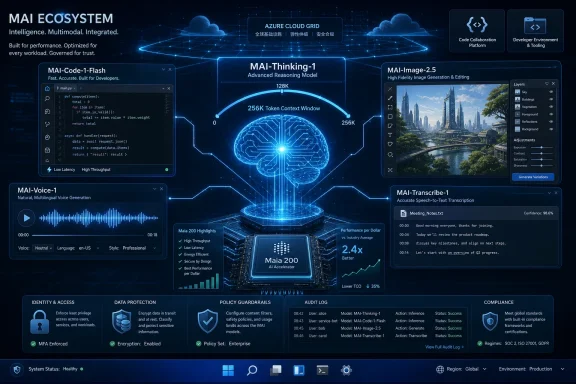
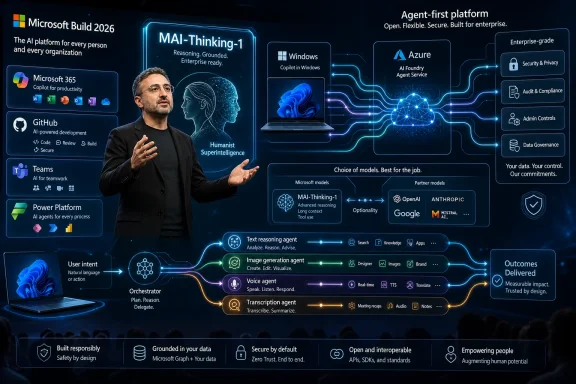
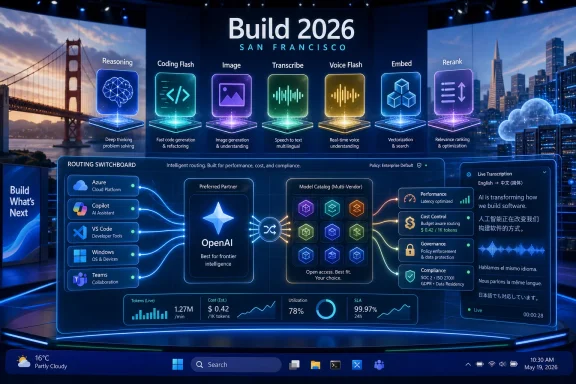
Microsoft used Build 2026 in San Francisco on June 2 to introduce MAI-Thinking-1, its first in-house reasoning model, alongside six other MAI models spanning coding, image generation, transcription, and voice, positioning the launch as a shipping turn in its post-OpenAI-exclusivity AI strategy. This was not Microsoft declaring independence from OpenAI. It was Microsoft making dependence look optional.
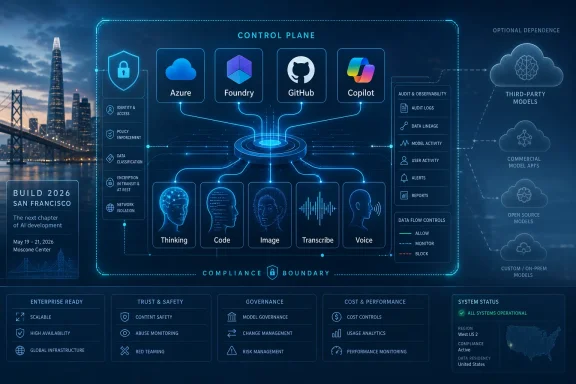
That distinction matters. For Windows developers, enterprise architects, and Copilot buyers, the story is less about a single benchmark champion and more about who controls the layer between the user, the model, the data, and the bill. Build 2026 was Microsoft’s clearest answer yet: the model may come from OpenAI, Anthropic, Microsoft AI, or another lab, but the control plane is meant to be Azure, Foundry, GitHub, and Copilot.
For the past two years, Microsoft has had to manage a delicate contradiction. It was the company most visibly commercializing OpenAI’s models, but also the company most exposed if OpenAI’s pricing, capacity, roadmap, or corporate structure moved in a direction Redmond did not like. The amended Microsoft-OpenAI agreement in April 2026 made that tension explicit by ending Microsoft’s exclusive OpenAI license while preserving a long-term, non-exclusive IP arrangement through 2032.
MAI-Thinking-1 is the first Build-stage answer to that new reality. Microsoft is not pretending OpenAI no longer matters; Azure remains OpenAI’s primary cloud partner, and Copilot products still rely heavily on OpenAI capabilities. But Microsoft is now showing customers that OpenAI is no longer the only route to frontier-adjacent AI inside the Microsoft stack.
That is the strategic value of MAI-Thinking-1, even before independent labs confirm Microsoft’s benchmark claims. A private-preview reasoning model trained without OpenAI data gives Microsoft a negotiating instrument, a compliance story, and a product fallback. It also gives enterprise customers something they have been asking for since the first wave of generative AI pilots: a clearer answer to where training data came from and who has the right to commercialize it.
The company’s claim that MAI-Thinking-1 was trained on clean, commercially licensed enterprise data, without distillation from third-party models, is therefore not a footnote. It is the sales pitch. In a market where vendors increasingly sound alike on speed, token windows, and coding scores, provenance is becoming a differentiator.
But the more interesting number is not the parameter count. It is zero: no distillation from OpenAI’s GPT series or other third-party models, according to Microsoft’s description. If that claim holds up under scrutiny, it gives Microsoft a cleaner enterprise story than the usual “trust us” assurances that dominate AI procurement.
This is especially important for regulated customers. Banks, healthcare organizations, government contractors, and large software vendors do not merely ask whether a model performs well. They ask whether its outputs create hidden licensing risk, whether customer data might leak into future training, and whether a vendor can explain the lineage of the system being embedded into daily work.
That does not make MAI-Thinking-1 automatically safer or better. It does mean Microsoft understands where the enterprise AI argument is going. The next phase will not be won only by the model that solves the hardest math problem; it will be won by the platform that can make risk officers, procurement teams, and developers comfortable enough to put agents into production.
Microsoft’s benchmark claims are aggressive. The company says MAI-Thinking-1 reaches 97.0 percent on AIME 2025 and 94.5 percent on AIME 2026, and that it performs strongly on SWE-Bench Pro. Those figures, if independently reproduced, would make the model a serious entrant rather than a vanity project. Until then, they should be treated as vendor claims from a company with every incentive to frame its first reasoning model as immediately competitive.
The key phrase is model picker. Microsoft has not officially said MAI-Code-1-Flash is replacing GPT-4 Turbo or any other OpenAI model as Copilot’s default engine. Some post-keynote reporting has described a more aggressive migration timeline, including a possible August 2026 default switch, but that is not yet in Microsoft’s formal product documentation. For now, the safe interpretation is that Microsoft is adding a first-party coding option, not ripping out the old back end.
Still, the direction is obvious. GitHub Copilot is one of Microsoft’s most important AI products because it sits at the point where AI converts directly into paid productivity claims. If Microsoft can tune a small, efficient coding model inside Copilot’s own production harness, it can reduce cost, improve latency, and shape behavior around real-world agentic workflows rather than benchmark theater.
That last point matters. Coding models do not fail only because they cannot write a function. They fail because they misunderstand a repository, make unsafe edits, follow tool instructions poorly, or generate plausible but brittle changes across multiple files. A model trained and evaluated inside Copilot’s live workflow may be less glamorous than a giant frontier model, but it could be more useful for the repetitive grind of software maintenance.
For developers, the short-term result is choice. For Microsoft, it is leverage. Every Copilot request served by a Microsoft-built model is one less request whose economics, availability, and roadmap depend entirely on a partner.
This is why Microsoft can simultaneously promote its own MAI models, keep OpenAI at the center of key products, and court Anthropic through Azure AI Foundry. The company is not asking customers to believe there will be one model to rule them all. It is asking them to believe Microsoft should be the place where all the models are managed.
That is a subtle but powerful shift. In the cloud era, Microsoft won by making Azure the place enterprises could run Windows Server, Linux, SQL, Kubernetes, and third-party software under one commercial umbrella. In the AI era, it wants Foundry to play the same role for models. The customer may care which model answers the prompt, but Microsoft wants the invoice, access policy, audit log, and deployment surface to remain inside its perimeter.
The Anthropic arrangement shows both the strength and the complication of this approach. Claude models in Foundry give Microsoft customers another frontier-class option under Azure billing and governance. But those models currently run on Anthropic-managed infrastructure rather than native Azure regional compute, which means data residency and operational equivalence are not automatic.
That distinction is not academic for European enterprises or heavily regulated sectors. Unified billing is useful, but it is not the same as unified infrastructure. If a model runs outside Azure’s regional compute fabric, compliance teams need to know exactly where inference happens, what subprocessors are involved, and how contractual commitments map to technical reality.
That change does not look like a breakup. It looks like a normalization. The extraordinary early phase of the Microsoft-OpenAI relationship gave Microsoft privileged access to the models that defined the first commercial wave of generative AI. The new phase accepts that OpenAI wants optionality, Microsoft wants optionality, and enterprise customers want fewer single points of dependency.
For Microsoft, the danger is that “multi-model” becomes a euphemism for “less differentiated.” If OpenAI can sell through other clouds and Anthropic can be accessed through multiple platforms, Microsoft needs more than reseller convenience. It needs first-party models, deep product integration, trusted governance, and enough developer mindshare to make Azure feel like the default place to build AI systems.
Build 2026 was designed to answer that concern. MAI-Thinking-1 says Microsoft can build a reasoning model. MAI-Code-1-Flash says it can ship a coding model into Copilot. MAI-Image-2.5, MAI-Transcribe-1.5, and MAI-Voice-2 say it can cover multimodal workloads without waiting for a partner. Foundry says all of it can be wrapped in one enterprise surface.
The open question is whether customers will treat that as freedom or lock-in wearing a friendlier jacket.
MAI-Image-2.5 appearing in PowerPoint and rolling out to OneDrive is a classic Microsoft move. The model does not need to win the entire text-to-image market if it becomes the image engine millions of office workers encounter while making decks, reports, and internal documents. In enterprise software, distribution is often more important than aesthetic supremacy.
MAI-Transcribe-1.5 and MAI-Voice-2 follow the same logic. Meetings, calls, recordings, presentations, training content, and accessibility workflows are not edge cases in Microsoft’s world. They are the daily exhaust of Microsoft 365. A transcription model that works across dozens of languages and a voice model that can adapt from short samples become more valuable when wired into Teams, PowerPoint, SharePoint, and Copilot workflows.
This is where Microsoft’s AI strategy differs from the pure lab model. It does not need every MAI system to be the absolute best standalone model in its category. It needs them to be good enough, governed enough, cheap enough, and close enough to the workflow that customers stop looking elsewhere for routine tasks.
That does not mean model quality is secondary. Poor image generation, hallucinated transcripts, or uncanny voice output can damage trust quickly. But Microsoft’s advantage is not that it can out-demo every AI lab. Its advantage is that it can turn an adequate model into a default feature.
Those are enormous claims. They are also the kind of claims that demand more than keynote confidence. Microsoft’s Majorana program has a complicated history, including a retracted 2018 claim related to Majorana zero modes and heavy scrutiny of Majorana 1. Majorana 2 will not escape that context simply because the numbers are larger.
Independent physicists have already raised concerns about the current preprint, including whether the data demonstrate the necessary topological qubit behavior. Some criticism centers on the absence of both X and Z measurements, while other concerns focus on the small number of device instances described. That does not prove Microsoft is wrong, but it does mean the company’s quantum story remains in the category of promising but unproven.
For WindowsForum readers, the practical message is simple: treat Microsoft’s AI announcements and quantum announcements differently. The AI models are already entering product surfaces, private previews, and developer tools. Majorana 2 is a research claim awaiting peer review and broader validation. One affects Copilot workflows this year; the other may reshape computing later if the science survives.
Microsoft deserves credit for continuing to pursue a hard quantum path rather than merely chasing near-term AI margins. But credibility in quantum is earned in journals, labs, and reproduced measurements, not on stage. If the company wants the 2029 target to be taken seriously, Majorana 2 needs independent confirmation more than it needs another cinematic chip render.
For CIOs and platform teams, the practical work now shifts from “which model is smartest?” to “which model is appropriate for this workload under our constraints?” A code-generation agent touching production repositories is not the same risk category as an image model helping build a PowerPoint. A long-context reasoning model reading acquisition documents is not the same as a voice model generating internal training audio.
Microsoft’s strongest argument is that it can make those choices manageable. Foundry can provide a common control plane, Copilot can provide familiar user surfaces, and Azure can provide commercial simplicity. In theory, that reduces sprawl and lets teams experiment without stitching together a dozen separate vendors.
The counterargument is that centralization has a cost. If Microsoft becomes the dominant broker for models, tooling, identity, and billing, customers may find that “choice” exists mostly inside Microsoft’s commercial boundary. Ongoing antitrust scrutiny in the United States and the United Kingdom reflects exactly that concern: whether Microsoft’s productivity and cloud dominance can be used to steer customers into Azure’s AI stack.
That does not make Foundry bad for customers. It means procurement teams should treat model flexibility as a contractual and technical requirement, not a slideware promise. The time to verify export paths, logging controls, data residency, fallback options, and model-switching costs is before agents become embedded in business processes.
That is why the MAI-Code-1-Flash rollout deserves close attention even without a confirmed replacement timeline. If Microsoft’s own coding model proves faster, cheaper, and more reliable for common Copilot workflows, the company will have a strong incentive to route more traffic toward it. Users may experience that as improved responsiveness rather than a strategic shift.
Administrators should also expect model governance to become a more visible part of developer tooling. Enterprises will want to control which models can access which repositories, whether prompts and outputs are retained, how agentic edits are audited, and what happens when models use external tools. The era of treating Copilot as a clever autocomplete box is ending.
The more autonomous coding assistants become, the more they resemble junior developers with API keys. That creates productivity upside, but also review burden, security exposure, and supply-chain risk. A first-party Microsoft coding model may simplify some governance questions, but it does not remove the need for disciplined controls.
Windows developers should therefore read Build 2026 as a platform signal. Microsoft wants AI assistance to become a normal part of the development environment, not a separate chatbot parked beside it. The model names may change, but the direction is toward agents that read, edit, test, summarize, and eventually operate across repositories and services.
That is why Frontier Tuning is worth watching. Microsoft describes it as a way to apply reinforcement learning inside a customer’s compliance boundary so agents can adapt to internal workflows and domain knowledge without exporting sensitive data. If it works as advertised, it gives enterprises a path beyond generic assistants toward organization-specific agents.
The Microsoft Discovery platform also fits the same pattern. Scientific research workflows are not mainstream Windows desktop tasks, but they are a useful proof point for agentic systems that coordinate tools, data, and domain knowledge. Microsoft’s examples from mining, semiconductors, and drug discovery are meant to show that AI agents can be more than office copilots.
The risk is that “agentic” remains a broad marketing term covering everything from useful automation to elaborate prompt chains. Enterprises should ask what is actually being learned, what is being stored, what can be audited, and how failures are contained. The more an agent adapts to an organization, the more important it becomes to understand exactly what adaptation means.
Microsoft’s advantage is that it can package these questions into procurement-friendly language. Its challenge is that enterprises have been burned before by platform promises that later became opaque dependencies. Build 2026 gives Microsoft a stronger story; customers still need evidence from deployments, not just demos.
For Windows enthusiasts, that means more AI features will arrive through familiar surfaces rather than standalone apps. PowerPoint, OneDrive, GitHub Copilot, VS Code, Microsoft 365 Copilot, and Azure Foundry are the rails. The models underneath will become more interchangeable, at least from the user’s perspective.
For IT pros, the work is less glamorous. They need to understand which models are enabled, where data travels, what defaults changed, whether logs are retained, and how model selection interacts with licensing. The AI platform is becoming part of the Windows and Microsoft 365 estate, and that means it belongs in the same governance conversations as identity, endpoint management, and data loss prevention.
For developers, the immediate question is whether MAI-Code-1-Flash improves Copilot enough to notice. The longer-term question is whether Microsoft-built models become the invisible default for routine coding assistance while frontier models are reserved for harder tasks. That kind of tiering would make economic sense for Microsoft and could become the quiet architecture of everyday AI development.
For skeptics, the right posture is not cynicism but verification. Benchmark claims need independent reproduction. Quantum claims need peer review. Data-provenance claims need documentation and contractual teeth. Model choice needs to be tested under real enterprise constraints.
That distinction matters. For Windows developers, enterprise architects, and Copilot buyers, the story is less about a single benchmark champion and more about who controls the layer between the user, the model, the data, and the bill. Build 2026 was Microsoft’s clearest answer yet: the model may come from OpenAI, Anthropic, Microsoft AI, or another lab, but the control plane is meant to be Azure, Foundry, GitHub, and Copilot.
 Microsoft’s AI Hedge Is Now a Product Line
For the past two years, Microsoft has had to manage a delicate contradiction. It was the company most visibly commercializing OpenAI’s models, but also the company most exposed if OpenAI’s pricing, capacity, roadmap, or corporate structure moved in a direction Redmond did not like. The amended Microsoft-OpenAI agreement in April 2026 made that tension explicit by ending Microsoft’s exclusive OpenAI license while preserving a long-term, non-exclusive IP arrangement through 2032.MAI-Thinking-1 is the first Build-stage answer to that new reality. Microsoft is not pretending OpenAI no longer matters; Azure remains OpenAI’s primary cloud partner, and Copilot products still rely heavily on OpenAI capabilities. But Microsoft is now showing customers that OpenAI is no longer the only route to frontier-adjacent AI inside the Microsoft stack.
That is the strategic value of MAI-Thinking-1, even before independent labs confirm Microsoft’s benchmark claims. A private-preview reasoning model trained without OpenAI data gives Microsoft a negotiating instrument, a compliance story, and a product fallback. It also gives enterprise customers something they have been asking for since the first wave of generative AI pilots: a clearer answer to where training data came from and who has the right to commercialize it.
The company’s claim that MAI-Thinking-1 was trained on clean, commercially licensed enterprise data, without distillation from third-party models, is therefore not a footnote. It is the sales pitch. In a market where vendors increasingly sound alike on speed, token windows, and coding scores, provenance is becoming a differentiator.
The Reasoning Model Is Really a Trust Model
Microsoft says MAI-Thinking-1 is a sparse Mixture of Experts model with roughly one trillion total parameters, 35 billion active parameters, and a 256,000-token context window. Those are the kind of numbers that make keynote slides hum: big enough to signal ambition, mid-sized enough to suggest sane inference costs, and long-context enough to promise whole-document reasoning without crude chunking.But the more interesting number is not the parameter count. It is zero: no distillation from OpenAI’s GPT series or other third-party models, according to Microsoft’s description. If that claim holds up under scrutiny, it gives Microsoft a cleaner enterprise story than the usual “trust us” assurances that dominate AI procurement.
This is especially important for regulated customers. Banks, healthcare organizations, government contractors, and large software vendors do not merely ask whether a model performs well. They ask whether its outputs create hidden licensing risk, whether customer data might leak into future training, and whether a vendor can explain the lineage of the system being embedded into daily work.
That does not make MAI-Thinking-1 automatically safer or better. It does mean Microsoft understands where the enterprise AI argument is going. The next phase will not be won only by the model that solves the hardest math problem; it will be won by the platform that can make risk officers, procurement teams, and developers comfortable enough to put agents into production.
Microsoft’s benchmark claims are aggressive. The company says MAI-Thinking-1 reaches 97.0 percent on AIME 2025 and 94.5 percent on AIME 2026, and that it performs strongly on SWE-Bench Pro. Those figures, if independently reproduced, would make the model a serious entrant rather than a vanity project. Until then, they should be treated as vendor claims from a company with every incentive to frame its first reasoning model as immediately competitive.
Copilot Gets a Microsoft-Built Coding Engine, Not a Divorce Decree
MAI-Code-1-Flash may matter more to ordinary developers than MAI-Thinking-1, precisely because it is arriving where developers already live. Microsoft says the coding model is rolling out across GitHub Copilot tiers, including Free, Pro, Pro+, and Max, beginning with a limited set of users before expanding over the coming weeks. That is a production channel, not a lab demo.The key phrase is model picker. Microsoft has not officially said MAI-Code-1-Flash is replacing GPT-4 Turbo or any other OpenAI model as Copilot’s default engine. Some post-keynote reporting has described a more aggressive migration timeline, including a possible August 2026 default switch, but that is not yet in Microsoft’s formal product documentation. For now, the safe interpretation is that Microsoft is adding a first-party coding option, not ripping out the old back end.
Still, the direction is obvious. GitHub Copilot is one of Microsoft’s most important AI products because it sits at the point where AI converts directly into paid productivity claims. If Microsoft can tune a small, efficient coding model inside Copilot’s own production harness, it can reduce cost, improve latency, and shape behavior around real-world agentic workflows rather than benchmark theater.
That last point matters. Coding models do not fail only because they cannot write a function. They fail because they misunderstand a repository, make unsafe edits, follow tool instructions poorly, or generate plausible but brittle changes across multiple files. A model trained and evaluated inside Copilot’s live workflow may be less glamorous than a giant frontier model, but it could be more useful for the repetitive grind of software maintenance.
For developers, the short-term result is choice. For Microsoft, it is leverage. Every Copilot request served by a Microsoft-built model is one less request whose economics, availability, and roadmap depend entirely on a partner.
Foundry Is the Real Product Microsoft Wants Enterprises to Buy
The model announcements make headlines, but Foundry is the strategic center of gravity. Microsoft wants enterprise AI to feel less like choosing a model and more like choosing a governed operating layer. That layer handles identity, billing, compliance, routing, monitoring, and integration with the rest of the Microsoft estate.This is why Microsoft can simultaneously promote its own MAI models, keep OpenAI at the center of key products, and court Anthropic through Azure AI Foundry. The company is not asking customers to believe there will be one model to rule them all. It is asking them to believe Microsoft should be the place where all the models are managed.
That is a subtle but powerful shift. In the cloud era, Microsoft won by making Azure the place enterprises could run Windows Server, Linux, SQL, Kubernetes, and third-party software under one commercial umbrella. In the AI era, it wants Foundry to play the same role for models. The customer may care which model answers the prompt, but Microsoft wants the invoice, access policy, audit log, and deployment surface to remain inside its perimeter.
The Anthropic arrangement shows both the strength and the complication of this approach. Claude models in Foundry give Microsoft customers another frontier-class option under Azure billing and governance. But those models currently run on Anthropic-managed infrastructure rather than native Azure regional compute, which means data residency and operational equivalence are not automatic.
That distinction is not academic for European enterprises or heavily regulated sectors. Unified billing is useful, but it is not the same as unified infrastructure. If a model runs outside Azure’s regional compute fabric, compliance teams need to know exactly where inference happens, what subprocessors are involved, and how contractual commitments map to technical reality.
The OpenAI Partnership Has Become Less Exclusive and More Honest
The April 2026 Microsoft-OpenAI amendment is the business backdrop for everything shown at Build. Microsoft remains a major OpenAI partner and shareholder, and OpenAI products still ship first on Azure unless Microsoft cannot or chooses not to support the required capabilities. But Microsoft’s license to OpenAI IP is now non-exclusive, and Microsoft no longer pays OpenAI a revenue share.That change does not look like a breakup. It looks like a normalization. The extraordinary early phase of the Microsoft-OpenAI relationship gave Microsoft privileged access to the models that defined the first commercial wave of generative AI. The new phase accepts that OpenAI wants optionality, Microsoft wants optionality, and enterprise customers want fewer single points of dependency.
For Microsoft, the danger is that “multi-model” becomes a euphemism for “less differentiated.” If OpenAI can sell through other clouds and Anthropic can be accessed through multiple platforms, Microsoft needs more than reseller convenience. It needs first-party models, deep product integration, trusted governance, and enough developer mindshare to make Azure feel like the default place to build AI systems.
Build 2026 was designed to answer that concern. MAI-Thinking-1 says Microsoft can build a reasoning model. MAI-Code-1-Flash says it can ship a coding model into Copilot. MAI-Image-2.5, MAI-Transcribe-1.5, and MAI-Voice-2 say it can cover multimodal workloads without waiting for a partner. Foundry says all of it can be wrapped in one enterprise surface.
The open question is whether customers will treat that as freedom or lock-in wearing a friendlier jacket.
The Multimodal Models Make Microsoft AI Harder to Dismiss
The seven-model launch is important because it prevents MAI-Thinking-1 from looking like an isolated prestige play. Microsoft is not merely trying to produce a reasoning model that can compete on math and coding tasks. It is building a suite of models mapped to the surfaces where Microsoft already owns user attention.MAI-Image-2.5 appearing in PowerPoint and rolling out to OneDrive is a classic Microsoft move. The model does not need to win the entire text-to-image market if it becomes the image engine millions of office workers encounter while making decks, reports, and internal documents. In enterprise software, distribution is often more important than aesthetic supremacy.
MAI-Transcribe-1.5 and MAI-Voice-2 follow the same logic. Meetings, calls, recordings, presentations, training content, and accessibility workflows are not edge cases in Microsoft’s world. They are the daily exhaust of Microsoft 365. A transcription model that works across dozens of languages and a voice model that can adapt from short samples become more valuable when wired into Teams, PowerPoint, SharePoint, and Copilot workflows.
This is where Microsoft’s AI strategy differs from the pure lab model. It does not need every MAI system to be the absolute best standalone model in its category. It needs them to be good enough, governed enough, cheap enough, and close enough to the workflow that customers stop looking elsewhere for routine tasks.
That does not mean model quality is secondary. Poor image generation, hallucinated transcripts, or uncanny voice output can damage trust quickly. But Microsoft’s advantage is not that it can out-demo every AI lab. Its advantage is that it can turn an adequate model into a default feature.
Quantum Remains the Flashiest and Least Settled Claim
Microsoft’s Majorana 2 announcement brought a very different flavor of ambition to Build. The company says its next-generation quantum chip achieves an average qubit lifetime of 20 seconds, with some instances reaching up to one minute, and claims a path toward a million qubits on a chip small enough to fit in a hand. It also set a target of a commercially valuable scalable quantum machine by 2029.Those are enormous claims. They are also the kind of claims that demand more than keynote confidence. Microsoft’s Majorana program has a complicated history, including a retracted 2018 claim related to Majorana zero modes and heavy scrutiny of Majorana 1. Majorana 2 will not escape that context simply because the numbers are larger.
Independent physicists have already raised concerns about the current preprint, including whether the data demonstrate the necessary topological qubit behavior. Some criticism centers on the absence of both X and Z measurements, while other concerns focus on the small number of device instances described. That does not prove Microsoft is wrong, but it does mean the company’s quantum story remains in the category of promising but unproven.
For WindowsForum readers, the practical message is simple: treat Microsoft’s AI announcements and quantum announcements differently. The AI models are already entering product surfaces, private previews, and developer tools. Majorana 2 is a research claim awaiting peer review and broader validation. One affects Copilot workflows this year; the other may reshape computing later if the science survives.
Microsoft deserves credit for continuing to pursue a hard quantum path rather than merely chasing near-term AI margins. But credibility in quantum is earned in journals, labs, and reproduced measurements, not on stage. If the company wants the 2029 target to be taken seriously, Majorana 2 needs independent confirmation more than it needs another cinematic chip render.
Enterprise IT Gets More Choice, and More Homework
The most generous reading of Build 2026 is that Microsoft is giving enterprises what they asked for: more model options, more governance hooks, more first-party capabilities, and less dependence on one AI lab. The less generous reading is that Microsoft is making Azure the tollbooth through which every model must pass. Both readings can be true at the same time.For CIOs and platform teams, the practical work now shifts from “which model is smartest?” to “which model is appropriate for this workload under our constraints?” A code-generation agent touching production repositories is not the same risk category as an image model helping build a PowerPoint. A long-context reasoning model reading acquisition documents is not the same as a voice model generating internal training audio.
Microsoft’s strongest argument is that it can make those choices manageable. Foundry can provide a common control plane, Copilot can provide familiar user surfaces, and Azure can provide commercial simplicity. In theory, that reduces sprawl and lets teams experiment without stitching together a dozen separate vendors.
The counterargument is that centralization has a cost. If Microsoft becomes the dominant broker for models, tooling, identity, and billing, customers may find that “choice” exists mostly inside Microsoft’s commercial boundary. Ongoing antitrust scrutiny in the United States and the United Kingdom reflects exactly that concern: whether Microsoft’s productivity and cloud dominance can be used to steer customers into Azure’s AI stack.
That does not make Foundry bad for customers. It means procurement teams should treat model flexibility as a contractual and technical requirement, not a slideware promise. The time to verify export paths, logging controls, data residency, fallback options, and model-switching costs is before agents become embedded in business processes.
Developers Should Watch Defaults, Not Demos
For developers, the Build keynote is less important than what happens quietly inside Copilot, VS Code, GitHub, and Microsoft 365 over the next six months. Defaults shape behavior. A model that appears as an optional picker is interesting; a model that becomes the default for millions of coding completions changes the software development supply chain.That is why the MAI-Code-1-Flash rollout deserves close attention even without a confirmed replacement timeline. If Microsoft’s own coding model proves faster, cheaper, and more reliable for common Copilot workflows, the company will have a strong incentive to route more traffic toward it. Users may experience that as improved responsiveness rather than a strategic shift.
Administrators should also expect model governance to become a more visible part of developer tooling. Enterprises will want to control which models can access which repositories, whether prompts and outputs are retained, how agentic edits are audited, and what happens when models use external tools. The era of treating Copilot as a clever autocomplete box is ending.
The more autonomous coding assistants become, the more they resemble junior developers with API keys. That creates productivity upside, but also review burden, security exposure, and supply-chain risk. A first-party Microsoft coding model may simplify some governance questions, but it does not remove the need for disciplined controls.
Windows developers should therefore read Build 2026 as a platform signal. Microsoft wants AI assistance to become a normal part of the development environment, not a separate chatbot parked beside it. The model names may change, but the direction is toward agents that read, edit, test, summarize, and eventually operate across repositories and services.
The Build 2026 Message Hides in the Routing Layer
The most concrete Build 2026 announcements are not the most futuristic ones. They are the ones that change routing: which model handles a Copilot request, which infrastructure runs a Claude inference, which enterprise data stays inside a compliance boundary, and which Microsoft surface becomes the place where a user first encounters generated media.That is why Frontier Tuning is worth watching. Microsoft describes it as a way to apply reinforcement learning inside a customer’s compliance boundary so agents can adapt to internal workflows and domain knowledge without exporting sensitive data. If it works as advertised, it gives enterprises a path beyond generic assistants toward organization-specific agents.
The Microsoft Discovery platform also fits the same pattern. Scientific research workflows are not mainstream Windows desktop tasks, but they are a useful proof point for agentic systems that coordinate tools, data, and domain knowledge. Microsoft’s examples from mining, semiconductors, and drug discovery are meant to show that AI agents can be more than office copilots.
The risk is that “agentic” remains a broad marketing term covering everything from useful automation to elaborate prompt chains. Enterprises should ask what is actually being learned, what is being stored, what can be audited, and how failures are contained. The more an agent adapts to an organization, the more important it becomes to understand exactly what adaptation means.
Microsoft’s advantage is that it can package these questions into procurement-friendly language. Its challenge is that enterprises have been burned before by platform promises that later became opaque dependencies. Build 2026 gives Microsoft a stronger story; customers still need evidence from deployments, not just demos.
The Practical Read for WindowsForum Readers Is Written in the Fine Print
Microsoft’s MAI launch is easy to overstate as a clean break from OpenAI and easy to understate as just another model announcement. It is neither. It is a strategic middle move: Microsoft is preserving the OpenAI relationship while building enough first-party capability to prevent that relationship from defining the limits of its AI business.For Windows enthusiasts, that means more AI features will arrive through familiar surfaces rather than standalone apps. PowerPoint, OneDrive, GitHub Copilot, VS Code, Microsoft 365 Copilot, and Azure Foundry are the rails. The models underneath will become more interchangeable, at least from the user’s perspective.
For IT pros, the work is less glamorous. They need to understand which models are enabled, where data travels, what defaults changed, whether logs are retained, and how model selection interacts with licensing. The AI platform is becoming part of the Windows and Microsoft 365 estate, and that means it belongs in the same governance conversations as identity, endpoint management, and data loss prevention.
For developers, the immediate question is whether MAI-Code-1-Flash improves Copilot enough to notice. The longer-term question is whether Microsoft-built models become the invisible default for routine coding assistance while frontier models are reserved for harder tasks. That kind of tiering would make economic sense for Microsoft and could become the quiet architecture of everyday AI development.
For skeptics, the right posture is not cynicism but verification. Benchmark claims need independent reproduction. Quantum claims need peer review. Data-provenance claims need documentation and contractual teeth. Model choice needs to be tested under real enterprise constraints.
Redmond’s New AI Stack Comes With Receipts Still Due
Microsoft’s Build 2026 pitch is strongest when it stays close to shipping products and weakest when it leans into grand scientific timelines. The company now has enough first-party AI models to make its multi-model strategy credible, but the proof will come from defaults, documentation, pricing, reliability, and independent validation.- Microsoft has not ended its OpenAI relationship; it has made that relationship less exclusive and less structurally limiting.
- MAI-Thinking-1 gives Microsoft a first-party reasoning model with a cleaner enterprise provenance story, but its benchmark claims still need outside confirmation.
- MAI-Code-1-Flash is rolling into GitHub Copilot as an option, not as a formally confirmed replacement for existing OpenAI-backed defaults.
- Foundry is the strategic layer Microsoft wants customers to standardize on, regardless of whether the underlying model comes from Microsoft, OpenAI, Anthropic, or another provider.
- Claude availability through Azure billing does not automatically mean native Azure infrastructure parity, especially for organizations with strict regional data requirements.
- Majorana 2 is a research claim, not a deployable computing platform, and Microsoft’s quantum roadmap needs peer-reviewed validation before its 2029 ambition can be treated as more than a target.
References
- Primary source: Tech Times
Published: Wed, 03 Jun 2026 01:02:40 GMT
Microsoft Build 2026: MAI-Thinking-1 Is First In-House Reasoning Model, Trained Without OpenAI Data
Microsoft Build 2026 launched MAI-Thinking-1, the company’s first in-house reasoning model, trained without OpenAI data. MAI-Code-1-Flash rolls out to all GitHub Copilot plans today. Independentwww.techtimes.com - Official source: blogs.microsoft.com
The next phase of the Microsoft-OpenAI partnership - The Official Microsoft Blog
Amended Agreement Provides Long-Term Clarity The rapid pace of innovation requires us to continue to evolve our partnership to benefit our customers and both companies. Today, we are announcing an amended agreement to simplify our partnership and the way we work together, grounded in...blogs.microsoft.com - Related coverage: scientificamerican.com
Microsoft Claims Quantum-Computing Breakthrough—but Some Physicists Are Skeptical
With its ‘topological’ quantum computers, Microsoft aims to reach useful scales faster than competing technologieswww.scientificamerican.com
- Related coverage: moneycontrol.com
OpenAI and Microsoft rewrite $13 billion deal, end exclusivity and revise revenue structure
OpenAI and Microsoft have revised their $13 billion partnership, ending exclusivity, updating revenue terms, and allowing OpenAI to expand across cloud platforms while keeping Microsoft as its primary partner.www.moneycontrol.com - Related coverage: beri.net
Microsoft Loses OpenAI Exclusivity: What CIOs Should Do Now
Microsoft and OpenAI ended cloud exclusivity. OpenAI can now deploy on AWS, Google Cloud, or any provider. For CIOs this creates pricing leverage and multi-clou www.beri.net
- Related coverage: windowscentral.com
"The work we’re doing together remains ambitious": OpenAI ends Microsoft exclusivity in a tone that doesn’t match last week’s leaked memo | Windows Central
OpenAI’s official announcement sounds optimistic, but last week’s leaked memo told a different story.www.windowscentral.com
- Official source: microsoft.ai
Models | Microsoft AI
 microsoft.ai
- Related coverage: theregister.com
Microsoft and OpenAI's open relationship is now official
: No. More. Exclusivity. Redmond keeps the ring until 2032, but OpenAI is free to see other cloudswww.theregister.com
- Related coverage: investing.com
Microsoft, OpenAI change terms of deal so startup can court Amazon and others By Reuters
Microsoft, OpenAI change terms of deal so startup can court Amazon and otherswww.investing.com
- Related coverage: tomshardware.com
Microsoft's latest Quantum computing claims have been named 'unreliable' by scientists
Microsoft got the science wrong, according to one physics and astronomy professor.www.tomshardware.com
- Related coverage: engadget.com
OpenAI breaks out of exclusivity agreements in its partnership with Microsoft - Engadget
OpenAI can license its latest AI models to other companies and use other cloud providers to ship its products. www.engadget.com
- Official source: news.microsoft.com
Microsoft stellt Majorana 2 vor - Source EMEA
 news.microsoft.com
- Related coverage: techcrunch.com
Microsoft takes on AI rivals with three new foundational models | TechCrunch
MAI released models that can transcribe voice into text as well as generate audio and images after the group's formation six months ago.techcrunch.com - Related coverage: axios.com
OpenAI breaks free of Microsoft's cloud
With its newest partnership deal OpenAI gets the cloud freedom Anthropic always had.www.axios.com
- Related coverage: time.com
OpenAI Completes Reorganization With $135B Microsoft Stake
The nonprofit arm, now called the OpenAI Foundation, will have a $130 billion stake in the for-profit enterprise. time.com
- Related coverage: techxplore.com