

Microsoft used its Build keynote on June 2, 2026, to introduce seven new in-house MAI models, led by MAI-Thinking-1, a 35-billion-active-parameter reasoning model pitched to developers and enterprises as powerful, efficient, and legally cleaner than rival systems. The announcement is not just another benchmark parade. It is Microsoft’s clearest attempt yet to turn anxiety over AI provenance, copyright exposure, and vendor dependence into a sales advantage. The company is no longer merely selling access to other people’s frontier models through Azure; it is selling Microsoft itself as the safer AI supply chain.
The most revealing part of the announcement was not the 97 percent AIME score, the SWE-Bench Pro comparison, or Mustafa Suleyman’s claim that early independent testers preferred MAI-Thinking-1 over Claude Sonnet 4.6 in blind side-by-side evaluations. Those numbers matter, especially to developers who want to know whether Microsoft’s internal models are serious. But the strategic payload was Microsoft’s repeated insistence that MAI-Thinking-1 was built “from scratch” and with “absolutely zero distillation.”
That is a loaded phrase in 2026. Distillation has become one of the AI industry’s least glamorous but most consequential practices: a smaller or cheaper model learns from the outputs, traces, or behavior of a larger model. It can make model development faster and cheaper, but it also muddies the ownership chain. If a model has absorbed behavior from a rival model that may itself have been trained on contested material, enterprise lawyers start asking exactly the kind of questions that slow procurement cycles.
Microsoft’s answer is to make lineage part of the pitch. The company is arguing, in effect, that an AI model is not merely a bundle of capabilities but a chain of custody. The buyer is not just paying for reasoning, coding, speech, or image generation; the buyer is paying for a story about where the model came from and why it is less likely to become a legal headache later.
That message is aimed squarely at enterprises that have spent the last three years watching generative AI lawsuits, copyright disputes, scraping controversies, and platform terms-of-service arguments pile up faster than internal governance committees can process them. For a consumer chatbot, ambiguity is survivable. For a regulated business embedding AI into customer support, software development, legal workflows, or creative production, ambiguity becomes an audit finding waiting to happen.
MAI-Thinking-1 is described as a mixture-of-experts model with 35 billion active parameters and roughly one trillion total parameters, a design that lets Microsoft position it as more efficient than huge dense models while still strong enough for serious work. Suleyman framed it as Microsoft AI’s first reasoning model, meaning it is designed to spend additional computation working through complex problems rather than simply generating the next plausible chunk of text. In practical terms, that puts it in the same competitive theater as OpenAI’s reasoning models, Anthropic’s extended-thinking systems, and Google’s thinking variants.
The claimed 53 percent score on SWE-Bench Pro is particularly important because enterprise buyers have grown weary of demos that look impressive in chat windows but collapse when asked to perform real software maintenance. Coding agents need to interpret repositories, apply patches, understand tests, and avoid breaking production assumptions. A strong SWE-Bench result does not prove that a model is ready to roam unsupervised through a corporate codebase, but it does suggest Microsoft is building for the developer workflow rather than merely sprinkling Copilot branding over generic language models.
Still, the comparison game cuts both ways. The Gizmodo report notes that Anthropic’s Claude Opus 4.6 sits just below Microsoft’s claimed SWE-Bench Pro result, while OpenAI’s GPT-5.4 is ahead. That is a useful reality check. Microsoft is not claiming undisputed technical supremacy; it is claiming that its model is competitive enough that risk, cost, deployment flexibility, and provenance can become deciding factors.
That is exactly where Microsoft wants the conversation. If the contest is only “whose frontier model is smartest this month,” the leaderboard churn favors specialized labs and whoever has the largest training run ready to ship. If the contest becomes “which model can my company defend in procurement, compliance, security review, and production operations,” Microsoft has decades of enterprise muscle to bring to bear.
That does not mean every distilled model is legally suspect. Distillation is a broad technique, and there are legitimate ways to use model outputs, synthetic data, and teacher-student training pipelines. But in a market where even basic training data disclosures remain patchy, Microsoft is betting that uncertainty itself has become commercially useful. It does not have to prove that rivals are unsafe; it only has to make customers value a cleaner paper trail.
This is a classic enterprise software move. Microsoft has spent decades turning messy technical shifts into procurement language: manageability, governance, compliance, identity, lifecycle support, indemnity, data residency, auditability. The company’s genius has rarely been inventing the most elegant technology first. It has been packaging technology in a way that CIOs, CFOs, CISOs, and general counsel can buy without feeling reckless.
AI model provenance is now getting that treatment. A few years ago, the question was whether generative AI worked at all. Then it became whether it could be integrated into productivity suites, IDEs, cloud platforms, and operating systems. Now the more mature question is whether a company can explain what it deployed when a customer, regulator, union, creator, or competitor challenges the system’s output.
For WindowsForum readers, that distinction matters because Microsoft’s AI strategy rarely stays confined to keynote slides. What begins as an Azure AI Foundry or GitHub Models announcement tends to migrate into Visual Studio Code, GitHub Copilot, Microsoft 365 Copilot, Windows experiences, security tooling, and partner platforms. The model lineage argument being tested here could eventually shape the AI features that appear on desktops, in management consoles, and inside developer pipelines.
Over the past year, Microsoft has moved to make its own AI stack less reliant on a single partner. The company’s Microsoft AI organization, led by Suleyman, has been building internal models for voice, image generation, transcription, coding, and now reasoning. The point is not necessarily to sever the OpenAI relationship. It is to make sure Microsoft can negotiate, route workloads, optimize costs, and ship products without waiting for another company’s roadmap.
That is why the seven-model bundle matters. MAI-Thinking-1 may be the headline, but the surrounding models show Microsoft trying to fill in the product surface area that modern AI platforms require. MAI-Image-2.5 and MAI-Image-2.5 Flash target creative generation. MAI-Transcribe-1.5 targets speech-to-text. MAI-Voice-2 and MAI-Voice-2 Flash target speech generation. MAI-Code-1-Flash targets lower-latency coding assistance. Together, they suggest a company assembling a portfolio, not tossing out a lab curiosity.
This is also the point at which Microsoft’s old identity as a platform company reasserts itself. OpenAI may still provide some of the most advanced frontier capabilities available through Microsoft products, but Microsoft wants the orchestration layer, the deployment layer, the identity layer, the management layer, and increasingly the model layer. Azure becomes more valuable when it is not merely a reseller shelf for outside intelligence but the home of Microsoft-controlled intelligence with enterprise guarantees attached.
For developers, that could be good news if it means more choice, lower latency, tighter integration with GitHub Copilot and VS Code, and models tuned for actual Microsoft-stack work. It could be bad news if it means more lock-in, more opaque routing between models, and more pressure to accept AI features that are tightly coupled to Microsoft’s cloud economics. The same strategy that makes procurement easier can also make exit harder.
The MAI launch gives that slogan a more concrete commercial form. Humanist AI, in Microsoft’s telling, is not only about philosophical guardrails. It is about models whose origins are knowable, whose deployment can be governed, and whose behavior can be integrated into existing enterprise controls. The company is trying to collapse safety, compliance, and productivity into one procurement story.
There is an obvious tension here. The same company pitching human-centered AI is also pushing agentic workflows deeper into software development, productivity, and business operations. Reasoning models are attractive precisely because they can take on more complex tasks with less step-by-step human instruction. The more capable they become, the more governance has to move from PowerPoint principles into logging, permissions, sandboxing, review gates, and rollback mechanisms.
That is where Microsoft’s Windows and enterprise heritage becomes both an asset and a risk. On the asset side, Microsoft knows how to build administrative controls, policy frameworks, identity systems, tenant boundaries, and compliance dashboards. On the risk side, Microsoft also has a long history of bundling new platform behaviors so deeply into its ecosystem that opting out becomes a project of its own.
The real test of “humanist” AI will not be whether Microsoft can produce reassuring keynote language. It will be whether administrators get clear controls, whether developers can see which models are being used for which tasks, whether organizations can restrict data flows, and whether users can understand when AI is acting as a suggestion engine versus an operational agent.
Enterprises should want more detail. What datasets were used? What rights were obtained? Were outputs from other models used at any stage for evaluation, filtering, critique, or reinforcement? What data was excluded? How does Microsoft handle takedown requests, opt-outs, or future court rulings that change the legal landscape? What indemnities, if any, attach to use of the model in production?
These are not academic questions. If an AI-generated image resembles protected work, if a code model emits license-contaminated snippets, or if a reasoning model produces advice traceable to proprietary materials, the buyer may face the business consequences even if the vendor insists the model was responsibly trained. Enterprise customers do not just need marketing claims; they need contractual terms, technical documentation, and operational controls.
The irony is that Microsoft helped create the market expectation that vendors should absorb some of this risk. With Copilot Copyright Commitment and similar enterprise assurances, Microsoft trained customers to ask not only “does the model work?” but “who stands behind it when it does something expensive?” The MAI models extend that logic from output indemnity toward input provenance.
That shift is welcome, but it is incomplete. A model’s training lineage is only one part of the risk surface. Retrieval-augmented generation can introduce sensitive internal documents. Agents can perform actions through APIs. Coding assistants can modify files in ways that pass superficial tests but introduce security flaws. Image and voice systems can create reputational, consent, and fraud risks. Clean training data does not eliminate messy deployment.
The company has already been explicit about its desire to make Windows more agentic. That has triggered predictable backlash from users who do not want the operating system to become a subscription-shaped assistant layer. The MAI models will not automatically settle that argument, but they give Microsoft more control over the cost, latency, and policy assumptions behind future Windows AI features.
If Microsoft can run smaller, efficient reasoning or coding models for common tasks, it can make AI feel less like a remote novelty and more like a default component of the computing environment. That could improve accessibility, troubleshooting, search, automation, and developer productivity. It could also make Windows feel increasingly mediated by systems that users did not explicitly ask to invite into every workflow.
Sysadmins should pay attention to the administrative model, not just the AI model. Can organizations disable specific model families? Can they force data residency? Can they audit prompts and actions without creating new privacy liabilities? Can they separate consumer Copilot behaviors from enterprise-governed agents? Can they prevent shadow AI usage through unmanaged endpoints while still giving employees approved tools?
Those are the questions that will determine whether MAI becomes a practical enterprise asset or another source of help-desk tickets and policy exceptions. Microsoft has the infrastructure to answer them well. It also has the commercial incentive to blur the line between useful default and unavoidable dependency.
That is why Microsoft’s MAI announcement feels like a supply-chain story. The company is not merely saying, “Our model is smart.” It is saying, “Our model has an origin story your lawyers can tolerate, a deployment path your IT department understands, and a vendor relationship your CFO already knows how to manage.” In enterprise technology, that combination is often more powerful than a leaderboard win.
This also explains why Microsoft is unlikely to abandon partnerships even as it builds more of its own models. A platform company benefits from breadth. It can offer OpenAI models, internal MAI models, open models, specialized third-party models, and industry-tuned systems, then use Azure, Microsoft 365, GitHub, and Windows as the distribution machinery. The more chaotic the model market becomes, the more valuable the broker becomes.
But brokerage is not neutrality. Microsoft will have incentives to route customers toward models that improve margins, reduce dependency, fit its compliance narrative, or strengthen its ecosystem. If MAI models become deeply integrated into Copilot and developer tools, customers may have to work harder to understand when they are using Microsoft’s intelligence rather than a partner’s. Model transparency will need to become a feature, not an afterthought.
This is where regulators may eventually take interest. If AI models become embedded in dominant productivity suites, operating systems, and developer platforms, questions about tying, disclosure, switching costs, and data access will follow. Microsoft knows that movie. It lived through the browser wars, the antitrust era, and decades of scrutiny over bundling. The AI version will not look identical, but the platform dynamics rhyme.
The danger is that developers may inherit procurement constraints disguised as model choice. A legal department may prefer a “clean lineage” model even when another model performs better on a given task. A security team may restrict external model access. A finance team may push cheaper flash variants. An engineering manager may be forced to balance productivity against explainability, vendor terms, and internal policy.
That is not necessarily bad. Mature software development already involves trade-offs around licenses, dependencies, cloud services, and support agreements. AI models are becoming another dependency class, and developers will need to treat them with the same seriousness they apply to libraries, containers, build systems, and package registries.
The practical difference is that models are harder to inspect. A library can be audited, forked, pinned, or replaced. A model is usually accessed through an API, governed by vendor behavior, and evaluated through outputs rather than readable source. Even when weights are available, training data and post-training processes often remain opaque. That makes vendor trust a bigger part of the engineering equation than many developers would like.
Microsoft’s advantage is that enterprises already trust it in an imperfect, resigned, operational sense. They may complain about licensing complexity, telemetry, Teams sprawl, Windows defaults, and admin-center churn, but they know how to buy Microsoft. The MAI launch is designed to convert that institutional familiarity into AI adoption.
Microsoft can strengthen its position by publishing model cards with meaningful training disclosures, clear allowed-use terms, evaluation methodology, safety limitations, and data-handling guarantees. It can also make model selection transparent inside Copilot products, rather than hiding routing decisions behind a single brand name. If customers are being sold provenance, they need to see provenance in the product.
The company also needs to avoid overclaiming what benchmarks prove. AIME measures advanced math problem-solving, not enterprise reliability. SWE-Bench Pro is useful for coding-agent evaluation, but it cannot capture every messy reality of proprietary codebases. Human preference studies can reveal perceived quality, but they depend on task design, rater pools, and comparison conditions. None of these numbers should be ignored; none should be treated as destiny.
The broader market will also test Microsoft’s economics. A 35-billion-active-parameter model may be cheaper to serve than larger frontier systems, but reasoning workloads can still be expensive because they use more computation at inference time. Flash models can help, but customers will need predictable pricing and controls to prevent agentic workflows from turning into runaway token meters.
That is the unglamorous enterprise truth behind the AI gold rush. The best model is not always the model with the highest score. It is the model that can be deployed, governed, monitored, paid for, defended, and improved without turning every internal stakeholder meeting into a risk tribunal.
That is a different race from the one OpenAI ignited with ChatGPT. It is less about wonder and more about institutional adoption. Microsoft is good at that race because it has spent decades turning technology shifts into enterprise defaults.
The most concrete takeaways are these:
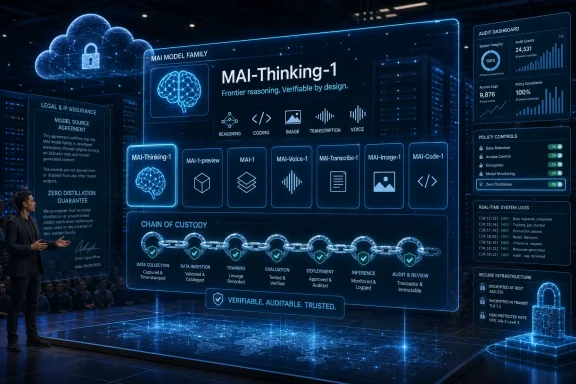 Microsoft Turns Model Provenance Into a Product Feature
The most revealing part of the announcement was not the 97 percent AIME score, the SWE-Bench Pro comparison, or Mustafa Suleyman’s claim that early independent testers preferred MAI-Thinking-1 over Claude Sonnet 4.6 in blind side-by-side evaluations. Those numbers matter, especially to developers who want to know whether Microsoft’s internal models are serious. But the strategic payload was Microsoft’s repeated insistence that MAI-Thinking-1 was built “from scratch” and with “absolutely zero distillation.”That is a loaded phrase in 2026. Distillation has become one of the AI industry’s least glamorous but most consequential practices: a smaller or cheaper model learns from the outputs, traces, or behavior of a larger model. It can make model development faster and cheaper, but it also muddies the ownership chain. If a model has absorbed behavior from a rival model that may itself have been trained on contested material, enterprise lawyers start asking exactly the kind of questions that slow procurement cycles.
Microsoft’s answer is to make lineage part of the pitch. The company is arguing, in effect, that an AI model is not merely a bundle of capabilities but a chain of custody. The buyer is not just paying for reasoning, coding, speech, or image generation; the buyer is paying for a story about where the model came from and why it is less likely to become a legal headache later.
That message is aimed squarely at enterprises that have spent the last three years watching generative AI lawsuits, copyright disputes, scraping controversies, and platform terms-of-service arguments pile up faster than internal governance committees can process them. For a consumer chatbot, ambiguity is survivable. For a regulated business embedding AI into customer support, software development, legal workflows, or creative production, ambiguity becomes an audit finding waiting to happen.
The Benchmarks Are the Hook, but the Lawyers Are the Audience
Microsoft still had to show that MAI-Thinking-1 can compete technically. A model that is “clean” but mediocre is not an enterprise product; it is a compliance brochure with a GPU bill. So the company came armed with the familiar AI launch grammar: parameter counts, math benchmarks, coding scores, and side-by-side human preferences.MAI-Thinking-1 is described as a mixture-of-experts model with 35 billion active parameters and roughly one trillion total parameters, a design that lets Microsoft position it as more efficient than huge dense models while still strong enough for serious work. Suleyman framed it as Microsoft AI’s first reasoning model, meaning it is designed to spend additional computation working through complex problems rather than simply generating the next plausible chunk of text. In practical terms, that puts it in the same competitive theater as OpenAI’s reasoning models, Anthropic’s extended-thinking systems, and Google’s thinking variants.
The claimed 53 percent score on SWE-Bench Pro is particularly important because enterprise buyers have grown weary of demos that look impressive in chat windows but collapse when asked to perform real software maintenance. Coding agents need to interpret repositories, apply patches, understand tests, and avoid breaking production assumptions. A strong SWE-Bench result does not prove that a model is ready to roam unsupervised through a corporate codebase, but it does suggest Microsoft is building for the developer workflow rather than merely sprinkling Copilot branding over generic language models.
Still, the comparison game cuts both ways. The Gizmodo report notes that Anthropic’s Claude Opus 4.6 sits just below Microsoft’s claimed SWE-Bench Pro result, while OpenAI’s GPT-5.4 is ahead. That is a useful reality check. Microsoft is not claiming undisputed technical supremacy; it is claiming that its model is competitive enough that risk, cost, deployment flexibility, and provenance can become deciding factors.
That is exactly where Microsoft wants the conversation. If the contest is only “whose frontier model is smartest this month,” the leaderboard churn favors specialized labs and whoever has the largest training run ready to ship. If the contest becomes “which model can my company defend in procurement, compliance, security review, and production operations,” Microsoft has decades of enterprise muscle to bring to bear.
“Zero Distillation” Is a Competitive Jab Disguised as Compliance Hygiene
The phrase “zero distillation” does more than reassure customers. It also throws a subtle elbow at the rest of the AI market. Microsoft is implying that some competing models may be harder to explain because they are downstream of other models, other datasets, or other legal assumptions.That does not mean every distilled model is legally suspect. Distillation is a broad technique, and there are legitimate ways to use model outputs, synthetic data, and teacher-student training pipelines. But in a market where even basic training data disclosures remain patchy, Microsoft is betting that uncertainty itself has become commercially useful. It does not have to prove that rivals are unsafe; it only has to make customers value a cleaner paper trail.
This is a classic enterprise software move. Microsoft has spent decades turning messy technical shifts into procurement language: manageability, governance, compliance, identity, lifecycle support, indemnity, data residency, auditability. The company’s genius has rarely been inventing the most elegant technology first. It has been packaging technology in a way that CIOs, CFOs, CISOs, and general counsel can buy without feeling reckless.
AI model provenance is now getting that treatment. A few years ago, the question was whether generative AI worked at all. Then it became whether it could be integrated into productivity suites, IDEs, cloud platforms, and operating systems. Now the more mature question is whether a company can explain what it deployed when a customer, regulator, union, creator, or competitor challenges the system’s output.
For WindowsForum readers, that distinction matters because Microsoft’s AI strategy rarely stays confined to keynote slides. What begins as an Azure AI Foundry or GitHub Models announcement tends to migrate into Visual Studio Code, GitHub Copilot, Microsoft 365 Copilot, Windows experiences, security tooling, and partner platforms. The model lineage argument being tested here could eventually shape the AI features that appear on desktops, in management consoles, and inside developer pipelines.
Microsoft’s OpenAI Safety Net Is Becoming a Negotiating Position
The MAI launch also has to be read against Microsoft’s shifting relationship with OpenAI. Microsoft’s early OpenAI bet remains one of the most consequential technology investments of the past decade, giving Redmond a privileged position when ChatGPT turned generative AI from research curiosity into mainstream product category. But dependence is not the same as control.Over the past year, Microsoft has moved to make its own AI stack less reliant on a single partner. The company’s Microsoft AI organization, led by Suleyman, has been building internal models for voice, image generation, transcription, coding, and now reasoning. The point is not necessarily to sever the OpenAI relationship. It is to make sure Microsoft can negotiate, route workloads, optimize costs, and ship products without waiting for another company’s roadmap.
That is why the seven-model bundle matters. MAI-Thinking-1 may be the headline, but the surrounding models show Microsoft trying to fill in the product surface area that modern AI platforms require. MAI-Image-2.5 and MAI-Image-2.5 Flash target creative generation. MAI-Transcribe-1.5 targets speech-to-text. MAI-Voice-2 and MAI-Voice-2 Flash target speech generation. MAI-Code-1-Flash targets lower-latency coding assistance. Together, they suggest a company assembling a portfolio, not tossing out a lab curiosity.
This is also the point at which Microsoft’s old identity as a platform company reasserts itself. OpenAI may still provide some of the most advanced frontier capabilities available through Microsoft products, but Microsoft wants the orchestration layer, the deployment layer, the identity layer, the management layer, and increasingly the model layer. Azure becomes more valuable when it is not merely a reseller shelf for outside intelligence but the home of Microsoft-controlled intelligence with enterprise guarantees attached.
For developers, that could be good news if it means more choice, lower latency, tighter integration with GitHub Copilot and VS Code, and models tuned for actual Microsoft-stack work. It could be bad news if it means more lock-in, more opaque routing between models, and more pressure to accept AI features that are tightly coupled to Microsoft’s cloud economics. The same strategy that makes procurement easier can also make exit harder.
The “Humanist Superintelligence” Slogan Meets the Enterprise Sales Funnel
Suleyman has spent months framing Microsoft AI around the idea of “humanist superintelligence,” a phrase that tries to distinguish Microsoft’s approach from both accelerationist AGI rhetoric and purely benchmark-driven competition. The language is lofty: AI should serve human agency, remain bounded, and focus on useful domains rather than open-ended autonomy. It is also, inevitably, brand positioning.The MAI launch gives that slogan a more concrete commercial form. Humanist AI, in Microsoft’s telling, is not only about philosophical guardrails. It is about models whose origins are knowable, whose deployment can be governed, and whose behavior can be integrated into existing enterprise controls. The company is trying to collapse safety, compliance, and productivity into one procurement story.
There is an obvious tension here. The same company pitching human-centered AI is also pushing agentic workflows deeper into software development, productivity, and business operations. Reasoning models are attractive precisely because they can take on more complex tasks with less step-by-step human instruction. The more capable they become, the more governance has to move from PowerPoint principles into logging, permissions, sandboxing, review gates, and rollback mechanisms.
That is where Microsoft’s Windows and enterprise heritage becomes both an asset and a risk. On the asset side, Microsoft knows how to build administrative controls, policy frameworks, identity systems, tenant boundaries, and compliance dashboards. On the risk side, Microsoft also has a long history of bundling new platform behaviors so deeply into its ecosystem that opting out becomes a project of its own.
The real test of “humanist” AI will not be whether Microsoft can produce reassuring keynote language. It will be whether administrators get clear controls, whether developers can see which models are being used for which tasks, whether organizations can restrict data flows, and whether users can understand when AI is acting as a suggestion engine versus an operational agent.
Clean Training Data Is a Claim, Not a Force Field
Microsoft’s most aggressive enterprise pitch is that its models have cleaner, commercially licensed data lineage. That is a meaningful claim, but it should not be mistaken for a magic shield. “Licensed” can cover a wide range of arrangements, and “clean” is a term that deserves scrutiny whenever it appears in a model launch.Enterprises should want more detail. What datasets were used? What rights were obtained? Were outputs from other models used at any stage for evaluation, filtering, critique, or reinforcement? What data was excluded? How does Microsoft handle takedown requests, opt-outs, or future court rulings that change the legal landscape? What indemnities, if any, attach to use of the model in production?
These are not academic questions. If an AI-generated image resembles protected work, if a code model emits license-contaminated snippets, or if a reasoning model produces advice traceable to proprietary materials, the buyer may face the business consequences even if the vendor insists the model was responsibly trained. Enterprise customers do not just need marketing claims; they need contractual terms, technical documentation, and operational controls.
The irony is that Microsoft helped create the market expectation that vendors should absorb some of this risk. With Copilot Copyright Commitment and similar enterprise assurances, Microsoft trained customers to ask not only “does the model work?” but “who stands behind it when it does something expensive?” The MAI models extend that logic from output indemnity toward input provenance.
That shift is welcome, but it is incomplete. A model’s training lineage is only one part of the risk surface. Retrieval-augmented generation can introduce sensitive internal documents. Agents can perform actions through APIs. Coding assistants can modify files in ways that pass superficial tests but introduce security flaws. Image and voice systems can create reputational, consent, and fraud risks. Clean training data does not eliminate messy deployment.
The Windows Angle Is Not the Model; It Is the Default
For Windows users and administrators, the immediate MAI announcement may look like cloud and developer news rather than desktop news. That would be too narrow a reading. Microsoft’s AI products tend to travel through the stack: Azure first, GitHub and developer tooling next, Microsoft 365 soon after, and Windows whenever the company believes the feature can be made ambient enough.The company has already been explicit about its desire to make Windows more agentic. That has triggered predictable backlash from users who do not want the operating system to become a subscription-shaped assistant layer. The MAI models will not automatically settle that argument, but they give Microsoft more control over the cost, latency, and policy assumptions behind future Windows AI features.
If Microsoft can run smaller, efficient reasoning or coding models for common tasks, it can make AI feel less like a remote novelty and more like a default component of the computing environment. That could improve accessibility, troubleshooting, search, automation, and developer productivity. It could also make Windows feel increasingly mediated by systems that users did not explicitly ask to invite into every workflow.
Sysadmins should pay attention to the administrative model, not just the AI model. Can organizations disable specific model families? Can they force data residency? Can they audit prompts and actions without creating new privacy liabilities? Can they separate consumer Copilot behaviors from enterprise-governed agents? Can they prevent shadow AI usage through unmanaged endpoints while still giving employees approved tools?
Those are the questions that will determine whether MAI becomes a practical enterprise asset or another source of help-desk tickets and policy exceptions. Microsoft has the infrastructure to answer them well. It also has the commercial incentive to blur the line between useful default and unavoidable dependency.
The AI Race Is Becoming a Supply-Chain Race
The first phase of the generative AI boom rewarded spectacle. Chatbots wrote poems, image models made surreal art, voice systems cloned speech, and code assistants produced demos that felt like science fiction. The next phase is less glamorous but more consequential: customers want to know which systems they can operationalize without creating legal, security, financial, or reputational landmines.That is why Microsoft’s MAI announcement feels like a supply-chain story. The company is not merely saying, “Our model is smart.” It is saying, “Our model has an origin story your lawyers can tolerate, a deployment path your IT department understands, and a vendor relationship your CFO already knows how to manage.” In enterprise technology, that combination is often more powerful than a leaderboard win.
This also explains why Microsoft is unlikely to abandon partnerships even as it builds more of its own models. A platform company benefits from breadth. It can offer OpenAI models, internal MAI models, open models, specialized third-party models, and industry-tuned systems, then use Azure, Microsoft 365, GitHub, and Windows as the distribution machinery. The more chaotic the model market becomes, the more valuable the broker becomes.
But brokerage is not neutrality. Microsoft will have incentives to route customers toward models that improve margins, reduce dependency, fit its compliance narrative, or strengthen its ecosystem. If MAI models become deeply integrated into Copilot and developer tools, customers may have to work harder to understand when they are using Microsoft’s intelligence rather than a partner’s. Model transparency will need to become a feature, not an afterthought.
This is where regulators may eventually take interest. If AI models become embedded in dominant productivity suites, operating systems, and developer platforms, questions about tying, disclosure, switching costs, and data access will follow. Microsoft knows that movie. It lived through the browser wars, the antitrust era, and decades of scrutiny over bundling. The AI version will not look identical, but the platform dynamics rhyme.
Developers Get More Power, and More Procurement Theater
For developers, MAI-Thinking-1 and MAI-Code-1-Flash promise a more specialized Microsoft-native path for AI-assisted engineering. The pitch is obvious: coding models integrated into GitHub Copilot, VS Code, Azure AI Foundry, and the broader Microsoft stack should understand the workflows where many enterprise developers already live. If the models are cheaper or faster than larger frontier systems, they could make agentic coding less of a budget exception and more of a daily habit.The danger is that developers may inherit procurement constraints disguised as model choice. A legal department may prefer a “clean lineage” model even when another model performs better on a given task. A security team may restrict external model access. A finance team may push cheaper flash variants. An engineering manager may be forced to balance productivity against explainability, vendor terms, and internal policy.
That is not necessarily bad. Mature software development already involves trade-offs around licenses, dependencies, cloud services, and support agreements. AI models are becoming another dependency class, and developers will need to treat them with the same seriousness they apply to libraries, containers, build systems, and package registries.
The practical difference is that models are harder to inspect. A library can be audited, forked, pinned, or replaced. A model is usually accessed through an API, governed by vendor behavior, and evaluated through outputs rather than readable source. Even when weights are available, training data and post-training processes often remain opaque. That makes vendor trust a bigger part of the engineering equation than many developers would like.
Microsoft’s advantage is that enterprises already trust it in an imperfect, resigned, operational sense. They may complain about licensing complexity, telemetry, Teams sprawl, Windows defaults, and admin-center churn, but they know how to buy Microsoft. The MAI launch is designed to convert that institutional familiarity into AI adoption.
The Fine Print Will Decide Whether Redmond’s Pitch Holds
The announcement gives Microsoft a strong story, but the story now needs documentation. Claims about clean lineage, zero distillation, commercial licensing, and production confidence are only as useful as the details customers can review. Enterprises should not treat keynote phrasing as due diligence.Microsoft can strengthen its position by publishing model cards with meaningful training disclosures, clear allowed-use terms, evaluation methodology, safety limitations, and data-handling guarantees. It can also make model selection transparent inside Copilot products, rather than hiding routing decisions behind a single brand name. If customers are being sold provenance, they need to see provenance in the product.
The company also needs to avoid overclaiming what benchmarks prove. AIME measures advanced math problem-solving, not enterprise reliability. SWE-Bench Pro is useful for coding-agent evaluation, but it cannot capture every messy reality of proprietary codebases. Human preference studies can reveal perceived quality, but they depend on task design, rater pools, and comparison conditions. None of these numbers should be ignored; none should be treated as destiny.
The broader market will also test Microsoft’s economics. A 35-billion-active-parameter model may be cheaper to serve than larger frontier systems, but reasoning workloads can still be expensive because they use more computation at inference time. Flash models can help, but customers will need predictable pricing and controls to prevent agentic workflows from turning into runaway token meters.
That is the unglamorous enterprise truth behind the AI gold rush. The best model is not always the model with the highest score. It is the model that can be deployed, governed, monitored, paid for, defended, and improved without turning every internal stakeholder meeting into a risk tribunal.
Redmond’s Real Bet Is That Trust Can Beat Raw Capability
The central lesson of the MAI launch is that Microsoft believes the AI market is mature enough for trust to become a differentiator. That does not mean trust in the sentimental sense. It means contractual trust, operational trust, compliance trust, and the kind of trust that lets a CIO tell the board that a deployment is ambitious but not reckless.That is a different race from the one OpenAI ignited with ChatGPT. It is less about wonder and more about institutional adoption. Microsoft is good at that race because it has spent decades turning technology shifts into enterprise defaults.
The most concrete takeaways are these:
- Microsoft’s MAI-Thinking-1 is being positioned as a competitive reasoning model, but its clean-lineage story is just as central as its benchmark performance.
- The “zero distillation” claim is a direct appeal to enterprise buyers worried about copyright, data provenance, and downstream legal exposure.
- The seven-model launch shows Microsoft building a broader in-house AI portfolio across reasoning, coding, image generation, transcription, and voice.
- Microsoft’s OpenAI partnership remains important, but MAI gives Redmond more leverage, independence, and control over its AI product roadmap.
- Windows and Microsoft 365 administrators should watch governance controls closely, because today’s model announcements often become tomorrow’s default platform features.
- The credibility of Microsoft’s pitch will depend on documentation, contractual terms, auditability, and transparent model routing, not just keynote claims.
References
- Primary source: Gizmodo
Published: Tue, 02 Jun 2026 21:05:04 GMT
Microsoft Targets Legal Fears to Sell Its Powerful New AI Model to Businesses
MAI-Thinking-1 is one of seven new models the company announced today, less than one year after unveiling its first in-house models. gizmodo.com
- Official source: microsoft.ai
MAI-Thinking-1 | Microsoft AI
 microsoft.ai
- Related coverage: chatforest.com
MAI-Thinking-1: Microsoft's First Reasoning Model Is Not a Distillation — ChatForest
Microsoft announced MAI-Thinking-1 at Build 2026 — a reasoning model trained from scratch, not distilled from GPT-4 or any other frontier model. It's bundled with GitHub Copilot Enterprise and runs inside Azure Confidential Computing enclaves. Here's what builders need to know.chatforest.com - Related coverage: techcrunch.com
Microsoft takes on AI rivals with three new foundational models | TechCrunch
MAI released models that can transcribe voice into text as well as generate audio and images after the group's formation six months ago.techcrunch.com - Related coverage: geekwire.com
Microsoft releases new AI models to expand further beyond OpenAI – GeekWire
Microsoft announced MAI-Transcribe-1, a new speech-to-text model, and made its in-house MAI-Voice-1 and MAI-Image-2 models broadly available to developers for commercial use for the first time, expanding its proprietary AI capabilities beyond its OpenAI partnership.www.geekwire.com - Related coverage: numerama.com
La guerre des IA repart de plus belle : Microsoft dévoile ses propres modèles MAI - Numerama
À l’occasion de sa conférence Build 2026, Microsoft a dévoilé une famille de sept nouveaux modèles d'IA développés en interne. Cette nouvelle gamme s'étend notamment de la génération d'images à la gestion de la voix. La guerre de l'intelligence artificielle générative monte... www.numerama.com
- Related coverage: computerworld.com
Microsoft builds its own AI stack to help wean it from its reliance on OpenAI – Computerworld
New proprietary models reduce Microsoft's dependence on its biggest AI partner, even as the two maintain a fragile alliance. www.computerworld.com
- Related coverage: business-standard.com
Microsoft unveils in-house image generation model in pivot away from OpenAI | Tech News - Business Standard
Microsoft unveils MAI-Image-1, its first fully in-house text-to-image AI model, now available for public testing on LMArenawww.business-standard.com
- Related coverage: tech.yahoo.com
Microsoft debuts Scout agent, homegrown reasoning model
Microsoft used its Build developer conference on Tuesday to debut the company's first internally developed reasoning model, along with a personal AI agent dubbed Scout that is built on top of OpenClaw.tech.yahoo.com - Related coverage: ca.finance.yahoo.com
Microsoft debuts in-house AI models as it looks to ease reliance on OpenAI
Microsoft launched slew of AI models as it looks to ease dependence on OpenAI.ca.finance.yahoo.com - Related coverage: ashgabattimes.com
- Related coverage: techxplore.com
- Official source: blogs.microsoft.com
The next phase of the Microsoft-OpenAI partnership - The Official Microsoft Blog
Amended Agreement Provides Long-Term Clarity The rapid pace of innovation requires us to continue to evolve our partnership to benefit our customers and both companies. Today, we are announcing an amended agreement to simplify our partnership and the way we work together, grounded in...blogs.microsoft.com - Related coverage: axios.com
Microsoft bets on superintelligence race after OpenAI deal reset
"Humanist Superintelligence" is an effort to build safer models.www.axios.com
- Related coverage: fortune.com
Microsoft, freed from reliance on OpenAI, joins the race for ‘superintelligence’—and AI chief Mustafa Suleyman wants to ensure it serves humanity | Fortune
The new Microsoft team, focused on “humanist superintelligence,” will move fast—but within the constraints of “making sure it doesn’t harm us.”fortune.com
- Related coverage: computerworld.es
Microsoft crea un equipo de “superinteligencia humanista” | Computerworld.es
El propósito del gigante de Redmond es convertirlo en un lugar para investigar y desarrollar IA como "tecnología práctica diseñada explícitamente para servir a la humanidad", tal y como defiende Mustafa Suleyman, jefe de IA de Microsoft, bajo cuyo paraguas se halla este proyecto. www.computerworld.es
- Official source: openai.com
El próximo capítulo de la alianza entre Microsoft y OpenAI | OpenAI
Microsoft y OpenAI firmaron un nuevo acuerdo que afianza su asociación a largo plazo, amplía sus horizontes de innovación y garantiza un desarrollo responsable de la IA.openai.com - Related coverage: winbuzzer.com
Microsoft Launches ‘Humanist Superintelligence’ Team, Charting AI Path Independent of OpenAI
Microsoft has formed a new Superintelligence Team under Mustafa Suleyman, aiming to build 'humanist' AI and signaling a strategic pivot from OpenAI. winbuzzer.com
- Related coverage: es.wired.com
Microsoft desarrolla una superinteligencia humanista que promete no dañar a la humanidad | WIRED
Mustafa Suleyman, jefe de Microsoft AI, asegura que esta nueva IA es subordinada, controlable y está diseñada solo para “servir a la humanidad”.es.wired.com - Related coverage: tomshardware.com
OpenAI and Microsoft sign agreement to restructure OpenAI into a public benefit corporation with Microsoft retaining 27% stake — non-profit 'Open AI Foundation' to oversee 'Open AI PBC' | Tom's Hardware
Microsoft's 27% stake is worth $135 billion right now.www.tomshardware.com - Related coverage: testingcatalog.com
Microsoft released MAI voice and image models for Build 2026
Microsoft is preparing several AI models, including MAI-Image-2.5, MAI-Transcribe-1.5, and multilingual MAI-Voice-2, for unveiling at Build 2026. www.testingcatalog.com
- Related coverage: windowscentral.com
Microsoft AI CEO pushes back against critics after recent Windows AI backlash — "the fact that people are unimpressed ... is mindblowing to me" | Windows Central
Mustafa Suleyman says people that are unimpressed with AI's capabilities are mind blowing to him, after recent backlash around Copilot and Windows as an agentic OS.www.windowscentral.com - Related coverage: theweek.com
Microsoft pursues digital intelligence ‘aligned to human values’ in shift from OpenAI | The Week
The iconic tech giant is jumping into the AI game with a bold new initiative designed to place people first in the search for digital intelligencetheweek.com - Related coverage: time.com
OpenAI Reorganizaes With $135 Billion Microsoft Stake
The nonprofit arm, now called the OpenAI Foundation, will have a $130 billion stake in the for-profit enterprise.time.com
