

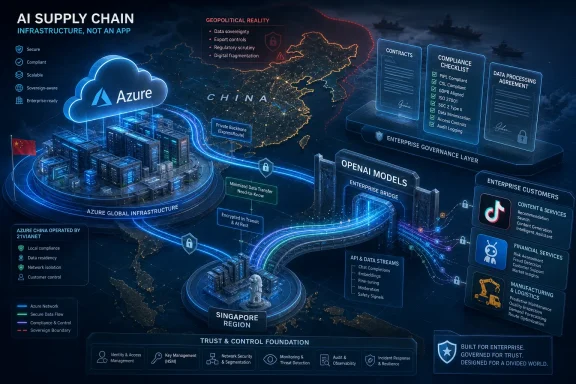
Microsoft is supplying OpenAI’s GPT models to major Chinese technology companies through Azure regions outside mainland China, with reports on June 18, 2026 naming ByteDance, Ant Group, Tencent and Meituan as customers despite OpenAI and Anthropic avoiding direct China-market service. That arrangement is not a loophole in the cartoon sense; it is what happens when cloud contracts, export politics, and enterprise demand collide. Microsoft has become the bridge OpenAI would rather not be seen crossing. The result is a new AI supply chain in which the most sensitive technology in the software industry moves not as a consumer app, but as cloud capacity, compliance paperwork, and negotiated access.
The story is easy to misread as a contradiction: OpenAI does not directly serve China, yet Chinese companies can reportedly access OpenAI models through Microsoft. But the AI economy is full of this kind of institutional plumbing. The consumer brand says one thing, the enterprise cloud contract permits another, and the geopolitical consequence lives in the gap between them.
Microsoft’s position is unusually powerful because Azure OpenAI Service is not merely a reseller storefront. It is the enterprise distribution channel that turned OpenAI’s models from a Silicon Valley phenomenon into something banks, manufacturers, retailers, and governments could procure under familiar cloud terms. That distinction matters in China as much as it does in New York, London, or Singapore.
The company has long argued that its China exposure is financially modest. Brad Smith told U.S. lawmakers in 2024 that China accounted for roughly 1.5 percent of Microsoft’s global revenue, a number meant to reassure Congress that Microsoft is not strategically captured by the Chinese market. Yet small percentages can conceal large leverage when the product is AI infrastructure and the customers are some of the world’s most technically capable platform companies.
ByteDance is the emblematic case. A company that operates TikTok globally and Douyin domestically does not buy AI the way a midsize firm buys chatbots for HR. It buys inference capacity, developer tooling, model access, and cloud elasticity at industrial scale. If reports that ByteDance may spend more than $1 billion annually on AI and cloud services prove directionally right, Microsoft is not selling a feature; it is selling a strategic input to a company sitting at the center of the U.S.-China technology argument.
That is why this is not just another “Microsoft sells cloud services” story. Azure is becoming the neutral-looking layer through which political non-decisions become commercial facts. OpenAI can say it does not directly serve Chinese companies. Microsoft can say it serves eligible enterprise customers through offshore regions and monitoring controls. Chinese firms can say they are buying from a legitimate cloud provider. Everyone gets a sentence that is technically defensible, while the system as a whole keeps moving.
That is the anxiety behind distillation, the practice of using the outputs of a larger model to train or tune a smaller one. In benign settings, distillation is a normal technique for making AI systems cheaper, faster, and more deployable. In a competitive setting, it becomes a way to convert someone else’s expensive frontier model into synthetic training data for a rival product.
OpenAI has reportedly pressed Microsoft to strengthen safeguards so Chinese customers cannot use GPT outputs to train their own models. The problem is that this is far easier to write into a contract than to enforce in the wild. A model output can be logged, transformed, mixed with human-written material, folded into evaluation sets, or used to bootstrap agent behavior. Once text leaves the service boundary, it becomes very difficult to distinguish “ordinary use” from “model development ingredient.”
Microsoft’s countermeasure, according to reporting, is to keep GPT access for Chinese customers outside mainland China, using overseas regions such as Singapore rather than servers in China. It also says it monitors usage patterns automatically and generally focuses service on existing corporate customers rather than anonymous individual developers. Those are not trivial controls. They make abuse more expensive, easier to flag, and more accountable than a public free-for-all.
But they do not resolve the fundamental asymmetry. Microsoft can monitor prompts and outputs moving through its systems; it cannot fully govern what a sophisticated customer later does with the resulting information. The more capable the customer, the less comforting the control layer becomes.
This is the uncomfortable commercial truth: Microsoft’s safeguards are meant to make GPT access governable enough for enterprise sale, not hermetically sealed against every strategic misuse. That may be the only practical standard available. It is also exactly the kind of standard that leaves model developers nervous and policymakers dissatisfied.
The difference is not simply moral theater. Anthropic’s entire brand is built around safety, controlled deployment, and a slower-burn enterprise trust story. Entering a supply chain where Chinese customers might access models through another company’s cloud would complicate that posture. It would also expose Anthropic to the same distillation fears now shadowing OpenAI, without Microsoft’s long history of operating in China as a political shock absorber.
OpenAI occupies a more conflicted position. Its partnership with Microsoft gave it the compute, distribution, and enterprise credibility needed to become a de facto standard. But the same partnership means OpenAI does not fully control the commercial surface area through which GPT models are sold. The frontier lab and the cloud giant are aligned in broad strategy, but not always in risk appetite.
That divergence will matter more as AI becomes less like software licensing and more like energy trading. Model access is capacity. Capacity is routed through regions. Regions have regulatory meanings. Customers with enough money can shop across jurisdictions, vendors, and contractual wrappers. The lab may define the model; the cloud decides where and how it becomes infrastructure.
Microsoft, unlike OpenAI or Anthropic, has decades of experience being useful to governments and corporations that dislike each other. It sells Windows to consumers, Azure to regulated industries, Microsoft 365 to multinationals, and security tools to agencies that may be investigating the same supply chains Microsoft serves. That institutional muscle is exactly why Azure is attractive here. It is also why Microsoft will draw more scrutiny than a smaller vendor would.
But AI changes the meaning of marginal revenue. A customer buying GPT inference at scale is not equivalent to a customer buying Office seats. The former can shape product roadmaps, capacity planning, pricing strategy, regional deployment, and the competitive dynamics of model ecosystems. A small slice of revenue can still represent a large slice of strategic consequence.
That is especially true when the customers are Chinese platform companies with their own model ambitions. ByteDance, Tencent, Ant Group, and Meituan are not passive adopters waiting for Copilot to summarize meeting notes. They are companies with enormous data assets, product surfaces, engineering teams, and reasons to build or improve domestic AI systems. Selling them frontier-model access is commercially rational and strategically fraught.
For Microsoft, the attraction is obvious. If American AI companies refuse to serve Chinese demand directly, Azure can capture the enterprise spend while keeping access inside a monitored, contractual framework. Microsoft can argue that this is better than pushing Chinese companies toward less transparent channels or entirely domestic alternatives. In Washington, that is likely to be the company’s preferred defense: engagement under rules beats uncontrolled substitution.
The counterargument is just as obvious. If the United States is trying to maintain an AI lead, then allowing strategic Chinese firms to use U.S.-developed frontier models through offshore cloud regions may erode that lead, even if no chips are shipped and no source code changes hands. In an AI economy, access to outputs can be access to capability. The line between using a model and learning from it is thinner than export-control language would like.
This is where the debate will get harder for regulators. Traditional controls focus on hardware, source code, and direct transfer. Model services are different. They are ephemeral, metered, and geographically abstracted. Nothing necessarily crosses a border in the old sense, yet the useful work does.
Singapore has become one of the most important pressure valves in the AI infrastructure map. It is close enough to serve Asia-Pacific demand, trusted enough for multinational enterprise deployments, and outside mainland China’s direct cloud sovereignty regime. For companies navigating U.S. restrictions and Chinese demand, that combination is gold.
But offshore routing does not automatically settle the policy question. If the concern is whether Chinese companies can benefit from American frontier models, the location of the inference server is only part of the answer. A prompt submitted from one jurisdiction and processed in another can still produce an output that becomes useful inside a third. Cloud geography is real, but it is not the same thing as strategic containment.
For WindowsForum readers who manage enterprise systems, this should sound familiar. The cloud has spent 15 years teaching administrators that “where the data lives” is a layered question: tenancy, region, control plane, support access, logging, backups, identity, and contractual jurisdiction all matter. AI adds another layer: where the capability is consumed and what the customer can extract from the interaction.
Microsoft’s data-center architecture gives it knobs to turn. It can restrict regions, log usage, require enterprise identity, impose contractual limits, and flag anomalous calls. Those knobs are meaningful for compliance. They are less decisive when the thing being governed is the semantic content of billions of model completions.
This is why “overseas data centers” is a control, not a cure. It reduces some risks and creates an audit trail. It does not make GPT access geopolitically neutral.
That does not mean distillation magically reproduces a frontier lab. A student model trained on teacher outputs may inherit patterns but not the full depth of the original training regime. It may also absorb errors, stylistic quirks, or shallow approximations. Still, for many commercial uses, “close enough at a fraction of the cost” is not a consolation prize; it is the winning product.
This is precisely why U.S. labs are worried about Chinese competitors. If a domestic Chinese model can reach attractive performance at dramatically lower cost, it can win developers, startups, and government customers in markets where U.S. services are too expensive, unavailable, or politically inconvenient. DeepSeek’s rise made that fear tangible. Whether every accusation about its training history is proved or not, the market learned that low-cost Chinese models could change the pricing psychology of AI almost overnight.
Microsoft is caught on both sides of that lesson. It sells premium access to OpenAI models through Azure, but it also has incentives to support cheaper models that make enterprise AI agents economical at scale. Reports that Microsoft has tested DeepSeek-based technology for low-cost enterprise agent workloads fit the broader direction of the industry. Customers do not want ideological purity in their model stack; they want acceptable accuracy at a price that does not turn every workflow into a GPU bonfire.
The irony is sharp. Microsoft may be helping Chinese firms access GPT models while also evaluating Chinese-origin models to lower costs for its own enterprise customers. That is not hypocrisy so much as cloud capitalism. Azure wants to be the platform where models compete, regardless of whether the model came from San Francisco, Beijing, Paris, Abu Dhabi, or Redmond.
For OpenAI, that platform logic is both blessing and threat. Azure made GPT ubiquitous in enterprise settings. But a model marketplace eventually reduces even the most famous model into one option among many, routed by cost, latency, policy, and task fit.
Chinese AI firms have leaned into that opening. DeepSeek, MiniMax, Xiaomi’s MiMo, Alibaba’s Qwen ecosystem, Tencent’s Hunyuan efforts, and ByteDance’s Doubao family all occupy different parts of a landscape that is increasingly difficult to dismiss as derivative. Some models may trail the best U.S. systems on frontier benchmarks, but they can be compelling when cost, language coverage, local integration, and deployment flexibility are weighted heavily.
This matters for Microsoft because enterprise AI is running into budget reality. The first wave of generative AI pilots was sold on transformation; the second wave is being judged by unit economics. CIOs are asking how much it costs to summarize every support ticket, generate every code suggestion, classify every document, or operate every internal agent. At that scale, the difference between dollars and cents per task is not trivia. It is the business case.
If Chinese models offer credible performance at radically lower prices, U.S. developers and startups will test them, even if some enterprises avoid them for security or compliance reasons. In software, cheaper infrastructure has a way of pulling innovation toward itself. Linux did it to operating systems, open-source databases did it to enterprise software, and commodity cloud services did it to hardware procurement. AI models are not exempt from that gravity.
This is why the China question cannot be answered only by blocking access. If the U.S. model ecosystem remains expensive and restrictive while Chinese alternatives become cheap and good enough, the market will route around policy. The smarter American strategy would pair sensible controls with aggressive cost reduction, open model availability where appropriate, and cloud deployment patterns that make trusted AI affordable.
Microsoft appears to understand that better than almost anyone. Its public posture is responsible access; its commercial instinct is model abundance. Those two forces can coexist for a while. They will not always point in the same direction.
But enterprise customers should pay attention because this is how AI governance will actually look: messy, regional, contractual, and layered over existing cloud relationships. The same Azure tenant that hosts identity, productivity data, security telemetry, and application workloads may also become the broker for multiple model families with different legal, ethical, and supply-chain profiles. AI procurement will not be a single vendor checkbox. It will be an architecture decision.
Administrators will need to ask harder questions than “is this model good?” They will need to know where inference occurs, what logs are retained, whether prompts are used for training, which subcontractors or partner models are involved, what regional failover means, and whether a supposedly blocked service is still reachable through a cloud wrapper. The Microsoft-China example is a preview of those ambiguities, not an exception to them.
Developers should also internalize the lesson. Model choice is becoming dynamic. A coding agent may use one model for planning, another for code generation, another for cheap test generation, and another for long-context documentation review. The user may never see those switches. The procurement and security teams, however, will need to understand them.
Security teams face a particularly awkward challenge. If distillation is difficult to detect at the provider level, it is even harder inside a large enterprise using AI across many teams. Employees can generate synthetic examples, copy outputs into local datasets, and build internal tools that blur the line between use and training. Policy will have to be backed by logging, education, and technical controls, not just stern language in an acceptable-use document.
Microsoft’s own customers should expect more transparency demands. If Azure becomes the place where OpenAI, Microsoft’s in-house models, Anthropic where available, DeepSeek-derived systems, and other third-party models all coexist, enterprises will want a clearer bill of materials for AI. In the software world, the SBOM became a response to dependency risk. AI needs an equivalent vocabulary for model lineage, region, training restrictions, and output handling.
Microsoft will likely argue that it follows applicable law, serves eligible enterprise customers, and uses overseas regions and monitoring to reduce abuse. That defense may be accurate. It may also be insufficient for a Congress that increasingly sees AI as strategic infrastructure rather than ordinary software.
The harder policy question is whether model inference should be regulated like an export-controlled technology when sold at scale to certain foreign customers. If the answer is yes, regulators will need mechanisms that go beyond chip bans. They would need to define restricted model capabilities, customer categories, volume thresholds, region rules, audit obligations, and penalties for misuse. That is a much more complicated regime than blocking a GPU shipment.
The risk is that regulation arrives late and blunt. A poorly designed restriction could push customers toward less visible providers, disadvantage U.S. cloud companies, and accelerate domestic Chinese alternatives without materially improving security. A permissive regime, on the other hand, could allow frontier capabilities to diffuse faster than policymakers understand. Neither path is clean.
Microsoft is an especially difficult target because it is also a national asset in the U.S. technology stack. The same company under scrutiny for China-related AI access provides cloud services to U.S. agencies, cybersecurity tools to enterprises, productivity software to government workers, and infrastructure for American AI labs. Washington can pressure Microsoft, but it cannot treat the company as disposable.
That gives Microsoft leverage, but not immunity. The more Azure becomes the operating layer of global AI, the more its regional business decisions will be interpreted as foreign policy choices. Redmond may prefer to speak in terms of customers and compliance. The rest of the world will hear alignment, leakage, and influence.
That invisibility is part of the power. A Chinese company does not need to receive a boxed copy of GPT, or a server full of model weights, to benefit from GPT. It can call the model through a cloud interface, integrate outputs into workflows, evaluate performance, and learn where domestic systems fall short. The service may be temporary, metered, and restricted, yet still strategically informative.
This is why the Microsoft arrangement deserves more scrutiny than a routine reseller story. It shows how AI capability can travel through institutional channels designed for ordinary enterprise software. The compliance vocabulary is familiar, but the strategic stakes are different.
For Microsoft, the ideal future is one in which Azure becomes the trusted global exchange for AI capability. Customers bring identity, data, applications, and governance; Microsoft supplies model choice, monitoring, region control, and billing. In that vision, OpenAI is a premium supplier, not the sovereign of the ecosystem.
For OpenAI, the ideal future is one in which its models remain both widely deployed and tightly controlled. Those goals were never perfectly compatible. The more useful GPT becomes, the more every major enterprise and platform company wants access. The more access expands, the more the model’s behavior becomes observable, reproducible, and potentially useful to rivals.
China exposes the contradiction because the stakes are geopolitical, but the same tension exists everywhere. Banks want private deployments. Governments want sovereign AI. Developers want cheaper models. Startups want portability. Cloud platforms want marketplaces. Frontier labs want control. The AI stack is being pulled apart by the needs of the very customers that made it valuable.
 Microsoft Has Turned Ambiguity Into Infrastructure
The story is easy to misread as a contradiction: OpenAI does not directly serve China, yet Chinese companies can reportedly access OpenAI models through Microsoft. But the AI economy is full of this kind of institutional plumbing. The consumer brand says one thing, the enterprise cloud contract permits another, and the geopolitical consequence lives in the gap between them.Microsoft’s position is unusually powerful because Azure OpenAI Service is not merely a reseller storefront. It is the enterprise distribution channel that turned OpenAI’s models from a Silicon Valley phenomenon into something banks, manufacturers, retailers, and governments could procure under familiar cloud terms. That distinction matters in China as much as it does in New York, London, or Singapore.
The company has long argued that its China exposure is financially modest. Brad Smith told U.S. lawmakers in 2024 that China accounted for roughly 1.5 percent of Microsoft’s global revenue, a number meant to reassure Congress that Microsoft is not strategically captured by the Chinese market. Yet small percentages can conceal large leverage when the product is AI infrastructure and the customers are some of the world’s most technically capable platform companies.
ByteDance is the emblematic case. A company that operates TikTok globally and Douyin domestically does not buy AI the way a midsize firm buys chatbots for HR. It buys inference capacity, developer tooling, model access, and cloud elasticity at industrial scale. If reports that ByteDance may spend more than $1 billion annually on AI and cloud services prove directionally right, Microsoft is not selling a feature; it is selling a strategic input to a company sitting at the center of the U.S.-China technology argument.
That is why this is not just another “Microsoft sells cloud services” story. Azure is becoming the neutral-looking layer through which political non-decisions become commercial facts. OpenAI can say it does not directly serve Chinese companies. Microsoft can say it serves eligible enterprise customers through offshore regions and monitoring controls. Chinese firms can say they are buying from a legitimate cloud provider. Everyone gets a sentence that is technically defensible, while the system as a whole keeps moving.
OpenAI’s China Problem Has Become Microsoft’s Business Model
OpenAI’s reluctance to serve Chinese customers directly is not hard to understand. The company’s frontier models are valuable not just because they answer questions, but because they encode patterns of reasoning, code generation, summarization, translation, and tool use that competitors would love to imitate. For a model lab, every API response is both a service and a potential training artifact.That is the anxiety behind distillation, the practice of using the outputs of a larger model to train or tune a smaller one. In benign settings, distillation is a normal technique for making AI systems cheaper, faster, and more deployable. In a competitive setting, it becomes a way to convert someone else’s expensive frontier model into synthetic training data for a rival product.
OpenAI has reportedly pressed Microsoft to strengthen safeguards so Chinese customers cannot use GPT outputs to train their own models. The problem is that this is far easier to write into a contract than to enforce in the wild. A model output can be logged, transformed, mixed with human-written material, folded into evaluation sets, or used to bootstrap agent behavior. Once text leaves the service boundary, it becomes very difficult to distinguish “ordinary use” from “model development ingredient.”
Microsoft’s countermeasure, according to reporting, is to keep GPT access for Chinese customers outside mainland China, using overseas regions such as Singapore rather than servers in China. It also says it monitors usage patterns automatically and generally focuses service on existing corporate customers rather than anonymous individual developers. Those are not trivial controls. They make abuse more expensive, easier to flag, and more accountable than a public free-for-all.
But they do not resolve the fundamental asymmetry. Microsoft can monitor prompts and outputs moving through its systems; it cannot fully govern what a sophisticated customer later does with the resulting information. The more capable the customer, the less comforting the control layer becomes.
This is the uncomfortable commercial truth: Microsoft’s safeguards are meant to make GPT access governable enough for enterprise sale, not hermetically sealed against every strategic misuse. That may be the only practical standard available. It is also exactly the kind of standard that leaves model developers nervous and policymakers dissatisfied.
Anthropic’s Refusal Makes Microsoft Look More Exposed
Anthropic’s reported absence from Microsoft’s China-facing AI lineup is a revealing contrast. Claude has become a major enterprise model family in the West, especially for coding, document analysis, and long-context work. But Anthropic has taken a more conservative posture toward China-linked access, and that caution has reportedly affected how some financial institutions approve the tool in Hong Kong and related markets.The difference is not simply moral theater. Anthropic’s entire brand is built around safety, controlled deployment, and a slower-burn enterprise trust story. Entering a supply chain where Chinese customers might access models through another company’s cloud would complicate that posture. It would also expose Anthropic to the same distillation fears now shadowing OpenAI, without Microsoft’s long history of operating in China as a political shock absorber.
OpenAI occupies a more conflicted position. Its partnership with Microsoft gave it the compute, distribution, and enterprise credibility needed to become a de facto standard. But the same partnership means OpenAI does not fully control the commercial surface area through which GPT models are sold. The frontier lab and the cloud giant are aligned in broad strategy, but not always in risk appetite.
That divergence will matter more as AI becomes less like software licensing and more like energy trading. Model access is capacity. Capacity is routed through regions. Regions have regulatory meanings. Customers with enough money can shop across jurisdictions, vendors, and contractual wrappers. The lab may define the model; the cloud decides where and how it becomes infrastructure.
Microsoft, unlike OpenAI or Anthropic, has decades of experience being useful to governments and corporations that dislike each other. It sells Windows to consumers, Azure to regulated industries, Microsoft 365 to multinationals, and security tools to agencies that may be investigating the same supply chains Microsoft serves. That institutional muscle is exactly why Azure is attractive here. It is also why Microsoft will draw more scrutiny than a smaller vendor would.
The China Revenue Number Is Small, but the Strategic Signal Is Large
Microsoft’s “only about 1.5 percent of revenue” argument is both true and incomplete. On a consolidated income statement, China is not the engine of Redmond’s business. Microsoft’s real profit centers remain global cloud, productivity software, Windows licensing, gaming, and enterprise security.But AI changes the meaning of marginal revenue. A customer buying GPT inference at scale is not equivalent to a customer buying Office seats. The former can shape product roadmaps, capacity planning, pricing strategy, regional deployment, and the competitive dynamics of model ecosystems. A small slice of revenue can still represent a large slice of strategic consequence.
That is especially true when the customers are Chinese platform companies with their own model ambitions. ByteDance, Tencent, Ant Group, and Meituan are not passive adopters waiting for Copilot to summarize meeting notes. They are companies with enormous data assets, product surfaces, engineering teams, and reasons to build or improve domestic AI systems. Selling them frontier-model access is commercially rational and strategically fraught.
For Microsoft, the attraction is obvious. If American AI companies refuse to serve Chinese demand directly, Azure can capture the enterprise spend while keeping access inside a monitored, contractual framework. Microsoft can argue that this is better than pushing Chinese companies toward less transparent channels or entirely domestic alternatives. In Washington, that is likely to be the company’s preferred defense: engagement under rules beats uncontrolled substitution.
The counterargument is just as obvious. If the United States is trying to maintain an AI lead, then allowing strategic Chinese firms to use U.S.-developed frontier models through offshore cloud regions may erode that lead, even if no chips are shipped and no source code changes hands. In an AI economy, access to outputs can be access to capability. The line between using a model and learning from it is thinner than export-control language would like.
This is where the debate will get harder for regulators. Traditional controls focus on hardware, source code, and direct transfer. Model services are different. They are ephemeral, metered, and geographically abstracted. Nothing necessarily crosses a border in the old sense, yet the useful work does.
Singapore Becomes the Cloud Era’s Convenient Border
The reported use of overseas data centers such as Singapore is not an incidental detail. It is the mechanism that lets everyone preserve their preferred fiction. The service is not hosted in mainland China. The customer is not necessarily buying from OpenAI. The transaction occurs through Azure’s global cloud posture rather than China’s physically and legally distinct cloud environment.Singapore has become one of the most important pressure valves in the AI infrastructure map. It is close enough to serve Asia-Pacific demand, trusted enough for multinational enterprise deployments, and outside mainland China’s direct cloud sovereignty regime. For companies navigating U.S. restrictions and Chinese demand, that combination is gold.
But offshore routing does not automatically settle the policy question. If the concern is whether Chinese companies can benefit from American frontier models, the location of the inference server is only part of the answer. A prompt submitted from one jurisdiction and processed in another can still produce an output that becomes useful inside a third. Cloud geography is real, but it is not the same thing as strategic containment.
For WindowsForum readers who manage enterprise systems, this should sound familiar. The cloud has spent 15 years teaching administrators that “where the data lives” is a layered question: tenancy, region, control plane, support access, logging, backups, identity, and contractual jurisdiction all matter. AI adds another layer: where the capability is consumed and what the customer can extract from the interaction.
Microsoft’s data-center architecture gives it knobs to turn. It can restrict regions, log usage, require enterprise identity, impose contractual limits, and flag anomalous calls. Those knobs are meaningful for compliance. They are less decisive when the thing being governed is the semantic content of billions of model completions.
This is why “overseas data centers” is a control, not a cure. It reduces some risks and creates an audit trail. It does not make GPT access geopolitically neutral.
Distillation Is the Word That Turns Product Access Into Industrial Policy
The debate over distillation is often presented as an arcane model-training issue, but it is really about the economics of catching up. Training a frontier model from scratch requires data pipelines, talent, infrastructure, evaluation, safety work, and staggering capital expenditure. Training a smaller system to imitate a larger one can reduce the cost of competence.That does not mean distillation magically reproduces a frontier lab. A student model trained on teacher outputs may inherit patterns but not the full depth of the original training regime. It may also absorb errors, stylistic quirks, or shallow approximations. Still, for many commercial uses, “close enough at a fraction of the cost” is not a consolation prize; it is the winning product.
This is precisely why U.S. labs are worried about Chinese competitors. If a domestic Chinese model can reach attractive performance at dramatically lower cost, it can win developers, startups, and government customers in markets where U.S. services are too expensive, unavailable, or politically inconvenient. DeepSeek’s rise made that fear tangible. Whether every accusation about its training history is proved or not, the market learned that low-cost Chinese models could change the pricing psychology of AI almost overnight.
Microsoft is caught on both sides of that lesson. It sells premium access to OpenAI models through Azure, but it also has incentives to support cheaper models that make enterprise AI agents economical at scale. Reports that Microsoft has tested DeepSeek-based technology for low-cost enterprise agent workloads fit the broader direction of the industry. Customers do not want ideological purity in their model stack; they want acceptable accuracy at a price that does not turn every workflow into a GPU bonfire.
The irony is sharp. Microsoft may be helping Chinese firms access GPT models while also evaluating Chinese-origin models to lower costs for its own enterprise customers. That is not hypocrisy so much as cloud capitalism. Azure wants to be the platform where models compete, regardless of whether the model came from San Francisco, Beijing, Paris, Abu Dhabi, or Redmond.
For OpenAI, that platform logic is both blessing and threat. Azure made GPT ubiquitous in enterprise settings. But a model marketplace eventually reduces even the most famous model into one option among many, routed by cost, latency, policy, and task fit.
Cheap Models Are Now a Geopolitical Weapon
The AI race began as a contest over who could build the most capable model. It is becoming a contest over who can deploy acceptable intelligence cheapest and widest. That shift favors companies and countries willing to compete on price, infrastructure efficiency, and rapid productization.Chinese AI firms have leaned into that opening. DeepSeek, MiniMax, Xiaomi’s MiMo, Alibaba’s Qwen ecosystem, Tencent’s Hunyuan efforts, and ByteDance’s Doubao family all occupy different parts of a landscape that is increasingly difficult to dismiss as derivative. Some models may trail the best U.S. systems on frontier benchmarks, but they can be compelling when cost, language coverage, local integration, and deployment flexibility are weighted heavily.
This matters for Microsoft because enterprise AI is running into budget reality. The first wave of generative AI pilots was sold on transformation; the second wave is being judged by unit economics. CIOs are asking how much it costs to summarize every support ticket, generate every code suggestion, classify every document, or operate every internal agent. At that scale, the difference between dollars and cents per task is not trivia. It is the business case.
If Chinese models offer credible performance at radically lower prices, U.S. developers and startups will test them, even if some enterprises avoid them for security or compliance reasons. In software, cheaper infrastructure has a way of pulling innovation toward itself. Linux did it to operating systems, open-source databases did it to enterprise software, and commodity cloud services did it to hardware procurement. AI models are not exempt from that gravity.
This is why the China question cannot be answered only by blocking access. If the U.S. model ecosystem remains expensive and restrictive while Chinese alternatives become cheap and good enough, the market will route around policy. The smarter American strategy would pair sensible controls with aggressive cost reduction, open model availability where appropriate, and cloud deployment patterns that make trusted AI affordable.
Microsoft appears to understand that better than almost anyone. Its public posture is responsible access; its commercial instinct is model abundance. Those two forces can coexist for a while. They will not always point in the same direction.
Windows and Azure Customers Should Read This as a Governance Warning
For most Windows users, the immediate impact of Microsoft’s China GPT business is indirect. Nobody’s Start menu changes because ByteDance buys Azure capacity in Singapore. Copilot on a Windows 11 PC does not suddenly become a Chinese supply-chain story because Azure sells model access abroad.But enterprise customers should pay attention because this is how AI governance will actually look: messy, regional, contractual, and layered over existing cloud relationships. The same Azure tenant that hosts identity, productivity data, security telemetry, and application workloads may also become the broker for multiple model families with different legal, ethical, and supply-chain profiles. AI procurement will not be a single vendor checkbox. It will be an architecture decision.
Administrators will need to ask harder questions than “is this model good?” They will need to know where inference occurs, what logs are retained, whether prompts are used for training, which subcontractors or partner models are involved, what regional failover means, and whether a supposedly blocked service is still reachable through a cloud wrapper. The Microsoft-China example is a preview of those ambiguities, not an exception to them.
Developers should also internalize the lesson. Model choice is becoming dynamic. A coding agent may use one model for planning, another for code generation, another for cheap test generation, and another for long-context documentation review. The user may never see those switches. The procurement and security teams, however, will need to understand them.
Security teams face a particularly awkward challenge. If distillation is difficult to detect at the provider level, it is even harder inside a large enterprise using AI across many teams. Employees can generate synthetic examples, copy outputs into local datasets, and build internal tools that blur the line between use and training. Policy will have to be backed by logging, education, and technical controls, not just stern language in an acceptable-use document.
Microsoft’s own customers should expect more transparency demands. If Azure becomes the place where OpenAI, Microsoft’s in-house models, Anthropic where available, DeepSeek-derived systems, and other third-party models all coexist, enterprises will want a clearer bill of materials for AI. In the software world, the SBOM became a response to dependency risk. AI needs an equivalent vocabulary for model lineage, region, training restrictions, and output handling.
Washington Will Not Let the Cloud Stay Neutral Forever
The political pressure around this arrangement is almost guaranteed to increase. U.S. lawmakers have already shown interest in Microsoft’s China operations, cyber history, and AI posture. A report that Chinese tech giants are significant buyers of GPT access through Azure gives critics a much easier story to tell.Microsoft will likely argue that it follows applicable law, serves eligible enterprise customers, and uses overseas regions and monitoring to reduce abuse. That defense may be accurate. It may also be insufficient for a Congress that increasingly sees AI as strategic infrastructure rather than ordinary software.
The harder policy question is whether model inference should be regulated like an export-controlled technology when sold at scale to certain foreign customers. If the answer is yes, regulators will need mechanisms that go beyond chip bans. They would need to define restricted model capabilities, customer categories, volume thresholds, region rules, audit obligations, and penalties for misuse. That is a much more complicated regime than blocking a GPU shipment.
The risk is that regulation arrives late and blunt. A poorly designed restriction could push customers toward less visible providers, disadvantage U.S. cloud companies, and accelerate domestic Chinese alternatives without materially improving security. A permissive regime, on the other hand, could allow frontier capabilities to diffuse faster than policymakers understand. Neither path is clean.
Microsoft is an especially difficult target because it is also a national asset in the U.S. technology stack. The same company under scrutiny for China-related AI access provides cloud services to U.S. agencies, cybersecurity tools to enterprises, productivity software to government workers, and infrastructure for American AI labs. Washington can pressure Microsoft, but it cannot treat the company as disposable.
That gives Microsoft leverage, but not immunity. The more Azure becomes the operating layer of global AI, the more its regional business decisions will be interpreted as foreign policy choices. Redmond may prefer to speak in terms of customers and compliance. The rest of the world will hear alignment, leakage, and influence.
The New AI Supply Chain Runs Through Contracts, Not Containers
The old technology supply chain was visible: chips, servers, phones, routers, cables, factories, ports. The new AI supply chain is harder to see. It runs through API endpoints, model licenses, cloud regions, usage logs, capacity reservations, and terms of service.That invisibility is part of the power. A Chinese company does not need to receive a boxed copy of GPT, or a server full of model weights, to benefit from GPT. It can call the model through a cloud interface, integrate outputs into workflows, evaluate performance, and learn where domestic systems fall short. The service may be temporary, metered, and restricted, yet still strategically informative.
This is why the Microsoft arrangement deserves more scrutiny than a routine reseller story. It shows how AI capability can travel through institutional channels designed for ordinary enterprise software. The compliance vocabulary is familiar, but the strategic stakes are different.
For Microsoft, the ideal future is one in which Azure becomes the trusted global exchange for AI capability. Customers bring identity, data, applications, and governance; Microsoft supplies model choice, monitoring, region control, and billing. In that vision, OpenAI is a premium supplier, not the sovereign of the ecosystem.
For OpenAI, the ideal future is one in which its models remain both widely deployed and tightly controlled. Those goals were never perfectly compatible. The more useful GPT becomes, the more every major enterprise and platform company wants access. The more access expands, the more the model’s behavior becomes observable, reproducible, and potentially useful to rivals.
China exposes the contradiction because the stakes are geopolitical, but the same tension exists everywhere. Banks want private deployments. Governments want sovereign AI. Developers want cheaper models. Startups want portability. Cloud platforms want marketplaces. Frontier labs want control. The AI stack is being pulled apart by the needs of the very customers that made it valuable.
Redmond’s China Bet Leaves Five Hard Lessons
Microsoft’s reported GPT sales to Chinese technology companies are not an isolated anomaly. They are a preview of how frontier AI will be distributed when the world wants the capability but cannot agree on the politics. The practical lessons are already visible.- Microsoft has become the enterprise channel through which OpenAI models can reach customers that OpenAI itself may prefer not to serve directly.
- Offshore Azure regions reduce legal and operational risk, but they do not eliminate the possibility that model outputs can be reused for competitive training or evaluation.
- China is a small share of Microsoft’s total revenue, yet Chinese AI demand can still shape Azure strategy because the customers are technically sophisticated and willing to buy at scale.
- Anthropic’s more conservative posture shows that model labs are making different bets about whether distribution risk is worth the revenue and reach.
- Cheap Chinese models are changing the AI market by forcing U.S. vendors to compete not only on benchmark performance, but also on cost, deployment flexibility, and availability.
- Enterprise IT teams should treat model access as a supply-chain issue, with region, vendor, logging, training rights, and output controls reviewed as seriously as software dependencies.
References
- Primary source: 디지털투데이
Published: Fri, 19 Jun 2026 01:32:28 GMT
Microsoft expands GPT model supply to Chinese big tech, OpenAI workaround supply chain emerges
Microsoft is supplying GPT models to major Chinese technology companies through Azure, while OpenAI and Anthropic avoid direct entry into China. Chinese groups including ByteDance, Ant Group and Tencent use the service, as demand and Microsoft’s China AI revenue rise. The arrangement also raises...www.digitaltoday.co.kr - Related coverage: businesstimes.com.sg
Microsoft makes big AI inroads in China by selling OpenAI models - The Business Times
The company operates multiple data centre regions in the country, near Beijing and Shanghai Read more at The Business Times.www.businesstimes.com.sg
- Related coverage: asatunews.co.id
Microsoft Jual Model AI ke Perusahaan China di Tengah Rivalitas AS
Microsoft Corp. tetap menjual bisnis model kecerdasan buatan (AI) ke sejumlah raksasa teknologi asal China di tengah meningkatnya persaingan AS-China.www.asatunews.co.id - Related coverage: axios.com
Microsoft and U.S. join AI forces in UAE deal to elbow out China
The $1.5 billion partnership with UAE's G42 is a big move on AI's geopolitical chessboard.www.axios.com
- Related coverage: scmp.com
Microsoft has limited exposure to China, but US lawmakers still raise questions | South China Morning Post
Microsoft has come under the spotlight amid rising geopolitical tensions, as US lawmakers questioned the company over its ties to the world’s second largest economy.www.scmp.com - Related coverage: windowscentral.com
Microsoft launches seven in‑house AI models to cut developer costs and reduce reliance on OpenAI | Windows Central
Microsoft’s new MAI model family includes a flagship reasoning model, zero distillation, and lower developer costs.www.windowscentral.com
- Related coverage: tomshardware.com
Alibaba and ByteDance allegedly train Qwen and Doubao LLMs using Nvidia chips, despite export controls — Southeast Asian data center leases skirt around U.S. chip restrictions | Tom's Hardware
Alibaba and ByteDance lease Southeast Asian data centers to work around U.S. restrictions.www.tomshardware.com - Related coverage: aimenta.ai
- Related coverage: pymnts.com
PYMNTS | Microsoft Won’t Block China Access to AI Models
OpenAI’s upcoming ban on API access to its AI models in China won’t apply to Microsoft Azure’s customers in the country. www.pymnts.com
- Related coverage: arstechnica.com
Microsoft now hosts AI model accused of copying OpenAI data - Ars Technica
OpenAI's largest investor now sells access to the "R1" model accused of breaking OpenAI's terms.arstechnica.com - Related coverage: computerworld.com
OpenAI models still available in China via Azure cloud despite company ban – Computerworld
Microsoft's circumvention of the restriction could give it a competitive advantage in the ongoing tech trade fight between the US and China. www.computerworld.com
- Official source: learn.microsoft.com
Foundry Models sold by Azure - Microsoft Foundry | Microsoft Learn
Learn about Microsoft Foundry Models sold by Azure, their capabilities, deployment types, and regional availability for AI applications.learn.microsoft.com - Related coverage: cryptobriefing.com
Microsoft expands AI model business in China amid OpenAI, Anthropic concerns
Microsoft's Azure AI revenue in China tripled last fiscal year as ByteDance, Ant Group, and Tencent fuel growth while OpenAI and Anthropic stay on thecryptobriefing.com - Official source: blogs.microsoft.com
Inside the world’s most powerful AI datacenter - The Official Microsoft Blog
This week we have introduced a wave of purpose-built datacenters and infrastructure investments we are making around the world to support the global adoption of cutting-edge AI workloads and cloud services. Today in Wisconsin we introduced Fairwater, our newest US AI datacenter, the largest and...blogs.microsoft.com - Official source: microsoft.com
- Official source: azure.microsoft.com
- Related coverage: cdn-ceo-ca.s3.amazonaws.com
1kmbodm Microsoft warns that China is winning AI race outside the west
PDF documentcdn-ceo-ca.s3.amazonaws.com
