

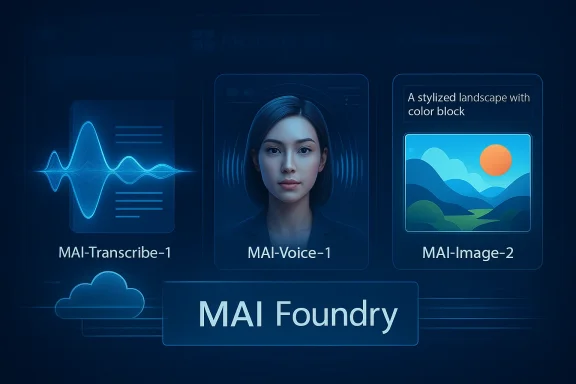
Microsoft’s latest AI move is less a single product launch than a strategic declaration: the company now wants to own more of the core model stack that powers voice, speech, and image experiences across its ecosystem. With the release of MAI-Transcribe-1, MAI-Voice-1, and MAI-Image-2, Microsoft AI is signaling that it intends to compete more directly with OpenAI, Google, Anthropic, and other frontier labs while also reducing dependence on outside model supply. The timing matters, because this is happening after Microsoft’s long partnership with OpenAI was reaffirmed, not abandoned, making the move feel like a hedge as much as a launch. (techcrunch.com)
Microsoft has spent the last several years building an AI strategy that looks increasingly multilayered. On one side, it still leans heavily on OpenAI for marquee generative capabilities in Copilot and Azure OpenAI Service, and the companies’ 2025 partnership update explicitly preserved Microsoft’s rights to OpenAI IP for use in Microsoft products through 2030. On another side, Microsoft has been quietly assembling its own model, infrastructure, and product pipeline, including its Maia silicon, its Foundry catalog, and now a first wave of internal MAI-branded foundation models. (blogs.microsoft.com)
That dual-track approach is not new in the cloud world, but Microsoft is pursuing it with uncommon force. The company can argue that customers benefit from model choice, while also making sure it is never trapped if external pricing, access, or roadmap decisions shift. This is especially important in a market where the fastest-growing AI features are increasingly multimodal, combining speech, text, and image generation in a single workflow. (blogs.microsoft.com)
The immediate significance of the announcement is less about consumer buzz and more about control. Microsoft has already been positioning AI as a platform layer inside Windows, Microsoft 365, Teams, Designer, and Azure, so in-house models give it more room to optimize latency, cost, compliance, and feature design for its own stack. In other words, this is not just about model bragging rights; it is about owning more of the machinery behind future products. (blogs.microsoft.com)
There is also a competitive message embedded in the launch. By releasing models for transcription, voice, and images at roughly the same time, Microsoft is not merely filling product gaps; it is building a credible internal alternative to the outside systems it has relied on, especially in areas where user-visible quality and unit economics matter. That is a very different posture from simply reselling someone else’s model through a cloud API. (techcrunch.com)
At the same time, Microsoft has been building its own speech and voice stack in public for years. Azure Speech already offers speech-to-text, text-to-speech, translation, avatars, and embedded speech features, with Microsoft explicitly promoting use cases such as meeting transcription, voice-enabled agents, call-center workflows, and multilingual communication. That means the new MAI models are not appearing in a vacuum; they are arriving into a mature product surface where Microsoft already has enterprise demand and integration points waiting. (azure.microsoft.com)
The hardware side matters too. Microsoft’s Maia 200 announcement in January 2026 revealed a much clearer appetite for first-party AI infrastructure, including the company’s own inference accelerator and a roadmap that explicitly mentions use for next-generation in-house models. That combination of custom silicon and proprietary models is the classic hyperscaler playbook, and Microsoft now appears to be applying it more aggressively to AI than it ever did to search or productivity software. (blogs.microsoft.com)
The OpenAI relationship is still central to understanding this moment. Microsoft’s January 2025 update made clear that the partnership, revenue sharing, and API exclusivity were continuing through 2030, but it also introduced a right-of-first-refusal structure around some capacity decisions and allowed OpenAI to build additional compute for research and training. That arrangement makes strategic independence more valuable, because Microsoft no longer has to assume that OpenAI will remain the only engine under the hood of Copilot-like experiences forever. (blogs.microsoft.com)
There is also an organizational clue in the way Microsoft frames the work. TechCrunch reported that the models were developed by Microsoft’s MAI Superintelligence team, led by Mustafa Suleyman, and that Microsoft says more models are coming soon into Foundry and directly into Microsoft products. That detail matters because it suggests this is not a one-off experiment; it is the visible start of a larger internal model roadmap. (techcrunch.com)
MAI-Transcribe-1 is the transcription model, and Microsoft says it supports 25 languages. Reports from the launch also describe it as faster than Microsoft’s existing Azure Fast offering, with Microsoft positioning it for batch transcription and business workflows such as meetings, call centers, and voice-driven assistants. In practical terms, this is the model that could quietly improve a huge amount of everyday Microsoft usage without most users ever noticing the transition. (techcrunch.com)
MAI-Voice-1 is the speech-generation model, and the launch messaging emphasizes expressive, natural-sounding audio with custom voice support. Microsoft has already been using voice heavily in Copilot-facing experiences, and the company’s broader Azure speech platform also supports customizable neural voices and avatars, so this model fits into an ecosystem that already has commercial demand. The important part is not just that it speaks, but that it does so in a way Microsoft believes can be deployed at scale. (techcrunch.com)
MAI-Image-2 is the image-generation model. Microsoft’s own launch coverage says it is available through Foundry and MAI Playground, and other reporting indicates it is being rolled into Microsoft products and experiences. That positions it as a successor to Microsoft’s earlier image work rather than a greenfield project, and it places the company squarely in competition with the current image-generation leaders. (techcrunch.com)
A useful way to think about these models is as internal primitives. They are the reusable building blocks that let Microsoft avoid relying on an external supplier every time it wants to ship a new feature. That may sound abstract, but in enterprise software, primitives often matter more than flashy demos because they govern price, performance, policy, and reliability. (blogs.microsoft.com)
The second reason is product fit. Microsoft can tailor its own models to the exact needs of its ecosystem, from enterprise compliance to latency budgets to multimodal workflows across Office, Windows, and Azure. That kind of tuning is harder when you are adapting a general-purpose external model to every Microsoft product family. (azure.microsoft.com)
The third reason is economics. Microsoft’s Maia 200 announcement makes clear that the company is focused on performance per dollar and token economics, while Azure Speech still presents pay-as-you-go pricing tied to audio hours or characters converted. Owning more of the model and hardware stack gives Microsoft more freedom to compress those costs over time, which could become a serious competitive advantage if AI usage continues expanding. (blogs.microsoft.com)
That approach mirrors what the cloud giants have already been doing, but Microsoft may be the most visible example because its products sit so close to end users. If the company can embed its own model layer under familiar products and still preserve access to external models where needed, it could end up with the best of both worlds. The risk, of course, is that trying to have both can also mean carrying the complexity of both.
The key competitive question is not whether MAI can launch; it is whether it can match the operational quality of these rivals. That means benchmark performance, latency, regional availability, cost, moderation controls, and how well the models hold up inside actual business workflows. Microsoft has not yet provided the kind of exhaustive comparative testing that would settle the matter decisively. (techcrunch.com)
There is a separate question around distribution. If Microsoft can put MAI models directly into Foundry, Copilot, Teams, and other Microsoft endpoints faster than competitors can replicate that integration depth, it may not need to win every pure benchmark. In enterprise AI, being the easiest choice often matters almost as much as being the technically best choice. (azure.microsoft.com)
This matters because enterprise buyers want predictability. If a company builds on an external model and that model’s pricing, usage limits, or safety policy changes, the downstream product can be disrupted fast. A Microsoft-owned model stack gives customers one more reason to bet on the company as a long-term AI platform, especially if they are already standardized on Microsoft identity, data, and cloud infrastructure. (blogs.microsoft.com)
There is also a procurement angle. Enterprises often want to compare multiple model families under one roof, and Microsoft’s Foundry strategy is designed precisely to make that possible. By adding its own MAI models to a catalog that already includes partner systems, Microsoft can present itself as both provider and marketplace, which is a powerful position in enterprise software.
The consumer story also intersects with accessibility. Microsoft has repeatedly emphasized speech, captions, and image descriptions in its accessibility work, and its broader speech platform already supports transcription and text-to-speech experiences in multiple languages. If MAI improves those surfaces, it could deliver one of the most meaningful forms of AI value: making software easier to use for more people.
At the same time, consumer-facing AI often exposes quality gaps faster than enterprise workflows do. If the voices sound synthetic, if image generation drifts into generic output, or if transcription struggles with accents and noisy environments, the user backlash can be immediate. Microsoft will need to balance speed of integration with real-world trust. (techcrunch.com)
The important strategic point is that AI economics are shifting from pure training scale to lifecycle efficiency. Training giant models still matters, but once products hit production, inference cost and throughput become the dominant operational concerns. By pairing Maia hardware with MAI models, Microsoft can tune the full chain from silicon to software to service delivery. (blogs.microsoft.com)
That makes Microsoft’s move more durable than a one-time model launch. The company can iterate on hardware, model architectures, and service packaging in a way that competitors relying on a more fragmented stack may find harder to match. This is the kind of advantage that compounds over time, especially inside a cloud business that already monetizes usage at scale. (blogs.microsoft.com)
Another strength is flexibility. Microsoft can keep using OpenAI where it makes sense, use MAI where it is cheaper or better aligned, and use third-party models when customers want choice. That makes the company less vulnerable to any one vendor and more resilient in a fast-changing AI market. (blogs.microsoft.com)
The opportunity set is broad, but the most compelling wins are likely to be operational rather than flashy. Better transcription, lower-cost voice generation, and more predictable image tools can all translate into real business value when embedded in daily workflows. Those are the kinds of improvements that make CIOs pay attention. (azure.microsoft.com)
A second concern is complexity. Running a multi-model, multi-partner AI stack can increase operational overhead, confuse product positioning, and create support challenges for customers trying to understand which model powers which feature. That is the price of flexibility, and it is not trivial. (blogs.microsoft.com)
A third risk is partner tension. Microsoft’s OpenAI relationship remains intact, but every in-house launch naturally raises the question of how much strategic overlap the two companies can tolerate over the long term. The relationship may stay cooperative, but it will almost certainly become more competitive in more product categories. (blogs.microsoft.com)
Independent benchmarks will matter a lot here. If MAI-Transcribe-1 genuinely proves superior on noisy audio, if MAI-Voice-1 can deliver consistent emotional range at low cost, and if MAI-Image-2 holds up against top-tier image systems, Microsoft will have something more serious than a diversification story. If not, the launch still matters, but mostly as a strategic signal. (techcrunch.com)
Investors, developers, and enterprise buyers should also watch how Microsoft frames MAI relative to OpenAI in future earnings commentary and product updates. The language Microsoft uses will reveal whether MAI is a complement, a substitute, or a gradual replacement in specific workloads. In a market this dynamic, wording is often a better indicator than slogans. (blogs.microsoft.com)
Source: Explosion.com Microsoft Launches Three New AI Models for Voice and Images
 Overview
Microsoft has spent the last several years building an AI strategy that looks increasingly multilayered. On one side, it still leans heavily on OpenAI for marquee generative capabilities in Copilot and Azure OpenAI Service, and the companies’ 2025 partnership update explicitly preserved Microsoft’s rights to OpenAI IP for use in Microsoft products through 2030. On another side, Microsoft has been quietly assembling its own model, infrastructure, and product pipeline, including its Maia silicon, its Foundry catalog, and now a first wave of internal MAI-branded foundation models. (blogs.microsoft.com)That dual-track approach is not new in the cloud world, but Microsoft is pursuing it with uncommon force. The company can argue that customers benefit from model choice, while also making sure it is never trapped if external pricing, access, or roadmap decisions shift. This is especially important in a market where the fastest-growing AI features are increasingly multimodal, combining speech, text, and image generation in a single workflow. (blogs.microsoft.com)
The immediate significance of the announcement is less about consumer buzz and more about control. Microsoft has already been positioning AI as a platform layer inside Windows, Microsoft 365, Teams, Designer, and Azure, so in-house models give it more room to optimize latency, cost, compliance, and feature design for its own stack. In other words, this is not just about model bragging rights; it is about owning more of the machinery behind future products. (blogs.microsoft.com)
There is also a competitive message embedded in the launch. By releasing models for transcription, voice, and images at roughly the same time, Microsoft is not merely filling product gaps; it is building a credible internal alternative to the outside systems it has relied on, especially in areas where user-visible quality and unit economics matter. That is a very different posture from simply reselling someone else’s model through a cloud API. (techcrunch.com)
Background
The path to this announcement began long before the MAI brand became public. Microsoft has spent years investing in model hosting, enterprise deployment, and model-adjacent infrastructure through Azure OpenAI Service, then expanded into broader model choice through Foundry Models. The Foundry catalog now spans thousands of models, including options from OpenAI, Anthropic, Meta, Cohere, and others, which tells you that Microsoft has been thinking about abundance at the infrastructure layer even while still depending on external foundation models for many flagship experiences.At the same time, Microsoft has been building its own speech and voice stack in public for years. Azure Speech already offers speech-to-text, text-to-speech, translation, avatars, and embedded speech features, with Microsoft explicitly promoting use cases such as meeting transcription, voice-enabled agents, call-center workflows, and multilingual communication. That means the new MAI models are not appearing in a vacuum; they are arriving into a mature product surface where Microsoft already has enterprise demand and integration points waiting. (azure.microsoft.com)
The hardware side matters too. Microsoft’s Maia 200 announcement in January 2026 revealed a much clearer appetite for first-party AI infrastructure, including the company’s own inference accelerator and a roadmap that explicitly mentions use for next-generation in-house models. That combination of custom silicon and proprietary models is the classic hyperscaler playbook, and Microsoft now appears to be applying it more aggressively to AI than it ever did to search or productivity software. (blogs.microsoft.com)
The OpenAI relationship is still central to understanding this moment. Microsoft’s January 2025 update made clear that the partnership, revenue sharing, and API exclusivity were continuing through 2030, but it also introduced a right-of-first-refusal structure around some capacity decisions and allowed OpenAI to build additional compute for research and training. That arrangement makes strategic independence more valuable, because Microsoft no longer has to assume that OpenAI will remain the only engine under the hood of Copilot-like experiences forever. (blogs.microsoft.com)
There is also an organizational clue in the way Microsoft frames the work. TechCrunch reported that the models were developed by Microsoft’s MAI Superintelligence team, led by Mustafa Suleyman, and that Microsoft says more models are coming soon into Foundry and directly into Microsoft products. That detail matters because it suggests this is not a one-off experiment; it is the visible start of a larger internal model roadmap. (techcrunch.com)
Why this matters now
The market has changed enough that Microsoft can no longer treat model sourcing as a back-office decision. As AI becomes embedded in productivity suites, developer tools, and workflow automation, the model itself becomes a strategic asset, not just a third-party dependency. That is why Microsoft’s move should be read as a platform control story, not just a product release story. (azure.microsoft.com)What Microsoft Actually Released
The new MAI models split cleanly across three media types: speech-to-text, voice generation, and image generation. Microsoft AI has framed them as foundational systems that can be used inside products and services rather than as consumer apps in their own right, which means the real value will show up in downstream integrations rather than standalone demos. That is typical Microsoft strategy: ship the engine first, then embed it broadly. (techcrunch.com)MAI-Transcribe-1 is the transcription model, and Microsoft says it supports 25 languages. Reports from the launch also describe it as faster than Microsoft’s existing Azure Fast offering, with Microsoft positioning it for batch transcription and business workflows such as meetings, call centers, and voice-driven assistants. In practical terms, this is the model that could quietly improve a huge amount of everyday Microsoft usage without most users ever noticing the transition. (techcrunch.com)
MAI-Voice-1 is the speech-generation model, and the launch messaging emphasizes expressive, natural-sounding audio with custom voice support. Microsoft has already been using voice heavily in Copilot-facing experiences, and the company’s broader Azure speech platform also supports customizable neural voices and avatars, so this model fits into an ecosystem that already has commercial demand. The important part is not just that it speaks, but that it does so in a way Microsoft believes can be deployed at scale. (techcrunch.com)
MAI-Image-2 is the image-generation model. Microsoft’s own launch coverage says it is available through Foundry and MAI Playground, and other reporting indicates it is being rolled into Microsoft products and experiences. That positions it as a successor to Microsoft’s earlier image work rather than a greenfield project, and it places the company squarely in competition with the current image-generation leaders. (techcrunch.com)
The product logic
Microsoft is not trying to win each category with a single splashy consumer app. Instead, it is creating a portfolio of models that can be stitched into the places where people already work. That means transcription in Teams, voices in Copilot, and image generation in Designer, PowerPoint, Bing, or whatever the next Microsoft surface turns out to be. (azure.microsoft.com)A useful way to think about these models is as internal primitives. They are the reusable building blocks that let Microsoft avoid relying on an external supplier every time it wants to ship a new feature. That may sound abstract, but in enterprise software, primitives often matter more than flashy demos because they govern price, performance, policy, and reliability. (blogs.microsoft.com)
Why Microsoft Is Doing This
The most obvious reason is diversification. Microsoft has invested heavily in OpenAI, and the January 2025 partnership update shows just how deeply the two companies remain intertwined. But when a single partner supplies the most strategic layer of your AI stack, the risk is not only cost; it is also timing, roadmap control, and bargaining power. (blogs.microsoft.com)The second reason is product fit. Microsoft can tailor its own models to the exact needs of its ecosystem, from enterprise compliance to latency budgets to multimodal workflows across Office, Windows, and Azure. That kind of tuning is harder when you are adapting a general-purpose external model to every Microsoft product family. (azure.microsoft.com)
The third reason is economics. Microsoft’s Maia 200 announcement makes clear that the company is focused on performance per dollar and token economics, while Azure Speech still presents pay-as-you-go pricing tied to audio hours or characters converted. Owning more of the model and hardware stack gives Microsoft more freedom to compress those costs over time, which could become a serious competitive advantage if AI usage continues expanding. (blogs.microsoft.com)
The strategic hedge
Microsoft’s posture is best understood as co-opetition. It can continue to partner with OpenAI, Anthropic, and others while ensuring that no single model provider becomes indispensable. That is a subtle but important shift: Microsoft is not rejecting partnerships, it is rejecting dependency. (blogs.microsoft.com)That approach mirrors what the cloud giants have already been doing, but Microsoft may be the most visible example because its products sit so close to end users. If the company can embed its own model layer under familiar products and still preserve access to external models where needed, it could end up with the best of both worlds. The risk, of course, is that trying to have both can also mean carrying the complexity of both.
How It Stacks Up Against Competitors
Microsoft is entering markets that are already crowded, and each of the three categories has a strong incumbent shape. In transcription, OpenAI’s Whisper remains a reference point; in image generation, Google, Midjourney, and Stability AI have each defined parts of the conversation; and in voice generation, specialized vendors like ElevenLabs have made rapid progress. Microsoft is late to some of these fights, but not necessarily late to the enterprise distribution game. (techcrunch.com)The key competitive question is not whether MAI can launch; it is whether it can match the operational quality of these rivals. That means benchmark performance, latency, regional availability, cost, moderation controls, and how well the models hold up inside actual business workflows. Microsoft has not yet provided the kind of exhaustive comparative testing that would settle the matter decisively. (techcrunch.com)
There is a separate question around distribution. If Microsoft can put MAI models directly into Foundry, Copilot, Teams, and other Microsoft endpoints faster than competitors can replicate that integration depth, it may not need to win every pure benchmark. In enterprise AI, being the easiest choice often matters almost as much as being the technically best choice. (azure.microsoft.com)
Competitor pressure by category
In transcription, Microsoft has a natural route to adoption because Azure Speech already serves enterprise workflows where meeting notes, call analytics, and multilingual support matter. In voice generation, the competition is more creative and consumer-facing, which means Microsoft will need to prove that its voices sound natural and stay controllable at scale. In image generation, Microsoft’s challenge is to stay relevant in a market where style, speed, and brand safety all matter simultaneously. (azure.microsoft.com)- Transcription is the easiest category to operationalize inside Microsoft’s existing enterprise channels.
- Voice generation can become a Copilot differentiator if the audio quality is strong enough.
- Image generation faces the heaviest consumer competition and the most subjective quality judgments.
- Distribution may matter more than raw novelty for Microsoft’s internal models.
- Pricing will be a major weapon in enterprise adoption if Microsoft undercuts external APIs.
- Trust and compliance could be the real differentiator in regulated deployments.
- Integration depth may determine long-term share more than launch-day benchmarks. (azure.microsoft.com)
Enterprise Implications
For enterprise customers, the biggest implication is not that Microsoft has another set of models, but that it now has more control over the policy, deployment, and cost envelope of AI features. Microsoft already markets Azure Speech as a platform for transcription, text-to-speech, translations, avatars, and embedded scenarios, so MAI can slot into that same commercial logic with more tightly aligned economics. (azure.microsoft.com)This matters because enterprise buyers want predictability. If a company builds on an external model and that model’s pricing, usage limits, or safety policy changes, the downstream product can be disrupted fast. A Microsoft-owned model stack gives customers one more reason to bet on the company as a long-term AI platform, especially if they are already standardized on Microsoft identity, data, and cloud infrastructure. (blogs.microsoft.com)
There is also a procurement angle. Enterprises often want to compare multiple model families under one roof, and Microsoft’s Foundry strategy is designed precisely to make that possible. By adding its own MAI models to a catalog that already includes partner systems, Microsoft can present itself as both provider and marketplace, which is a powerful position in enterprise software.
Where the money is
The commercial upside is especially strong in call centers, meeting intelligence, accessibility tools, training content, and sales enablement. These are areas where transcription, speech synthesis, and image generation are not gimmicks but workhorse capabilities that can be packaged into recurring subscriptions or usage-based consumption. Microsoft is clearly angling for that kind of durable AI revenue, not just demo traffic. (azure.microsoft.com)- Call centers can benefit from cheaper, faster transcription and post-call analysis.
- Training and documentation workflows can use voice generation for narration and localization.
- Accessibility tools may get more natural voices and better captioning quality.
- Developer teams gain a new model option inside the same Microsoft ecosystem.
- Procurement teams may prefer a single vendor with broader AI coverage.
- Compliance teams may value Microsoft’s existing enterprise controls and audit posture.
- Cost-sensitive deployments can benefit if MAI undercuts external model usage. (azure.microsoft.com)
Consumer Implications
Consumers will probably feel this change indirectly before they notice it directly. Microsoft has a habit of embedding model improvements into existing products, so better transcription in Teams, more natural narration in audio tools, and richer image generation in creative apps are the most likely early outcomes. That makes the launch important even if most users never see a MAI logo on screen. (techcrunch.com)The consumer story also intersects with accessibility. Microsoft has repeatedly emphasized speech, captions, and image descriptions in its accessibility work, and its broader speech platform already supports transcription and text-to-speech experiences in multiple languages. If MAI improves those surfaces, it could deliver one of the most meaningful forms of AI value: making software easier to use for more people.
At the same time, consumer-facing AI often exposes quality gaps faster than enterprise workflows do. If the voices sound synthetic, if image generation drifts into generic output, or if transcription struggles with accents and noisy environments, the user backlash can be immediate. Microsoft will need to balance speed of integration with real-world trust. (techcrunch.com)
Quiet rollout, loud implications
The most likely consumer pattern is gradual rollout through features people already use. That may make the launch appear modest, but it is actually a sign of confidence: Microsoft does not need a blockbuster app when it can insert model upgrades into products with massive installed bases. In a platform company, invisibility is sometimes the most powerful form of adoption. (azure.microsoft.com)- Teams could see better live transcription and summarization.
- Copilot could use richer voice and image experiences.
- Designer and PowerPoint may gain improved image creation tools.
- Windows accessibility features could benefit from better speech and narration.
- Bing-like surfaces may get new creative generation options.
- Voice interfaces could become more natural and less robotic.
- Localization may improve across more languages and regions. (azure.microsoft.com)
The Infrastructure Story
This launch is also about infrastructure maturity. Microsoft’s Maia 200 announcement showed that the company wants tighter control over inference economics, with the chip explicitly positioned to improve performance per dollar and to support both OpenAI models and Microsoft’s own next-generation systems. That kind of infrastructure investment only becomes truly valuable when it has a homegrown model stack to feed. (blogs.microsoft.com)The important strategic point is that AI economics are shifting from pure training scale to lifecycle efficiency. Training giant models still matters, but once products hit production, inference cost and throughput become the dominant operational concerns. By pairing Maia hardware with MAI models, Microsoft can tune the full chain from silicon to software to service delivery. (blogs.microsoft.com)
That makes Microsoft’s move more durable than a one-time model launch. The company can iterate on hardware, model architectures, and service packaging in a way that competitors relying on a more fragmented stack may find harder to match. This is the kind of advantage that compounds over time, especially inside a cloud business that already monetizes usage at scale. (blogs.microsoft.com)
Why inference matters more than hype
For customers, the practical result could be lower latency, better responsiveness, and more predictable pricing. For Microsoft, it could mean retaining margin even as AI usage grows across Copilot, Azure, and productivity apps. That is why the infrastructure story is not a side note; it is the economic foundation of the entire MAI strategy. (blogs.microsoft.com)- Inference efficiency can lower the cost of running AI features at scale.
- Custom silicon can improve Microsoft’s control over AI workloads.
- Unified tooling in Foundry can simplify deployment for developers.
- Performance tuning may be easier when models and chips are built together.
- Hybrid hardware gives Microsoft flexibility across customer scenarios.
- Model economics can become a differentiator in enterprise procurement.
- End-to-end control may reduce dependence on outside supply chains. (blogs.microsoft.com)
Strengths and Opportunities
Microsoft’s big advantage is that it already owns the distribution layer. It can push MAI models into products people already use, which gives the company a faster path to scale than most standalone AI labs. The combination of Foundry, Azure, Copilot, and Microsoft 365 creates a massive built-in market for adoption.Another strength is flexibility. Microsoft can keep using OpenAI where it makes sense, use MAI where it is cheaper or better aligned, and use third-party models when customers want choice. That makes the company less vulnerable to any one vendor and more resilient in a fast-changing AI market. (blogs.microsoft.com)
The opportunity set is broad, but the most compelling wins are likely to be operational rather than flashy. Better transcription, lower-cost voice generation, and more predictable image tools can all translate into real business value when embedded in daily workflows. Those are the kinds of improvements that make CIOs pay attention. (azure.microsoft.com)
- Built-in distribution through Microsoft’s product ecosystem
- Enterprise credibility from existing Azure and Microsoft 365 relationships
- Model choice across in-house and partner systems
- Potential cost savings from tighter infrastructure integration
- Better product tailoring for Microsoft’s own use cases
- Accessibility gains from stronger speech and voice tooling
- A credible hedge against overdependence on OpenAI (blogs.microsoft.com)
Risks and Concerns
The biggest risk is that Microsoft could end up overstating differentiation before the benchmarks are fully in. Launch narratives are often strong, but enterprise buyers will want independent validation on accuracy, latency, safety, and cost. If the models are good but not clearly better, Microsoft may discover that ownership alone is not enough to shift behavior. (techcrunch.com)A second concern is complexity. Running a multi-model, multi-partner AI stack can increase operational overhead, confuse product positioning, and create support challenges for customers trying to understand which model powers which feature. That is the price of flexibility, and it is not trivial. (blogs.microsoft.com)
A third risk is partner tension. Microsoft’s OpenAI relationship remains intact, but every in-house launch naturally raises the question of how much strategic overlap the two companies can tolerate over the long term. The relationship may stay cooperative, but it will almost certainly become more competitive in more product categories. (blogs.microsoft.com)
- Benchmark uncertainty could limit credibility until third-party tests arrive
- Product confusion may grow if model branding becomes too fragmented
- Operational overhead rises with more internal and external model choices
- Safety and moderation expectations increase as deployment widens
- Partner friction with OpenAI could intensify over time
- Consumer disappointment is possible if integration feels incremental
- Execution risk remains high across three different model domains (techcrunch.com)
Looking Ahead
The next phase will be defined by integration, not announcement. Microsoft has already indicated that more models are coming into Foundry and Microsoft products, and that suggests MAI is a platform roadmap rather than a one-off release cycle. The real test will be whether these models become default choices inside high-traffic Microsoft surfaces. (techcrunch.com)Independent benchmarks will matter a lot here. If MAI-Transcribe-1 genuinely proves superior on noisy audio, if MAI-Voice-1 can deliver consistent emotional range at low cost, and if MAI-Image-2 holds up against top-tier image systems, Microsoft will have something more serious than a diversification story. If not, the launch still matters, but mostly as a strategic signal. (techcrunch.com)
Investors, developers, and enterprise buyers should also watch how Microsoft frames MAI relative to OpenAI in future earnings commentary and product updates. The language Microsoft uses will reveal whether MAI is a complement, a substitute, or a gradual replacement in specific workloads. In a market this dynamic, wording is often a better indicator than slogans. (blogs.microsoft.com)
- Third-party benchmarks for transcription, voice, and image quality
- Azure Foundry access expansion and pricing changes
- Copilot integration across voice and creative workflows
- Teams and Office adoption of MAI-powered features
- Any shift in OpenAI messaging during Microsoft earnings calls
- New MAI model launches beyond the first three
- Customer feedback on latency, quality, and governance (techcrunch.com)
Source: Explosion.com Microsoft Launches Three New AI Models for Voice and Images
