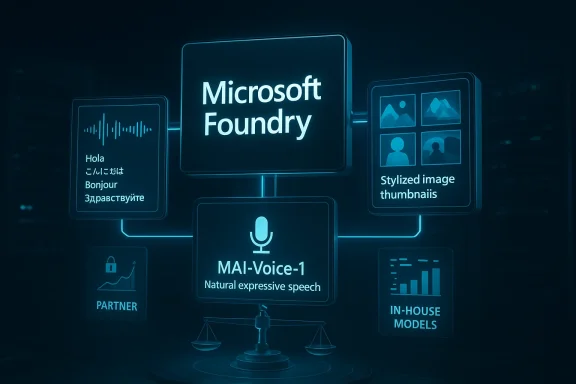
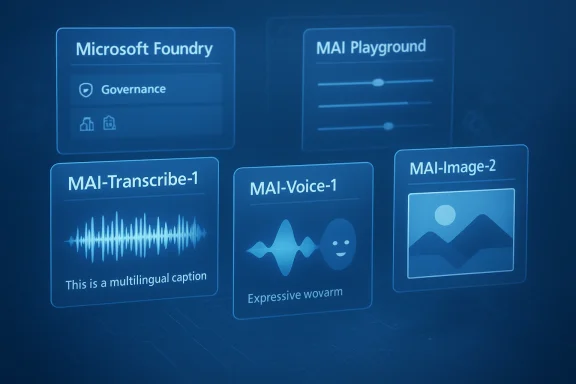
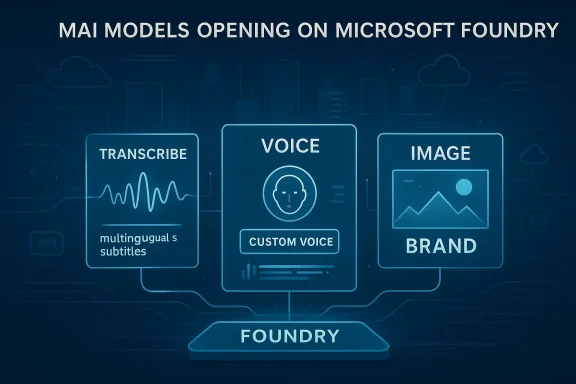
Microsoft MAI public preview: Foundry-first transcription, voice and image models

  • Thread Author
Microsoft’s launch of MAI-Transcribe-1, MAI-Voice-1, and MAI-Image-2 in public preview is more than a routine model drop. It is a clear signal that Microsoft wants its Foundry stack to become the default place where developers build speech, voice, and image experiences with first-party models. The timing matters too: these models are already powering Microsoft products like Copilot and Bing, but now they are being exposed to developers as a productized platform play rather than a behind-the-scenes capability. Microsoft is also putting a strong emphasis on efficiency, latency, and cost, which suggests the company is competing not just on model quality but on operational economics.

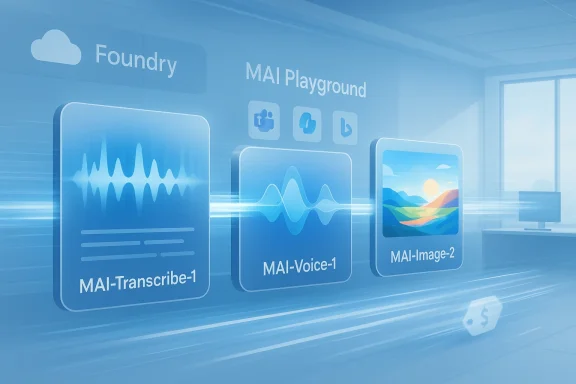
Neon UI shows a laptop streaming a serene lake-and-mountains preview with audio caption icons.Background​

Microsoft has spent the last several years turning AI from a bundle of features into a platform strategy. What began as scattered integrations across Office, Bing, and Azure has evolved into a more unified approach centered on Microsoft Foundry, where models, APIs, and deployment tooling are meant to live under one developer umbrella. The new MAI releases fit neatly into that plan because they cover three of the most commercially important multimodal workloads: transcription, speech synthesis, and image generation.
The important strategic point is that Microsoft is not introducing these as isolated experiments. The company says the models are already used in consumer and enterprise products such as Copilot, Bing, PowerPoint, and Azure Speech, which means Microsoft has had time to battle-test the stack internally. That matters because the AI market has often rewarded vendors that can prove their models work in production-like settings, not just in benchmark demos.
At the same time, Microsoft’s move reflects a broader industry shift. Developers increasingly want model access that is tightly connected to deployment, security, governance, and billing, rather than a loose collection of APIs stitched together by the customer. Foundry is Microsoft’s answer to that demand, and the MAI family gives it a more complete in-house story.
The announcement also arrives during a period when enterprise buyers are asking harder questions about cost per minute, latency per request, and scalability under load. That makes Microsoft’s emphasis on GPU efficiency especially notable. In other words, the company is not only saying these models are good; it is arguing they are practical to run at scale.

Why this launch matters​

The MAI family is important because it creates a more coherent stack for voice and visual AI. Instead of relying entirely on third-party model providers, Microsoft can offer developers a first-party path from audio input to speech output to image generation. That lowers friction for teams building agents, assistants, contact-center tools, and creative workflows.
It also strengthens Microsoft’s control over the AI value chain. When a cloud vendor owns the model, the platform, the identity layer, and the surrounding developer tools, it has more leverage over performance tuning, pricing, and enterprise compliance. That is a major competitive advantage in a market where customers want fewer moving parts and more predictable bills.
  • Foundry is becoming Microsoft’s primary developer front door for AI.
  • The MAI models extend Microsoft’s first-party model strategy into core multimodal tasks.
  • Internal adoption inside Copilot and Bing helps validate these models operationally.
  • The launch reflects a shift from “AI features” to “AI infrastructure.”

Overview​

The three models each target a different part of the multimodal workflow. MAI-Transcribe-1 handles speech recognition, MAI-Voice-1 produces synthetic speech, and MAI-Image-2 generates visuals from text prompts. Together, they form what Microsoft wants developers to see as a unified creative and conversational stack.
That matters because many AI applications are no longer text-only. A support bot may need to transcribe a customer’s voice, summarize the issue, and answer in a natural voice. A marketing tool may need to generate draft copy, speak it aloud, and create supporting imagery. A modern productivity app may need all three. Microsoft is positioning Foundry to cover that whole chain.
The company’s messaging also shows a desire to differentiate from generic model marketplaces. Rather than just saying developers can “access models,” Microsoft is framing the MAI family as a first-party AI stack with cost, latency, and product integration advantages. That is a subtle but meaningful distinction.
The early public preview status is another key detail. Microsoft is giving developers access now, but it is also leaving itself room to refine the models, adjust pricing, and expand support before claiming full production maturity. That is standard for Microsoft previews, yet it also underscores that this is still the beginning of a broader rollout.

The platform angle​

The launch is not only about the models themselves. It is also about where the models live, how they are consumed, and how easily they fit into enterprise workflows. By putting them in Foundry and tying voice capabilities into Azure Speech, Microsoft is effectively consolidating usage paths for builders who want a single ecosystem.
That consolidation has market implications. If Microsoft can make its own models easy to discover, cheap to test, and reliable to deploy, developers may default to the Microsoft stack rather than mixing vendors. That would deepen Foundry’s strategic importance and make Microsoft harder to displace in AI infrastructure deals.
  • The release is tied to developer platform strategy, not just model R&D.
  • Microsoft is aiming for workflow completeness across speech, voice, and image.
  • Public preview allows iteration while still capturing developer mindshare.
  • The stack is designed to reduce integration complexity for teams.

MAI-Transcribe-1: Efficiency as a differentiator​

MAI-Transcribe-1 is the clearest example of Microsoft’s efficiency-first approach. The model is designed for speech recognition workloads and supports 25 languages, with a stated emphasis on handling accents and messy real-world audio. Microsoft says it is built for enterprise transcription use cases such as call centers, voice input, and audio pipelines, which are exactly the kinds of tasks where cost and speed can make or break deployment economics.
Microsoft’s own documentation says the feature is in public preview and not recommended for production workloads yet, but it also describes the model as having a dual focus on accuracy and efficiency. The Learn page lists supported languages and notes that diarization is not currently supported, which is a meaningful limitation for meetings or multi-speaker call-center scenarios. That means the model is promising, but not yet a full replacement for every transcription workflow.

Accuracy, cost, and deployment​

The most eye-catching claim is the efficiency story. Microsoft says MAI-Transcribe-1 can achieve roughly 50% lower GPU cost compared with leading alternatives when benchmarked. If that claim holds up in customer environments, it could be a powerful differentiator, especially for businesses processing large volumes of audio.
That cost positioning matters because transcription is often a volume game. Enterprises do not just care whether a model works; they care whether it can transcribe thousands of hours per month without ballooning cloud spend. A lower-cost model can unlock use cases that were previously marginal or too expensive.
  • Supports 25 languages.
  • Designed for real-world noisy audio.
  • Targets enterprise transcription rather than hobbyist demos.
  • Claims lower GPU cost than leading alternatives.
  • Current preview limitations include no diarization.

Practical enterprise relevance​

For enterprises, transcription is often the first step in a larger automation pipeline. Audio can be converted to text, analyzed for sentiment or compliance risk, summarized, routed to a CRM, or handed off to an agent. That means a more efficient transcription model can cascade into lower costs across the entire workflow.
Microsoft is clearly betting that buyers will value predictability as much as raw benchmark performance. In a large deployment, even small efficiency gains can translate into major savings. If MAI-Transcribe-1 performs well on accent-heavy, low-quality, or mixed-language audio, it could become a strong option for global customer-service operations.

MAI-Voice-1: Fast speech synthesis for real-time applications​

MAI-Voice-1 is Microsoft’s speech generation model, and it is aimed squarely at real-time, conversational experiences. The company says it can generate up to 60 seconds of audio in under one second on a single GPU, which is an attention-grabbing claim because latency is one of the biggest barriers to natural voice agents. The lower the delay, the more human the interaction feels.
This model is clearly intended for voice assistants, interactive agents, and content-generation tools. Microsoft describes it as natural and expressive, which is important because generic synthetic voices can still sound flat, robotic, or emotionally disconnected. In consumer products, that can hurt engagement. In enterprise tools, it can reduce user trust.

Why latency is the real battleground​

The voice market is becoming increasingly competitive, and latency is one of the few things users immediately notice. If a system hesitates too long after a prompt, the experience feels broken even if the underlying answer is correct. Microsoft’s focus on rapid generation suggests it wants voice to feel as immediate as chat.
That speed also opens doors for richer agent behavior. A fast model can support back-and-forth dialogue, brief confirmations, spoken summaries, and live coaching without long pauses. It can also be paired with transcription to create a complete speech loop inside a Microsoft-hosted stack.
  • Designed for low-latency voice responses.
  • Can generate long-form audio rapidly.
  • Fits conversational agents and voice assistants.
  • Useful for audio content generation and narration.
  • Strengthens Microsoft’s end-to-end voice pipeline.

Consumer and enterprise implications​

On the consumer side, this could improve Copilot-style voice experiences and make voice interaction more central to Windows and productivity apps over time. On the enterprise side, it matters for customer support, training, and internal knowledge systems where spoken answers can reduce friction.
It also hints at a broader platform ambition: voice should not be a special feature bolted onto an app; it should be a native interaction mode. If Microsoft can make voice generation feel cheap and instant, more developers will design for spoken interfaces from the start rather than treating them as an afterthought.

MAI-Image-2: Microsoft’s creative model gets sharper​

MAI-Image-2 is Microsoft’s new text-to-image model, and the emphasis here is on visual fidelity, prompt adherence, and better text rendering inside generated images. That combination is especially relevant for enterprise users, because many business graphics fail when they need labels, charts, packaging, or layout-heavy compositions. A model that handles those better has immediate practical value.
Microsoft says the model was trained with input from designers, photographers, and visual storytellers, which suggests a more curated creative direction than a purely scale-at-all-costs approach. The company also points to strong benchmark performance, including a #3 debut on the Arena.ai leaderboard for image model families. That is not the final word on quality, but it is a useful signal that the model is competitive.

Why text rendering still matters​

One of the most persistent problems in image generation is readable text. Posters, mockups, slides, and product visuals often break down because generated lettering becomes garbled or inconsistent. If MAI-Image-2 improves that area, it becomes much more useful for real work, not just eye-catching novelty.
That is where Microsoft’s enterprise audience comes in. Workers do not merely want pretty images; they want usable images. Product teams, marketers, and internal communications teams care about layout, legibility, and brand alignment as much as style.
  • Focuses on photorealism and structured visuals.
  • Improves text handling in generated images.
  • Suited to marketing, design, and product visualization.
  • Trained with creative-professional input.
  • Already integrated into Microsoft products like Copilot and PowerPoint.

Competitive positioning in image AI​

The image-generation market is crowded, but Microsoft’s advantage may lie in distribution rather than novelty. By embedding MAI-Image-2 into tools like PowerPoint and Bing Image Creator, Microsoft can turn casual users into active AI users without asking them to adopt a separate application. That is a classic Microsoft move: win through workflow placement.
Enterprise partner adoption, including creative workflows with WPP, also matters because it helps validate the model in professional settings. When a large agency publicly experiments with a tool, it can influence other buyers who care about production readiness and brand control.

Foundry and Azure Speech: The distribution layer matters​

Microsoft is making a deliberate distinction between general developer access and speech-specific deployment. The models are available in Foundry, with additional integration for voice through Azure Speech. That dual route is important because it suggests Microsoft wants developers to choose between experimentation in Foundry and more operational speech deployments in Azure.
According to Microsoft Learn, MAI-Transcribe-1 is available in Azure Speech preview through the LLM Speech API, and the documentation explicitly says the preview comes without an SLA and is not recommended for production workloads. That kind of wording is routine, but it also tells enterprises exactly where Microsoft thinks the model is on the maturity curve. It is ready for evaluation, not yet for mission-critical dependence.

Why multiple access paths matter​

Different teams build differently. Some want a playground to test prompts and workflows. Others want APIs that drop directly into production apps. Still others need regional deployment, service keys, or governance hooks tied to Azure. Microsoft is trying to satisfy all of them without fragmenting the experience too much.
That is a subtle advantage over companies that have strong models but weaker enterprise plumbing. The easier it is to move from testing to production, the more likely a developer is to stay inside the ecosystem. That is where Foundry can become sticky.
  • Playground for testing and experimentation.
  • APIs for application and agent development.
  • Azure Speech for voice-related deployment.
  • Preview status means limited production guarantees.
  • Microsoft is offering a graduated adoption path.

Enterprise governance and control​

For enterprises, platform coherence is not just a convenience; it is a risk-management feature. Centralized access, resource controls, and policy alignment make procurement easier and reduce the number of places where sensitive data may be exposed. Microsoft has long sold its cloud story on exactly that idea.
The MAI launch reinforces that approach. If businesses can keep transcription, speech, and image generation within Microsoft’s trust boundary, they may be less inclined to stitch together multiple vendors. That could be especially attractive for regulated industries that need tighter control over data flows and auditability.

Pricing, economics, and the real competitive fight​

Microsoft’s published pricing is likely to get a lot of attention because the company is clearly trying to make the economics compelling. The announced starting points are $0.36 per hour for MAI-Transcribe-1, $22 per 1 million characters for MAI-Voice-1, and $5 per 1 million text-input tokens plus $33 per 1 million image-output tokens for MAI-Image-2. Those numbers suggest Microsoft wants to undercut or at least closely match alternatives while highlighting efficiency gains.
Pricing, however, is only part of the story. In AI, the effective cost of adoption includes integration effort, model tuning, latency, governance, and support. Microsoft appears to be betting that a tightly integrated stack will be worth more than a slightly cheaper standalone model from a competitor.

What the pricing signals​

The pricing structure also reveals how Microsoft thinks about usage patterns. Transcription is often metered by time, voice synthesis by generated characters, and image generation by input and output tokens. That variety reflects the different compute profiles of each workload and indicates Microsoft is aiming for a more granular, enterprise-friendly billing model.
The strategic question is whether these prices will remain attractive as usage scales. Early preview pricing is often designed to encourage experimentation, so enterprises should assume the economics may shift as the product matures. That is normal, but it means budgeting teams should watch closely.
  • Transparent preview pricing encourages trial use.
  • Different workload types get different billing meters.
  • Efficiency claims may be used to justify long-term adoption.
  • Competitive pressure will likely shape later pricing adjustments.
  • Cost predictability may matter more than sticker price.

Competing with the rest of the market​

The deeper competition here is not just with one vendor. It is with a whole class of AI platforms that offer separate tools for transcription, voice, and images. Microsoft is trying to collapse those categories into one cohesive proposition, which can be powerful if it works well enough.
If developers believe they can get comparable quality with fewer vendors and lower total infrastructure costs, Microsoft may win even where it is not obviously the “best” single model provider. That is the kind of advantage cloud incumbents like to build: not a single brilliant feature, but a system that is good enough everywhere and excellent where integration matters most.

The broader strategic bet on first-party AI​

The most important implication of the MAI rollout is that Microsoft is increasingly comfortable being both the platform owner and the model creator. That dual role gives it more control, but it also raises expectations. If Microsoft makes the models, then customers will compare them not just to the market, but to Microsoft’s own claims about performance and efficiency.
This is a strong play because it can reduce dependency on external model providers while improving product differentiation across Microsoft 365, Copilot, Bing, and Azure. It also lets Microsoft tune models for its own ecosystem in ways that third-party APIs may not allow. The company can optimize for its products first, then expose that optimization to developers.

Internal leverage becomes external value​

When Microsoft says the models are already used internally, that gives the company a credibility boost. Internal usage implies the models must satisfy real product constraints: scale, reliability, moderation, and cost. That can reassure enterprise buyers who worry that preview AI models are merely academic demonstrations.
At the same time, internal usage creates a feedback loop. Microsoft can gather operational data from its own products, improve the models, and then distribute those improvements to developers. That is a classic platform advantage and one that rivals will struggle to match unless they have similarly broad product surfaces.
  • Microsoft can optimize models for its own product ecosystem.
  • Internal usage provides a real-world validation loop.
  • Developers benefit from improvements tested at Microsoft scale.
  • The company deepens its moat across cloud and productivity.
  • First-party models reduce dependence on external providers.

Strengths and Opportunities​

The strongest part of this launch is that it aligns product, platform, and infrastructure in one move. Microsoft is not just releasing three models; it is defining an architecture for how developers can build next-generation voice and image experiences inside the company’s stack. That creates both immediate utility and longer-term strategic leverage.
The opportunity is especially large in enterprise workflows, where cost, governance, and integration matter more than flashy demos. Microsoft can win by making these models easy to adopt, cheap enough to scale, and tightly connected to existing tools. If it does that well, Foundry could become a default destination for multimodal AI builders.
  • Unified developer experience across transcription, voice, and image.
  • Strong fit for enterprise automation and contact-center scenarios.
  • Potential for lower operating costs through efficiency gains.
  • Better workflow integration with Copilot, Bing, PowerPoint, and Azure Speech.
  • First-party control over model quality and roadmap.
  • Attractive for teams that want fewer vendors and simpler governance.
  • Stronger positioning for real-time voice agents.

Risks and Concerns​

The biggest caution is that public preview does not equal production readiness. Microsoft’s own documentation makes clear that at least some of these features are preview-only and may have limited capabilities or missing functions, such as diarization. Enterprises that rush in too early could find themselves stuck with capabilities that are not yet complete enough for real workloads.
There is also the risk of overpromising on benchmarks and efficiency. Claims about cost and speed are useful, but buyers will care about actual results in their own environments. If real-world audio quality, multilingual edge cases, or creative consistency fall short, the excitement could fade quickly.
  • Preview status means no SLA and limited production guarantees.
  • Some workflows still lack important features like diarization.
  • Efficiency claims need validation in customer environments.
  • Voice and image safety concerns will remain a live issue.
  • Pricing may change as preview converts to general availability.
  • Competitive pressure could force Microsoft to revise positioning.
  • Enterprises may hesitate until compliance and governance are clearer.

Looking Ahead​

Microsoft’s next challenge is execution. The company has shown it can identify high-value AI categories and package them into a platform story, but the real test is how fast these models mature and how consistently they perform across diverse workloads. Developers will quickly move from curiosity to skepticism if the models are impressive in demos but uneven in production.
What will matter most is whether Microsoft can keep the stack coherent while improving each model’s specialization. A strong transcription model, a fast voice engine, and a capable image generator are useful on their own, but the bigger prize is a seamless multimodal pipeline that feels like one product. That is the vision Microsoft is selling, and the industry will now judge how much of that vision survives contact with real deployment.
  • Watch for general availability timelines.
  • Monitor whether diarization and other missing features arrive.
  • Track whether pricing remains stable after preview.
  • Compare real-world performance against rival speech and image models.
  • Look for deeper integration into Copilot and Microsoft 365.
  • Pay attention to enterprise case studies, especially in support and creative workflows.
Microsoft’s MAI rollout is best understood as a platform move disguised as a model announcement. By combining transcription, voice, and image generation under Foundry, the company is trying to make its cloud stack feel not only comprehensive, but inevitable. If the models live up to their efficiency and quality claims, Microsoft will have strengthened one of its most important AI advantages: the ability to turn internal product innovation into external developer dependency.

Source: FoneArena.com Microsoft rolls out MAI-Transcribe-1, MAI-Voice-1 and MAI-Image-2 in Foundry public preview
 

Microsoft’s release of three in-house AI models marks more than a routine product expansion. It is a signal that the company is no longer content to be seen primarily as OpenAI’s biggest backer and cloud host; it wants to be a model maker in its own right. By launching MAI-Transcribe-1, MAI-Voice-1, and MAI-Image-2 inside Microsoft Foundry, the company is now competing directly in the same enterprise lanes where OpenAI’s transcription, speech, and image tools already live. Microsoft’s own signal is clear: the company wants greater independence, broader platform control, and a tighter grip on the economics of AI.

A digital visualization related to the article topic.Background​

The Microsoft-OpenAI relationship has always been unusual: part investment, part partnership, and part strategic hedge. Microsoft became OpenAI’s largest investor and deeply embedded itself in OpenAI’s growth by supplying Azure infrastructure while also using OpenAI models to power Copilot across its software stack. That arrangement gave Microsoft access to frontier AI without having to build everything from scratch, but it also created a dependency that looked increasingly uncomfortable as AI became central to both consumer and enterprise strategy.
Over the past year, Microsoft has made a series of moves that suggest it wants optionality, not just alliance. The company reorganized around Microsoft AI under Mustafa Suleyman, and in 2025 he publicly framed the work in terms of creating AI companions and broader consumer experiences. More recently, Microsoft announced a leadership update that explicitly tied Suleyman’s remit to superintelligence efforts and “world class models” over the next five years. That wording matters because it reads less like a product support function and more like the foundation of an independent model strategy.
At the same time, Microsoft has been widening the surface area of its own AI platform. Foundry now serves as the company’s central place for building, customizing, and deploying AI applications at scale, and its model catalog includes not only OpenAI offerings but also models from Anthropic, Meta, Mistral, Cohere, NVIDIA, Hugging Face, and others. Microsoft is clearly positioning Foundry as a brokerage layer for enterprise AI, one that makes Microsoft the default marketplace rather than merely the favorite tenant hosting someone else’s frontier models.
The timing of this release also reflects a broader market shift. By 2026, enterprise buyers no longer want a single model story; they want a portfolio, with specialized tools for transcription, voice, image generation, search, and agents. Microsoft’s in-house models fit neatly into that need. They are not pitched as universal replacements for GPT-class systems. Instead, they are task-specific models that can be sold into workflows where accuracy, latency, price, or governance matter more than raw generality.

What Microsoft Actually Released​

The three models are narrowly scoped but strategically important. According to Microsoft’s own announcement, MAI-Transcribe-1 handles transcription across 25 languages, MAI-Voice-1 produces natural expressive speech generation, and MAI-Image-2 is described as Microsoft’s most capable image model yet. The company says they are available on Microsoft Foundry and the MAI Playground, with Foundry being the enterprise-facing route.
That matters because Microsoft is not merely experimenting in a lab. It is productizing these models as commercial services for developers and businesses. This immediately places them in the same category as OpenAI’s Whisper, text-to-speech tools, and DALL·E family, which Microsoft also sells through Foundry in one form or another. In other words, Microsoft is now competing with a partner whose models still remain part of its own sales story.

A targeted rather than general-purpose approach​

This release is best understood as a specialized model bundle, not a grand declaration that Microsoft has matched OpenAI across the board. Each model solves a specific problem, which is exactly what enterprise customers often need when deploying AI into production workflows. Transcription, speech synthesis, and image generation are all highly monetizable infrastructure tasks that can be sold independently of the broader chatbot stack.
The narrowness is actually a strength. Microsoft can tune each model for a defined business scenario, integrate them tightly into Foundry, and market them as building blocks for applications rather than as headline-grabbing general intelligence. That makes them easier to govern, easier to benchmark, and potentially easier to sell to regulated industries. It also lets Microsoft compete where the margin is good and the switching costs are high.
Key implications:
  • Task-specific AI is now a core Microsoft product strategy.
  • Enterprise distribution may matter more than raw model prestige.
  • Foundry becomes the commercial center of gravity.
  • OpenAI overlap is no longer theoretical; it is a sales reality.
  • Model specialization supports pricing and governance advantages.

Why Foundry Matters More Than the Models Themselves​

The models are important, but the platform is the real story. Microsoft Foundry is designed to be the place where customers discover, test, customize, and deploy a wide range of AI models within Azure. Microsoft’s documentation presents it as an “AI app and agent factory,” which is a telling phrase because it frames AI not as a single chatbot capability but as a production pipeline.
By placing MAI models inside Foundry, Microsoft can bundle them with its broader cloud, security, compliance, and enterprise tooling. That gives Microsoft a classic platform advantage: model choice becomes part of a larger procurement and governance relationship. A customer evaluating transcription or voice generation is no longer buying only model quality; they are also buying Microsoft identity, Azure integration, compliance posture, and operational simplicity.

The enterprise distribution moat​

For enterprises, distribution often matters more than novelty. A model can be technically excellent and still lose if it is hard to procure, harder to secure, or awkward to integrate with existing systems. Microsoft’s advantage is that Foundry already sits inside a huge enterprise ecosystem where Azure contracts, security frameworks, and developer familiarity can accelerate adoption.
That is why this announcement should be read as a platform maneuver as much as a model launch. Microsoft is using in-house AI to deepen the value of its cloud relationship and reduce the risk that an enterprise customer might drift toward another provider for specific workloads. If a customer can buy OpenAI and Microsoft-trained models in the same place, Microsoft benefits from being the default broker.

What this means for developers​

Developers gain more choice, but also more complexity. They now need to compare not just model performance, but how each model fits into latency, region availability, pricing, guardrails, and workflow integration. Microsoft’s Foundry documentation already emphasizes model variety and deployment options, which suggests the company wants developers to think in terms of architecture selection rather than brand loyalty.
That could be good news for teams building production applications. If Microsoft can offer a transcription model that is cheaper or faster, a voice model that sounds more natural, or an image model that better suits enterprise content pipelines, the company can win by incrementally displacing OpenAI in specific jobs. That is a classic platform strategy: win the workflow, not the ideology.

The OpenAI Overlap Is Real​

Microsoft is not launching these models in a vacuum. OpenAI already supplies transcription, voice, and image capabilities through Whisper, text-to-speech, and DALL·E, and those capabilities are already available in Microsoft’s own ecosystem. That means Microsoft is effectively both hosting and competing with its own partner in adjacent product categories.
This overlap is not necessarily a breakup signal. If anything, it reflects how mature AI markets work once they move from novelty into procurement. Enterprises want benchmarks, alternatives, and negotiating leverage. Microsoft can preserve its OpenAI relationship while still building substitutes where the economics or strategic control make sense. The real question is not whether the partnership ends tomorrow; it is whether Microsoft gradually reduces the share of workloads that depend on OpenAI alone.

Competitive tension without open conflict​

The public tone remains careful. Microsoft has not framed the models as replacements for OpenAI, and OpenAI remains central to Copilot and Azure’s AI story. But the product architecture tells a more interesting story: Microsoft is making sure it can answer a customer request without having to route every use case through OpenAI. That is a subtle but meaningful power shift.
The same logic applies to investor dynamics. Microsoft’s continued role as OpenAI’s biggest backer gives it a seat at the table, but not necessarily full control over the model roadmap. Building its own models gives Microsoft insurance against shifts in pricing, access, or strategic direction. In a fast-moving AI market, insurance is often worth as much as innovation.

Why specialization can beat generality​

OpenAI’s biggest strengths are broad capability and brand leadership. Microsoft’s opening is different: specialize aggressively where the customer wants dependable, production-grade infrastructure. Transcription and voice, in particular, are often judged by a few painful metrics such as word error rate, latency, and stability under noisy conditions. If Microsoft can outperform on those dimensions, it can win business even without dethroning OpenAI’s broader reputation.
Image generation is similarly ripe for segmentation. Enterprise buyers care about control, safety, watermarking, style consistency, and integration with content systems. A model that is slightly less famous but better governed can be more attractive in corporate environments. Microsoft’s challenge is proving that its models are not just “good enough,” but commercially superior for real workloads.

Why Voice, Speech, and Images Are the Right Beachhead​

Microsoft’s choice of categories is not random. Speech-to-text, text-to-speech, and image generation are among the most practical, widely deployable AI functions in enterprise software. They sit close to customer service, media workflows, accessibility, content moderation, documentation, and knowledge capture, which means they can generate value quickly.
These tasks are also easier to benchmark than open-ended chat. A company can measure transcription accuracy, voice naturalness, or image quality with internal evaluation sets and user feedback. That makes them ideal for a new entrant that wants to prove itself without needing to win the entire frontier model race on day one.

Enterprise use cases are obvious​

The most immediate enterprise uses are straightforward. Call centers can transcribe interactions, internal teams can convert meetings into searchable records, and customer-facing products can add voice interfaces or image tools. Microsoft already has the distribution pathways to put these capabilities into Azure-based apps, Copilot-adjacent experiences, and custom enterprise workflows.
That practical angle is important because the AI market is maturing. Buyers are less impressed by demos than by reliability, compliance, and integration. Microsoft is betting that the winning pitch is not “our model is the most magical,” but “our model is integrated, governable, and deployable inside your existing stack.”

Consumer and creator spillover​

The consumer opportunity is different. A voice model can power narration, assistants, accessibility tools, and creation features; an image model can support design, marketing, and productivity. Microsoft may eventually push these capabilities deeper into consumer products, but the current rollout is clearly enterprise-first. That is sensible because enterprise sales can validate the technology while consumer branding catches up.
It also gives Microsoft room to iterate under lower public scrutiny. Consumer AI features are judged instantly and emotionally, while enterprise tools can be improved through controlled pilots and account-level deployment. Microsoft’s likely playbook is prove it in business, refine it in the platform, then surface it more broadly.

Mustafa Suleyman’s Role Changes the Interpretation​

This release would mean less if Microsoft AI were still viewed as a small product team. But Mustafa Suleyman’s position changes the stakes. Since joining Microsoft to lead Copilot and later being tasked with a broader Microsoft AI mandate, he has been one of the company’s clearest voices for building more of the stack in-house.
His public language has increasingly emphasized self-sufficiency, frontier model building, and systems that reinforce Microsoft’s own product roadmap. That framing matters because it turns model development into a strategic necessity rather than an optional experiment. When a CEO uses phrases like world class models and self-sufficient in AI, the company is not signaling dependence reduction as a side effect; it is making it the point.

A more vertically integrated Microsoft​

Microsoft’s history in cloud and software has always favored integration. The company understands that owning more of the stack can improve margins, simplify support, and create lock-in. In AI, that instinct is now becoming explicit, and Suleyman is the executive most closely associated with that turn.
That vertical integration is especially relevant in enterprise AI, where customers often want fewer vendors, not more. If Microsoft can provide the models, the deployment layer, the security stack, and the application layer, it can capture a much larger share of the AI budget. OpenAI, by contrast, remains primarily a model and product company, even as it expands its own ecosystem.

A hedge against partner dependency​

There is also a geopolitical and business continuity angle. Dependence on a single external model supplier can become a risk if prices rise, access changes, or strategic priorities diverge. Microsoft’s in-house models provide a hedge, and hedge-building is what disciplined enterprise platforms do when they become too important to outsource.
That does not mean the OpenAI relationship is fraying. It means Microsoft is acting like a company that expects AI to remain a strategic battleground for years, not months. The smarter move is to preserve partnership optionality while building internal muscle at the same time.

The Market Reaction Will Depend on Benchmark Proof​

Announcements like this tend to generate excitement first and scrutiny later. The real test will not be the launch blog post, but the comparative performance data Microsoft releases, the customer benchmarks it can stand behind, and the adoption it drives inside Foundry. Without that proof, the models risk being seen as symbolic rather than transformative.
Microsoft’s strongest claim so far is directional, not definitive. The company says MAI-Transcribe-1 is the most accurate transcription model in the world and MAI-Voice-1 sets a new standard for natural speech. Those are bold claims, but they will need independent validation, especially because transcription and voice quality are easy to assert and harder to settle in a universally accepted way.

How rivals may respond​

OpenAI will likely respond by continuing to improve its own audio and image offerings. It has already positioned newer audio models as outperforming Whisper on established benchmarks, and it has a broader multimodal roadmap than the narrow categories Microsoft is emphasizing here. The competitive response may therefore be less about panic and more about acceleration.
Other cloud rivals will also pay attention. If Microsoft can successfully sell homegrown models alongside outside models in Foundry, it reinforces the idea that cloud providers should be marketplaces for multiple AI suppliers rather than single-brand showcases. That is potentially good for enterprise buyers and potentially less good for model makers who want direct customer relationships.

What will matter most​

The most important factors over the next few quarters will be practical, not theatrical. Customers will want to know whether the models are cheaper, faster, easier to govern, or better integrated than the alternatives. If Microsoft can answer yes on even one or two of those dimensions, the launch could matter far more than the headline suggests.
Watch for:
  • Independent benchmarks on transcription and speech quality.
  • Enterprise adoption inside regulated industries.
  • Pricing and packaging changes in Foundry.
  • Whether Microsoft surfaces these models in consumer products.
  • Any sign that OpenAI usage in Microsoft workflows becomes more selective.

Strengths and Opportunities​

Microsoft’s move has several obvious strengths. It deepens the company’s AI sovereignty, improves platform leverage, and creates room to tailor models to enterprise needs that may be underserved by general-purpose frontier systems. It also turns Foundry into a more complete commercial destination, which could increase customer stickiness and reduce reliance on any single outside supplier.
The opportunity is bigger than the immediate product set. If Microsoft can prove that it can build competitive models internally, it gains strategic flexibility across pricing, procurement, and roadmap planning. It also sends a message to the market that the company is not merely an OpenAI distribution channel, but a credible AI platform builder in its own right.
  • Greater strategic independence from OpenAI
  • Tighter enterprise integration inside Azure and Foundry
  • More pricing flexibility for specialized workloads
  • Better fit for regulated customers seeking governance and compliance
  • Expanded model choice for developers building production apps
  • Potential consumer spillover into Copilot and accessibility features
  • Stronger negotiating position in future AI partnerships

Risks and Concerns​

The biggest risk is that Microsoft overpromises and underdelivers relative to its own benchmarks. Claims like “most accurate” or “new standard” invite scrutiny, and if the models fail to clearly beat or at least match the competition, the launch could look like strategic theater. That would be especially damaging because Microsoft is now setting expectations for self-sufficiency in AI.
There is also the possibility of channel conflict. Microsoft benefits from selling OpenAI models through Foundry, but it now also benefits from replacing some of that usage with its own models. Managing that tension without confusing customers or weakening the partnership will require careful packaging and messaging. That balance may be harder than the model training itself.
  • Benchmark risk if claims are not independently confirmed
  • Partner friction if OpenAI sees direct substitution
  • Customer confusion over which Microsoft-branded model to choose
  • Fragmentation risk if the product catalog becomes too complex
  • High expectations for future in-house frontier model releases
  • Possible pricing pressure if competitors undercut enterprise rates
  • Execution risk as Microsoft scales model operations and governance

Looking Ahead​

The next phase will be about evidence. Microsoft needs to show that these models are not just available, but adopted, benchmarked, and embedded into real enterprise workflows. If the company starts publishing comparative performance data, case studies, or workload-specific pricing advantages, the announcement will look much more consequential in hindsight.
The broader strategic question is whether Microsoft continues to expand its in-house model family beyond speech and images. If it does, then the company is effectively building a parallel AI stack that can stand beside OpenAI rather than beneath it. If it does not, the current release may end up as a useful but limited proof point.
What to watch:
  • New benchmark disclosures for MAI-Transcribe-1, MAI-Voice-1, and MAI-Image-2.
  • Enterprise customer announcements tied to Microsoft Foundry.
  • Any expansion of MAI Playground or broader availability.
  • Pricing comparisons against OpenAI and other cloud model providers.
  • Whether Microsoft introduces additional in-house frontier models later in 2026.
Microsoft’s release is best seen as the opening move in a longer campaign. The company is trying to transform a close partnership into a position of strength, and the safest way to do that is not to sever ties abruptly but to build credible alternatives underneath them. If these models perform as advertised, Microsoft will have done more than add three tools to Foundry; it will have advanced its bid to become an AI company that can stand on its own.

Source: Business Insider Microsoft released 3 new AI models, ramping up competition with its close partner, OpenAI
 

Microsoft’s decision to surface three in-house MAI models marks a more aggressive phase in its AI strategy, but the more interesting story is not the launch itself. It is the signal that Microsoft now wants to be judged as a model owner, not just a model distributor. By putting MAI-Transcribe-1, MAI-Voice-1, and MAI-Image-2 into Microsoft Foundry and MAI Playground, the company is widening its own stack while still preserving its crucial OpenAI partnership. Microsoft’s own materials say the models are available “starting today” on both platforms, with MAI-Transcribe-1 covering 25 languages, MAI-Voice-1 generating expressive speech, and MAI-Image-2 positioned as the company’s most capable image model yet (news.microsoft.com). In other words, this is less a one-off product launch than a strategic declaration.

A digital visualization related to the article topic.Overview​

Microsoft has spent the last two years trying to reconcile two truths that are not always comfortable together. First, it is one of the biggest commercial beneficiaries of the OpenAI boom. Second, it cannot build a long-term AI platform that depends entirely on someone else’s roadmap. That tension has been visible since Mustafa Suleyman joined Microsoft in March 2024 to lead Microsoft AI, with Satya Nadella explicitly saying the move was meant to accelerate consumer AI products and research while still preserving Microsoft’s “most strategic and important partnership with OpenAI” (blogs.microsoft.com).
The new MAI models fit neatly into that broader arc. Microsoft is no longer merely packaging frontier models from others into Copilot and Azure surfaces. It is building its own specialized capability in speech, audio, and visual generation, and it is doing so at a moment when the economics of inference matter as much as the quality of the output. That is why Microsoft’s infrastructure investments matter here too. In January 2026, the company unveiled Maia 200, an in-house inference accelerator it said was designed to improve the economics of AI token generation and support both external and internal models, including Microsoft’s own superintelligence work (blogs.microsoft.com).
The release also shows how the company’s AI messaging has evolved. Earlier Microsoft model work often sounded defensive, almost like a hedge against dependency. This latest round sounds more assertive. The company is framing these models as practical, cost-aware building blocks for real workflows, not novelty demos. That distinction matters because the AI market has matured quickly: users and enterprise buyers now care less about whether a model can wow them once and more about whether it can become dependable inside everyday products.
There is also a competitive reality beneath the branding. Microsoft is competing in a market where Google, OpenAI, and a growing set of specialized model vendors all claim some combination of quality, speed, and ecosystem breadth. Microsoft’s answer is to combine model ownership with distribution power. The company has the platforms, the enterprise relationships, and the infrastructure to embed MAI models where work actually happens. That is a tougher proposition for rivals to copy than a single headline benchmark result.

The strategic meaning of Microsoft’s MAI push​

The most important thing to understand about these models is that they are not isolated products. They are pieces of a larger corporate reshaping that has been underway since Microsoft AI was formed and Suleyman was given responsibility for consumer AI products and research in 2024 (blogs.microsoft.com). Microsoft has steadily moved from being an AI enabler to being an AI operator.
That shift is more consequential than it may first appear. When Microsoft depends primarily on external model providers, it can move quickly but has limited control over pricing, product behavior, safety rules, and release timing. When it owns more of the stack, it gains room to optimize for cost, quality, latency, and product identity. That is especially important in consumer AI, where the backend often disappears from view but still determines how users feel about the product.

Why control matters​

Control gives Microsoft several advantages at once. It can tune models for specific tasks, align output with product design goals, and adjust cost structures to fit internal business priorities. It can also negotiate with partners from a position of greater strength, because it is less exposed if another vendor changes course.
  • More pricing flexibility across Microsoft products.
  • More control over model behavior and safety posture.
  • Better product differentiation inside Copilot, Bing, and Foundry.
  • Less reliance on a single external frontier model supplier.
  • Greater leverage in long-term platform negotiations.
The larger implication is that Microsoft is now behaving like a company that expects AI to become a durable internal competency, not just a partnership layer. That is a meaningful change in posture.

Why the timing matters​

The timing of this release is also strategic. AI models are becoming more specialized and more expensive to run at scale, which means inference efficiency is a competitive advantage rather than a background detail. Microsoft’s Maia 200 announcement earlier this year showed the company wants to win on the economics of AI, not just its optics (blogs.microsoft.com).
That makes the MAI models part of a bigger optimization loop. Better internal models reduce dependence on third parties, while better internal chips reduce the cost of serving those models. The result is a more vertically integrated AI stack.

MAI-Transcribe-1: speech recognition as platform plumbing​

Among the three models, MAI-Transcribe-1 may be the least flashy, but it could be one of the most important. Microsoft Learn describes it as a speech recognition model developed by the MAI Superintelligence team with a dual focus on high accuracy and high efficiency, and says it is available in public preview through the LLM Speech API (learn.microsoft.com). The same documentation lists support for 25 languages, which aligns with Microsoft’s public rollout messaging (news.microsoft.com).
That language breadth matters because transcription is no longer a narrow office task. It underpins customer support, meeting notes, multilingual media workflows, accessibility tools, compliance capture, and content localization. If Microsoft can offer a model that is both faster and cheaper than prior offerings, it can quietly become the default engine behind a large number of business workflows.

A practical model for enterprise use​

Microsoft’s description suggests that MAI-Transcribe-1 is meant to be a utility model, not a showcase model. That is a smart move. Speech-to-text buyers generally care less about celebrity status and more about repeatability, latency, and robustness under real-world conditions.
The Microsoft Learn page also notes that the preview currently does not support diarization, which is a reminder that the model is still evolving and not positioned as a perfect drop-in replacement for every transcription need (learn.microsoft.com). But even with that limitation, the model is clearly aimed at core enterprise use cases.
  • Meeting and call transcription.
  • Multilingual customer service workflows.
  • Accessibility and captioning pipelines.
  • Media rough cuts and newsroom logging.
  • Internal knowledge capture and searchable archives.

Why speed matters​

Microsoft says the model is significantly faster than its Azure Fast offering, which implies that latency is a core selling point. In speech systems, speed often matters as much as accuracy because transcription is frequently part of an interactive workflow. If the model is delayed, the downstream experience degrades immediately.
That means MAI-Transcribe-1 is not just a transcription upgrade. It is also a platform enabler. Faster turnaround makes real-time voice applications more viable, and that in turn can expand the use cases for Microsoft’s broader AI services.

MAI-Voice-1 and the new economics of audio generation​

MAI-Voice-1 is Microsoft’s audio-generation model, and the company is clearly betting that voice will become one of the most commercially important interfaces in AI. Microsoft’s own description says the model can generate 60 seconds of audio in one second and supports custom voice creation (news.microsoft.com). That is not just a technical flourish; it is a signal that Microsoft wants to compete in a category where speed, expressiveness, and controllability all matter.
Voice models sit at the intersection of productivity and media. They can power narration, accessibility features, customer support, interactive agents, language learning tools, and synthetic media workflows. They also raise the stakes around safety and identity, because voice is one of the most personal and easily abused forms of AI output.

Use cases that could scale fast​

The strongest commercial opportunities are not necessarily in entertainment, but in routine communication. If Microsoft can make high-quality voice generation easy to access inside its own ecosystem, it could normalize AI-assisted audio the same way it normalized cloud productivity.
  • Training and onboarding narration.
  • Multilingual product explainers.
  • Accessibility layers for reading and listening.
  • Customer support scripts and agents.
  • Internal presentations and explainer videos.
There is also a consumer angle. A voice model that is fast enough to feel instantaneous changes user expectations. Once a person can create spoken content quickly, the tool starts to feel less like a production asset and more like a conversational interface.

The custom voice question​

The custom voice capability is where the opportunity and the risk collide. On one hand, it gives users more flexibility and opens the door to branded assistants, personalized narration, and localized audio experiences. On the other hand, it makes governance, consent, and abuse prevention more important than ever.
Microsoft already has strong reasons to be careful here. Voice cloning can be highly useful in legitimate contexts, but it can also be used for impersonation or fraud. That means the product’s success will depend not only on model quality but on the safeguards surrounding it.

MAI-Image-2 and the creative stack​

The most visible model in the trio is MAI-Image-2, because image generation is the most publicly legible way to show AI progress. Microsoft says it originally appeared on MAI Playground on March 19 and is now being released through Microsoft Foundry as well. The company also describes it as its most capable image model yet, which is the kind of language that invites comparison with OpenAI, Google, Adobe, and Midjourney.
This matters because the image market has moved beyond novelty. Users now expect prompt adherence, text rendering, visual consistency, and enough control to integrate outputs into real workflows. The battle is no longer just about making an image. It is about making a usable one.

Why the model matters beyond aesthetics​

For Microsoft, MAI-Image-2 is not just a creative play. It is a way to turn visual generation into a native feature of its own ecosystem. That could mean Microsoft 365 slides, Bing image creation, Copilot prompts, marketing mockups, and internal design workflows all relying on one in-house backbone.
That has several strategic benefits:
  • Less dependency on outside image vendors.
  • More consistent user experience across products.
  • Better control of safety and brand standards.
  • Stronger economics if the model is widely used.
  • A clearer Microsoft-native creative identity.
In a market where distribution matters as much as raw artistic reputation, this is a serious move.

Competitive implications​

Microsoft does not need MAI-Image-2 to be the absolute best image model in every qualitative dimension. It needs it to be good enough, fast enough, and integrated enough to win in the places that matter commercially. That is a different playbook from Midjourney’s premium-aesthetic lane or OpenAI’s broad experimental reach.
The competitive logic is straightforward. If Microsoft can make image generation feel like part of work, not just a separate destination, it can shift user habits. That is often how platform companies win: by embedding useful tools inside places people already visit every day.

Foundry and Playground as distribution engines​

The move to surface these models in Microsoft Foundry and MAI Playground is almost as important as the models themselves. Foundry is where Microsoft can turn a model launch into an enterprise product strategy. Playground is where it can turn the same launch into a developer and user experience story.
This is classic Microsoft behavior. The company rarely wants to sell a capability in only one layer. It wants to make sure developers can test it, enterprises can deploy it, and end users can encounter it through familiar surfaces later on.

Why Foundry matters​

Foundry is the enterprise-grade path. That means governance, integration, access control, and predictable deployment matter as much as raw model quality. If Microsoft wants these models to become part of corporate workflows, Foundry is where that happens.
That is especially important for transcription and voice, where customers may care about compliance, retention, or sector-specific controls. It is also important for image generation, where businesses often want guardrails around brand consistency and content safety.

Why Playground matters​

Playground is the discovery layer. It lets Microsoft show off the models without forcing users into a procurement conversation first. That is useful because it lowers the barrier to experimentation. Developers and product teams can try the models, understand the output quality, and decide whether they are worth adopting.
The two surfaces together create a funnel. Playground generates interest. Foundry turns that interest into workflows. That is exactly the kind of dual-motion strategy Microsoft likes to use.
  • Playground drives awareness and experimentation.
  • Foundry drives deployment and monetization.
  • Together they create a platform funnel.
  • The same models can serve both consumers and enterprises.
  • That makes Microsoft’s rollout more defensible than a single-demo launch.

Microsoft AI, OpenAI, and the question of dependence​

No analysis of this launch is complete without the OpenAI question. Microsoft has invested heavily in the partnership, and nothing in the recent announcements suggests that relationship is ending. In fact, Microsoft’s own 2024 statement explicitly said its AI innovation would continue to build on its “most strategic and important partnership with OpenAI” while also allowing Microsoft to innovate on top of foundation models and infrastructure of its own (blogs.microsoft.com).
That is the key frame. Microsoft is not trying to replace OpenAI overnight. It is trying to create optionality.

Why optionality matters​

A company as large as Microsoft cannot afford to have every important AI experience depend on an outside roadmap. If the vendor changes its pricing, safety rules, product design, or release cadence, Microsoft would feel it immediately. Internal models reduce that risk.
Optionality also improves bargaining power. If Microsoft can credibly say it has viable in-house alternatives for transcription, voice, and image generation, it can better balance partnership and independence. That is a classic platform strategy.

The industry is moving toward mixed stacks​

Microsoft is not alone in this logic. The broader AI industry has increasingly moved toward mixed-model strategies, where companies combine in-house models, partner models, and specialized systems depending on the task. That tends to make products more resilient and cost-efficient.
In that sense, Microsoft’s MAI releases should be read less as a break with OpenAI and more as a hedge against overreliance. The company appears to want the best of both worlds: partner access to frontier capabilities and internal control over selected product layers.
  • Partner models for breadth and frontier experimentation.
  • Internal models for cost control and product identity.
  • Infrastructure ownership for long-term leverage.
  • Distribution assets to normalize the experience.
  • Flexibility to move faster if market conditions shift.

Infrastructure is now part of the model story​

One reason this rollout deserves attention is that Microsoft has spent real money building the infrastructure required to support it. Maia 200 is the clearest example so far. Microsoft said the chip is designed to improve inference economics, deliver strong FP4 and FP8 performance, and support both external models and its own superintelligence efforts (blogs.microsoft.com).
That may sound like back-end plumbing, but in AI it is a strategic moat. A company that can serve models more efficiently can iterate faster, price more competitively, and keep margins under better control.

Inference economics are the hidden battleground​

Training gets the headlines. Inference pays the bills. The more frequently users generate text, voice, or images, the more the serving cost matters. That is why Microsoft’s work on custom silicon is so relevant to the MAI launch.
If the company can lower the cost of serving its own models, it can do several things at once:
  • Offer more competitive pricing.
  • Support higher-volume consumer experiences.
  • Improve latency and responsiveness.
  • Reduce dependency on third-party cloud economics.
  • Keep experimentation closer to the product team.
That combination is hard for rivals to match unless they also own a substantial infrastructure stack.

The product and chip loops reinforce each other​

What makes this particularly interesting is the feedback loop. Better internal models justify better internal chips. Better chips make internal models cheaper and more attractive. That loop can become self-reinforcing over time.
It also makes Microsoft less like a reseller of AI capability and more like a vertically integrated AI platform company. That is a much stronger competitive posture than the market sometimes gives it credit for.

Consumer impact versus enterprise impact​

Microsoft’s new MAI models will likely land differently depending on who is using them. Consumers will judge them by convenience, quality, and how often they appear inside familiar products. Enterprises will judge them by governance, reliability, cost, and integration.
That distinction matters because Microsoft serves both markets at scale, and the company’s rollout choices may not please both groups equally.

What consumers will care about​

For consumers, the most important question is whether the model feels easy and generous. If image and voice generation are built into products people already use, adoption can happen almost by accident. That is how consumer AI becomes sticky.
But consumer patience is limited. If a tool feels too restricted, too slow, or too difficult to use, people notice immediately. They may not care about strategic positioning if the experience is frustrating.

What enterprises will care about​

Enterprises, by contrast, care far more about predictability. They want to know whether the model can be governed, whether outputs can be controlled, and whether the results are consistent enough to use in real workflows. They also care about total cost of ownership.
That is where Microsoft may have an edge. Its enterprise credibility, procurement channels, and product stack make it easier to position these models as business tools rather than experimental toys.
  • Consumers want speed and simplicity.
  • Enterprises want control and predictability.
  • Microsoft can serve both, but not with identical product rules.
  • The launch strategy will shape adoption as much as the model quality.
  • Product friction will be tolerated less in consumer settings.

Competitive pressure on Google, OpenAI, and others​

Microsoft’s launch lands in an increasingly crowded market. Google is pushing its own AI capabilities deeper into products and workflows. OpenAI remains a benchmark for frontier mindshare. Midjourney still owns a premium creative reputation for many users. Adobe remains powerful in professional workflows. Microsoft’s answer is not to beat all of them on their own terrain. It is to build a workflow-first alternative.
That is a sensible strategy, but it also means Microsoft has to keep moving. The market does not reward “good enough” forever unless “good enough” is also the easiest thing to use.

Why the workflow argument is strong​

Microsoft’s greatest advantage is still distribution. It can place AI inside Windows, Microsoft 365, Bing, Copilot, and Foundry. That means it can normalize use without requiring users to adopt a brand-new creative habit.
This is the heart of Microsoft’s competitive edge:
  • Google can win on ecosystem breadth.
  • OpenAI can win on model versatility and brand excitement.
  • Midjourney can win on aesthetic prestige.
  • Microsoft can win where people already work.
That is not flashy, but it is often how durable platform wins are built.

Why rivals still matter​

Still, Microsoft cannot assume integration alone will carry the day. Users increasingly expect strong typography, compositional consistency, and model reliability. If rivals offer visibly better outputs, Microsoft will need to keep improving.
That is especially true in image generation, where visual quality is immediately obvious. Users can tell within seconds whether a model is merely acceptable or genuinely impressive.

Strengths and Opportunities​

Microsoft’s latest MAI rollout has several clear strengths. It gives the company more ownership of its AI destiny, strengthens the Foundry platform, and expands the number of tasks Microsoft can serve without depending entirely on external models. It also plays to Microsoft’s deepest advantage: putting capable AI inside products people already trust and use every day.
  • More model independence from OpenAI and other third-party providers.
  • Better cost control through in-house model and infrastructure alignment.
  • Stronger enterprise appeal via Foundry and governance-friendly deployment.
  • Broader product integration across Copilot, Bing, and Microsoft 365.
  • Improved multilingual coverage through MAI-Transcribe-1.
  • New voice experiences enabled by MAI-Voice-1.
  • A stronger creative stack with MAI-Image-2.
  • Platform credibility from Microsoft’s custom silicon and inference strategy.
Microsoft also has a subtle but important opportunity to make AI feel routine rather than dramatic. That may sound less exciting than a viral demo, but it is often the more durable path to adoption.

Risks and Concerns​

The launch is strategically strong, but it is not risk-free. Microsoft has to prove that the models are not only good in demos but useful in production. It also has to balance openness with safety, especially in voice and image generation where abuse risks can be significant.
  • Overly cautious rollout rules could limit adoption.
  • Safety concerns around custom voice could attract scrutiny.
  • Transcription limitations like missing diarization may reduce some enterprise appeal.
  • Competitive pressure from Google, OpenAI, and Midjourney will remain intense.
  • User expectations may outpace the models’ real-world performance.
  • Fragmentation risk could emerge if Microsoft’s AI story feels inconsistent across products.
  • Dependency tension with OpenAI may continue to complicate positioning.
The biggest danger may be a classic one for Microsoft: being technically credible but narratively unclear. If users do not understand why MAI matters, then the strategy loses some of its power.

What to Watch Next​

The next few months will reveal whether this is the start of a broader Microsoft-native model stack or simply a well-timed release cycle. The most important signs will not be the launch headlines themselves, but what Microsoft does with the models afterward.
The clearest test will be integration. If these models begin showing up more visibly in Copilot, Bing, Microsoft 365, and developer workflows, then Microsoft’s AI posture will be shifting in a meaningful way. If they remain mostly niche tools inside Foundry, the strategic impact will be smaller.
The second test will be economics. Microsoft has already made clear that it cares deeply about inference efficiency, and that means price-performance will matter just as much as benchmark bragging rights. The third test will be trust: enterprise buyers will want assurance that governance, privacy, and policy controls are strong enough for serious deployment.
  • Broader rollout of MAI-Transcribe-1 in business workflows.
  • More visible MAI-Voice-1 integrations in Microsoft products.
  • Expanded MAI-Image-2 availability and feature depth.
  • Signs of tighter Copilot and Bing integration.
  • Pricing and usage limits that indicate how Microsoft wants these models adopted.
  • Any updates on MAI Playground that show the company’s product direction.
  • Further signals that Microsoft is pairing model development with infrastructure gains.
The bigger picture is that Microsoft is now pursuing a more self-reliant AI future without abandoning the partnerships that helped it get here. That is a difficult balance, but it is also a rational one in a market where control, cost, and distribution increasingly matter as much as raw model performance.
Microsoft’s latest MAI releases suggest the company understands that the AI race is no longer about who can make the loudest demonstration. It is about who can build the most useful, scalable, and strategically coherent AI platform. If Microsoft keeps moving in that direction, these models may be remembered less as a launch and more as a turning point.

Source: Gulf Daily News International Business: Microsoft takes on rivals with new foundational AI models
 

Microsoft’s move to ship three in-house AI models is more than a product launch; it is a clear statement that the company wants to control more of the AI stack itself. On April 2, 2026, Microsoft made MAI-Transcribe-1, MAI-Voice-1, and MAI-Image-2 broadly available through Microsoft Foundry and the MAI Playground, positioning them as faster, cheaper alternatives to competing services from OpenAI, Google, Amazon, and specialist startups. Microsoft’s own announcement says the models are now available for commercial use, while its Microsoft Signal post confirms the launch and the three supported modalities.
The timing matters. Microsoft and OpenAI revised their partnership in October 2025, preserving important commercial ties while also making room for Microsoft to continue building its own frontier models independently. That shift, combined with the company’s push for “self-sufficiency,” explains why this launch feels like an inflection point rather than just another cloud update.

A digital visualization related to the article topic.Background​

For years, Microsoft’s AI strategy was defined by a paradox: it was one of OpenAI’s deepest investors and most important distribution partners, yet it also depended on outside model providers for much of its most visible AI functionality. That arrangement made sense when the priority was speed. Microsoft could add ChatGPT-class capabilities to Copilot, Azure, and Foundry without waiting for its own foundation-model efforts to mature.
But the market has changed. Cloud buyers increasingly expect not just model access, but price discipline, workload specialization, and platform flexibility. Microsoft’s April launch is designed to address all three. By offering its own models in transcription, voice synthesis, and image generation, Microsoft can reduce third-party dependency while also controlling margins on workloads that are likely to scale quickly across enterprise products.
The OpenAI relationship remains central, but it is no longer the only pillar of Microsoft’s AI story. The October 2025 partnership update preserved Microsoft’s access to OpenAI intellectual property and kept OpenAI as a frontier partner, yet it also removed the old constraint that had limited Microsoft’s ability to pursue AGI independently. That created the policy space for Mustafa Suleyman’s superintelligence team to move from planning to production.

Why these three models matter​

The selected categories are not random. Speech recognition, voice synthesis, and image generation are three of the most commercially useful AI modalities because they map directly to customer service, productivity, marketing, creative tooling, and accessibility. Microsoft is effectively targeting workloads that can be embedded into daily software use rather than relegated to experimental chat demos.
That makes the launch strategically efficient. Microsoft does not need to win every benchmark to make the products valuable; it only needs to be good enough, cheaper, and easier to deploy inside the company’s existing ecosystem. In enterprise software, distribution often beats raw novelty, especially when the vendor already controls identity, collaboration, and cloud procurement.

The bigger strategic arc​

This is also a talent-and-architecture story. Microsoft has emphasized small teams, flat structure, and high leverage engineering, with Suleyman saying the audio model was built by just 10 people. That claim, whether taken literally or as a rhetorical signal, reflects a broader bet that model efficiency and data quality can offset the size advantage of larger research organizations.
In practical terms, the launch says Microsoft wants to own more of the AI economics. If you can serve transcription or image generation through your own model, you keep more of the value chain, simplify integration, and reduce the risk that a partner changes pricing, access rules, or roadmap priorities later. That is the core logic behind the self-sufficiency push.

The MAI Model Family​

Microsoft’s MAI brand now spans three production systems that cover different parts of the multimodal stack. MAI-Transcribe-1 handles speech-to-text, MAI-Voice-1 handles text-to-speech, and MAI-Image-2 handles text-to-image generation. Together, they give Microsoft a more complete set of first-party AI building blocks than it has had before.

MAI-Transcribe-1​

Microsoft says MAI-Transcribe-1 delivers state-of-the-art transcription across 25 languages and does so with high efficiency. The company claims it outperforms a range of rival systems on the FLEURS benchmark and runs batch transcription 2.5 times faster than its Azure Fast offering. Microsoft Learn now documents the model directly and notes support for WAV, MP3, and FLAC files up to 300 MB, though diarization is not yet supported.
That last limitation matters more than it may seem. Many enterprise transcription workflows depend on identifying who said what, not just converting audio into text. Without diarization, MAI-Transcribe-1 is powerful, but not yet a full replacement for every meeting-intelligence or call-center pipeline. It is production-ready, but still evolving.

MAI-Voice-1​

MAI-Voice-1 is Microsoft’s first-party text-to-speech push into a market that has been reshaped by startup innovators and platform incumbents alike. Microsoft says the model can generate expressive audio at 60x real-time and supports custom voice creation from a few seconds of sample audio. That makes it relevant not just for accessibility, but also for branded assistants, training content, and internal communications.
The appeal for enterprises is obvious. A company that can produce custom branded voices inside its own cloud stack does not need to stitch together separate vendors for speech generation, workflow orchestration, and governance. For Microsoft, that translates into a stronger claim that Foundry is an end-to-end AI platform rather than just a marketplace of external models.

MAI-Image-2​

MAI-Image-2 is the most visible creative piece of the trio. Microsoft says it launched in the top tier on Arena.ai and generates images roughly twice as fast as its predecessor. The company is also rolling it into Bing and PowerPoint, which means its value is not confined to developers; ordinary users will likely encounter it as part of everyday productivity flows.
That integration strategy is important because image generation is now a feature, not just a standalone product category. Microsoft wants to treat image creation the way it treats spellcheck or document formatting: as an embedded capability that supports productivity rather than a separate destination app. That is a much harder competitive posture for rivals to disrupt.

Pricing as Strategy​

Microsoft is not merely launching models; it is launching a pricing attack. According to Microsoft’s own materials and reporting around the launch, the company set the models below comparable offerings from Amazon and Google, explicitly trying to win enterprise cloud workloads on cost. That is a classic hyperscaler move, but the message is unusually direct in this case.

Why undercutting matters​

In enterprise AI, the sticker price is only part of the equation. Buyers also care about data residency, integration with existing contracts, governance, and whether a workload can be absorbed into an existing spend commitment. Lower price helps Microsoft in all of those negotiations because it strengthens the argument that customers can consolidate rather than fragment their AI usage.
The move also gives Microsoft a way to defend Azure from competitive pressure. If customers can buy transcription, voice, and image workloads directly from Microsoft at aggressive rates, the company can preserve those workloads inside its ecosystem instead of losing them to AWS, Google Cloud, or specialist providers. That is especially valuable when enterprise AI adoption is still being normalized.

Cost structure and inference economics​

Suleyman’s claim that the transcription model uses roughly half the GPUs of competing systems, if it holds up in broader use, would be a material cost advantage. Less GPU intensity means better gross margins or more room to price aggressively, and both outcomes are useful at a time when AI infrastructure spending is under scrutiny. Still, self-reported efficiency claims should be treated cautiously until independent testing catches up.
Microsoft is also implicitly betting that inference efficiency will matter more than pure model scale in these categories. That is a pragmatic position. Transcription and voice generation are often judged by latency, reliability, and cost per minute or per character, not just by open-ended reasoning prowess.

Enterprise buying behavior​

Enterprise procurement teams tend to reward predictable economics. A model priced below major cloud rivals gives Microsoft a more credible story for customer migration, especially when the company can bundle the service into broader agreements for Microsoft 365, Teams, PowerPoint, or Azure consumption. The pitch is not just “better AI,” but cheaper AI that is already close to where you work.
That bundling advantage is especially powerful in a recession-sensitive budget cycle. If AI spend is being questioned internally, Microsoft can present the MAI models as efficiency upgrades rather than new line items. That is a far easier sell to finance teams than asking them to adopt another standalone AI vendor.

OpenAI, Independence, and the Contract Shift​

The Microsoft–OpenAI partnership remains one of the most consequential alliances in modern tech, but it is no longer the sole engine of Microsoft’s AI future. The revised agreement announced in October 2025 preserved Microsoft’s access to OpenAI IP and kept OpenAI as a frontier model partner, while also introducing an independent expert panel for any future AGI declaration.

What changed in 2025​

The practical significance of the new arrangement is that Microsoft is no longer boxed in by the original restrictions that prevented independent AGI pursuit. That is why the April 2026 launch matters so much: it is the first tangible evidence that Microsoft has turned contractual freedom into product output. The company’s path from dependency to autonomy is now visible in shipping software, not just strategy memos.
That said, the relationship is not dead or even obviously diminished. Microsoft still benefits from OpenAI’s ecosystem, and OpenAI remains embedded in parts of Microsoft’s consumer and enterprise stack. The more accurate framing is that Microsoft is building an insurance policy against overdependence.

Suleyman’s superintelligence team​

Mustafa Suleyman has been central to this shift. He publicly described the company’s goal as self-sufficiency and said Microsoft needed to train frontier models using its own data and compute. Reports indicate the superintelligence team was assembled in late 2025, with formal leadership and hiring accelerating into 2026.
That matters because the launch is not just a product story; it is an organizational story. Microsoft is signaling that it wants one internal AI group with enough authority to build, ship, and iterate at a speed the company historically struggled to sustain in research-heavy efforts. The smaller-team philosophy is part of that management doctrine.

The long-tail implications​

The key question is whether Microsoft can keep using OpenAI and still build enough independence to negotiate from a position of strength. The answer is probably yes, but only if MAI keeps shipping useful models at a steady pace. If the company stalls, the launch will look like a headline; if it keeps iterating, it becomes a structural change in the AI market.
There is also a subtle competitive advantage in keeping both options alive. Microsoft can route some workloads through OpenAI models and others through MAI models, optimizing for cost, quality, or policy depending on the use case. That flexibility is a platform operator’s dream because it makes Microsoft harder to benchmark, harder to undercut, and harder to lock out.

Enterprise Product Integration​

Microsoft’s strongest advantage is not just model quality; it is product placement. MAI-Transcribe-1 is already being tested in Copilot Voice and Teams, while MAI-Image-2 is being rolled into Bing and PowerPoint. Those integrations turn the models into features inside software that millions of users already know.

Copilot and Teams​

For enterprise customers, Teams transcription is an especially strategic placement. Meeting transcription is frequent, high-volume, and deeply tied to collaboration workflows, which means even modest efficiency gains can translate into visible cost and time savings. It also creates a natural pathway for Microsoft to expand from transcription into summaries, search, compliance, and task automation.
Copilot integration is equally important because it makes MAI models feel native rather than experimental. If users can ask Copilot to transcribe, synthesize, or create within the same environment where they already write documents and join meetings, the AI feels like part of the OS of work. That is a far stronger adoption model than a separate developer API.

Bing and PowerPoint​

Image generation in Bing and PowerPoint gives Microsoft an immediate consumer-to-enterprise bridge. Bing can drive discovery and experimentation, while PowerPoint turns image generation into presentation polish, marketing support, and internal storytelling. It is a neat example of how Microsoft can turn one model into multiple monetization paths.
The deeper implication is that Microsoft is trying to normalize generative AI inside the productivity suite, not on the side of it. That gives the company a better shot at durable usage because the models are attached to common work outputs, not novelty prompts. That distinction will matter a great deal as the AI market matures.

Foundry as the control plane​

Microsoft Foundry is the real platform play here. Microsoft has positioned it as the place where customers can access first-party models and third-party options in one place, reducing the risk of single-provider dependence. The April launch strengthens that positioning because Microsoft can now sell not just access, but choice with a Microsoft default.
That structure is smart from a procurement perspective. Enterprise customers often want optionality, but they also want a vendor that can simplify support and billing. Foundry plus MAI lets Microsoft say, in effect, “We can be your platform, your model provider, or both.”

Competitive Pressure on Rivals​

The immediate competitive effect of the launch is pressure on everyone from OpenAI to Google to specialist AI startups. Microsoft is now competing not only as a consumer of frontier models, but as a producer of its own. That dual role can be uncomfortable for rivals because Microsoft has both scale and distribution.

OpenAI under a new kind of competition​

OpenAI is still Microsoft’s partner, but it now faces a more complex relationship. Microsoft can continue to buy, integrate, or showcase OpenAI models where it makes sense, while also proving that it does not need OpenAI for every workload. That shifts bargaining power over time, even if the public partnership remains cordial.
The risk for OpenAI is not immediate displacement, but gradual commoditization in areas where Microsoft can produce “good enough” models internally. Transcription and voice generation are particularly vulnerable to this because customers may prioritize price and embedded workflow support over having the single best standalone model.

Google and AWS​

Google and AWS face a different challenge. Microsoft is now more aggressively using its own infrastructure to defend enterprise AI spend and pull more workloads into Azure and Foundry. If buyers can get competitive performance at lower price points within Microsoft’s ecosystem, rivals must justify either better model quality or superior platform economics.
This is especially relevant in the cloud wars, where AI services have become a new reason to choose or stay with a provider. Microsoft’s launch suggests it wants to be the company that offers cloud, workplace software, and in-house AI models as one coherent bundle. That integrated pitch is difficult for point-solution rivals to match.

Startups like ElevenLabs and transcription specialists​

Specialist vendors will still matter because they often innovate faster in narrow categories. But Microsoft’s scale can compress the addressable market by making high-volume AI features part of standard enterprise contracts. Voice startups, transcription tools, and image-generation platforms may find that their wedge gets smaller once Microsoft’s own stack is competitive enough.
That does not mean the startups are doomed. It does mean they need sharper differentiation, stronger vertical integration, or better developer ergonomics. Microsoft’s move is a reminder that in AI, distribution is often the hardest moat to overcome.

Strengths and Opportunities​

Microsoft’s launch has several advantages that extend beyond the launch-day headline. The company is not just offering models; it is aligning technical performance, pricing, and product integration in a way that could reshape enterprise procurement. If Microsoft executes well, this can become a durable strategic layer across its cloud and productivity franchises.
  • Lower-cost positioning gives Microsoft a practical wedge against AWS and Google Cloud.
  • Native integration into Teams, Copilot, Bing, and PowerPoint increases adoption odds.
  • Foundry centralization makes Microsoft look like a true platform operator.
  • Efficiency claims could translate into stronger margins if they hold up under real workloads.
  • Modal coverage across transcription, voice, and image generation broadens customer use cases.
  • Self-sufficiency reduces strategic dependence on OpenAI over time.
  • Small-team execution may help Microsoft move faster than its historical reputation suggests.

A platform advantage, not just a model advantage​

The most important opportunity is that Microsoft can sell workflow continuity. Enterprises do not just want a model; they want AI that fits procurement, governance, and collaboration habits already in place. Microsoft is one of the few vendors that can credibly offer all three at once.
Another opportunity lies in benchmarking and iteration. If Microsoft’s self-reported performance holds up, it can use the MAI family to pressure rivals on both price and engineering efficiency. That combination is often more powerful than raw benchmark supremacy alone.

Risks and Concerns​

The launch is impressive, but there are real caveats. Microsoft is making bold claims about speed, cost, and benchmark performance, yet some of those claims remain self-reported and not independently verified. That does not invalidate the models, but it does mean the market should keep a skeptical eye on the data. AI launches often look stronger on paper than in production.
  • Benchmark claims are self-reported and need independent validation.
  • Diarization is missing from MAI-Transcribe-1 at launch.
  • Enterprise replacement risk is limited if workflows require specialized features.
  • Competitive response from Google, AWS, OpenAI, and startups could erase pricing advantages.
  • Stock-market pressure may push Microsoft to emphasize speed over polish.
  • Regulatory scrutiny may increase as Microsoft expands its own frontier-model ambitions.
  • Integration complexity could slow rollout across the full Microsoft product stack.

The execution risk​

One concern is that Microsoft is trying to do a lot at once: build models, defend Azure, strengthen Foundry, maintain the OpenAI relationship, and integrate all of it into flagship products. That is a lot of moving parts, even for a company of Microsoft’s size. If product quality slips, the self-sufficiency story can quickly become a distraction.
Another issue is market perception. Investors have been watching Microsoft’s AI spending closely, and the company’s stock decline earlier in the year added pressure to show returns. The new models help narratively, but the market will want evidence that they improve economics, not just headlines.

The feature gap problem​

The omission of diarization at launch is the kind of detail that enterprise buyers notice immediately. Missing features can force customers to keep multiple vendors in the stack, which blunts the cost and simplicity story Microsoft wants to tell. That is why roadmap discipline will be just as important as model quality.
There is also the larger question of whether Microsoft’s small-team philosophy scales across multiple modalities. Building a good transcription model with 10 people is impressive; sustaining a full frontier agenda across speech, image, and eventually more ambitious models is a much harder test. Efficiency is not the same thing as durability.

What to Watch Next​

The next phase will determine whether this is a one-off product announcement or the beginning of a sustained Microsoft AI platform transition. The most important signals will be shipping velocity, enterprise uptake, and whether the MAI models start displacing third-party workloads inside Microsoft’s own products.
Microsoft will need to prove three things quickly. First, that the models perform well in messy, real-world enterprise settings. Second, that the pricing advantage survives wider adoption. Third, that the company can keep improving the stack without losing the flexibility it still gets from OpenAI and other partners.

Key signals to monitor​

  • Whether MAI-Transcribe-1 adds diarization and streaming support on schedule.
  • Whether Copilot and Teams usage shifts measurably toward Microsoft’s own models.
  • Whether enterprise customers choose Foundry because of price or because of platform convenience.
  • Whether Microsoft expands the MAI family into more modalities or larger frontier systems.
  • Whether competitors respond with lower prices, faster releases, or better integration.

The broader strategic test​

The real test is whether Microsoft can turn model launches into platform habit. If MAI becomes the default route for speech, voice, and image workloads inside the Microsoft ecosystem, then the company will have converted a strategic dependency into a strategic advantage. If not, the launch will still matter, but mostly as evidence of ambition.
It is also worth watching how Microsoft talks about OpenAI over the next few quarters. If the company increasingly frames OpenAI as one partner among many rather than the defining AI relationship, that will confirm the broader shift already visible in this launch.
Microsoft’s three-model launch is best understood as the company stepping into a new phase of AI maturity. It still wants OpenAI close, but it no longer wants to be structurally dependent on OpenAI for every major modality. That is a meaningful change in both strategy and psychology, and it could reshape how Microsoft competes for the next several years.

Source: WinBuzzer Microsoft Ships 3 In-House AI Models to Rival OpenAI
 

Microsoft’s decision to open its MAI speech and image stack to developers marks more than a routine model launch. It is a clear signal that the company wants its in-house AI family to compete as a full platform, not just a set of Copilot features. With MAI-Transcribe-1, MAI-Voice-1, and MAI-Image-2 now available in Microsoft Foundry, Microsoft is making a broader bet that builders will adopt its native models when the economics, latency, and integration story are compelling enough. The move also sharpens the company’s posture against rivals that have already turned speech, voice, and image generation into commodity building blocks for app developers.

A digital visualization related to the article topic.Overview​

The April 2 rollout is notable because it changes where Microsoft is willing to let these models live. Before this, the MAI family had mostly surfaced inside Microsoft-owned experiences such as Copilot and the MAI Playground, which made the technology feel more like an internal showcase than a developer platform. Now, Microsoft Foundry is the distribution layer, and that matters because Foundry is positioned as the company’s unified enterprise AI environment for building, deploying, and governing applications and agents.
That framing is important for enterprise buyers. A model that is only impressive in a demo is a curiosity; a model that is accessible through a managed cloud platform becomes part of procurement, architecture, and governance discussions. Microsoft is effectively telling developers that its own models are now fair game for production planning, even if some capabilities still sit in preview and the MAI Playground itself remains U.S.-only for testing.
The timing is also telling. Microsoft has spent the last year turning Foundry into a broad model marketplace and orchestration layer, while simultaneously deepening its own speech and image capabilities. That makes the MAI release feel less like a one-off and more like the culmination of an internal platform strategy: build first-party models, validate them inside Copilot, then distribute them to developers through Foundry. In other words, Microsoft is trying to own both the experience layer and the infrastructure layer of AI.
The three models serve different parts of the stack. MAI-Transcribe-1 handles speech-to-text, MAI-Voice-1 generates speech and custom voices, and MAI-Image-2 handles image generation with a stronger push toward commercial quality. That combination suggests Microsoft is not merely chasing novelty; it is assembling a media toolkit for agentic workflows, content production, accessibility, and multimodal user interfaces.

Background​

Microsoft’s own AI portfolio has been shifting toward first-party capability for some time. For years, the company leaned heavily on partnerships and external model providers, while building Azure and Copilot as the distribution surface. But the rise of AI-native applications has made it increasingly valuable to own not just the hosting environment, but also the model behavior, pricing levers, and roadmap. The MAI family is the clearest expression of that ambition so far.
The speech side of the story has been building for longer than the public realizes. Microsoft has already spent months iterating on its speech stack in Foundry, including GPT-based transcription and voice models, custom voice workflows, and real-time audio patterns. MAI-Transcribe-1 and MAI-Voice-1 therefore do not emerge from a vacuum; they sit on top of a broader Foundry push to make speech a core enterprise primitive rather than an add-on feature.
The image side follows a similar path. Microsoft has steadily added generative visual capabilities to Foundry, including image editing and image generation features, before bringing MAI-Image-2 into the mix. That sequence suggests a deliberate progression: first establish the platform, then fill it with native models that can be positioned as optimized for Microsoft’s own workflow and customer base.
This is also part of a broader competitive reset. The AI market has increasingly rewarded providers that can bundle model access, hosting, governance, and application scaffolding into one coherent environment. Microsoft Foundry is designed to do exactly that, and MAI is now a way for Microsoft to demonstrate that the platform is not dependent on outside model vendors to feel complete. That is the strategic subtext of this release, even if Microsoft couches it in product language and benchmark claims.

Why this release matters now​

The immediate significance is that Microsoft is turning a previously closed set of capabilities into something builders can actually ship against. That matters because the best AI platforms are increasingly judged less by benchmark charts and more by whether developers can wire them into product flows without friction. Microsoft appears to understand that the enterprise value is in adoption, not in isolated demonstrations.
It also matters because voice has become a major battleground. A company that can combine transcription, synthesis, and image generation inside one managed cloud stack has a real opportunity to become the default choice for customer support bots, meeting assistants, accessible UI layers, and marketing pipelines. The MAI launch is a platform play, not just a model release.
  • Microsoft is moving MAI from product feature to platform asset.
  • Foundry is the important distribution mechanism, not just the models themselves.
  • The release strengthens Microsoft’s ability to sell end-to-end AI workflows.
  • The company is signaling confidence in its own model quality and economics.
  • Speech and image are now first-class components of the Foundry story.

MAI-Transcribe-1 and the speech stack​

Among the three releases, MAI-Transcribe-1 is the most operationally important. Microsoft positions it as its most accurate transcription model across the 25 most-used languages, and the model page says it is tuned for noisy, real-world audio. That emphasis is not cosmetic; transcription quality is often the difference between a useful enterprise tool and a frustrating one, especially in meetings, support calls, and accessibility scenarios.
Microsoft also claims the model leads the FLEURS benchmark across the top 25 languages and beats several prominent transcription models on that test set. Benchmarks always deserve caution, but the fact that Microsoft is making strong comparative claims indicates it wants to compete on perceived quality as much as on integration. If those claims hold up in customer workloads, the model could become a serious challenger in multilingual transcription.

What developers can do with it​

The model is aimed at practical enterprise tasks rather than novelty use cases. Microsoft highlights captions, meeting notes, call analysis, accessibility workflows, and voice agents, which is a useful clue about the intended customer base. These are boring in the best possible way: they are workflows with budgets, recurring usage, and obvious ROI.
Supported formats currently include WAV, MP3, and FLAC, and the model is exposed through the LLM Speech API. Microsoft notes that real-time transcription, diarization, and context biasing are not yet available, which is a meaningful limitation for contact-center and live-assistant use cases. Still, the public-preview status suggests the company expects the feature set to deepen quickly.
  • Strong fit for meeting capture and note-taking.
  • Useful for call-center analytics and QA workflows.
  • Valuable for accessibility, captioning, and content indexing.
  • Less mature for live conversation until real-time and diarization arrive.
  • Best suited to batch or near-batch workloads today.

MAI-Voice-1 and the rise of voice agents​

MAI-Voice-1 is Microsoft’s clearest signal that it sees voice agents as a mainstream interface, not an experimental one. The company says the model can generate 60 seconds of audio in one second, which is exactly the kind of claim that gets attention in a market where latency is often the limiting factor for natural conversation. Fast speech generation is not just a performance metric; it is a prerequisite for making voice feel responsive enough to replace or augment human interaction.
Microsoft has already been using MAI-Voice-1 in Copilot Daily, podcasts, and Copilot Labs, so the model already has some real-world seasoning. The new shift is the opening of custom voice creation inside Foundry from just a few seconds of audio, which makes the model far more relevant to brand-specific assistants and enterprise personas. That is where the commercial value begins to compound.

Why custom voices matter​

Custom voices are not merely a nice-to-have. For customer service, training, accessibility, and branded assistants, voice identity can shape trust, recall, and consistency. If Microsoft can deliver compelling quality with short training samples, it could lower the barrier for organizations that want a distinct voice presence without building from scratch.
This is also where Microsoft’s broader Voice Live direction comes into focus. The company wants speech recognition, generation, and orchestration to work as one low-latency stack, which would make it easier for developers to build conversational systems without stitching together multiple vendors. That kind of integration tends to be more valuable than isolated model performance, especially for enterprises that care about reliability and support.
  • Fast enough output for conversational UX.
  • Custom voice creation broadens enterprise appeal.
  • Strong fit for assistant branding and accessibility.
  • Strategic alignment with Microsoft’s Voice Live stack.
  • Could reduce dependency on third-party TTS vendors.

MAI-Image-2 and the visual workflow push​

MAI-Image-2 is being marketed less like a toy generator and more like a production visual engine. Microsoft’s own description leans into photography, design, branding, and commercial storytelling, and that is a subtle but meaningful distinction. It suggests the company wants the model judged on consistency, polish, and text rendering rather than on how well it can produce whimsical prompt art.
That approach lines up with current demand in enterprise creative teams. Marketing departments, product teams, and agencies need image models that understand brand cues, lighting, texture, and typography. If MAI-Image-2 can genuinely outperform its predecessor in those areas, Microsoft may have a model that slots neatly into PowerPoint, Bing, Copilot, and broader content production pipelines.

Technical and product implications​

The documentation says MAI-Image-2 supports PNG output, a 32K context window, and image sizes up to 1,048,576 pixels total. Those details matter because they show Microsoft is thinking about structured prompt control, quality ceilings, and practical output sizes rather than only raw creativity. For enterprise use, those constraints often matter more than headline image flair.
Microsoft also says the model has already begun rolling into Copilot, with phased deployment in Bing and PowerPoint, while WPP is mentioned as an early enterprise partner. That is a classic Microsoft move: seed the model in consumer-facing products, then point to enterprise adoption as proof that the model has real utility. It is a smart loop, because consumer exposure drives familiarity while enterprise use validates spend.
  • Better alignment with commercial design use cases.
  • Stronger text rendering can support branding work.
  • PowerPoint integration is a major distribution advantage.
  • Early enterprise partnership gives the model credibility.
  • High-resolution outputs broaden creative applicability.

Pricing, availability, and the economics of access​

The pricing structure is part of the story because it reveals how Microsoft wants these models used. Transcription starts at $0.36 per hour, voice at $22 per 1 million characters, and image generation at $5 per 1 million text-input tokens plus $33 per 1 million image-output tokens. Those figures do not tell the whole cost story, but they do show Microsoft is trying to build a menu that can map cleanly to different types of workloads.
That matters because AI pricing is increasingly a strategic weapon. A model that is slightly better but dramatically more expensive often loses in enterprise procurement. Microsoft appears to be aiming for a sweet spot: credible quality, native platform access, and enough pricing clarity to help buyers compare MAI against other cloud offerings.

Foundry versus Playground​

The distinction between Foundry and MAI Playground is more than a documentation footnote. Foundry is where companies deploy, govern, and operationalize models, while the Playground is where people test and experiment. By keeping the Playground U.S.-only for now while widening Foundry access, Microsoft is effectively separating experimentation from production-like access.
That split gives Microsoft room to manage demand, regional readiness, and platform stability. It also reduces the risk that a flashy consumer-facing test environment becomes the public’s main perception of the models. In practice, that is a very Microsoft compromise: invite broad developer interest while still controlling the operational surface area.
  • Clearer usage-based pricing helps procurement teams.
  • Foundry access matters more than Playground access.
  • Regional scope may expand after preview stabilizes.
  • Consumer testing and enterprise deployment are being separated.
  • Microsoft is signaling that these are serious cloud workloads, not demos.

Competitive implications​

The competitive read on this launch is straightforward: Microsoft is trying to reduce its dependence on external model ecosystems by making its own models good enough to matter. That does not mean the company will stop partnering with other vendors, but it does mean Microsoft now has a stronger internal answer when customers ask why they should stay inside the Microsoft stack. In a crowded market, owning the native media layer is a powerful differentiator.
For rivals, the challenge is not just that Microsoft has models. It is that Microsoft can bundle models with Azure infrastructure, identity, security, compliance, collaboration apps, and productivity surfaces like PowerPoint and Copilot. That creates a distribution advantage that pure model companies cannot easily replicate. The real competition may not be between MAI and any single rival model, but between Microsoft’s integrated stack and everyone else’s fragmented experience.

Who feels the pressure most​

Speech vendors will be watching transcription pricing and quality very closely. If MAI-Transcribe-1 performs as Microsoft claims, it could pressure adjacent products that have relied on strong multilingual or enterprise positioning. Voice synthesis providers face a similar issue, especially if Microsoft makes custom voice creation cheap and easy inside Foundry.
Image model competitors face a different but equally important threat. Microsoft is not targeting casual creators first; it is targeting structured enterprise work where brand fidelity, layout, and workflow integration matter. That is a more defensible market over time because switching costs rise when the model becomes embedded in design, marketing, and presentation pipelines.
  • Microsoft can cross-sell MAI through existing enterprise relationships.
  • Foundry gives the company a distribution moat.
  • Productivity app integration can reduce customer churn.
  • Competitors must match both quality and platform convenience.
  • Speech and voice may become the most immediately contested areas.

Enterprise adoption and workflow impact​

For enterprise teams, the immediate appeal is not just model capability but simplification. Companies often piece together transcription, synthesis, and image generation from different vendors, each with its own API shape, billing model, and governance layer. If Microsoft can unify those needs inside Foundry, it can lower operational friction in a way that resonates with IT, procurement, and development teams alike.
That simplification could be especially valuable in regulated or highly managed environments. Enterprises are often cautious about spreading sensitive media workflows across multiple third-party systems, especially when speech data, brand assets, and customer interactions are involved. A Microsoft-native stack has an advantage here simply because it can fit into existing identity, policy, and compliance processes more naturally.

Consumer versus enterprise value​

Consumer users will mostly experience these models indirectly through Copilot, Bing, and Office surfaces. That makes the launch feel polished and familiar, but it also hides the operational importance of Foundry as the real engine room. Enterprise users, by contrast, can build around the models directly, which means the release could influence budgets and roadmaps in ways casual users never see.
This split matters because consumer success can create demand, but enterprise adoption creates durable revenue. Microsoft seems to be using the consumer layer to prove quality and the enterprise layer to monetize utility. That is a sensible strategy, and one that has served the company well across other product categories.
  • Better enterprise governance than ad hoc model stitching.
  • Easier procurement through one vendor.
  • More consistent brand and voice experiences.
  • Stronger fit for Microsoft-heavy workplaces.
  • Consumer exposure can accelerate enterprise familiarity.

Strengths and Opportunities​

Microsoft’s MAI rollout has several obvious strengths. It leverages the company’s enormous enterprise footprint, adds differentiated first-party media models, and gives developers a more integrated path from experimentation to deployment. If Microsoft executes well, it could make Foundry the default place to assemble speech and image workflows for organizations already living in the Microsoft ecosystem.
The opportunity is not just model sales. It is platform gravity. Every speech agent, transcription workflow, branded voice, or image-driven content system built on MAI increases the value of Foundry, Azure, and Copilot together, which is exactly the kind of ecosystem reinforcement cloud vendors want.
  • Integrated distribution through Foundry and Copilot.
  • Enterprise trust from Microsoft’s existing governance stack.
  • Workflow breadth across speech, voice, and image tasks.
  • Strong monetization paths via usage-based pricing.
  • Brand alignment with productivity and collaboration tools.
  • Potential stickiness once models are embedded in production apps.
  • Faster developer adoption thanks to familiar Microsoft tooling.

Risks and Concerns​

The biggest risk is that the benchmark story outpaces real-world reliability. Microsoft’s claims around accuracy, speed, and creative quality are impressive, but enterprise buyers will care far more about edge cases, language variety, and consistency under load. If the models are excellent in demos but merely average in production, the enthusiasm could fade quickly.
Another concern is feature maturity. Microsoft itself notes that some MAI-Transcribe-1 capabilities, such as real-time transcription and diarization, are not yet available. For many customers, those are not optional extras; they are core requirements. The current release is therefore promising, but not complete.

Operational and ethical considerations​

Custom voice generation always raises questions about consent, impersonation, and misuse. Microsoft can and should build strong safeguards, but the moment a system makes it easy to create convincing branded voices, the abuse surface expands. That is an unavoidable tradeoff with high-quality voice technology. Convenience and control rarely advance at the same pace.
Image generation brings its own risks. Enterprise customers will want to know how Microsoft handles copyright sensitivity, output moderation, and branding safety, especially if the model is used in customer-facing assets. And because the release is being positioned for business use, any serious quality inconsistency could create reputational damage faster than a consumer-facing novelty app would.
  • Benchmark claims will need validation in real deployments.
  • Missing real-time and diarization features limit current speech use cases.
  • Custom voice creation introduces consent and impersonation risk.
  • Image generation quality must be consistent for enterprise adoption.
  • Preview-stage availability can complicate production planning.
  • Pricing may still be too high for some high-volume workloads.
  • Regional limits could frustrate global teams.

Looking Ahead​

The next phase will be about proving that MAI can do more than impress observers. Microsoft needs to show that these models are not only strong on paper but also robust in messy, multilingual, enterprise-grade conditions. If it can do that, Foundry becomes more than an AI hosting layer; it becomes a strategic operating environment for speech and media applications.
The other question is how fast Microsoft expands regional access and feature depth. The current launch already hints at a broader roadmap, especially around transcription enhancements and deeper voice-agent integration. That roadmap will matter as much as the launch itself, because customers evaluating platform commitment need to know whether Microsoft is treating MAI as a flagship family or a carefully fenced preview.

What to watch next​

  • Expansion of real-time transcription and diarization for MAI-Transcribe-1.
  • More detail on safety guardrails for custom voice creation.
  • Broader regional rollout beyond the current testing boundaries.
  • Deeper integration of MAI-Image-2 into Copilot, Bing, and PowerPoint.
  • Clearer enterprise case studies from early adopters like WPP.
  • Reactions from competing speech and image model providers.
Microsoft’s MAI launch is best understood as a platform move with product consequences, not the other way around. The company is building a vertically integrated AI stack that stretches from model development to enterprise distribution, and the addition of speech and image models makes that stack substantially more complete. If the quality holds up, Microsoft may have just taken a meaningful step toward making Foundry the default home for enterprise media AI. If the quality does not, the launch will still have clarified Microsoft’s ambition: it wants to own the workflow, the interface, and the model underneath both.

Source: TestingCatalog Microsoft opens MAI speech and image models to developers
 

Back
Top