

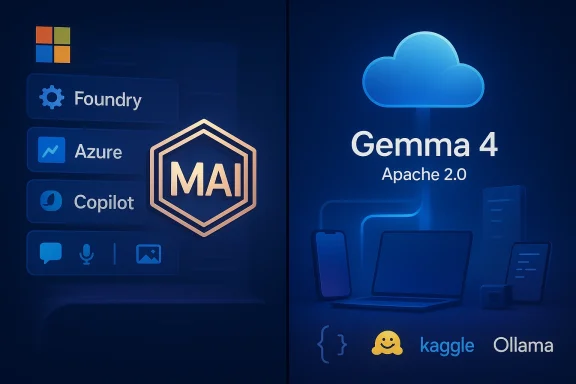
Microsoft and Google both used the same news cycle to signal very different ambitions, and the contrast matters as much as the launches themselves. Microsoft is leaning harder into first-party model ownership with its new MAI family, while Google is widening the distribution of its Gemma 4 open models and changing the licensing terms that govern how developers can use them. That combination is more than product noise; it is a snapshot of where the AI market is heading, with one giant tightening platform control and the other broadening local, open deployment options. The result is a sharper competition over who gets to define the next layer of everyday AI.
Microsoft’s announcement is notable because it is not just shipping a single model or a narrow feature update. It is unveiling a family of in-house models—MAI-Transcribe-1, MAI-Voice-1, and MAI-Image-2—through Microsoft Foundry and the MAI Playground, and positioning them as building blocks for both developer workflows and Microsoft’s own products. The company says MAI-Transcribe-1 handles speech-to-text across the top 25 most-used languages and delivers 2.5x faster batch transcription than Azure Fast, while MAI-Voice-1 can generate a minute of audio in roughly a second and support custom voices through short samples. MAI-Image-2 is already rolling out in Copilot, with Bing and PowerPoint next in line. ir image. The company’s Gemma 4 models are being positioned as its most capable open models yet, with availability under Apache 2.0 instead of the company’s earlier custom Gemma license. Google says the family is sized to run efficiently on hardware ranging from Android devices to laptop GPUs and workstations, and the official launch materials emphasize local use, agentic workflows, and multimodal capabilities. The models are downloadable from Hugging Face, Kaggle, and Ollama, reinforcing the message that Google wants developers to build with Gemma on their own hardware, not just in Google Cloud.
The strategic split is obvious. Microsoft is making its models more tightly bound to its platform, while Google is making its models easier to take off-platform. That difference is not cosmetic; it reflects two separate theories of AI value creation. One says the best way to win is to own the stack and keep the most important parts close. The other says the best way to win is to make the model ubiquitous, portable, and legally simple to adopt.
For users, the launch day headlines may sound similar, but the consequences are not. Microsoft is building productized infrastructure for speech, voice, and image creation inside Foundry and Microsoft apps. Google is building an open model family that can live on consumer GPUs, Android phones, and edge devices, including offline environments. In other words, Microsoft is selling a platform moat, while Google is selling **de
That shift makes strategic sense. Microsoft has enormous surface area across Windows, Microsoft 365, Copilot, Bing, Azure, and Foundry, which means it can turn model improvements into immediate product advantages. It also means the company can reduce dependence on external providers and create more control over cost, latency, and feature cadence. In a market where model switching is increasingly a competitive weapon, that independence matters more than ever. The real story is not whether Microsoft can build one model; it is whether it can build a durable moemeanwhile, has been steadily moving the Gemma family toward broader utility and easier deployment. Gemma 3 already emphasized lightweight, open, device-friendly models, while Google’s later on-device efforts and small-model work leaned into multimodal, local, and edge use cases. Gemma 4 extends that trajectory, but with a meaningful policy change: the switch to Apache 2.0 lowers friction for developers, startups, and enterprises that want clarity and portability. That is not just a legal detail; it is a market-access decision.
The licensing move matters because open model ecosystems rise or fall on the ease of reuse. A custom license can limit adoption, create compliance uncertainty, and make derivative work harder to justify internally. Apache 2.0 is a much cleaner fit for enterprise procurement, community contribution, and commercial product design. In practical terms, it tells developers that Google is willing to compete on model quality and tooling, not on license friction.*
The broader market context is also important. The AI industry has been drifting away from a single “best model wins” narrative and toward a more segmented landscape in which speech, voice, image, code, reasoning, and on-device tasks are all optimized differently. Microsoft’s MAI launch and Google’s Gemma 4 rollout both reinforce that trend. They do it from opposite directions, but the underlying message is the same: specialization is becoming a feature, not a compromise.
The significance goes beyond transcription. Speech recognition sits near the bottom of a lot of high-value workflows: meeting notes, accessibility, call centers, dictation, interviews, customer support, and compliance logging. If Microsoft can make transcription faster, cheaper, and more accurate inside its own stack, it can improve the economics of a whole family of business products. That is classiattack a boring but essential layer and turn it into leverage.
ps the most obvious attempt to give Microsoft a stronger creative foothold. The model is already being rolled into Copilot, with Bing and PowerPoint next, which means Microsoft is treating image generation as a productivity primitive rather than a side feature. That is a significant change in posture. It suggests the company wants AI-generated images to appear in the places where work already happens, not just in dedicated creative tools.
Microsoft’s choice l a playground environment is equally important. It lets the company test adoption in a controlled setting while also giving developers a path into first-party model use. That creates a feedback loop: Microsoft can watch what customers build, improve the models, and then fold those improvements back into Copilot and adjacent products. That is a more mature strategy than a one-off launch; it is a platform loop.
That openness matters because it gives developers more freedom to optimize for their own constraints. The larger 26B and 31B models are aimed at consumer GPUs and workstation-class use, while the lighter E2B and E4B variants are optimized for low-latency multimodal tasks on mobile and IoT devices. Google’s messaging explicitly mentions Android and offline operation, which is an important signal: this is not just a cloud story.
Google also appears to be positioning Gemma 4 as a complement to Gemini rather than a replacement for it. The official language stresses that the models give developers a powerful combination of open and proprietary tools. That is smart positioning because it avoids forcing a binary choice. Developers can use Gemini for cloud-scale premium capabilities and Gemma for local, embedded, or open deployments.
This is where Google’s broader ecosystem advantage shows up. A strong open model line can drive experimentation, community adoption, and platform loyalty, even if the company continues to reserve its most advanced cloud capabilities for Gemini. In effect, Google is extending its reach in both directions: upward into premium proprietary AI and downward into open local deployment.
Google is doing the opposite. Gemma 4 is being distributed through Hugging Face, Kaggle, and Ollama, which are exactly the channels many developers already use to test, fine-tune, and deploy open models. The choice is deliberate. It lowers friction and helps the model family spread in community and commercial ecosystems without needing Google Cloud as the first stop.
A useful way to think about the split is this: Microsoft is trying to make the model feel like part of the workspace. Google is trying to make the model feel like part of the device. Those are very different emotional and operational pitches, and each aligns with the company’s strengths.
That matters becausten care less about whether a model is the absolute best in the world and more about whether it is secure, governable, and easy to operationalize. Microsoft’s advantage is not just model quality; it is the surrounding ecosystem. Identity, policy, storage, and workflow tooling are already in place, which means the MAI family can slot into a procurement environment that values control.
Consumer appeal is more diffuse but potentially larger in scale. Microsoft can tuck MAI models into Copilot, Bing, PowerPoint, and other mainstream surfaces, which means many consumers may use them without even realizing which model is behind the scenes. Google’s consumer story is subtler: the user may not interact with “Gemma 4” directly, but they may benefit from apps that run better offline, respond faster, or respect device-local constraints. The consumer winner may not be the loudest launch, but the one that disappears most elegantly into the product.
There is also a branding dimension here. Microsoft is trying to become a model maker in its own right, not just the biggest AI distributor. Google is trying to show that open models can still be world-class and commercially useful. Both are identity plays as much as technical releases. If Microsoft succeeds, it strengthens the case that first-party platform AI is a competitive moat. If Google succeeds, it strengthens the case that open, local AI is not a second-class category.
For Google, the competitive message is different. Gemma 4 is not mainly a frontal assault on Microsoft’s Foundry strategy. It is a broader attempt to normalize Google models in open, local, and edge environments where proprietary cloud systems are less attractive. That still creates competitive pressure on Microsoft, because it raises the bar for what developers expect from open deployment, but it does so indirectly.
Microsoft also has the advantage of being able to embed MAI models into products users already trust, at least nominally. Google has the advantage of being able to distribute Gemma 4 into communities that value transparency, local execution, and the freedom to customize. Those strengths point toward different kinds of market power, not necessarily one winner.
Another concern is fragmentation. More model options are useful, but they also make integration decisions harder. Enterprises may end up supporting multiple stacks for speech, voice, and image tasks, which increases operational overhead. That is manageable, but only if vendors offer strong tooling, documentation, and governance.
Finally, there is the strategic issue of identity. Microsoft is now balancing three things at once: partner to OpenAI, platform host for enterprise AI, and first-party model maker. That can work, but it can also become confusing. Google faces a similar, though not identical, challenge: it wants to be both a proprietary frontier of open deployment. Managing those identities will matter as much as launching the models themselves.
The most important thing to watch is adoption. If developers start building real workloads on MAI through Foundry, Microsoft’s model independence becomes more than a strategic talking point. If Gemma 4 sees strong uptake in local tools, mobile apps, and open-source workflows, Google’s licensing gamble will have paid off. If both happen, the market may shift even faster toward specialization, portability, and stack-level competition.
In that sense, these launches are not just competitive maneuvers. They are signs that the industry is maturing. The next wave of AI wins may belong to the companies that make their models easiest to trust, easiest to deploy, and hardest to leave.
Source: Thurrott.com Microsoft and Google Launch New AI Models
 Overview
Microsoft’s announcement is notable because it is not just shipping a single model or a narrow feature update. It is unveiling a family of in-house models—MAI-Transcribe-1, MAI-Voice-1, and MAI-Image-2—through Microsoft Foundry and the MAI Playground, and positioning them as building blocks for both developer workflows and Microsoft’s own products. The company says MAI-Transcribe-1 handles speech-to-text across the top 25 most-used languages and delivers 2.5x faster batch transcription than Azure Fast, while MAI-Voice-1 can generate a minute of audio in roughly a second and support custom voices through short samples. MAI-Image-2 is already rolling out in Copilot, with Bing and PowerPoint next in line. ir image. The company’s Gemma 4 models are being positioned as its most capable open models yet, with availability under Apache 2.0 instead of the company’s earlier custom Gemma license. Google says the family is sized to run efficiently on hardware ranging from Android devices to laptop GPUs and workstations, and the official launch materials emphasize local use, agentic workflows, and multimodal capabilities. The models are downloadable from Hugging Face, Kaggle, and Ollama, reinforcing the message that Google wants developers to build with Gemma on their own hardware, not just in Google Cloud.The strategic split is obvious. Microsoft is making its models more tightly bound to its platform, while Google is making its models easier to take off-platform. That difference is not cosmetic; it reflects two separate theories of AI value creation. One says the best way to win is to own the stack and keep the most important parts close. The other says the best way to win is to make the model ubiquitous, portable, and legally simple to adopt.
For users, the launch day headlines may sound similar, but the consequences are not. Microsoft is building productized infrastructure for speech, voice, and image creation inside Foundry and Microsoft apps. Google is building an open model family that can live on consumer GPUs, Android phones, and edge devices, including offline environments. In other words, Microsoft is selling a platform moat, while Google is selling **de
Background
Microsoft has been working toward this moment for some time. The company’s AI strategy has evolved from relying heavily on external frontier models to building a more self-sufficient stack that spans infrastructure, product surfaces, and now first-party foundation models. That evolution is visible in the company’s public messaging, which says the MAI models are being used to power consumer and commercial experiences and will show up more broadly in Microsoft products and Foundry. The implication is clear: Microsoft no longeryomeone else’s AI breakthroughs.That shift makes strategic sense. Microsoft has enormous surface area across Windows, Microsoft 365, Copilot, Bing, Azure, and Foundry, which means it can turn model improvements into immediate product advantages. It also means the company can reduce dependence on external providers and create more control over cost, latency, and feature cadence. In a market where model switching is increasingly a competitive weapon, that independence matters more than ever. The real story is not whether Microsoft can build one model; it is whether it can build a durable moemeanwhile, has been steadily moving the Gemma family toward broader utility and easier deployment. Gemma 3 already emphasized lightweight, open, device-friendly models, while Google’s later on-device efforts and small-model work leaned into multimodal, local, and edge use cases. Gemma 4 extends that trajectory, but with a meaningful policy change: the switch to Apache 2.0 lowers friction for developers, startups, and enterprises that want clarity and portability. That is not just a legal detail; it is a market-access decision.
The licensing move matters because open model ecosystems rise or fall on the ease of reuse. A custom license can limit adoption, create compliance uncertainty, and make derivative work harder to justify internally. Apache 2.0 is a much cleaner fit for enterprise procurement, community contribution, and commercial product design. In practical terms, it tells developers that Google is willing to compete on model quality and tooling, not on license friction.*
The broader market context is also important. The AI industry has been drifting away from a single “best model wins” narrative and toward a more segmented landscape in which speech, voice, image, code, reasoning, and on-device tasks are all optimized differently. Microsoft’s MAI launch and Google’s Gemma 4 rollout both reinforce that trend. They do it from opposite directions, but the underlying message is the same: specialization is becoming a feature, not a compromise.
Microsoft’s MAI Strategy
Microsoft’s new MAI models look like the company’s most explicit step yet toward owning more of its own AI stack. MAI-Transcribe-1 is being framed as a high-accuracy speech-to-text model for real-world environments, including noisy and messy audio conditions, and Microsoft is emphasizing both language coverage and speed. The company’s e Fast—is itself a hint that this is a productization play, not just a lab exercise.The significance goes beyond transcription. Speech recognition sits near the bottom of a lot of high-value workflows: meeting notes, accessibility, call centers, dictation, interviews, customer support, and compliance logging. If Microsoft can make transcription faster, cheaper, and more accurate inside its own stack, it can improve the economics of a whole family of business products. That is classiattack a boring but essential layer and turn it into leverage.
Why transcription matters
Transcription is one of the most underrated AI categories because the outputs are rarely flashy, but the utility is immediate. Faster batch processing can reduce operational costs for enterprises that ingest large volumes of audio. Better language coverage broadens the practical audience, especially for multinational organizations. And if the to run at scale, it becomes sticky fast.- Lower transcription latency can change workflow economics.
- Multilingual support increases enterprise appeal.
- Better batch speed improves back-office automation.
- Reliable transcription boosts accessibility tooling.
- A first-party model creates tighter integration with Microsoft services.
From narration to interaction
Voice is not just about sounding good. It is about shaping how users feel about the product. A well-designed voice model can make Copilot feel less mechanical and more like a polished assistant, while also reducing the overhead of producing learning materials, explainers, or accessibility narration. The upside is clear; the risk is that voice cloning and synthetic speech can attract policy scrutiny if controls are not tight enough.ps the most obvious attempt to give Microsoft a stronger creative foothold. The model is already being rolled into Copilot, with Bing and PowerPoint next, which means Microsoft is treating image generation as a productivity primitive rather than a side feature. That is a significant change in posture. It suggests the company wants AI-generated images to appear in the places where work already happens, not just in dedicated creative tools.
Microsoft’s choice l a playground environment is equally important. It lets the company test adoption in a controlled setting while also giving developers a path into first-party model use. That creates a feedback loop: Microsoft can watch what customers build, improve the models, and then fold those improvements back into Copilot and adjacent products. That is a more mature strategy than a one-off launch; it is a platform loop.
Google’s Gemma 4 Opening
Google’s Gemma 4 launch is eposition. Rather than keeping the models close, Google is pushing them outward under Apache 2.0, making them easier to adopt, modify, and ship across a wide range of environments. The company describes the family as its most capable open model line to date, with support for reasoning, agentic workflows, coding, and multimodal generation.That openness matters because it gives developers more freedom to optimize for their own constraints. The larger 26B and 31B models are aimed at consumer GPUs and workstation-class use, while the lighter E2B and E4B variants are optimized for low-latency multimodal tasks on mobile and IoT devices. Google’s messaging explicitly mentions Android and offline operation, which is an important signal: this is not just a cloud story.
Local-first, not cloud-first
The local-run angle is a strong differentiator. Many developers want models they can ship into apps that need low latency, offline access, or better privacy posture. Google is clearly trying to make Gemma 4 the answer to those requirements. By emphasizing on-device deployment and edge support, the company is broadening the ways developers can use AI without always paying cloud inference costs.- Smaller variants help with latency-sensitive apps.
- Offline use broadens privacy-conscious deployments.
- Android support expands mobile reach.
- Consumer GPUs lower the barrier for independent developers.
- Edge deployment fits industrial and IoT scenarios.
Why Apache 2.0 changes the equation
Open model adoption often hinges less on raw benchmark claims than on what lawyers, procurement teams, and platform maintainers are comfortable approving. Apache 2.0 is familiar, permissive, and enterprise-friendly. That makes Gemma 4 easier to evaluate in real businesses, where time-to-approval can matter as much as time-to-train.Google also appears to be positioning Gemma 4 as a complement to Gemini rather than a replacement for it. The official language stresses that the models give developers a powerful combination of open and proprietary tools. That is smart positioning because it avoids forcing a binary choice. Developers can use Gemini for cloud-scale premium capabilities and Gemma for local, embedded, or open deployments.
This is where Google’s broader ecosystem advantage shows up. A strong open model line can drive experimentation, community adoption, and platform loyalty, even if the company continues to reserve its most advanced cloud capabilities for Gemini. In effect, Google is extending its reach in both directions: upward into premium proprietary AI and downward into open local deployment.
Distribution and Access
Distribution is the hidden battleground behind both announcements.ining access to Azure Foundry and the US-only MAI Playground, which tells you the company wants enterprise control and a measured rollout. That restriction can help with governance, compliance, and quality management, but it also makes the launch feel less open and less accessible to independent developers outside the US.Google is doing the opposite. Gemma 4 is being distributed through Hugging Face, Kaggle, and Ollama, which are exactly the channels many developers already use to test, fine-tune, and deploy open models. The choice is deliberate. It lowers friction and helps the model family spread in community and commercial ecosystems without needing Google Cloud as the first stop.
Where each company is betting
Microsoft is betting that developers will accept a narrower integration story is strong enough. That is reasonable in enterprise contexts, where identity, compliance, and workflow controls often matter more than pure openness. Google is betting that broad accessibility and simple licensing will generate momentum that eventually feeds back into its ecosystem. Both strategies can work, but they rely on very different forms of trust.- Microsoft favors controlled rollout and enterprise governance.
- Google favors broad distribution and developer flexibility.
- Microsoft emphasizes product integration.
- Google emphasizes local execution and licensing simplicity.
- Both aim to strengthen ecosystem loyalty.
A useful way to think about the split is this: Microsoft is trying to make the model feel like part of the workspace. Google is trying to make the model feel like part of the device. Those are very different emotional and operational pitches, and each aligns with the company’s strengths.
Enterprise and Consumer Impact
For enterprises, Microsoftmle of the two. The company is offering models that map cleanly to common business workflows: transcription for meetings and compliance, voice for narration and customer experiences, and image generation for presentations, marketing, and product planning. Because the models already integrate with Copilot and are being exposed through Foundry, enterprises can imagine relatively low-friction adoption paths.That matters becausten care less about whether a model is the absolute best in the world and more about whether it is secure, governable, and easy to operationalize. Microsoft’s advantage is not just model quality; it is the surrounding ecosystem. Identity, policy, storage, and workflow tooling are already in place, which means the MAI family can slot into a procurement environment that values control.
Enterprise fit versus consumer appeal
Google’s Gemma 4, by contrast, is likely to resonate first with developers and technically inclined organizations that want local control. Its ability to run on consumer GPUs, Android devices, and offline environments makes it attractive for edge scenarios, embedded assistants, and privacy-sensitive products. For enterprise teams, that can translate into lower inference costs and more flexible deployment options.Consumer appeal is more diffuse but potentially larger in scale. Microsoft can tuck MAI models into Copilot, Bing, PowerPoint, and other mainstream surfaces, which means many consumers may use them without even realizing which model is behind the scenes. Google’s consumer story is subtler: the user may not interact with “Gemma 4” directly, but they may benefit from apps that run better offline, respond faster, or respect device-local constraints. The consumer winner may not be the loudest launch, but the one that disappears most elegantly into the product.
There is also a branding dimension here. Microsoft is trying to become a model maker in its own right, not just the biggest AI distributor. Google is trying to show that open models can still be world-class and commercially useful. Both are identity plays as much as technical releases. If Microsoft succeeds, it strengthens the case that first-party platform AI is a competitive moat. If Google succeeds, it strengthens the case that open, local AI is not a second-class category.
Competitive Implications
The competitive implications are biggodline. Microsoft’s MAI launch creates more pressure on OpenAI, because it gives Microsoft a credible in-house option for speech, voice, and image tasks inside its own stack. That reduces supplier dependence and gives Microsoft more leverage in negotiations over pricing, roadmap, and integration. It also means Microsoft can be both partner and competitor at the same time, which is a very modern platform relationship.For Google, the competitive message is different. Gemma 4 is not mainly a frontal assault on Microsoft’s Foundry strategy. It is a broader attempt to normalize Google models in open, local, and edge environments where proprietary cloud systems are less attractive. That still creates competitive pressure on Microsoft, because it raises the bar for what developers expect from open deployment, but it does so indirectly.
A market of specialized lanes
What both launches really show is that AI is fragmenting into specialized lanes. Speech, voice, image, local reasoning, and agentic workflows are no longer all expected to come from one monolithic model family. Instead, companies are increasingly shaping model portfolios around specific usage patterns. That shift favors organizations that can own multiple parts of the stack and optimize for integration.- Microsoft is competing on integration depth.
- Google is competing on openness and portability.
- OpenAI is under pressure from both directions.
- Smaller startups face a harder differentiation story.
- Enterprise buyers gain more model choice, but also more complexity.
Microsoft also has the advantage of being able to embed MAI models into products users already trust, at least nominally. Google has the advantage of being able to distribute Gemma 4 into communities that value transparency, local execution, and the freedom to customize. Those strengths point toward different kinds of market power, not necessarily one winner.
Strengths and Opportunities
Microsoft’s MAI family and Google’s Gemma 4 line each bring clear strengths, but the real opportunity lies in how they reshape the defaults of AI adoption. Microsoft gets to use its distribution machine to turn model launches into product habits, while Google gets to use licensing and local execution to broaden the open-model ecosystem. If either company executes well, these launches can become durable platform advantages rather than short-lived press events.- Microsoft can embed MAI models directly into Copilot, Bing, and PowerPoint.
- MAI-Transcribe-1 could improve transcription economics for enterprise customers.
- MAI-Voice-1 could strengthen accessibility and narrated content workflows.
- MAI-Image-2 can make AI visuals more useful inside productivity software.
- Google gains goodwill from moving Gemma 4 to Apache 2.0.
- Gemma 4 can reach more devices, including Android phones and edge hardware.
- Local deployment gives developers lower latency and better privacy options.
- Both companies can use these releases to reduce reliance on third-party model suppliers.
Risks and Concerns
The upside is substantial, but so are the risks. Microsoft is now exposing its own models to public scrutiny, which means it owns the consequences if quality, safety, or availability do not match the promise. Google’s open approach, meanwhile, will only pay off if developers believe the new models are not just legally convenient but practically competitive. In AI, good intentions are cheap; operational reliability is what earns loyalty.- Preview status can limit confidence in production deployments.
- Voice and image features raise misuse and safety concerns.
- Microsoft’s regional access limits may frustrate non-US developers.
- Google’s open models still face intense competition from proprietary systems.
- Benchmarks may not fully reflect real-world performance.
- Local-running models can be constrained by hardware diversity.
- Licensing clarity helps, but it does not guarantee adoption.
- Rapid competition could compress margins for everyone.
Another concern is fragmentation. More model options are useful, but they also make integration decisions harder. Enterprises may end up supporting multiple stacks for speech, voice, and image tasks, which increases operational overhead. That is manageable, but only if vendors offer strong tooling, documentation, and governance.
Finally, there is the strategic issue of identity. Microsoft is now balancing three things at once: partner to OpenAI, platform host for enterprise AI, and first-party model maker. That can work, but it can also become confusing. Google faces a similar, though not identical, challenge: it wants to be both a proprietary frontier of open deployment. Managing those identities will matter as much as launching the models themselves.
Looking Ahead
The next few months will tell us whether these announcements become genuine platform shifts or simply strong openings. Microsoft will need to prove that MAI models are not just technically impressive, but also deeply integrated, consistently available, and economically compelling inside its broader product stack. Google will need to prove that Gemma 4 is not just easier to download, but genuinely useful enough to anchor serious local and edge AI projects.The most important thing to watch is adoption. If developers start building real workloads on MAI through Foundry, Microsoft’s model independence becomes more than a strategic talking point. If Gemma 4 sees strong uptake in local tools, mobile apps, and open-source workflows, Google’s licensing gamble will have paid off. If both happen, the market may shift even faster toward specialization, portability, and stack-level competition.
Key signals to watch
- Whether MAI models spread beyond Foundry into more Microsoft products.
- Whether Microsoft expands access beyond the current US-only MAI Playground.
- Whether MAI-Voice-1 and MAI-Image-2 gain broader enterprise controls.
- Whether Gemma 4 becomes a default choice for local and edge developers.
- Whether third-party ecosystems build around Apache 2.0 Gemma support.
- Whether cloud and on-device AI begin to converge in the same workflows.
In that sense, these launches are not just competitive maneuvers. They are signs that the industry is maturing. The next wave of AI wins may belong to the companies that make their models easiest to trust, easiest to deploy, and hardest to leave.
Source: Thurrott.com Microsoft and Google Launch New AI Models
