

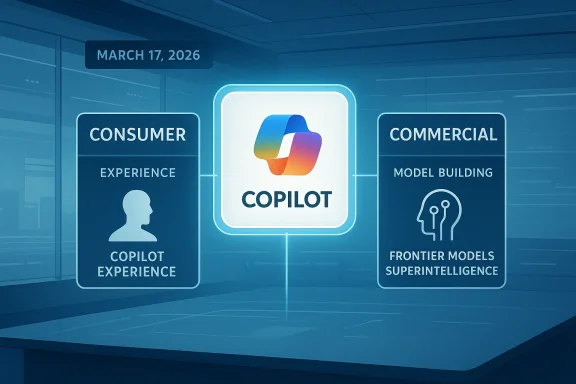
Microsoft’s latest Copilot shake-up is more than a routine org-chart shuffle. It is a sign that the company is trying to answer a harder question than “How do we add more AI?”—namely, how to turn expensive model ambition into a simpler, more coherent product strategy that users can actually feel. The reported move to consolidate Copilot engineering, elevate Jacob Andreou, and let Mustafa Suleyman focus more narrowly on next-generation model work reflects a familiar pressure point in 2026: the AI race is no longer just about who has the flashiest demo, but who can convert scale, distribution, and model access into durable business returns.
Background — full context
Microsoft entered the generative AI era with a structural advantage many rivals envied: the company already owned a vast productivity suite, a major cloud platform, and one of the world’s most visible consumer-facing search experiences. That allowed Microsoft to weave AI into Windows, Microsoft 365, Bing, and its broader enterprise stack without needing to invent a new customer relationship from scratch. The company’s Copilot branding became the umbrella for that ambition, but the umbrella also hid a challenge: one name was being asked to cover several very different products, user behaviors, and monetization models. (blogs.microsoft.com)The current reorganization is best understood against that backdrop. Microsoft publicly tied Mustafa Suleyman’s arrival in 2024 to a new consumer AI organization, Microsoft AI, with Copilot and consumer AI products as the center of gravity. Satya Nadella’s original announcement also made clear that Microsoft intended to strengthen both product development and the partnership model behind its AI stack, rather than rely on any single model provider. That is still the core story in 2026: Microsoft is not abandoning that approach, but it is refining how the teams are arranged around it. (blogs.microsoft.com)
A second layer of context is product experience. Microsoft has spent the past year pushing toward a more unified Copilot surface across apps and workflows. Recent Microsoft documentation and blog updates describe a more consistent Copilot experience across Microsoft 365 apps and Teams, including the use of shared context, unified chat, and in-app assistance. In other words, Microsoft is clearly trying to reduce fragmentation. If the product is supposed to feel like a single assistant, the organization behind it increasingly has to behave like a single product group. (techcommunity.microsoft.com)
The third context is market pressure. The AI assistant market is crowded and quickly becoming a comparison game. Consumers can switch between ChatGPT, Gemini, and Copilot with almost no switching cost, while enterprise buyers are increasingly asking whether the productivity gain justifies the subscription or infrastructure cost. Microsoft’s strategy has been to place Copilot inside the software people already use every day, but that also means expectations are brutal: users compare Copilot not with generic software, but with the best model they have seen anywhere. That raises the bar on both UX and model quality. (learn.microsoft.com)
Finally, the financial lens matters. AI capex and model-servicing costs have forced every major tech company to defend its spending with evidence of payback. Microsoft has the balance sheet to invest, but investors have shown increasing impatience with open-ended AI spending absent clear monetization. That pressure is part of why this leadership restructuring matters. It is not just about who reports to whom; it is about whether Microsoft can create a cleaner path from frontier-model work to a lower-friction, higher-value product experience. (learn.microsoft.com)
What Microsoft is actually changing
At the center of the reported shift is a familiar management move: collapsing adjacent engineering and product functions so execution becomes faster and less siloed. In practical terms, that usually means fewer layers between strategy, model integration, and customer-facing features. The goal is to make Copilot development feel less like a federation of overlapping efforts and more like a single product engine.Jacob Andreou’s expanded role
The reported elevation of Jacob Andreou to oversee consumer and business Copilot products signals a stronger product-management spine for the company’s AI assistant efforts. Reporting directly to Satya Nadella is not just symbolic; it implies a direct line to the CEO for prioritization, tradeoffs, and escalation.- Faster product decisions
- Clearer ownership across experiences
- Less duplication between consumer and business flows
- More direct alignment with Microsoft’s broader platform priorities
- Tighter feedback loops for feature launches
Mustafa Suleyman’s narrower focus
The most important strategic clue is that Mustafa Suleyman appears to be moving toward a deeper model- and research-centric role, with a stated focus on next-generation AI models. That matters because it aligns technical leadership with the part of the stack where Microsoft thinks the biggest future leverage may lie.- Model development
- Long-horizon AI capabilities
- Enterprise optimization
- Superintelligence-oriented research
- Cross-product AI quality improvements
More executive proximity to Nadella
The restructuring reportedly brings additional executives closer to Nadella, especially around Microsoft 365 applications and the Copilot platform. That usually means one of two things: the company wants more centralized control, or it wants to de-risk a strategic area by making sure leadership can react quickly.- Better coordination across Microsoft 365
- Reduced friction between app teams
- More direct accountability
- Quicker escalation for user experience problems
- Greater consistency in messaging and roadmap timing
Why the unified experience matters
The phrase “unified experience” sounds like corporate jargon until you look at how AI products are actually used. Users do not think in terms of internal org charts. They think in terms of whether the assistant appears where they need it, remembers context, and gives a consistently useful answer without forcing them to relearn the interface every time.Copilot across Microsoft 365
Microsoft has been steadily working toward a more coherent Copilot layer inside Word, Excel, PowerPoint, Outlook, Teams, and the Microsoft 365 app. Its own release notes and feature updates show ongoing work to make Copilot more context-aware and more deeply embedded into workflows. That matters because the strongest AI use cases are not isolated chat sessions; they are embedded, repeated, and workflow-specific.- Drafting documents
- Summarizing email threads
- Analyzing meeting notes
- Generating recaps
- Pulling relevant context from files and messages
- Helping users move from question to action
Copilot in Teams and meetings
Microsoft’s Teams updates have highlighted a more unified Copilot experience across chats, channels, and meetings for Microsoft 365 Copilot users. That is a meaningful signal because Teams is a high-frequency collaboration surface where context accumulates quickly. If Copilot can surface relevant meeting history, conversation trails, and calendar context in a single interface, it becomes much harder for users to go back to a fragmented workflow.- Chat history awareness
- Meeting transcript analysis
- Calendar context
- Smart recaps
- Message rewriting
- Action-oriented summaries
The UX challenge
A unified experience is not just about consistency. It is about trust. If a user sees the assistant behave differently in Word than it does in Teams, the product starts to feel unreliable. If answers vary too much by surface, users assume the model is inconsistent, even when the real issue is integration design.- Consistency builds trust
- Trust increases usage
- Usage justifies the subscription
- Subscription revenue justifies the investment
- Investment supports better models
The model strategy behind the reorganization
The reported emphasis on next-generation AI models is the most strategically interesting part of the story. Microsoft is not just trying to package existing models better. It appears to be positioning itself for a future in which model quality, cost, and specialization become key differentiators.Why “superintelligence” language matters
The term superintelligence is loaded, but in a corporate context it often signals aspiration rather than literal product promise. Microsoft’s reported emphasis suggests a push toward much more capable models for enterprise optimization and advanced automation. Whether that becomes a consumer-visible feature or remains mostly an internal engineering ambition, it implies a long-term bet on frontier capability.- Higher reasoning quality
- Better task planning
- Improved enterprise automation
- More efficient model routing
- Lower marginal serving costs
- Greater differentiation from commodity assistants
OpenAI, Anthropic, and model pluralism
Microsoft continues to integrate models from both OpenAI and Anthropic, which shows that it is not locked into a single-model worldview. That pluralism is strategically important. It lets Microsoft route tasks to the model that best fits the use case, hedge supplier risk, and keep pressure on performance and pricing.- OpenAI for flagship capability
- Anthropic for certain enterprise and reasoning workloads
- Microsoft orchestration for product integration
- Task-based model selection
- Flexibility across cost and capability tiers
Why this helps Copilot
A better model strategy can improve Copilot in at least four ways:- More reliable outputs
- Sharper domain performance
- Reduced hallucination risk
- Lower operating cost
Copilot’s market reality
Even with Microsoft’s enormous distribution advantage, Copilot faces a stubborn competitive reality: it is not the default AI assistant in the minds of many users. In the consumer market, OpenAI’s ChatGPT remains the cultural benchmark. In the broader assistant race, Google’s Gemini continues to benefit from tight integration with the company’s own ecosystem. Microsoft must therefore win on utility, not just on visibility.Daily active users and mindshare
The challenge for Microsoft is not just raw install base. It is habit. Users open the assistant that best matches their muscle memory and most common tasks. If Copilot is perceived as slower, less flexible, or less impressive than alternatives, it loses even in environments where it is already available.- Mindshare is not the same as distribution
- Distribution is not the same as engagement
- Engagement is not the same as retention
- Retention is not the same as willingness to pay
Search and ecosystem leverage
Microsoft’s search footprint remains well behind Google’s, and that matters because search is still the root of many consumer AI interactions. Even if exact percentages vary by measurement, the broader picture is clear: Google remains the dominant search gateway, while Microsoft is trying to use AI to improve the relative attractiveness of its own ecosystem.- Search relevance
- Browser integration
- Workspace integration
- Desktop integration
- Cross-device continuity
The comparison with ChatGPT
OpenAI’s ChatGPT has become the shorthand for “good AI.” That creates a high psychological bar for Microsoft. Users often compare Copilot with ChatGPT even when the use cases differ, because the question is not only whether Copilot works, but whether it feels best in class.- Better conversational quality
- Stronger general-purpose reputation
- High user familiarity
- Perceived innovation leadership
What this says about Microsoft’s leadership model
This restructuring also says something broader about how Microsoft likes to operate in a fast-moving technology cycle. The company often starts with decentralization, then recentralizes the strategic layer once the product becomes too important to leave scattered across teams.Centralization when stakes are high
When an initiative becomes core to the company’s identity, leadership tends to pull it closer to the center. That usually means stronger executive oversight, clearer accountability, and fewer experimental side paths.- More direct CEO involvement
- Less ambiguity about priorities
- Fewer duplicated roadmaps
- Faster conflict resolution
- Tighter alignment across engineering and product
Splitting product and research
There is a long-standing tension in AI companies between shipping useful products now and building the next model wave for later. Microsoft’s new structure appears designed to resolve that tension by allowing one leader to focus more on product and another more on model advancement.- Product leader for adoption
- Research leader for capability
- Platform leadership for integration
- Executive oversight for discipline
The enterprise angle
Microsoft’s business strength has always been enterprise trust. The Copilot restructuring appears intended to protect that trust by ensuring that the product feels less experimental and more dependable.- Predictable behavior
- Security-aware deployment
- Better admin controls
- More consistent licensing experience
- Cleaner enterprise procurement story
The investor lens: AI spending must earn its keep
There is a reason Wall Street watches these reorganizations so closely. AI is expensive. Model training, inference, orchestration, and productization all cost real money, and those costs can mount faster than revenue if the product story remains fuzzy.Why investors care
The investment community is increasingly asking whether AI spending is producing measurable outcomes. That question is not unique to Microsoft, but Microsoft is especially exposed because expectations around Copilot are so high.- Revenue growth
- Margin protection
- Subscriber conversion
- Seat expansion
- Enterprise attach rate
The ETF and stock context
The reported declines in software ETFs and Microsoft shares underscore how market sentiment can shift when AI enthusiasm collides with profit realism. That does not mean Microsoft is in trouble; it means the company is operating in a more skeptical era than the one that initially greeted generative AI.- Enthusiasm has matured
- Valuation discipline has returned
- Product proof is now required
- Execution quality matters more than messaging
Cost efficiency as strategy
A more efficient model and a more unified product surface are not separate goals. They reinforce each other.- Better routing reduces inference cost
- Better UX increases usage
- Better usage increases revenue
- Higher revenue supports further model investment
Strengths and Opportunities
Microsoft’s Copilot restructuring has several obvious strengths, especially if the company executes with discipline.Strong distribution
Microsoft already sits inside the workflows of hundreds of millions of users. That distribution advantage is enormous, and it is hard for standalone AI products to replicate.- Microsoft 365
- Windows
- Teams
- Bing
- Azure-connected enterprise environments
Clearer ownership
Putting product leadership in a tighter line of sight to Nadella can speed up decisions and reduce internal ambiguity.- Faster execution
- Simpler accountability
- Stronger roadmap alignment
Better model-product separation
Letting Suleyman focus more on frontier-model work while Andreou manages product coherence could improve both sides of the house.- Less cross-functional drag
- More focused technical investment
- Cleaner product prioritization
Unified experience potential
If Microsoft succeeds, users will experience Copilot less as a feature and more as a layer across work.- One assistant across apps
- More context
- Less switching
- Better continuity
Multi-model flexibility
Microsoft’s ability to integrate models from different providers gives it an important hedge.- Capability choice
- Cost optimization
- Risk diversification
- Faster adaptation
Risks and Concerns
For all the upside, the restructuring also exposes Microsoft to several risks.Fragmentation can persist
A reorg does not automatically fix product complexity. If the user experience remains inconsistent across apps and services, the organizational chart will not matter much.- Different surfaces may still feel disconnected
- Feature parity may lag
- Messaging may remain confusing
Model ambition can outrun product value
Pursuing ever more advanced models is exciting, but users care about usefulness. If the company spends too much on aspiration and too little on practical value, the economics can suffer.- High inference costs
- Unclear monetization
- Delayed payback
- Feature creep
Competitive pressure is relentless
OpenAI, Google, and others are all moving quickly. Microsoft cannot afford slow cycles or inconsistent product quality.- Consumer expectations rise fast
- Enterprise buyers compare options carefully
- Model leadership can shift quickly
Brand confusion is possible
Copilot is already a broad term. If Microsoft keeps expanding the brand without simplifying the promise, users may not know what Copilot actually does best.- Too many surfaces
- Too many subscription tiers
- Too many overlapping experiences
Investor patience is finite
If spending keeps rising while adoption remains uneven, the market may become less forgiving.- Revenue must catch up
- Margins must remain credible
- Narrative alone will not satisfy investors
What to Watch Next
The next few months will tell us whether this restructuring is a meaningful strategic reset or just a well-phrased internal shuffle.Product consistency across Microsoft 365
Watch whether Copilot becomes more uniform across Word, Excel, PowerPoint, Outlook, Teams, and the Microsoft 365 app.- Shared interface patterns
- Consistent prompt behavior
- Better context transfer
- Fewer surface-specific quirks
New model disclosures
If Microsoft begins talking more openly about next-generation enterprise models, that will be a sign the Suleyman-led technical agenda is becoming more visible.- Model announcements
- Benchmarks
- Enterprise optimization claims
- Inference-efficiency improvements
Enterprise adoption metrics
The best proof will be in usage, not press releases.- Seat growth
- Renewal rates
- Active usage trends
- Feature engagement
- Workflow depth
Consumer traction
Microsoft also needs to prove Copilot can matter outside enterprise procurement.- Daily engagement
- Retention
- Cross-device use
- General assistant preference
Competitive responses
Watch how OpenAI and Google position their own assistants in response to Microsoft’s more unified story.- Feature acceleration
- Pricing adjustments
- Deeper ecosystem integration
- New enterprise hooks
Microsoft’s latest Copilot restructuring is a reminder that the AI race is entering a more mature phase. The first act was about proving the technology could do impressive things; the second act is about organizing the company so those impressive things become reliable, profitable, and coherent products. By tightening leadership, separating product and model responsibilities, and pushing for a unified Copilot experience, Microsoft is trying to turn scale into strategy. Whether that works will depend less on the drama of the reorg and more on the dull but decisive details: speed, consistency, cost, and user trust.
Source: gurufocus.com https://www.gurufocus.com/news/8720...erate-ai-and-copilot-development/?mobile=true
Last edited:
