

F9Analytics has introduced RealAccretive, a multifamily profit management platform positioned as a deterministic alternative to AI-driven rent and revenue management systems, with availability through Microsoft Marketplace and deployment on Microsoft Azure. The announcement arrives at a crucial moment for apartment operators: algorithmic pricing has become both a powerful operational tool and a major legal, regulatory, and reputational flashpoint across the U.S. rental market.
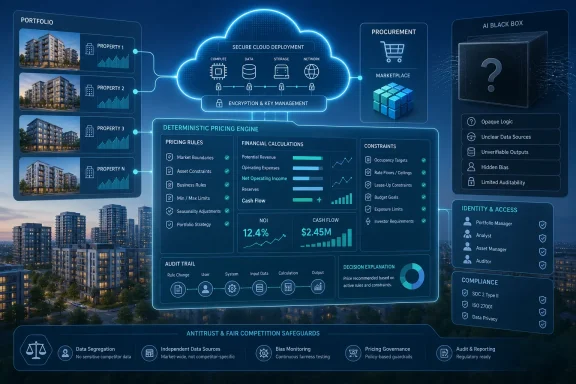
The company’s central argument is unusually direct. Rather than relying on probabilistic models, RealAccretive uses rule-based financial logic and constraint-based optimization to calculate pricing decisions that it says are transparent, auditable, and aligned with asset-level and portfolio-level business objectives. F9Analytics is also making bold claims around cost, speed, antitrust safeguards, and long-term shareholder value.
For Windows and cloud professionals, the more compelling story is not merely another real estate SaaS launch. It is an example of how Microsoft Azure, Microsoft Marketplace distribution, deterministic optimization, enterprise governance, and industry-specific compliance concerns are converging in one of the most scrutinized vertical software categories.
RealAccretive is marketed as a Multifamily Profit Management solution for apartment owners, REITs, asset managers, and large-scale property operators. Its stated purpose is to improve Net Operating Income (NOI) and Net Cash Flow (NCF) through automated pricing and profit-management workflows.
At a practical level, the platform appears designed to support pricing decisions across new leases, renewals, incentives, concessions, and broader portfolio-level operating targets. That places it in the same broad category as revenue management software, but F9Analytics is deliberately distancing RealAccretive from traditional rent optimization products and from newer AI-powered pricing systems.
The distinction is central to the product’s identity.
F9Analytics presents RealAccretive as a system built on:
That emphasis could resonate with multifamily operators facing rising insurance, debt-service, maintenance, staffing, construction, and compliance costs. In a market where a higher asking rent does not necessarily produce a better financial outcome, the ability to evaluate price alongside vacancy, concessions, lease duration, operating expense, and cost of capital is meaningful.
For Microsoft-centric organizations, that can offer several practical advantages:
That distinction is particularly important here because the announcement repeatedly characterizes the relationship as a partnership with Microsoft. The verified practical element is clear: RealAccretive is available in Microsoft’s commercial marketplace ecosystem and uses Azure. What is less clear from public product information is whether the arrangement includes a deeper co-sell agreement, joint engineering program, exclusive commercial relationship, or formal Microsoft-backed validation of the product’s performance claims.
For enterprise buyers, the operational question should be straightforward: What does Microsoft’s involvement actually mean for support, architecture, procurement, security, account management, and contractual accountability?
A marketplace listing and Azure deployment can be highly useful. They do not eliminate the need to understand the provider’s service boundaries.
A deterministic system, by contrast, should generate the same output whenever it receives the same validated inputs and follows the same rules.
That matters in financial operations because reproducibility can be more important than novelty.
This does not mean deterministic optimization is automatically superior to all AI approaches. It means the technology is often better suited to environments in which traceability, governance, and repeatability are essential requirements.
In broad terms, that principle holds that a business should continue increasing output or pricing activity until the revenue created by the next incremental unit equals the cost of producing or supporting it. In multifamily operations, the real-world implementation is more complicated than a classroom equation.
Apartment operators must account for:
An auditable model can still produce poor or socially harmful outcomes if its inputs or incentives are poorly designed.
That positioning is timely.
The multifamily industry has become a major test case for this principle. Enforcement actions and litigation have focused on allegations that software platforms facilitated the use of competitively sensitive, nonpublic information across landlords and encouraged alignment on rental prices, concessions, availability, or price floors.
As a result, apartment operators are under pressure to establish that any revenue management platform:
But it is essential to draw a careful line: software architecture can reduce risk; it cannot by itself guarantee legal compliance.
It also depends on:
The better interpretation of RealAccretive’s message is that it seeks to offer a more compliance-friendly design model: one that prioritizes first-party business inputs, rule-based governance, transparent calculations, and separable customer decision-making.
That is a worthwhile product direction. It should not be mistaken for immunity from legal scrutiny.
A rent optimization platform may calculate base rent, incentives, lease terms, or cost-related pricing decisions. Fee compliance is broader. It can involve how mandatory charges are disclosed, whether advertised prices reflect unavoidable costs, how utility charges are presented, and whether prospective renters receive accurate information before committing to a lease.
The biggest risk is assuming that transparent calculation inside a back-office system automatically translates into transparent disclosure to consumers. It does not.
For RealAccretive to make a meaningful impact on fee-practice compliance, it will need integrations and workflow controls that extend beyond finance and asset management teams. Leasing, legal, marketing, customer service, and regional operations all need to work from the same source of truth.
The cost difference between deterministic optimization and AI workloads can indeed be substantial under certain conditions.
That can be a compelling architectural advantage, especially for organizations that have been encouraged to add generative AI to workflows that may not require it.
For multifamily operators, a well-designed Azure deployment can support:
Organizations evaluating RealAccretive should establish:
For the property owner, explainability supports compliance, accountability, and better internal decision-making. For tenants, it can support clearer disclosures and a more understandable leasing experience.
RealAccretive’s deterministic approach could be valuable if it provides decision records that answer basic questions clearly:
Multifamily owners will want to see measurable results across diverse market conditions, including:
Key integration questions include:
The challenge is to preserve oversight without forcing every pricing decision into a manual bottleneck. RealAccretive’s promise of automation will be tested by how well it balances control with speed.
That argument has merit.
Not every problem needs a generative model. Not every pricing decision benefits from probabilistic inference. In domains where rules, constraints, margins, financial assumptions, and accountability matter most, deterministic optimization can be both technically appropriate and easier to govern.
The multifamily sector is especially likely to reward systems that can demonstrate the following:
Yet the company’s most ambitious assertions—particularly around complete antitrust protection, universal cost savings, and superior performance versus AI—should be evaluated through pilots, contractual commitments, independent validation, and rigorous customer-side governance.
The opportunity is substantial. A multifamily pricing platform that can improve financial performance while reducing opaque decision-making and avoiding prohibited data practices would be valuable in a sector that urgently needs both operational efficiency and public trust.
The company’s central argument is unusually direct. Rather than relying on probabilistic models, RealAccretive uses rule-based financial logic and constraint-based optimization to calculate pricing decisions that it says are transparent, auditable, and aligned with asset-level and portfolio-level business objectives. F9Analytics is also making bold claims around cost, speed, antitrust safeguards, and long-term shareholder value.
For Windows and cloud professionals, the more compelling story is not merely another real estate SaaS launch. It is an example of how Microsoft Azure, Microsoft Marketplace distribution, deterministic optimization, enterprise governance, and industry-specific compliance concerns are converging in one of the most scrutinized vertical software categories.
 Overview: A Multifamily Pricing Platform Built Around Deterministic Logic
RealAccretive is marketed as a Multifamily Profit Management solution for apartment owners, REITs, asset managers, and large-scale property operators. Its stated purpose is to improve Net Operating Income (NOI) and Net Cash Flow (NCF) through automated pricing and profit-management workflows.At a practical level, the platform appears designed to support pricing decisions across new leases, renewals, incentives, concessions, and broader portfolio-level operating targets. That places it in the same broad category as revenue management software, but F9Analytics is deliberately distancing RealAccretive from traditional rent optimization products and from newer AI-powered pricing systems.
The distinction is central to the product’s identity.
F9Analytics presents RealAccretive as a system built on:
- Deterministic pricing logic rather than stochastic AI outputs
- Constraint-based optimization rather than opaque recommendation engines
- Standard Azure compute resources rather than resource-intensive AI infrastructure
- Auditable financial decision-making rather than black-box automation
- Enterprise business rules that can incorporate costs, incentives, capital requirements, and investment objectives
- Portfolio-wide automation intended to scale across large multifamily property portfolios
That emphasis could resonate with multifamily operators facing rising insurance, debt-service, maintenance, staffing, construction, and compliance costs. In a market where a higher asking rent does not necessarily produce a better financial outcome, the ability to evaluate price alongside vacancy, concessions, lease duration, operating expense, and cost of capital is meaningful.
Microsoft Marketplace Availability Matters, But It Needs Context
RealAccretive is listed through Microsoft Marketplace, providing a recognizable enterprise procurement and deployment channel for organizations already standardized on Microsoft cloud technologies. The software is also described as operating as a SaaS offering hosted on Azure.For Microsoft-centric organizations, that can offer several practical advantages:
- A more familiar acquisition path for IT and procurement teams
- Alignment with existing Azure billing, governance, and cloud architecture discussions
- Potentially simpler vendor onboarding processes
- A more straightforward path toward enterprise identity integration
- Better alignment with cloud security review processes already built around Microsoft technologies
- Reduced friction for organizations that prefer cloud applications available through a centralized marketplace
That distinction is particularly important here because the announcement repeatedly characterizes the relationship as a partnership with Microsoft. The verified practical element is clear: RealAccretive is available in Microsoft’s commercial marketplace ecosystem and uses Azure. What is less clear from public product information is whether the arrangement includes a deeper co-sell agreement, joint engineering program, exclusive commercial relationship, or formal Microsoft-backed validation of the product’s performance claims.
For enterprise buyers, the operational question should be straightforward: What does Microsoft’s involvement actually mean for support, architecture, procurement, security, account management, and contractual accountability?
A marketplace listing and Azure deployment can be highly useful. They do not eliminate the need to understand the provider’s service boundaries.
Why Deterministic Pricing Is the Core of the RealAccretive Pitch
The company’s strongest technical argument is its rejection of what it calls “stochastic AI.” In simple terms, a stochastic system introduces probability, statistical inference, variability, or model-driven uncertainty into its outputs. Many modern AI systems work this way, including predictive models that estimate demand, churn, renewal likelihood, or price elasticity from historical data.A deterministic system, by contrast, should generate the same output whenever it receives the same validated inputs and follows the same rules.
That matters in financial operations because reproducibility can be more important than novelty.
The appeal of repeatable financial decisions
A multifamily operator may need to answer questions such as:- Why was a particular renewal price recommended?
- Which incentives were considered?
- Did the recommendation respect local rent restrictions?
- Did the model account for vacancy targets?
- How did financing costs influence the proposed lease rate?
- Can the decision be recreated six months later for an audit?
- Did the system use data from competing landlords?
- Can a manager override a result, and is that override recorded?
This does not mean deterministic optimization is automatically superior to all AI approaches. It means the technology is often better suited to environments in which traceability, governance, and repeatability are essential requirements.
Marginal revenue equals marginal cost
RealAccretive’s platform is built around the economic concept that returns are optimized where marginal revenue equals marginal cost, commonly expressed as MR = MC.In broad terms, that principle holds that a business should continue increasing output or pricing activity until the revenue created by the next incremental unit equals the cost of producing or supporting it. In multifamily operations, the real-world implementation is more complicated than a classroom equation.
Apartment operators must account for:
- Vacancy risk
- Lease expiration patterns
- Renewal probability
- Turnover costs
- Marketing expenses
- Free-rent concessions
- Bad debt exposure
- Property-specific operating expenses
- Local demand conditions
- Debt and capital costs
- Asset business plans
- Regulatory constraints
- Tenant affordability pressures
An auditable model can still produce poor or socially harmful outcomes if its inputs or incentives are poorly designed.
The Antitrust Argument: Important, Relevant, and Not Automatically Settled
F9Analytics’ most consequential claim is that its software architecture eliminates antitrust risk. The company says RealAccretive uses ring-fenced logic and avoids the kinds of information sharing that have placed legacy multifamily revenue management platforms under intense legal scrutiny.That positioning is timely.
The regulatory backdrop for rental pricing software
Federal and state authorities have made clear that the use of algorithms does not place pricing conduct outside competition law. The core issue is not whether software is involved. The issue is whether competitors use a shared system, nonpublic data, coordinated recommendations, or market-wide pricing mechanisms in a way that substitutes coordination for independent decision-making.The multifamily industry has become a major test case for this principle. Enforcement actions and litigation have focused on allegations that software platforms facilitated the use of competitively sensitive, nonpublic information across landlords and encouraged alignment on rental prices, concessions, availability, or price floors.
As a result, apartment operators are under pressure to establish that any revenue management platform:
- Does not pool nonpublic sensitive competitive data from unrelated owners.
- Does not generate recommendations based on competitors’ confidential pricing behavior.
- Does not impose or incentivize pricing floors that suppress legitimate competition.
- Does not require automatic acceptance of recommendations.
- Allows meaningful independent business judgment.
- Maintains appropriate compliance controls, records, and review processes.
- Can explain the sources of data used in a pricing decision.
But it is essential to draw a careful line: software architecture can reduce risk; it cannot by itself guarantee legal compliance.
Why “eliminates antitrust risk” is too absolute
No vendor can realistically eliminate all antitrust risk for a customer. Competition law analysis depends on more than software code.It also depends on:
- The data an operator provides
- The data a vendor collects or processes
- The system’s recommendation methodology
- Human oversight and approval practices
- Contractual terms
- Market concentration
- Competitor interactions
- Internal policy enforcement
- The behavior of property managers and asset managers
- The actual effects of pricing practices in the market
The better interpretation of RealAccretive’s message is that it seeks to offer a more compliance-friendly design model: one that prioritizes first-party business inputs, rule-based governance, transparent calculations, and separable customer decision-making.
That is a worthwhile product direction. It should not be mistaken for immunity from legal scrutiny.
The FTC Fee Issue Is Separate From Rent Optimization
The announcement also connects RealAccretive with protection against unfair rental fee practices under Federal Trade Commission rules. This aspect deserves particular scrutiny because rental pricing and fee transparency are related, but they are not the same problem.A rent optimization platform may calculate base rent, incentives, lease terms, or cost-related pricing decisions. Fee compliance is broader. It can involve how mandatory charges are disclosed, whether advertised prices reflect unavoidable costs, how utility charges are presented, and whether prospective renters receive accurate information before committing to a lease.
A platform can help, but policies still matter
A deterministic pricing platform may assist compliance if it can:- Include mandatory fees in the total cost presented to renters
- Require fee disclosures as part of the pricing workflow
- Prevent lease offers from being generated without required disclosures
- Record who approved a fee structure
- Track changes to pricing and concession rules
- Create audit logs for property-level communications
- Apply location-specific disclosure rules
The biggest risk is assuming that transparent calculation inside a back-office system automatically translates into transparent disclosure to consumers. It does not.
For RealAccretive to make a meaningful impact on fee-practice compliance, it will need integrations and workflow controls that extend beyond finance and asset management teams. Leasing, legal, marketing, customer service, and regional operations all need to work from the same source of truth.
Cost Claims: The 90% Figure Requires Customer Validation
F9Analytics says RealAccretive can deliver immediate 90% cost savings compared with probabilistic AI models by using native Azure architecture and standard Azure compute resources. This is one of the announcement’s most attention-grabbing claims, but it should be treated as a vendor performance assertion rather than a universal benchmark.The cost difference between deterministic optimization and AI workloads can indeed be substantial under certain conditions.
Why a deterministic platform may cost less
Large AI deployments can generate meaningful expenses through:- GPU or accelerator consumption
- Model training and retraining
- Vector databases and retrieval pipelines
- Managed AI service fees
- Higher storage and data-processing requirements
- Data labeling and data quality programs
- Model monitoring and evaluation
- AI safety and governance tooling
- Specialist engineering and machine learning operations staff
That can be a compelling architectural advantage, especially for organizations that have been encouraged to add generative AI to workflows that may not require it.
Where cost comparisons can become misleading
The 90% figure can only be assessed against a clear baseline. Customers should ask:- Which AI model or competing platform is being used for comparison?
- Is the calculation based on infrastructure cost, subscription cost, implementation cost, or total cost of ownership?
- Does it include data integration, support, consulting, and migration?
- How large is the modeled property portfolio?
- Which Azure services are assumed?
- Is the comparison based on actual customer deployments or internal performance testing?
- Does the cost model include human review and operational change management?
- Are security, backup, recovery, monitoring, and disaster recovery included?
Azure Architecture: A Strong Fit for Enterprise Deployment
The Azure component of the RealAccretive strategy may be one of its more practical strengths. Microsoft’s cloud platform gives smaller specialist vendors access to enterprise-grade building blocks without requiring customers to build and operate their own infrastructure from scratch.For multifamily operators, a well-designed Azure deployment can support:
- Elastic compute for portfolio-wide pricing calculations
- Centralized security and identity controls
- Data storage and backup services
- Regional deployment options
- Monitoring and operational telemetry
- Integration with Microsoft Entra ID
- Role-based access controls
- Enterprise logging and auditability
- Disaster recovery planning
- API-based connections to property management and financial systems
Identity and access should be a buying priority
Pricing systems can affect large volumes of leases and millions of dollars in revenue. Access governance is therefore not a peripheral IT concern. It is a financial control.Organizations evaluating RealAccretive should establish:
- Single sign-on requirements through Microsoft Entra ID.
- Role-based access controls for asset managers, regional teams, leasing leadership, finance, and administrators.
- Segregation of duties between configuration, approval, and override functions.
- Immutable audit logging for price changes, rule changes, and manual exceptions.
- Conditional access policies appropriate to the sensitivity of the system.
- Periodic access reviews for users with authority to alter portfolio-wide logic.
- Incident response processes that address both cybersecurity events and business-rule failures.
The Value of Explainability in a High-Stakes Housing Market
The word explainability has become overused in AI marketing, but it has real weight in multifamily pricing. Housing is not an ordinary retail category. A price decision can determine whether a household can remain in a home, whether a tenant renews a lease, and whether a property develops a reputation for opaque fees or aggressive pricing.For the property owner, explainability supports compliance, accountability, and better internal decision-making. For tenants, it can support clearer disclosures and a more understandable leasing experience.
RealAccretive’s deterministic approach could be valuable if it provides decision records that answer basic questions clearly:
- What pricing inputs were considered?
- Which constraints affected the result?
- Which internal objectives were prioritized?
- Were incentives included?
- Did the system apply local restrictions?
- Did an employee override the recommendation?
- What changed between one quote and the next?
Potential Risks for F9Analytics and Its Customers
RealAccretive has a differentiated narrative, but the product faces substantial execution challenges.The burden of proving performance
The platform claims strong pricing outcomes, extreme cost savings, low latency, scalability, and legal safeguards. Those claims will require customer evidence over time.Multifamily owners will want to see measurable results across diverse market conditions, including:
- High-vacancy periods
- Lease-up properties
- Mature stabilized assets
- Rent-controlled or heavily regulated jurisdictions
- Markets with weak renewal rates
- Properties dependent on concessions
- Portfolios with varied unit mix and tenant segments
- Assets with high debt-service burdens
Data integration remains difficult
Most large multifamily operators already use a complex mix of property management, accounting, CRM, leasing, marketing, payment, and business intelligence platforms. A pricing engine must fit into that ecosystem without creating duplicate data, inconsistent approvals, or manual workarounds.Key integration questions include:
- Which property management systems are supported?
- How frequently does operational data synchronize?
- How are data errors detected and corrected?
- Can the platform distinguish actual signed rents from advertised rents?
- How are concessions represented?
- How are renewals, transfers, and notice-to-vacate events modeled?
- Can customers export full historical decision records?
- What happens when integrations fail?
Governance can become an operational burden
Transparency is beneficial, but governance requirements can slow organizations down if the product does not present controls in a usable way. A large asset manager may need strict approval workflows, while a site-level operator may need a rapid, practical response to changing availability.The challenge is to preserve oversight without forcing every pricing decision into a manual bottleneck. RealAccretive’s promise of automation will be tested by how well it balances control with speed.
What RealAccretive Signals for the Future of Multifamily Software
The most significant implication of this launch may be the wider strategic shift it represents. For several years, enterprise software has often treated AI as the default answer to nearly every analytical problem. F9Analytics is arguing for a more selective approach: use advanced mathematics where the business problem is structured, measurable, governed, and economically defined.That argument has merit.
Not every problem needs a generative model. Not every pricing decision benefits from probabilistic inference. In domains where rules, constraints, margins, financial assumptions, and accountability matter most, deterministic optimization can be both technically appropriate and easier to govern.
The multifamily sector is especially likely to reward systems that can demonstrate the following:
- Clear separation from competitors’ nonpublic data
- Transparent business-rule enforcement
- Strong audit trails
- Reliable financial logic
- Controlled employee overrides
- Clear fee disclosures
- Measurable unit economics
- Secure cloud deployment
- Repeatable enterprise operations
Yet the company’s most ambitious assertions—particularly around complete antitrust protection, universal cost savings, and superior performance versus AI—should be evaluated through pilots, contractual commitments, independent validation, and rigorous customer-side governance.
The opportunity is substantial. A multifamily pricing platform that can improve financial performance while reducing opaque decision-making and avoiding prohibited data practices would be valuable in a sector that urgently needs both operational efficiency and public trust.
References
- Primary source: 01net
Published: 2026-07-23T18:19:00+00:00
F9Analytics and Microsoft, a Partnership to Transform Multifamily Pricing Operations
When you control your data, when you control your pricing, you control your performance.SAN FRANCISCO--(BUSINESS WIRE)--F9Analytics, in Partnership with Microsoft, introduces RealAccretive, the advanced Multifamily Profit Management solution now avail... www.01net.it
- Related coverage: f9analytics.com
F9Analytics ∫ Predictive Pricing Analytics
Unleash F9Analytics Predictive Pricing Analytics, to experience why 'getting the price right is one of the most fundamental and important management functions'.www.f9analytics.com