

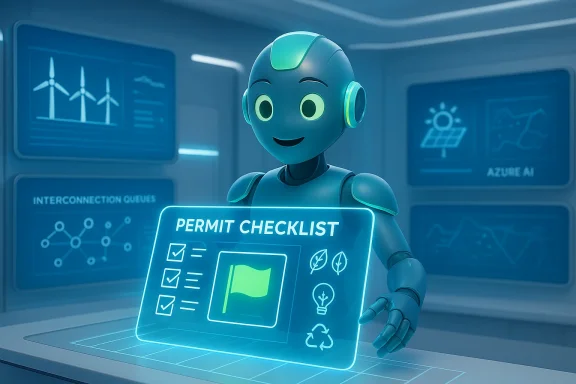
Microsoft's latest Copilot push has a new face — and a new pitch for industrial customers: Mico, the animated Copilot avatar unveiled in late 2025, is now being promoted by Microsoft’s Copilot channels as more than a conversational companion. According to a February 10, 2026 Copilot post summarized in industry press, Microsoft is positioning Mico as part of an AI-assisted planning workflow that can help teams “get green flagged” on energy projects — reducing guesswork in permitting, surfacing compliance gaps, and accelerating approvals — a capability that could reshape how renewable and grid projects move from concept to construction.
Microsoft’s Copilot evolution has moved quickly from a productivity assistant inside Microsoft 365 to a broader set of enterprise-focused copilots that connect to Azure, Microsoft Graph, Edge and third-party systems. The Copilot update that introduced Mico framed it as a human‑friendly avatar — expressive, customizable, and useful in voice and visual modes — as well as a vehicle for new Copilot features like richer memory, Copilot Actions and deeper app integrations. Multiple outlets covered the fall 2025 rollout and its UX ambitions, noting that Mico ships with privacy controls and initially rolled out in select markets.
At the same time, utilities and developers are under pressure to compress long, paperwork‑heavy approval cycles for renewable projects. The energy sector’s permitting and pre‑construction phase commonly involves dozens of stakeholders, environmental assessments, interconnection studies, and local code reviews — workflows that are highly repetitive, rules‑based and prime for automation and decision support. Microsoft’s recent Copilot messaging suggests Mico can act as a planning assistant inside these workflows: generating draft permit packages, checking submission checklists, summarizing stakeholder comments, and surfacing missing documents that cause delays. That positioning puts Copilot — and by extension Microsoft’s Azure AI stack — squarely into the business of operationalizing climate investments.
For buyers, the sensible path is pragmatic: pilot small, insist on auditable outputs, and treat AI suggestions as decision support rather than final authority. For vendors, the opportunity is to build domain‑specific connectors and governance features that turn promotional claims into measurable operational value. The energy transition rewards speed and certainty; copilots that can legitimately shorten approval cycles and provide defensible, explainable guidance will be commercially valuable. Mico may be the face that draws attention — but the value will be proven in integrations, audits and documented outcomes, not in avatars alone.
Source: blockchain.news Microsoft Copilot Highlights Mico: AI Planning Tool to Streamline Green-Flag Energy Projects – 5 Business Impacts and 2026 Trends | AI News Detail
 Background / Overview
Microsoft’s Copilot evolution has moved quickly from a productivity assistant inside Microsoft 365 to a broader set of enterprise-focused copilots that connect to Azure, Microsoft Graph, Edge and third-party systems. The Copilot update that introduced Mico framed it as a human‑friendly avatar — expressive, customizable, and useful in voice and visual modes — as well as a vehicle for new Copilot features like richer memory, Copilot Actions and deeper app integrations. Multiple outlets covered the fall 2025 rollout and its UX ambitions, noting that Mico ships with privacy controls and initially rolled out in select markets. At the same time, utilities and developers are under pressure to compress long, paperwork‑heavy approval cycles for renewable projects. The energy sector’s permitting and pre‑construction phase commonly involves dozens of stakeholders, environmental assessments, interconnection studies, and local code reviews — workflows that are highly repetitive, rules‑based and prime for automation and decision support. Microsoft’s recent Copilot messaging suggests Mico can act as a planning assistant inside these workflows: generating draft permit packages, checking submission checklists, summarizing stakeholder comments, and surfacing missing documents that cause delays. That positioning puts Copilot — and by extension Microsoft’s Azure AI stack — squarely into the business of operationalizing climate investments.
What Microsoft Says — and What the Coverage Shows
- Microsoft’s Copilot account and the company’s fall 2025 release describe Mico as an engagement and usability layer for Copilot, not a separate AI model. The avatar is intended to make interactions feel more natural while Copilot provides the reasoning and actions under the hood.
- Industry summaries of Microsoft’s messaging about Mico extend it into practical workflows: Copilot Actions can apply reasoning across browser tabs and apps, and Mico offers a visible surface that can guide users through multi‑step templates — including project planning and compliance checklists. That combination is what Microsoft and some trade outlets now position toward energy workflows.
- Independent reporting confirms the user‑facing product features (avatar, memory, Copilot Actions) and notes the emphasis on privacy controls and regional rollouts. What is less clear in third‑party coverage is the depth of specialized planning capabilities for energy developers — many of the energy‑specific claims derive from Microsoft marketing and aggregated industry commentary rather than field studies.
Why Mico-as-Planner Matters to Energy Projects
Energy projects — especially renewables and grid upgrades — face lengthy pre‑construction timelines due to regulatory reviews, environmental impact studies, interconnection queues and multi‑agency signoffs. AI copilots that can reliably reduce friction during these stages create real value:- Faster approvals reduce capital carry costs and improve project NPV.
- Automated documentation and consistency checks lower the risk of deficiency rejections.
- Standardized templates and role‑specific briefings shrink coordination overhead between developers, regulators and landowners.
Technical and Research Context: What AI Already Delivers in Energy
AI’s role in energy is not hypothetical. Over the past five years research and commercial deployments have documented measurable forecasting and optimization gains:- Machine‑learning and deep‑learning models for wind and solar forecasting have repeatedly shown double‑digit accuracy improvements over legacy statistical models in many contexts. Recent academic surveys and peer‑reviewed studies report improvements in the range of roughly 10–25%, depending on horizon, model architecture and dataset. These gains directly reduce imbalance costs and reserve needs for grids with high renewable penetration.
- Across grid operations and asset management, AI has been applied successfully to predictive maintenance, anomaly detection and dispatch optimization. Pilots from major vendors and labs show lower downtime and more efficient asset scheduling when ML models are integrated with SCADA and EMS data. The practical upshot: better forecast accuracy and automated decision support translate to lower operating costs and lower carbon intensity.
- Business‑facing market estimates show fast growth in AI‑for‑energy segments, though the precise size and timelines vary by vendor and analyst. Multiple market research groups project multi‑billion‑dollar markets for AI energy software and services through the rest of the decade. These projections are commonly used to support vendor go‑to‑market strategies, but individual forecasts should be treated cautiously because methodologies differ.
Five Business Impacts (Practical Lens)
Below are five concrete ways Microsoft’s Mico/Copilot positioning could affect energy customers and vendors — with realistic caveats.1. Shorter pre‑construction cycles (permitting and approvals)
- How: AI copilots automate checklist validation, compile submission packages, and produce stakeholder‑ready executive briefs that reduce back‑and‑forth.
- Business impact: Faster land rights, environmental signoffs and interconnection approvals reduce time‑to‑construction and financing costs.
- Caveat: Realizing this depends on integration with domain datasets (permitting portals, GIS, interconnection studies) and validation by subject‑matter experts.
2. Better bid and grant success rates
- How: Standardized, AI‑generated bid responses and compliance documentation reduce human error and present consistent narratives to reviewers.
- Business impact: Higher hit rates on RFPs and grant awards; lower admin cost per bid.
- Caveat: Outputs must be audited; regulatory bodies expect source data and provenance, so explainability matters.
3. Scalable ESG reporting and certification readiness
- How: Copilot can ingest project data and auto‑generate LEED/ISO‑50001 evidence packages or ESG reports, with Mico guiding users through data gaps.
- Business impact: Lower reporting cost and faster audits; easier access to sustainability‑linked financing.
- Caveat: Certification bodies require attestations and often original data files — AI summaries accelerate preparation but do not replace third‑party verification.
4. New monetization models for software vendors
- How: SaaS vendors can layer Copilot connectors and Mico templates into vertical planning products (subscription, outcome‑based pricing).
- Business impact: Productization of domain-specific copilots (grid planning, interconnection, environmental compliance) opens recurring revenue models.
- Caveat: Market success will depend on data portability, API stability, and enterprise trust in model outputs.
5. Workforce augmentation and role changes
- How: Engineers and permitting specialists will shift from drafting repetitive artifacts to supervising AI‑generated outputs and managing exceptions.
- Business impact: Productivity gains but also a need for reskilling and new quality‑assurance governance roles.
- Caveat: Poorly governed automation can introduce systemic errors; organizations must maintain human‑in‑the‑loop processes and traceability.
Implementation Playbook: How Utilities and Developers Should Pilot Copilot + Mico
- Inventory critical workflows that are rules‑based and document‑heavy (permitting, interconnection, environmental assessments).
- Start with a narrow pilot: connect Copilot to one data source (e.g., a permitting portal, GIS layer or interconnection queue).
- Define success metrics upfront: time saved per submission, number of missing items detected before formal reviews, reviewer satisfaction.
- Build an audit trail and retention policy: ensure every AI suggestion links back to source documents and timestamps.
- Scale iteratively: expand connectors, add role‑based templates, and run external audits of model outputs.
Trust, Governance and Regulatory Considerations
AI in energy planning is inherently high‑risk in some respects: wrong guidance can delay projects, cause compliance failures, or expose developers to liability. Regulators and standards bodies are already focusing on transparency and risk controls.- The EU’s AI Act and similar frameworks emphasize transparency for high‑risk systems; energy planning copilots that influence regulated outcomes will likely fall into these categories. Organizations must ensure model explainability, versioning, and audit logs.
- Data privacy and access controls are central. Copilot integrations that draw from enterprise‑wide data (via Microsoft Graph) require carefully scoped permissions and governance policies to prevent accidental disclosure of sensitive contract or grid data. Some enterprises have delayed AI deployments pending permission and governance reviews.
- Verification and liability: AI outputs should be treated as recommendations. Contracts and workflows must specify human approvals and acceptance criteria for regulatory submissions to avoid misattributed compliance failures.
Strengths and Opportunities
- Speed and scale: AI copilots can process dozens of regulatory documents and cross‑reference requirements far faster than manual teams.
- Consistency: Templates enforced by AI reduce variance across portfolios and improve reusability for repeat projects.
- Commercial leverage: Vendors can productize domain‑specific copilots (e.g., a Copilot connector for interconnection queue analytics) and offer vertical SaaS extensions.
- Operational carbon impact: Improved forecasting and scheduling via AI reduce curtailment and improve renewable integration — a direct environmental win when models are accurate and integrated.
Risks and Open Questions
- Marketing vs. field readiness: Microsoft’s public messaging frames Mico as an assistant in planning workflows; independent verification of enterprise‑grade, end‑to‑end energy planning functionality is limited in public reporting. The Copilot posts and industry writeups are promotional and should be treated as such until vendor case studies demonstrate measurable, audited outcomes.
- Data quality and bias: AI models are only as good as the data they ingest. Historical permitting decisions and environmental assessments contain biases and incomplete records; models trained on such corpora can replicate or amplify mistakes. Robust validation and diverse training data are required.
- Explainability and auditability: Regulatory reviewers will demand provenance; organizations must maintain clear links from AI suggestions back to input datasets, and models must record decision paths for audits.
- Vendor lock‑in and permissions risk: Copilot’s power stems from deep integrations across Microsoft 365 and Azure. Enterprises must weigh the productivity gains against vendor lock‑in and the governance overhead of broad Graph permissions. Some organizations are treating agentic copilots as high‑risk until permission models stabilize.
- Unverified market numbers and claims: Several widely cited figures in promotional writeups require scrutiny. For example, the blockchain.news item we are analyzing repeats a PwC 2021 projection that AI could reduce global GHG by up to 10% by 2030 — however, other interpretations of the PwC work and associated writeups cite a smaller figure (closer to 4%). Similarly, market size claims like “$13 billion by 2025 for AI energy management” are frequently attributed to Gartner or other analysts but the primary Gartner report is not publicly accessible in many cases, and independent estimates differ. Readers and procurement teams should verify such numbers directly with the analyst reports before relying on them for investment decisions. Treat these headline numbers as indicative, not definitive.
The Competitive Landscape: Where Mico Fits
Microsoft is not alone in embedding AI into energy planning:- Cloud vendors (Google Cloud, AWS) and specialist vendors (Eos, AutoGrid, utility‑specific platforms) already offer forecasting and optimization modules.
- Enterprise partners have begun packaging Copilot‑style assistants into domain products — ABB’s Genix Copilot is a concrete example of an industry partner building a Copilot experience tailored to asset performance and sustainability analytics, showing how Copilot technology can surface operational and sustainability insights for industrial customers. That partnership and product development path is a template for how Mico‑like experiences could be embedded in sectoral workflows.
Evidence and Verification: What the Public Data Shows
- The Copilot / Mico product UX and feature set (avatar, memory, Copilot Actions) are well documented across multiple outlets and Microsoft communications. These features are real and shipping in stages.
- The specific claim that Mico is now a field‑tested energy planning engine that reliably “green flags” projects appears to be an extension of Microsoft’s positioning rather than proof of widely published, audited pilot results in the public domain. The blockchain.news summary is accurate as a description of Microsoft’s social messaging and CTAs, but third‑party case studies or regulator‑facing audits demonstrating consistent approval speedups are not yet publicly available. Procurement teams should demand pilot results and audit reports before concluding parity with domain‑specific planning platforms.
- Academic and applied research supports the technical premise that AI improves forecasting and operations: multiple peer‑reviewed studies and surveys report double‑digit accuracy gains for renewable forecasting and operational optimization when ML methods are applied appropriately. Those technical gains underpin the business case for copilots that can automate planning checks and forecast outcomes — but practical deployment success depends on robust integration and governance.
Recommendations for CIOs, Energy Executives and Vendors
- CIOs and Head of Renewables: Run narrowly scoped pilots that connect Copilot to one or two authoritative data sources (permitting portal, GIS layers, interconnection) with explicit KPIs and human approval gates.
- General Counsel and Compliance: Insist on model provenance, version control, and explainability requirements before accepting AI‑generated regulatory deliverables.
- Procurement: Demand measurable, auditable case studies showing time‑savings and error reduction before committing to platform‑level integrations.
- Vendors and System Integrators: Build modular connectors that expose data provenance and human‑in‑the‑loop rollback; offer outcome‑based trials to demonstrate value.
- Policy makers and regulators: Engage with vendors to define acceptable evidence standards for AI‑assisted submissions and create sandbox frameworks where experimental submissions can be safely validated.
Conclusion
Microsoft’s Mico represents a clear shift in how large cloud vendors package AI: an approachable, avatar‑driven surface wrapping potent enterprise integrations. The company’s messaging about Copilot + Mico as a planning assistant for green‑flagging energy projects is strategic and compelling — it connects product UX advances to a real pain point in the energy transition. But marketing is not proof. Public reporting shows that the technical foundation for improved forecasting and planning exists, and early deployments of Copilot in industrial contexts (for example, partner solutions built on Azure OpenAI) demonstrate the potential.For buyers, the sensible path is pragmatic: pilot small, insist on auditable outputs, and treat AI suggestions as decision support rather than final authority. For vendors, the opportunity is to build domain‑specific connectors and governance features that turn promotional claims into measurable operational value. The energy transition rewards speed and certainty; copilots that can legitimately shorten approval cycles and provide defensible, explainable guidance will be commercially valuable. Mico may be the face that draws attention — but the value will be proven in integrations, audits and documented outcomes, not in avatars alone.
Source: blockchain.news Microsoft Copilot Highlights Mico: AI Planning Tool to Streamline Green-Flag Energy Projects – 5 Business Impacts and 2026 Trends | AI News Detail
