

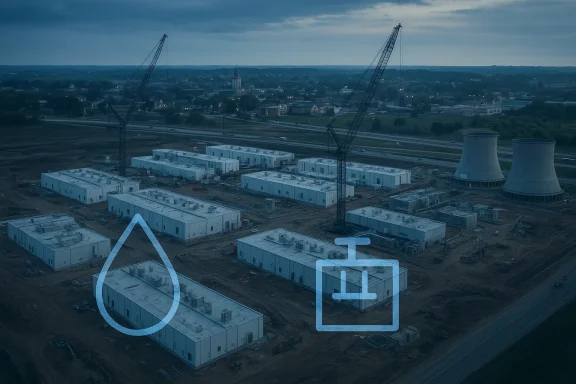
Microsoft’s push to plant 15 more datacenter campuses in Mount Pleasant, Wisconsin, underscores a sobering paradox at the heart of the AI boom: hyperscalers promise local economic benefits and technological leadership while quietly reshaping the environmental and infrastructure footprints of entire regions. Local officials last week gave Microsoft the green light to subdivide land for up to 15 additional buildings near its existing Mount Pleasant AI campus, a project now described in public documents as part of a multibillion‑dollar expansion that will extend Microsoft’s presence on the former Foxconn property.
Microsoft’s Mount Pleasant approvals are the latest—and among the most visible—examples of AI infrastructure scaling faster than communities, regulators, and sometimes the companies themselves can reconcile with local water and power realities. The company has signalled massive concurrent investments in Europe and elsewhere: a reported $30 billion program for the United Kingdom and roughly $10 billion for a Portuguese AI hub, and a stated ambition to more than double datacenter capacity across multiple European countries by 2027.
At the same time, internal planning documents reported in the press suggest that Microsoft anticipated enormous increases in operational water demand across its estate—numbers that, if accurate in aggregate, would shift the conversation about datacenter sustainability from per‑unit efficiency to absolute resource management. Microsoft has publicly revised some of those forecasts and launched a new set of community commitments intended to limit impacts on utilities, but activists and local leaders remain unconvinced that corporate pledges alone are enough.
The choice ahead is not binary. Communities can and should welcome high‑quality jobs and economic opportunity, but they also have the right to insist that the price of technological progress isn’t paid in depleted aquifers, higher utility bills, or unaccountable emissions. Public policy, corporate governance, and community engagement must move faster than the machines they seek to cool.
Source: theregister.com Microsoft plans more server farms, despite water worries
 Overview
Microsoft’s Mount Pleasant approvals are the latest—and among the most visible—examples of AI infrastructure scaling faster than communities, regulators, and sometimes the companies themselves can reconcile with local water and power realities. The company has signalled massive concurrent investments in Europe and elsewhere: a reported $30 billion program for the United Kingdom and roughly $10 billion for a Portuguese AI hub, and a stated ambition to more than double datacenter capacity across multiple European countries by 2027. At the same time, internal planning documents reported in the press suggest that Microsoft anticipated enormous increases in operational water demand across its estate—numbers that, if accurate in aggregate, would shift the conversation about datacenter sustainability from per‑unit efficiency to absolute resource management. Microsoft has publicly revised some of those forecasts and launched a new set of community commitments intended to limit impacts on utilities, but activists and local leaders remain unconvinced that corporate pledges alone are enough.
Background: Mount Pleasant, the Foxconn legacy, and the new “AI campus” dynamic
Why Mount Pleasant matters
Mount Pleasant sits on land that was once earmarked for a major Foxconn plant. That history left the village with upgraded infrastructure, large tracts of development‑ready land, and a yearning for new tax base and jobs—conditions that make it attractive to hyperscalers. Microsoft’s initial campus in the area has already been framed as a flagship AI facility, and the approval to allow up to 15 more buildings effectively clears the legislative path for a major densification of compute capacity in southeastern Wisconsin. Local reportage and planning documentation indicate the new parcels sit immediately northwest of Microsoft’s active construction zone and would add nearly nine million square feet of development across two new campuses.The economic case Microsoft makes
Microsoft and local advocates point to construction jobs, ongoing operations roles, property tax revenue, and secondary economic activity—hotels, suppliers, and training programs—that accompany datacenter campuses. The company has used those arguments repeatedly when negotiating local approvals and community benefit arrangements, and it says it will not seek tax breaks that would undercut municipal finances. These commitments are central to Microsoft’s “Community‑First AI Infrastructure” messaging.The water problem: forecasts, revisions, and technical responses
What journalists reported about Microsoft’s internal forecasts
Reporting based on documents attributed to Microsoft’s internal planning found that projected annual water needs for roughly 100 datacenter complexes could have been expected to more than triple—rising to about 28 billion liters per year by 2030 versus a 2020 baseline. After questioning in the press, Microsoft told reporters it had revised the projection downward to roughly 18 billion liters in 2030 to reflect new cooling designs and updated assumptions. Those figures, and the revisions, have become focal points for critics who argue that absolute water use is what ultimately matters to stressed watersheds, not per‑rack efficiency gains. Because the primary reporting was attributed to internal documents obtained by The New York Times and summarized widely, readers should treat the raw numbers as company projections subject to change and verification.How Microsoft says it will change the engineering baseline
Microsoft’s January announcement of its Community‑First AI Infrastructure initiative adds technical specificity to its claims. The company has committed to a 40 percent improvement in “datacenter water‑use intensity” by 2030 and described a new closed‑loop liquid‑cooling design—already deployed in some pilot campuses—that recirculates coolant and can eliminate the need to draw potable water in certain sites. Microsoft also promises to publish regional water‑use data, fund local water infrastructure upgrades where needed, and invest in replenishment projects that return more water to a watershed than its facilities withdraw. Those steps are material engineering responses to the very problem critics highlight: AI servers generate sustained thermal loads that make cooling choices central to environmental impacts.Why the engineering fixes don't fully neutralize the risk
Closed‑loop and liquid cooling reduce freshwater withdrawal but do not eliminate other stressors: thermal discharge, wastewater handling, increased electricity demand (which indirectly drives water use in thermal power plants), and the sheer scale effect. When a company doubles or triples the number of datacenters, even large percentage gains in water‑use intensity can be overwhelmed by the absolute increase in IT load. Moreover, many of the sites that are expected to absorb the largest growth—Arizona in the U.S., parts of India and Southeast Asia, and some Mediterranean regions—are already under water stress, making local replenishment projects necessary but not sufficient for ensuring long‑term water security. Independent studies and industry analyses warn that siting decisions matter as much as per‑server efficiency.Emissions and energy: the twin pressures
Rising emissions despite pledges
Microsoft’s corporate sustainability reporting documents confirm a complex reality: absolute emissions have risen even as Microsoft invests in renewable contracts and carbon removal. The company’s public sustainability report for the relevant reporting period shows a year‑over‑year rise in overall emissions and a material increase in Scope 3 emissions from supply chains. Microsoft says it is contracting large amounts of carbon removal and expanding procurement of carbon‑free electricity, but the immediate effect of a rapid datacenter build‑out has been to increase total operational emissions. That dynamic—efficiency gains offset by scale growth—is consistent with what other hyperscalers have experienced during rapid AI expansion.Grid impacts, ratepayer risks, and political friction
The arrival of new hyperscale loads can stress regional grids and prompt utilities to procure additional generation capacity—often via fossil fuels in the short run—unless policy or market mechanisms accelerate carbon‑free alternatives. In multiple U.S. counties, residents and regulators have raised alarm about utility rate impacts when major datacenters are connected without commensurate local generation or capacity investments. Those political impacts helped fuel the recent coalition calling for a moratorium on new datacenters until clearer regulatory guardrails are put in place.Local politics and community response
Approvals do not equal consensus
Mount Pleasant’s unanimous board vote to allow Microsoft’s new lots shows the power of municipal incentives and the appeal of new commercial tax bases. But local public meetings and media coverage reveal a split in sentiment: some residents celebrate job prospects and municipal revenue; others worry about water tables, traffic, and the long‑term character of their communities. The local debate mirrors national tensions: communities that host hyperscalers often bear immediate infrastructure costs and environmental risks while receiving benefits that are meaningful but sometimes diffuse over time.The national coalition demanding a timeout
More than 230 organizations—including national environmental groups, water advocates, and community coalitions—have publicly called for a federal moratorium on new datacenter approvals until Congress enacts standards to safeguard water, air, and ratepayer protections. That letter shifts the debate from isolated permitting fights to a coordinated national policy question: should a technology sector with outsized resource demands be allowed to expand under legacy rules that were written for a different era of compute? The campaign argues that patchwork local approvals cannot adequately manage cross‑boundary water and energy consequences.What Microsoft is doing right—and where the company still has work to do
Notable strengths in Microsoft’s approach
- Engineering innovation: Microsoft’s closed‑loop liquid cooling and investments in higher‑temperature operation modes demonstrate genuine engineering efforts to reduce potable water draw. These technologies represent the most direct path to reducing freshwater dependency for GPU‑heavy AI workloads.
- Local infrastructure commitments: The pledge to fund water and sewer upgrades, as Microsoft has done in past projects, can prevent displacement of costs onto ratepayers when growth strains municipal systems. Such financial backstops are important political and practical levers.
- Transparency commitments (if delivered): Promising to publish regional water‑use and replenishment data could create a baseline for independent oversight and community trust—provided the data are sufficiently granular, timely, and audited.
Persistent gaps and risky practices
- Absolute growth outpacing per‑unit gains: Even aggressive water‑efficiency targets can be swallowed by overall capacity growth. The difference between intensity and aggregate use is the crux of the problem, and Microsoft’s revised projection from 28B to 18B liters—which it attributes to updated designs—is illustrative of how uncertain these forecasts can be. Independent verification is essential.
- Opaque local agreements and NDAs: Journalistic investigations and local advocates point to nondisclosure arrangements that can limit what municipalities or utilities know about a facility’s projected water and power use. Those information asymmetries hamper public oversight and erode trust.
- Siting in water‑stressed regions: Some of the largest projected site increases are in basins already under strain—Arizona in the U.S., Jakarta in Indonesia, parts of India and Spain—where replenishment projects may be insufficient to sustain community water needs in times of drought. Microsoft has revised some location‑level numbers downwards, but the underlying siting choices remain a policy lever that must be managed more deliberately.
Stronger public policy and corporate governance options
To reconcile AI infrastructure growth with community and environmental safety, stakeholders should consider a layered approach that combines engineering, regulation, and economic policy.- Require transparent, standardized reporting of site‑level water and energy use that is publicly auditable and comparable across projects. Microsoft’s pledge to publish regional water data is a useful start, but the data must be independently verified and tied to enforceable commitments.
- Mandate watershed‑level impact assessments for any datacenter above a material threshold, similar to environmental reviews required for large industrial projects. These reviews must consider cumulative impacts, not just a single facility.
- Incentivize siting in low‑water, low‑carbon locations and near renewables or resilient grids—through tax policy or permitting advantages—while discouraging development in highly stressed basins. This aligns corporate incentives with regional resource security.
- Standardize community benefit agreements (CBAs) that include binding requirements for utility upgrades, local hiring, and long‑term monitoring funds that survive ownership changes. Voluntary commitments are less durable than enforceable CBAs.
- Accelerate non‑potable recycled water supply projects and industrial reuse programs, making reclaimed water the default for datacenter cooling where feasible. Microsoft’s Quincy water‑reuse approach is a replicable model, but scaling it requires public‑private coordination and regulatory clarity.
Practical steps for communities and utilities
- Short of a national moratorium, municipalities should insist on binding, measurable guarantees before approving major data center expansions. These guarantees should include: capped annual water draws tied to local supply metrics, reimbursable infrastructure funding, and enforceable remediation obligations if impacts exceed forecasts.
- Utilities need clearer legal authority and incentives to secure long‑term capacity without unduly shifting risk to residential ratepayers. Where new load requires new generation, states and regulators should demand clean energy procurement and avoid short‑term fossil fixes that lock in emissions.
- Regional planning entities should build cumulative permitting frameworks that account for the combined effect of multiple hyperscale projects in a watershed or power region. This is the only reliable way to prevent incremental approvals from becoming systemic crises.
The broader industry context: not just Microsoft
Microsoft is not unique in this dilemma. Amazon, Google, Meta, and other cloud operators face the same tension between per‑unit efficiency and aggregate growth driven by AI demand. Industry‑wide trends suggest that datacenter water and energy footprints are likely to grow substantially unless siting, cooling architectures, and grid decarbonization accelerate in tandem. Independent studies and trade data show that the sector’s resource profile is becoming a public‑policy question as much as an engineering challenge.Conclusion: engineering progress meets governance reality
Microsoft’s Mount Pleasant expansion and its parallel investments in Europe illuminate a central truth of the AI era: technical innovation can reduce the intensity of resource use per compute unit, but it cannot by itself control the aggregate environmental footprint created when global demand scales explosively. Microsoft’s closed‑loop cooling, quantified replenishment commitments, and promises of local investment are meaningful advances—but they must be paired with transparent reporting, enforceable local agreements, and better regional planning to avoid trading short‑term economic gains for long‑term water and grid vulnerabilities.The choice ahead is not binary. Communities can and should welcome high‑quality jobs and economic opportunity, but they also have the right to insist that the price of technological progress isn’t paid in depleted aquifers, higher utility bills, or unaccountable emissions. Public policy, corporate governance, and community engagement must move faster than the machines they seek to cool.
Source: theregister.com Microsoft plans more server farms, despite water worries
