

Microsoft’s MWC 2026 push for telecoms is less about splashy roadmaps and more about plumbing: a tightly integrated stack that stitches cloud, sovereign edge, unified data, and agentic AI into operational fabrics telecom operators can actually run and measure for profit and resilience. m]
Telecom operators face an urgent imperative: deliver ultra-low-latency services, monetize differentiated 5G/edge offerings, and shrink operational cost and failure rates — all while satisfying sovereign and regulatory constraints. Microsoft’s MWC 2026 announcements aim to meet that intersection by offering a single, pole-to-pole platform that combines Azure Local (for sovereign, disconnected edge), Microsoft Foundry/Foundry Local (for managed model runtime and local inferencing), Microsoft Fabric (unified, governed data lakehouse), aions layer anchored by Microsoft’s Agent Framework, Copilot, and the Network Operations Agent (NOA) blueprint.
This is not a single product launch; it’s a platform message built on three practical commitments:
Independent industry surveys echo the broad direction: operators report significant revenue and cost benefits from AI — especially when AI is embedded into network automation and customer operations rather than treated as isolated pilots. NVIDIA’s 2026 telco survey and IDC analyses show operators seeing strong gains from autonomous network automation and CX automation, but they also show wide variance depending on data readiness and change management. In short: the ROI claim is directionally supported, but the precise multiple depends heavily on execution and preconditions.
Key point for operators and buyers: ROI is real, but it’s concentrated. Expect measurable wins where three conditions are met:
Why that matters: many telecom workloads — critical orchestration, billing control, carrier interconnect, emergency services, regulated enterprise slices — cannot tolerate the uncertainty of public-cloud-only models or data egress. Providing a consistent Azure management and policy plane that can operate fully air-gapped is a practical differentiator for carriers targeting public-sector, defense, or highly regulated enterprise segments.
What operators should scrutinize:
Operator checklist for data modernization:
For operators, the takeaway is clear: this generation of AI will reward disciplined integrators who treat models and agents as part of their operational fabric, not as standalone experiments. Demand measurable proof, insist on governance and auditability, and plan for the operational realities of running models and GPUs in sovereign and disconnected environments. When those elements are aligned, the promise Microsoft outlined at MWC becomes a pragmatic path to “return on intelligence” rather than just marketing rhetoric.
Source: Microsoft MWC 2026: Microsoft Helps Telecoms Realize AI ROI - Microsoft Industry Blogs
 Background / Overview
Telecom operators face an urgent imperative: deliver ultra-low-latency services, monetize differentiated 5G/edge offerings, and shrink operational cost and failure rates — all while satisfying sovereign and regulatory constraints. Microsoft’s MWC 2026 announcements aim to meet that intersection by offering a single, pole-to-pole platform that combines Azure Local (for sovereign, disconnected edge), Microsoft Foundry/Foundry Local (for managed model runtime and local inferencing), Microsoft Fabric (unified, governed data lakehouse), aions layer anchored by Microsoft’s Agent Framework, Copilot, and the Network Operations Agent (NOA) blueprint.This is not a single product launch; it’s a platform message built on three practical commitments:
- Move compute and data to where regulations, latency, or resilience require them (Azure Local, disconnected modes).
- Bring models and agentic orchestration to the same boundary (Foundry Local + Agent Framework).
- Provide a governed, auditable control plane for operators to scale agentic autonomy safely (NOA + Copilot + Microsoft governance).
Why this matters: AI ROI — promises vs. measurable claims
Microsoft frames the narrative around measurable returns: industry studies and vendor case studies point to multi‑times ROI from generative and agentic AI investmentsany cites IDC and internal customer evidence showing operators can achieve ~2.8× returns on generative/agentic AI investments — with leaders reaching as high as 5× or more. Those headline metrics have two important caveats: they come from selective, sponsor-aligned studies and from leading adopters that combined culture, data readiness, and operational redesign — not simply by plugging in models.Independent industry surveys echo the broad direction: operators report significant revenue and cost benefits from AI — especially when AI is embedded into network automation and customer operations rather than treated as isolated pilots. NVIDIA’s 2026 telco survey and IDC analyses show operators seeing strong gains from autonomous network automation and CX automation, but they also show wide variance depending on data readiness and change management. In short: the ROI claim is directionally supported, but the precise multiple depends heavily on execution and preconditions.
Key point for operators and buyers: ROI is real, but it’s concentrated. Expect measurable wins where three conditions are met:
- Unified data access across OSS/BSS, telemetry, and business systems.
- Agentic workflows that actually act (and are governed) across systems rather than just summarizing.
- Operational governance that keeps risk, audit and compliance controls intact.
Building the sovereign, AI‑ready edge
Azure Local and disconnected operations: what’s new
Microsoft is extending Azure into deeply sovereign and disconnected contexts with Azure Local disconnected operations, Microsoft 365 Local, and Foundry Local for large-model inferencing inside customer-controlled boundaries. These are positioned not as experiments but as generally available and previewed capabilities to run mission-critical systems without a continuous connection to public cloud. The offering includes multi-rack deployments for scale, rack-aware clustering, and explicit disconnected management paths for highly regulated or remote environments.Why that matters: many telecom workloads — critical orchestration, billing control, carrier interconnect, emergency services, regulated enterprise slices — cannot tolerate the uncertainty of public-cloud-only models or data egress. Providing a consistent Azure management and policy plane that can operate fully air-gapped is a practical differentiator for carriers targeting public-sector, defense, or highly regulated enterprise segments.
Foundry Local and on-prem model inferencing
Foundry Local is explicitly touted to support large multimodal models running on local GPU infrastructure — Microsoft calls out partner hardware like NVIDIA as part of that stack. That matters for latency-sensitive inferencing (real-time control loops, on-site NOC/SON tasks) and for sovereignty, where model weights and telemetry cannot leave the operator’s boundary. Microsoft’s developer and Foundry communications show the roadmap is real and already in gated preview for qualified customers. Operators should evaluate:- Capacity planning needs (multi-rack, GPU types).
- Operational overhead (patching, model lifecycle, data residency).
l updates and security support from platform partners.
Agentic customer experiences and monetization paths
From clicks to intent: agentic stores and the telecom contact center
Microsoft’s pitch is to replace fragmented, click-based customer journeys with intent-driven, agentic experiences that coordinate sales, service, billing, and partner offers behind the scenes. The proposed telecom agentic store reference framework is an architecture for federated marketplaces: identity, billing, offer federation, and sovereign deployment controls built in. Early case studies, like FiberCop’s move to an AI-first contact center using Dynamics 365 Contact Center and Copilot add-on experiences, illustrate operational benefits — higher digital completion rates, faster resolutions, and emergent monetization channels for partner services.What operators should scrutinize:
- Does the multi-agent stack actually integrate with live BSS/CRM and revenue systems? Integration complexity is the real gating factor.
- How are compliance and billing handled for federated partner offers — especially when offers cross sovereign boundaries?
Customer benefits vs. cost-to-serve
Agentic contact centers can cut cost-to-serve by increasing digital completion and routing complex tasks to assisted human agents rather than full human handling. But measurable success requires:- Clean identity and consent flows.
- Unified session state and contextual memory across channels.
- Strong observability and rollback for actions agents may take (e.g., billing changes).
Intelligent business operations: Fabric, Lakehouse, and Lakebase
Microsoft Fabric as the telco lakehouse
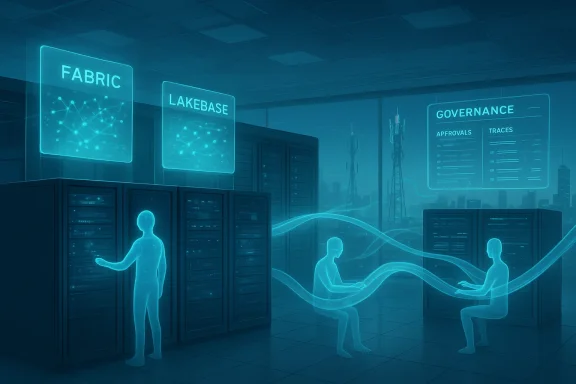
Microsoft continues to promote Microsoft Fabric as the single, policy-governed foundation for telco real-time operational and analytical data. Fabric’s OneLake and connectors are architected to collapse OSS/BSS silos and deliver data to agents and analytic workloads without repeated extract-transform-load cycles. Operators that have siloed telemetry and transactional systems will find Fabric’s governance and Policy-driven connectors useful — but only if they commit to data modeling and domain ontologies that make telecom semantics usable by AI agents.Databricks Lakebase: OLTP for the lakehouse
Microsoft announced that Azure Databricks Lakebase (Databricks’ operational Postgres-like layer) will be on Azure to bring OLTP capabilities to lakehouse architectures — features like separation of storage/compute, instant cloning, and scale-to-zero for transactional workloads. Databricks launched Lakebase in 2025 and Azure release notes now show Lakebase autoscaling and Lakebase features rolling out on Azure, aligning with Microsoft’s March/early‑2026 availability statements. This reduces the friction between operational systems and the lakehouse — a critical gap for agentic systems that need both analytic context and transactional timeliness.Operator checklist for data modernization:
- Prioritize a single logical data layer for telemetry + OSS/BSS.
- Allocate engineering capacity to map telecom ontologies into OneLake or Lakebase.
- Build test harnesses so agents can be validated against production-like data flows before they act in live systems.
Powering autonomous networks: NOA, NetAI and production readiness
The NOA blueprint: production-first agentic operations
Microsoft’s Network Operations Agent (NOA) reference architecture is a pragmatic, modular blueprint for autonomous network operations: multi-agent orchestration (Azure Agent Framework), unified data (Microsoft Fabric), Copilot/Teams integration for operator interactions, and robust governance with audarrative is not a research paper — it’s informed by Microsoft’s NetAI program and real Azure networking deployments. Public Microsoft technical posts and technical community materials document how NOA is designed to safely gate automation with human oversight and open standards alignment (TM Forum APIs).Real deployments and measured impacts — where to trust the numbers
Microsoft and partners point to concrete operational improvements in early deployments:- Microsoft’s own Azure networking teams reportedly use agentic automation to reduce manual field dispatches and speed repairs.
- Published partner stories cite lower times-to-detect and faster root-cause analysis.
Safety, governance and the human-in-the-loop
NOA’s architecture deliberately keeps humans in control via:- Approval gating for sensitive actions.
- Read-only defaults until explicit permissions are granted.
- Full observability and traceability of agent decisions.
- Clearly defined escalation and rollback procedures.
- Immutable audit logs for each agent action.
- Periodic independent audits of agent behavior and decision rationale.
Partner ecosystem: who benefits and who supplies what
Microsoft’s announcements pair platform claims with concrete partner tie-ins:- Ericsson: Enterprise 5G Connect integrates with Windows 11 ECMC and Surface Copilot+ to provide AI-driven 5G connectivity management for enterprise laptops. Early pilots with carriers give the approach practical on-ramps for corporate mobility bundles.
- Databricks: Lakebase brings operational database primitives to the Fabric + Databricks stack, reducing friction for agentic apps that need transactional semantics.
- NVIDIA: Provider of GPU infrastructure and partner in Foundry Local model runtimes; critical for operators wanting on‑prem, high-performance inferencing.
- Amdocs, Nokia, Kenmei, Colt and others: delivering OSS/BSS modernization, domain agent libraries, and integration services to map agentic workflows into operator systems.
Risks and open questions
No platform is without tradeoffs. The Microsoft MWC narrative surfaces several risks operators must evaluate before full-scale adoption:- Data gravity vs. vendor lock-in: Centralizing data in a Fabric-layer on Azure simplifies agent access, but operators must negotiate data portability and multi-cloud escape hatches. Demand contractual clarity on data egress, standardized APIs, and in-place export tooling.
- Sovereignty complexity: Azure Local and Foundry Local enable disconnected operations, but they also require operators to own more of the stack lifecycle (hardware, firmware, model updates). Expect elevated OPEX and new skills requirements for on-prem model ops.
- Governance and auditability: Agentic systems that act autonomously must provide clear, human-readable decision trails; black-box model actions will not pass regulatory or internal risk reviews. Insist on explainability and test harnesses tied to safety scenarios.
- Measurement and expectation management: Vendor-reported ROI and operator success stories are useful signals; they are not guarantees. Plan controlled pilots with measurable, auditable KPIs and a staged ramp to production.
- Skills and change management: Shifting to agentic operations is an organizational change as much as a technical one. Operators need to retrain staff from repetitive tasks to higher-value oversight and exception handling.
Practical recommendations for operators and integrators
- Start with the data foundation: unify telemetry, OSS/BSS, and customer data into a governed lakehouse before scaling agents. Fabric + Lakebase is a sensible path but requires investment in ontologies and connectors.
- Treat agentic pilots as integrated modernization programs — not feature projects. Combine BSS/OSS modernization, API standardization, and an agent safety framework to ensure pilots produce repeatable, auditable outcomes.
- Validate sovereignty claims with proofs-of-concept: test Azure Local disconnected operations and Foundry Local on representative hardware and network constraints. Demand clear SLAs for model updates and support.
- Contract for measurable outcomes: require vendor obligations for pre/post KPIs, data extracts, and joint evaluation windows to verify claims like reduced time-to-repair or decreased cost-to-serve.
- Prioritize human-in-the-loop controls: require approvals, rollback, and audit logging for any agent action that changes network configurations, billing, or customer entitlements.
The market signal: what MWC 2026 reveals about telco AI MWC messaging is simultaneously defensive and opportunistic. It defends a cloud-centric control plane by extending Azure into sovereign and disconnected boundaries, and it opportunistically positions the company as the glue between enterprise productivity (Copilot), data (Fabric), model runtimes (Foundry), and domain orchestration (NOA). The result is a compelling story for telcos seeking a single-vendor path to agentic scale — but that path demands heavy integration discipline.
Independent industry research and vendor surveys support the direction: operators that embed AI into network automation and customer operations see disproportionately higher returns. But those returns are concentrated among disciplined operators who have already solved data access and governance problems. If you are an operator evaluating this approach, treat Microsoft’s platform as a comprehensive offering that can shorten time to production — but insist on third-party validation, measurable KPIs, and explicit plans to mitigate sovereignty, operational, and vendor-concentration risks.Conclusion
MWC 2026 showed an important evolution: AI in telecom is moving from tactical pilots to a platform-driven, production-first strategy. Microsoft’s announcements stitch together practical building blocks — sovereign on‑prem Azure Local, Foundry Local for local model inferencing, Fabric and Lakebase for transactional + analytic data, and NOA/Agent Framework for agentic orchestration — into a coherent blueprint operators can act on. The potential payoffs are real: lower cost-to-serve, faster incident response, and new monetization channels. But those payoffs depend on painstaking work — data modernization, governance, multi-rack capacity planning, and organizational change.For operators, the takeaway is clear: this generation of AI will reward disciplined integrators who treat models and agents as part of their operational fabric, not as standalone experiments. Demand measurable proof, insist on governance and auditability, and plan for the operational realities of running models and GPUs in sovereign and disconnected environments. When those elements are aligned, the promise Microsoft outlined at MWC becomes a pragmatic path to “return on intelligence” rather than just marketing rhetoric.
Source: Microsoft MWC 2026: Microsoft Helps Telecoms Realize AI ROI - Microsoft Industry Blogs
