

Microsoft’s November 17 slate reads like an instruction manual for a company that has moved from software-first to full-stack AI infrastructure: new enterprise agent rollouts and Copilot features, tighter cloud‑sovereignty offers in Europe, a public preview for the Exchange admin API, a major Xbox developer push, urgent security fixes, and an unmistakable reminder that compute demand is bumping up against the physical limits of power and sites. The announcements and reporting arriving today reveal a single truth: Microsoft is stitching AI into every layer of its business — apps, tooling, datacenters, geopolitics and partner programs — and that integration is creating new commercial momentum and fresh operational headaches at the same time.
Microsoft’s recent messaging and partner briefings show a consistent playbook: build a comprehensive AI stack (Copilot family, Azure AI Foundry, local runtimes), pair it with massive infrastructure spending to close capacity gaps, and wrap those capabilities with governance and sovereign-cloud options for regulated customers. That combination shapes everything we saw reported on November 17: enterprise customer pilots (retail, observability), product-level Copilot expansions (advertising creative APIs and analytics), developer and publishing documentation becoming public, and regulatory work designed to ease adoption in Europe and other regulated markets.
This article unpacks the most consequential items, explains why they matter to IT leaders and buyers, highlights operational risks, and flags claims that need closer verification or contractual confirmation.
Why it matters: if multi‑agent orchestration proves reliable and auditable, large retailers and distributed frontline workforces gain a single discovery surface into enterprise data and workflows — a potent productivity win. But it also multiplies governance requirements: identity, least privilege, audit trails, and traceable agent outputs become central operational controls that IT must design and test before broad rollout.
Operational takeaway: organizations must validate the approval and safety gates for automated remediation steps. The value is real, but the risk surface expands when systems are allowed to act on behalf of operators; auditability, rollbacks, and human‑in‑the‑loop designs matter.
A number of commercial and startup efforts have begun exploring firm, 24/7 power sources — including modular reactors and PPAs tied to nuclear or hybrid renewables — as a way to create baseload for future Fairwater‑style GPU campuses. Reports that companies are prototyping AI-enabled permitting or digitalized operator systems are strategically interesting, but some of those vendor disclosures require verification in contractual or technical detail. Treat claims about specific reactor models or timelines as exploratory unless you have the original vendor/partner documentation. (The idea — tying firm power to datacenter buildouts — is well documented; some project-level details in the press remain provisional.
Caution: several nuclear‑for‑AI items published in PR and trade outlets were summarized for this cycle; where a named start‑up or prototype is cited, buyers and regulators should require public engineering reports or permitting filings before treating them as operational commitments.
Practical consequences for enterprise customers and procurement teams:
What marketers need to validate:
Admin checklist (high level):
Operational lesson: scale both defences and fallbacks — protect public endpoints with DDoS services and ensure management‑plane independence and tested failover plans for critical control‑plane dependencies.
Migration practicalities:
Developer checklist:
What to demand as a buyer:
The practical verdict for IT leaders is straightforward: treat Microsoft’s product rollouts and partner wins as enablers, but insist on the usual enterprise rigor — pilot with measurable KPIs, require contractual commitments on locality and capacity, and build hardened, auditable governance around every agent that is permitted to act. The strategic opportunity is real; the engineering and legal work to capture it safely remains the decisive factor.
Source: ts2.tech Microsoft News Today, November 17, 2025: AI Power Crunch, New Copilot Tools, Xbox Showcase and Key EU Rulings
 Background / Overview
Microsoft’s recent messaging and partner briefings show a consistent playbook: build a comprehensive AI stack (Copilot family, Azure AI Foundry, local runtimes), pair it with massive infrastructure spending to close capacity gaps, and wrap those capabilities with governance and sovereign-cloud options for regulated customers. That combination shapes everything we saw reported on November 17: enterprise customer pilots (retail, observability), product-level Copilot expansions (advertising creative APIs and analytics), developer and publishing documentation becoming public, and regulatory work designed to ease adoption in Europe and other regulated markets.This article unpacks the most consequential items, explains why they matter to IT leaders and buyers, highlights operational risks, and flags claims that need closer verification or contractual confirmation.
AI partnerships and agentic deployments: retail, observability and beyond
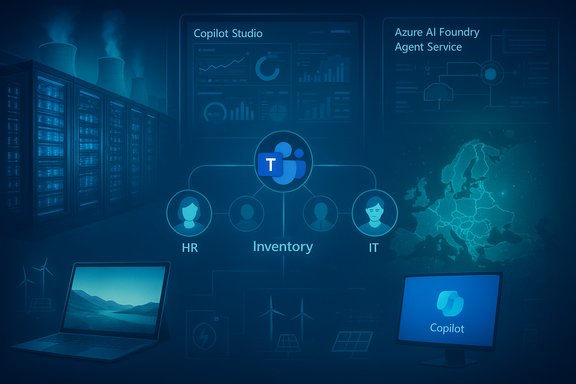
Levi Strauss: a Teams “superagent” for frontline retail
Levi Strauss’s announcement that it is building a Teams‑embedded “superagent” using Microsoft 365 Copilot, Copilot Studio and Azure AI Foundry is an early, high‑visibility example of the agentic AI pattern: a single conversational portal that orchestrates multiple specialized subagents (HR, inventory, returns, IT) behind the scenes. Levi’s intends the orchestrator to live inside Microsoft Teams and to combine device rollouts (Surface Copilot+ managed with Intune) and developer productivity (GitHub Copilot) to accelerate DTC goals. The architecture maps directly to Microsoft’s publicly stated Copilot Studio and Agent Service primitives and is positioned as a pilot-to-production showcase.Why it matters: if multi‑agent orchestration proves reliable and auditable, large retailers and distributed frontline workforces gain a single discovery surface into enterprise data and workflows — a potent productivity win. But it also multiplies governance requirements: identity, least privilege, audit trails, and traceable agent outputs become central operational controls that IT must design and test before broad rollout.
Dynatrace + Azure SRE Agent: observability meets agentic remediation
Dynatrace announced an integration with Microsoft’s Azure SRE Agent to surface its AI‑driven root‑cause analysis inside Azure’s chat‑style SRE assistant, enabling recommended remediation hints and automatable runbook actions. This is a classic product pairing: vendor telemetry + platform native remediation pathways intended to reduce MTTR and automate routine operational tasks. The joint workflow will be visible at Ignite and signals a broader pattern — partners plugging deep domain signals into Azure’s agent framework to deliver actionable fixes.Operational takeaway: organizations must validate the approval and safety gates for automated remediation steps. The value is real, but the risk surface expands when systems are allowed to act on behalf of operators; auditability, rollbacks, and human‑in‑the‑loop designs matter.
Energy and AI: nuclear talk, and the hard constraint that isn’t chips
Multiple pieces of reporting this week underline a structural reality: Microsoft’s AI growth is colliding with power and site capacity. Executives and coverage have moved from chip scarcity narratives to physical constraints — installing GPUs is trivial relative to finding low‑carbon, high‑reliability power near available sites. Microsoft’s large capex commitments and regional capacity expansions are a direct response to this operational bottleneck.A number of commercial and startup efforts have begun exploring firm, 24/7 power sources — including modular reactors and PPAs tied to nuclear or hybrid renewables — as a way to create baseload for future Fairwater‑style GPU campuses. Reports that companies are prototyping AI-enabled permitting or digitalized operator systems are strategically interesting, but some of those vendor disclosures require verification in contractual or technical detail. Treat claims about specific reactor models or timelines as exploratory unless you have the original vendor/partner documentation. (The idea — tying firm power to datacenter buildouts — is well documented; some project-level details in the press remain provisional.
Caution: several nuclear‑for‑AI items published in PR and trade outlets were summarized for this cycle; where a named start‑up or prototype is cited, buyers and regulators should require public engineering reports or permitting filings before treating them as operational commitments.
AI infrastructure and the “power crunch”: what IT and finance teams must plan for
Microsoft’s public posture is unambiguous: massive infrastructure spending + strategic leases + partnerships to accelerate GPU availability. That cash is intended to reduce latency and place inference capacity close to customers. However, executives now openly argue that the real bottleneck is power and cooling infrastructure and the speed at which new facilities can be sited and connected to the grid — not chips. The result: thousands of accelerators sit idle in inventory when sites and power cannot be provisioned fast enough.Practical consequences for enterprise customers and procurement teams:
- Expect regional capacity constraints for high‑density GPU SKUs; plan multi‑region failover and constrained‑capacity budgets.
- Validate SLAs for low‑latency inference and negotiate capacity reservation terms when you require firm performance windows.
- Factor in longer procurement and deployment timelines for on‑prem AI clouds — and require supplier attestations about where inference runs.
Copilot product moves: Advertising creative, analytics, and device experience
Copilot in Microsoft Advertising: Image Animation, generative APIs, and performance comparison
Microsoft expanded Copilot in the Advertising Platform with three headline features: an Image Animation capability that converts still images into short, scroll‑qualified video creatives; broader generative creative APIs (backgrounds, display, video, brand‑kit aware assets) for integration into enterprise creative pipelines; and a natural‑language performance comparison engine that can analyze campaigns period‑over‑period or by A/B test. Advertisers and agencies are being pitched an end‑to‑end Copilot creative + analytics co‑pilot rather than a draft‑copy assistant. Case studies cited by Microsoft show measurable CTR improvements when Copilot is embedded into large‑scale creative pipelines.What marketers need to validate:
- Model and creative provenance: confirm training data and brand‑kit fidelity.
- Compliance and geo restrictions — some APIs and pilots remain unavailable in certain geographies.
- Measurement parity — run controlled A/B comparisons and monitor for drift or homogenization of creative.
Windows devices, Copilot+ PCs and UX changes
Microsoft continues to push richer on‑device AI experiences with Copilot+ hardware guidance and staged enablement of features via server‑side flags. Device NPUs, Copilot keys, and managed provisioning (Intune) are the operational primitives Microsoft expects enterprise IT to adopt as on‑device experiences proliferate. But the rollout strategy is incremental and can produce heterogeneity across fleets; pilot testing and careful pilot ring management are critical to reduce help‑desk churn.Security and reliability: Patch Tuesday, record DDoS mitigations, and operational incidents
November Patch Tuesday — immediate remediation priorities
Microsoft’s November security bundle patched 63 vulnerabilities across Windows, Office and cloud products and included an actively exploited Windows kernel elevation‑of‑privilege tracked as CVE‑2025‑62215. Multiple security vendors and incident response teams advised immediate patching of high‑value hosts (admin workstations, jump boxes, servers that process untrusted media) and prioritized mitigations for a critical GDI+ remote code execution issue that affects image/metafile parsing. The incident profile makes kernel EoP issues particularly dangerous as second‑stage primitives in multi‑stage attacks; defenders should assume attackers will attempt to chain available RCEs with local escalation bugs.Admin checklist (high level):
- Apply Microsoft’s November cumulative updates mapped to your OS builds.
- Patch domain controllers, jump boxes, VDI/remote host pools, mail gateways and servers that parse user uploads first.
- If immediate patching is impossible, restrict upload parsing, isolate critical hosts, use application allow‑listing and tighten local admin policies.
Azure reliability: record‑scale attack mitigations and outage patterns
Microsoft has published and commented on major DDoS mitigations and large control‑plane incidents in 2025. Azure’s protection pipeline and global mitigation fabric are now battle‑tested for multi‑Tbps attacks, and customers are being advised to protect internet‑facing endpoints ahead of holiday traffic spikes. Separately, control‑plane misconfigurations (for example, edge routing or front‑door changes) produced high‑visibility outages that exposed the fragility of centralized management planes — a reminder that resilience design needs defensive architecture and multi‑path fallbacks.Operational lesson: scale both defences and fallbacks — protect public endpoints with DDoS services and ensure management‑plane independence and tested failover plans for critical control‑plane dependencies.
Developers and admins: Exchange Online Admin API, Xbox publishing guide, and licensing automation
Exchange Online Admin API public preview
Microsoft opened public preview of the Exchange Online Admin API, a modern REST surface intended to supplant Exchange Web Services (EWS) for many administrative automation tasks. The preview provides a transition path and early endpoints for common admin scenarios — organizations with large, scripted EWS footprints should treat this announcement as their cue to inventory scripts, plan migrations, and provide feedback to shape the final API design.Migration practicalities:
- Inventory EWS-based scripts and map them to the preview endpoints.
- Build a dual‑path for testing (EWS + Admin API) during staged migration.
- Engage Microsoft’s preview feedback channels to influence missing endpoints and behavior.
Xbox: publishing guide goes public and a Partner Preview showcase
Microsoft published the Xbox Game Publishing Guide publicly and scheduled a Partner Preview showcase for November 20 to spotlight third‑party titles. Making internal publishing documentation public lowers the barrier for indies and mid‑sized teams to plan certification, partner center setup, wish‑list and pre‑order workflows, and the end‑to‑end launch plan. This is a deliberate move to make Xbox publishing more transparent and developer‑friendly — part of a broader push to keep studios engaged with Microsoft’s platform as the company balances first‑party consolidation and ecosystem openness.Developer checklist:
- Read the guide end‑to‑end, set up Partner Center early, and prototype packaging with the new XGPM tooling.
- Validate GameInput and PlayFab integration for cross‑platform parity.
- Use the Partner Preview and certification playbooks to reduce last‑mile surprises.
Compliance and regulation: Europe’s data questions and Microsoft’s sovereignty play
EU Data Boundary, in‑country Copilot processing, and the limits of technical promises
Microsoft’s expanded EU Data Boundary and in‑country Copilot options are central to November’s regulatory headlines: the company now offers routable, in‑region processing guarantees for Copilot interactions in a phased set of countries, plus enhanced Azure Local / Microsoft 365 Local packages and partner‑run “national clouds.” For regulated customers, these are significant engineering and contractual steps meant to reduce procurement risk — but they are not a legal silver bullet. Jurisdictional realities (for example, extraterritorial legal processes) and the need for contractual right‑to‑audit and key‑control arrangements remain hard constraints. Customers should convert vendor roadmaps into written, tenant‑level contractual commitments and independent audits.What to demand as a buyer:
- A day‑one service inventory showing which Copilot features are in‑country and which require extra configuration.
- Customer‑managed keys (BYOK) with EU‑resident HSMs where strict secrecy is required.
- Contractual exception rules: explicit notification timelines and audit evidence when cross‑border transfers are triggered.
Signals for investors, partners and IT leaders
- Wall Street and analysts continue to view Microsoft as a central AI winner — large capex is expected to pay off if capacity and regional availability meet demand. Expect ongoing scrutiny of capex ROI and utilization metrics as builds come online.
- Partner signals (awards and finalist placements) show Microsoft is deepening its partner ecosystem around security and data governance; customers should treat awards as shortlists that require independent verification.
- For IT and procurement: the rule of thumb is to demand measurable, auditable commitments for sovereignty and capacity — roadmaps are helpful, but contract terms and audit evidence are what protect regulated buyers.
Strengths, risks and verifications
Notable strengths
- Microsoft is executing a coherent full‑stack AI strategy: models, agents, device integrations, observability, and cloud capacity are designed to work together for enterprise workloads. That integration reduces vendor fragmentation for buyers who choose the Microsoft stack.
- Product maturity in agent tooling (Copilot Studio, Azure AI Foundry Agent Service, SRE Agent) is translating into concrete partner integrations and customer pilots that move beyond proof of concept.
Principal risks
- Power and site capacity remain the single largest physical constraint for hyperscale AI; if Microsoft or its partners cannot match the pace of GPU procurement with usable powered sites, inventory will remain underutilized. This is a structural infrastructure risk that capital alone does not instantly fix.
- Sovereign claims and "in‑country processing" deliver meaningful governance tools — but they require contractual enforcement, independent audits and operational verification to be certifiable for regulated procurements. Legal limits (extraterritorial orders) are a structural caveat.
- Security exposure remains high; an actively exploited kernel zero‑day in November’s Patch Tuesday and high‑volume DDoS and control‑plane incidents earlier in the year show that scale attracts sophisticated attacks and amplifies operational responsibility. Rapid patching and multi‑layered defenses are non‑negotiable.
Verification notes and caution flags
- Some partnership or project claims seen in week‑end PR or trade pieces (for example, bespoke modular‑reactor projects explicitly named to power specific sites) were summarized in press reports — those items should be validated against primary partner filings, regulatory permitting documents, or engineering deliverables before relying on them operationally. Treat these as strategic signposts rather than closed contracts.
- Product availability roadmaps (Copilot in‑country timelines, Azure Local SKU parity) are vendor roadmaps; customers must obtain tenant‑level, binding commitments for day‑one parity if that parity is procurement‑critical.
Practical short‑term checklist for IT leaders (top 10 actions)
- Patch critical systems now: prioritize the November cumulatives for domain controllers, jump boxes and upload‑parsing servers.
- Inventory Copilot-reliant workflows and require a vendor day‑one inventory for in‑country processing before procurement.
- Start mapping EWS automation to the Exchange Online Admin API preview and schedule conversion pilots.
- Add DDoS protection to internet‑facing endpoints and confirm Azure DDoS/WAF coverage for holiday traffic.
- Test and pilot Copilot agent designs in a narrow ring with auditable logs and human approval gates.
- Verify contractual BYOK and audit rights for any sovereign‑cloud procurement; insist on tamper‑evident access logs and EU‑resident HSMs if regulation demands it.
- For Xbox‑targeted studios: read the public Xbox Publishing Guide, validate Partner Center flows, and test packaging with the new XGPM.
- Assess power and cooling exposure for any private AI deployment — plan for tiered capacity and fallbacks.
- Require independent penetration tests and SRM playbooks for agentic systems that can act on corporate resources.
- Treat public case studies and award statements as shortlists — insist on named references and audited proof before signing large transformation deals.
Conclusion
November 17’s Microsoft news flow is less a scattershot of unrelated announcements than the visible motion of a single corporate thesis: treat AI as a full‑stack product and industrial program. That thesis creates enormous opportunity for customers — higher productivity, integrated agentic workflows, and more creative advertising and gaming tooling — while simultaneously concentrating new operational responsibilities in power procurement, governance, and security.The practical verdict for IT leaders is straightforward: treat Microsoft’s product rollouts and partner wins as enablers, but insist on the usual enterprise rigor — pilot with measurable KPIs, require contractual commitments on locality and capacity, and build hardened, auditable governance around every agent that is permitted to act. The strategic opportunity is real; the engineering and legal work to capture it safely remains the decisive factor.
Source: ts2.tech Microsoft News Today, November 17, 2025: AI Power Crunch, New Copilot Tools, Xbox Showcase and Key EU Rulings
