

Microsoft’s placement as a Leader in The Forrester Wave™: Industry Cloud Solutions for Public Sector, Q1 2026 represents more than a marketing milestone — it’s a defining moment for how governments think about deploying AI, protecting sensitive services, and modernizing mission delivery across agencies that cannot afford missteps.
Forrester’s new Industry Cloud evaluation targets platforms built specifically for public sector realities — not generic enterprise clouds. The firm’s assessment framework emphasizes mission readiness, including transparency, compliance, data sovereignty, and the ability to support AI-native workflows that can reason and take action across government processes. That focus responds to an industry inflection point: public agencies confront tighter regulations, constrained budgets and workforces, and rising constituent expectations for “no-wrong-door” digital services that are fast, auditable, and secure.
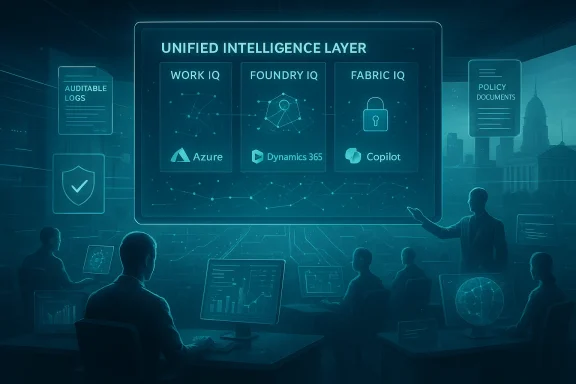
Microsoft’s announcement that it was named a Leader in the inaugural public-sector Industry Cloud Wave ties directly to its positioning around an “intelligence layer” — a collection of capabilities Microsoft calls Work IQ, Foundry IQ, and Fabric IQ — integrated with Azure, Dynamics 365, Power Platform, and Copilot. These components are framed as a single platform to build agentic AI: agents that do more than answer queries, and instead reason, recommend, and act within governed workflows.
This recognition from Forrester is noteworthy because it is the analyst community validating a platform-level strategy for government modernization: combine cloud infrastructure, data unification, low-code automation, and an auditable AI layer that can be constrained to the risk posture agencies require.
The practical sales pitch for agencies is straightforward: use one vendor to reduce integration overhead, get auditable AI that meets compliance frameworks, and accelerate measurable outcomes — for example, faster case intake or reduced time on routine investigations.
Three converging trends make a platform approach compelling:
But adoption must be accompanied by stringent governance: auditable knowledge foundations, robust model change processes, sovereign deployment plans where required, and procurement terms that protect agency autonomy. The promise of faster, smarter mission delivery is real; the pathway to get there without introducing unacceptable risk is narrower than many vendors imply.
Public sector leaders should move forward, but with structure, skepticism, and measurement: pilot carefully, govern rigorously, demand portability, and publish outcomes. When those guardrails are in place, industry clouds like Microsoft’s can deliver meaningful, trusted modernization — and that is precisely the outcome government leaders say they want.
Source: Microsoft Microsoft is named a Leader in The Forrester Wave™: Industry Cloud Solutions For Public Sector, Q1 2026 - Microsoft Industry Blogs
 Background: what Forrester assessed and why it matters
Forrester’s new Industry Cloud evaluation targets platforms built specifically for public sector realities — not generic enterprise clouds. The firm’s assessment framework emphasizes mission readiness, including transparency, compliance, data sovereignty, and the ability to support AI-native workflows that can reason and take action across government processes. That focus responds to an industry inflection point: public agencies confront tighter regulations, constrained budgets and workforces, and rising constituent expectations for “no-wrong-door” digital services that are fast, auditable, and secure.Microsoft’s announcement that it was named a Leader in the inaugural public-sector Industry Cloud Wave ties directly to its positioning around an “intelligence layer” — a collection of capabilities Microsoft calls Work IQ, Foundry IQ, and Fabric IQ — integrated with Azure, Dynamics 365, Power Platform, and Copilot. These components are framed as a single platform to build agentic AI: agents that do more than answer queries, and instead reason, recommend, and act within governed workflows.
This recognition from Forrester is noteworthy because it is the analyst community validating a platform-level strategy for government modernization: combine cloud infrastructure, data unification, low-code automation, and an auditable AI layer that can be constrained to the risk posture agencies require.
Overview: Microsoft’s public-sector proposition in plain terms
Microsoft is pitching a platform approach for government that emphasizes four core promises:- Close the intelligence gap by unifying structured systems of record and unstructured operational knowledge so AI agents have accurate, timely context.
- Enable agentic AI that can reason and execute across workflows while preserving policy controls, audit trails, and human-in-the-loop checkpoints.
- Allow sovereign, secure deployments — from public cloud to air-gapped and local/offline environments — so classified or regulated work remains within agency boundaries.
- Reduce administrative drag through low-code automation and integrated productivity tools so frontline workers spend less time on re-entry and more on decisions that matter.
The practical sales pitch for agencies is straightforward: use one vendor to reduce integration overhead, get auditable AI that meets compliance frameworks, and accelerate measurable outcomes — for example, faster case intake or reduced time on routine investigations.
Why this matters now: the public sector’s AI moment
Public agencies are simultaneously attracted and cautious about AI. On one hand, generative and agentic AI offer speed-ups across intake, casework, permitting, licensing, and mission operations. On the other, governments must maintain trust, transparency, and sovereignty.Three converging trends make a platform approach compelling:
- Operational urgency: Many local and federal agencies operate on legacy systems that impose manual handoffs, duplicated data entry, and decision-making delays. AI that can orchestrate across systems promises time savings and faster outcomes for constituents.
- Regulatory pressure: New laws, procurement rules, and national security requirements increase emphasis on deployable, auditable AI that respects data residency and classification boundaries.
- Sovereignty demand: Agencies and labs handling sensitive data want the capability of modern models without requiring open connections to public model endpoints — a pattern exemplified by secure, on-prem or sovereign model snapshots.
What Microsoft brings: architecture and capabilities
The intelligence layer: Work IQ, Foundry IQ, Fabric IQ
- Work IQ ingests and understands work signals from Microsoft 365 to give agents context about team processes and collaboration patterns.
- Foundry IQ creates knowledge bases of authoritative policies, procedures, and institutional knowledge to ground agents in verifiable facts and constraints.
- Fabric IQ focuses on unifying mission data into consistent meaning so analytics and agents operate on a harmonized dataset.
Platform integration: Azure, Dynamics 365, Power Platform, Copilot
Microsoft leans on the strength of a broad product portfolio:- Azure provides cloud infrastructure with options for sovereign and disconnected deployments.
- Dynamics 365 supplies the case management and customer/constituent workflows often central to government service delivery.
- Power Platform enables citizen developers and IT teams to build configurable, low-code workflows that connect systems of record to AI agents.
- Copilot brings AI directly into productivity and contact-center scenarios — summarizing, recommending next steps, and automating routine updates.
Sovereign and disconnected options
Microsoft has invested in deployable options for regulated environments: local, disconnected variants of Azure and Foundry (marketed as Azure Local, Microsoft 365 Local, and Foundry Local) that allow agencies to run models and productivity services without persistent public cloud connections. That capability is central to the narrative that agencies can use modern AI while preserving the security posture required for classified, sensitive, or regulated workloads.On-the-ground evidence: customer outcomes and reproducibility
Microsoft’s message is supported by two repeated customer narratives:- Washington, DC Child and Family Services Agency (CFSA): Rebuilt a 25-year-old system using Dynamics 365, Power Apps, and Azure AI to reduce intake time (45 minutes saved per intake reported during pilot) and eliminate repetitive work. Staff reported entering information once and seeing it propagate across needed systems, reducing manual handoffs and decreasing burnout.
- Sandia National Laboratories: Deployed an internal, secure AI chat based on Azure OpenAI in Foundry Models. Sandia reports deploying a “snapshot” of models in a private environment so employees could gain new model capabilities without connecting to public endpoints; adoption expanded to nearly 17,000 users with measured time savings on typical search-and-curate workflows.
Strengths: why Forrester and many agencies find Microsoft credible
- Breadth of platform: Microsoft offers an unusually broad stack spanning infrastructure, productivity, CRM/case management, low-code tooling, and AI. That breadth simplifies procurement and reduces integration overhead for agencies seeking a unified approach.
- Sovereignty options: Air-gapped and local/offline deployment capabilities directly address the central barrier to AI adoption for regulated agencies: the inability to rely on public model endpoints.
- Governance-first design: The intelligence layer’s emphasis on grounding agents in authoritative knowledge and maintaining auditable workflows aligns with public sector priorities around compliance and oversight.
- Proven customer outcomes: Case studies from diverse government entities provide tangible evidence that the platform can deliver measurable outcomes, such as time saved and improved case worker throughput.
- Partner ecosystem: Microsoft’s extensibility model and partner network enable specialized, local, and sector-specific integrations — important in public safety, emergency dispatch, and jurisdictional implementations.
Risks, trade-offs, and areas requiring scrutiny
While the platform approach offers advantages, governments must weigh real trade-offs and risks before committing.1. Vendor concentration and long-term lock-in risk
Adopting a single vendor for infrastructure, productivity, data, automation, and AI can reduce complexity in the short term but may increase strategic dependence over time. Agencies must evaluate:- The cost and operational friction of migrating away if requirements change.
- How open Microsoft’s platform truly is when it comes to third-party models, proprietary data formats, and connector lifecycles.
- The degree to which partners or custom implementations can be moved between clouds without expensive rewrites.
2. Hidden integration and total cost of ownership
A platform that promises to unify everything still requires significant engineering work to integrate legacy systems, map data, and configure governance controls. Agencies should budget not only for licenses but for:- Data engineering, mapping, and cleansing work.
- Rigorous testing and validation of agentic automations before they touch operational workflows.
- Ongoing model governance and retraining to prevent drift and inaccuracies.
3. Explainability, auditability, and algorithmic risk
Agentic AI that reasons and takes actions introduces new audit challenges. Even with Foundry IQ or similar grounding mechanisms:- Agencies must establish clear policies on when agents can act autonomously and when a human must approve.
- There must be robust logging, change history, and deterministic traceability from inputs to agent outputs to satisfy oversight bodies.
- The risk of model hallucination — plausible but incorrect outputs — must be mitigated through strong retrieval and grounding strategies and clear operational playbooks.
4. Sovereignty and supply-chain complexity
Sovereign and local deployments solve many regulatory problems, but they also introduce operational complexity:- Local deployments of models still require secure update processes, patching, and supply-chain validation.
- Hardware and performance constraints (e.g., the need for specialized accelerators) may affect cost and timeline.
- Agencies will need trusted procedures to evaluate and “snapshot” new models safely without introducing vulnerabilities.
5. Procurement, accountability, and skills gaps
Large platform deals demand procurement agility and contract terms that protect government interests. Agencies should insist on:- Clear SLAs, exit clauses, and data ownership guarantees.
- Third-party audit rights and independent verification of compliance claims.
- Investment in workforce development to operate and govern AI-enabled systems responsibly.
Practical guidance for agency leaders: an adoption playbook
If you’re a public-sector IT leader evaluating Microsoft’s platform or similar industry clouds, consider this structured approach:- Start with high-value, low-risk pilots
- Pick a use case with clear metrics (e.g., intake time reduction, fewer manual handoffs) and limited jurisdictional exposure.
- Use pilots to validate grounding approaches (Foundry IQ-style knowledge bases) and agent behaviour under E2E governance.
- Establish model governance and an AI change control board
- Define approval gates, risk tiers, and monitoring requirements before any agent can take actions that affect citizens.
- Require deterministic logging and version control for every model and knowledge base snapshot.
- Enforce data sovereignty and release management
- For regulated workloads, insist on local snapshots or private model deployments and test the procedures for updating those snapshots.
- Validate supply-chain controls and hardware requirements for on-prem or sovereign cloud configurations.
- Design for portability and openness
- Use standards-based connectors and avoid proprietary data silos where possible.
- Ensure partners and custom applications can be decoupled if strategic goals change.
- Invest in people and process, not just tech
- Allocate budget for change management and training for frontline workers who will use Copilot-style assistants.
- Build cross-functional teams that include legal, compliance, and domain experts to define policy-grounding content.
- Measure outcomes and publish impact
- Track time saved, error rate reductions, citizen satisfaction, and audit quality improvements.
- Use those measurements to justify incremental scaling and procurement decisions.
What agencies should ask vendors and integrators
Before contracting with a platform provider, agencies should demand clarity on specific points:- How does the intelligence layer ensure grounding and prevent hallucinations? What is the evidence from production deployments?
- What are the precise deployment options for sovereign or disconnected environments? What are the hardware, update, and patching requirements?
- Can you demonstrate auditable chains of custody from source data to agent decisions, including change history for knowledge bases and policies?
- What are the data export and portability guarantees should the agency need to migrate or interoperate with third-party systems?
- What independent verification, third-party audits, or certifications back the vendor’s compliance and security claims?
The competitive landscape and what “Leader” implies
Forrester labeling Microsoft a Leader in this new Industry Cloud Wave signals analyst recognition of Microsoft’s platform completeness, roadmap, and market traction in public sector scenarios. However, readers should note:- Analyst Waves are comparative snapshots — they show relative positioning based on criteria at a point in time. They are valuable for strategic orientation but not a substitute for hands-on evaluation.
- The evaluation will have judged multiple vendors across mission readiness, governance, product capabilities, and strategy. Agencies should still run their own due diligence because local regulatory and mission needs vary widely.
The bottom line: cautious optimism with strict controls
Microsoft’s Forrester Wave recognition reinforces a central truth about government AI adoption in 2026: agencies are no longer choosing between modern models and regulatory compliance — they expect both. The platform approach — unifying data, productivity, automation, and governed agentic AI — can shorten delivery timelines and produce measurable outcomes for citizens when implemented with discipline.But adoption must be accompanied by stringent governance: auditable knowledge foundations, robust model change processes, sovereign deployment plans where required, and procurement terms that protect agency autonomy. The promise of faster, smarter mission delivery is real; the pathway to get there without introducing unacceptable risk is narrower than many vendors imply.
Public sector leaders should move forward, but with structure, skepticism, and measurement: pilot carefully, govern rigorously, demand portability, and publish outcomes. When those guardrails are in place, industry clouds like Microsoft’s can deliver meaningful, trusted modernization — and that is precisely the outcome government leaders say they want.
Source: Microsoft Microsoft is named a Leader in The Forrester Wave™: Industry Cloud Solutions For Public Sector, Q1 2026 - Microsoft Industry Blogs
