

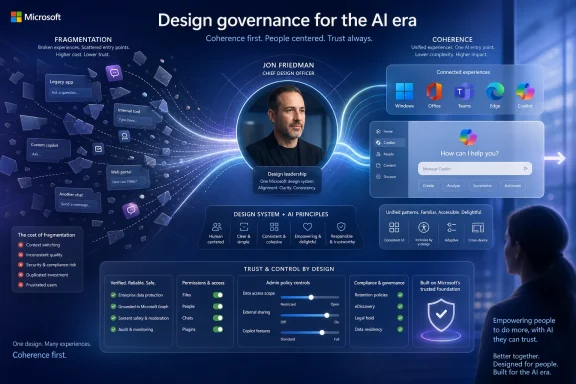
Microsoft named Jon Friedman as its first Chief Design Officer on May 14, 2026, elevating a longtime Microsoft 365 design leader into a companywide role meant to reduce product fragmentation and steer human-centered design through the company’s accelerating AI push. That is the factual move; the more interesting story is why Microsoft believes it needs the role now. Friedman’s own explanation is unusually candid for a corporate promotion note: Copilot moved fast, Microsoft attached AI across products, and coherence did not automatically follow. The new title is therefore less a trophy than a warning label for the AI era.
For decades, Microsoft’s power has come from platforms, distribution, developer gravity, and enterprise trust. Design mattered, but it often arrived as a corrective force after architecture, licensing, compatibility, and organizational incentives had already hardened into product reality. The company could afford that because Windows and Office were not merely interfaces; they were environments people had to inhabit.
The Chief Design Officer role changes the framing. It says design is not just the final layer of polish on Word, Teams, Windows, Outlook, Copilot, or Surface. It is now part of the operating model for deciding what Microsoft should build, how its products should relate to one another, and whether users can understand the company’s direction at all.
That matters because Microsoft is in the middle of one of the most aggressive product rewrites in its history. Generative AI is being inserted into Office apps, Windows, Edge, developer tools, security products, business workflows, and cloud services at a pace that would have been unimaginable in the old boxed-software era. Every one of those insertions creates a design problem before it creates a revenue problem.
Friedman’s appointment is therefore not a decorative signal that Microsoft has discovered taste. It is a structural admission that AI has made product coherence harder, not easier. The company can build faster than ever; the risk is that it can also confuse users faster than ever.
That is a notable concession because it names the exact tension many WindowsForum readers have felt in practice. Copilot has appeared as a sidebar, a button, a chat box, a context menu, a web assistant, an Office companion, a Windows feature, and an enterprise productivity layer. Some of those appearances make sense. Others feel like Microsoft asking the same question in five different accents.
The problem is not that Microsoft lacks ambition. The problem is that Copilot is simultaneously a brand, a product surface, a platform strategy, a subscription driver, and a user-interface experiment. When one word has to carry that much corporate meaning, users start to wonder which version they are actually dealing with.
Design leadership becomes important precisely because AI features are less self-explanatory than traditional software features. A spell-check button has a fairly obvious contract. A generative assistant that can summarize, rewrite, search, reason over files, draft messages, automate workflows, or hallucinate plausible nonsense needs a much clearer contract with the user.
That contract is design. It is not just color, typography, animation, or icon placement. It is the whole chain of expectation, feedback, permission, reversibility, trust, and accountability that determines whether a person feels helped or handled.
That history explains why Microsoft design has often been judged unfairly and fairly at the same time. Fairly, because the company has shipped plenty of experiences that felt bolted together by committee. Unfairly, because committee-driven software is sometimes the cost of serving a planet-sized installed base.
AI changes the bargain. Users may tolerate a cluttered ribbon if they understand what the buttons do. They are less likely to tolerate an intelligent system that appears in multiple places, asks for trust, consumes organizational data, generates work product, and behaves differently depending on context.
The stakes are especially high in enterprise environments. A confusing AI feature is not merely an annoyance when it touches regulated data, customer records, confidential documents, or administrative workflows. It becomes a governance issue, a training issue, a compliance issue, and sometimes a security issue.
This is where Friedman’s language about trust, clarity, agency, and dignity is more than corporate poetry. Those are practical design requirements when software begins to act less like a tool and more like a semi-autonomous collaborator. Microsoft cannot sell AI as a productivity revolution while letting the experience feel like a scavenger hunt.
The easy reading is that Microsoft once misunderstood design as decoration. The more interesting reading, and the one Friedman now seems to prefer, is that Microsoft already had the raw material for good design: scale, utility, trust, and deep customer dependency. What had to change was not the company’s desire to build useful things, but its ability to integrate human-centered thinking into the core of product development.
That distinction matters. Microsoft has had strong design moments for years, from the Office ribbon’s controversial but consequential rethinking of command discovery to Metro’s bold typography-first attempt to make Windows feel modern, to Fluent Design’s effort to create a shared language across devices and services. The company’s design history is not a flat line from ugly to elegant.
It is a history of periodic breakthroughs constrained by organizational sprawl. Teams solved their own problems, often well, but the user experienced the seams. A new Chief Design Officer is supposed to make those seams harder to ignore inside the company before customers find them outside it.
Friedman is not arriving as an outsider with a manifesto. He is a Microsoft lifer by design-industry standards, a leader associated with Microsoft 365, Office, and Copilot work. That makes the appointment less dramatic and more revealing: Microsoft is not importing a new religion; it is promoting an internal practice that has become too important to leave distributed.
That is the power of this appointment. A design leader with companywide authority can ask whether a Copilot feature belongs in Windows, in Edge, in the Office canvas, in Teams, in a system tray surface, or nowhere yet. That question is not aesthetic. It affects engineering resources, user education, licensing strategy, support burden, and customer trust.
Microsoft’s biggest design challenge is not making every product look identical. Friedman explicitly argues against coherence as uniformity. The harder task is making products feel intentionally related while still adapting to different contexts.
That is especially true for Windows. The operating system is no longer just the place where apps run; it is becoming one of the places where Microsoft wants AI to mediate work. But Windows users are unusually sensitive to intrusion because the desktop is personal territory, even on managed corporate machines. A feature that feels helpful inside Word can feel invasive if it appears uninvited at the OS level.
A strong design function should be able to say no, or at least not yet. In the AI boom, that may be its most valuable contribution.
Microsoft has lived this pattern before. Settings and Control Panel coexisted for years as a running joke and a practical headache. Teams absorbed collaboration, calling, chat, meetings, apps, files, and workflows until its power and clutter became inseparable. Windows 11 improved visual consistency in some places while leaving older interface layers intact because compatibility never retires politely.
AI threatens to multiply that problem. Every product team can justify a Copilot entry point. Every workflow can claim to be a candidate for assistance. Every application can argue that its context is special enough to require its own agent behavior.
Without stronger design governance, the result is predictable: overlapping assistants, inconsistent prompts, unclear permissions, mixed metaphors, and an enterprise admin experience that has to explain all of it. Users do not care which internal Microsoft group owns the feature. They experience the whole thing as Microsoft.
That is why the Chief Design Officer role is both symbolic and operational. Symbolically, it tells employees that design has executive legitimacy. Operationally, it creates a place where the company can fight the natural entropy of a sprawling AI product portfolio.
A tasteful AI experience knows when to speak and when to stay silent. It knows when a suggestion should be prominent and when it should be tucked away. It makes uncertainty visible without drowning the user in disclaimers. It gives people enough control to feel agency without demanding that every worker become a prompt engineer.
This is not easy to do in Microsoft’s world because the company serves both enthusiasts and people who never asked for more software in their day. Windows power users may want granular controls, local options, model transparency, and registry-level escape hatches. A finance department may want policy enforcement, auditability, and predictable defaults. A teacher may want drafting help without student data anxiety. A home user may just want the button to stop glowing.
Design has to reconcile those realities without flattening them. If Microsoft treats AI as a universal layer that behaves roughly the same everywhere, it risks being generic. If every team improvises its own AI behavior, it risks chaos. The CDO role exists in the uncomfortable middle.
That middle is where product companies increasingly win or lose. Model capability will matter, but users rarely judge technology in benchmark tables. They judge it at the moment it interrupts them, saves them, misleads them, or asks for permission.
Windows has always been a negotiation between Microsoft’s strategy and the user’s machine. The more AI becomes part of the OS experience, the more that negotiation needs visible rules. Users should not have to decode whether a feature is local, cloud-backed, enterprise-managed, account-dependent, or tied to a subscription tier after it appears on their desktop.
The design challenge is also educational. Microsoft is asking users to adopt new mental models: prompts, agents, context windows, grounding, summaries, actions, automations, and generated content. Those concepts cannot simply be thrown into a help article and called onboarding. They need to be embodied in the product.
That is where a companywide design office could prove useful if it has real authority. It can push Microsoft toward patterns that repeat across products without making everything look like a pasted template. It can make the strange parts of AI feel learnable.
The risk, of course, is that the role becomes a beautiful layer over unchanged incentives. If business units are rewarded primarily for Copilot attachment, engagement metrics, and subscription conversion, design may still lose when it argues for restraint. A CDO title matters only if the person holding it can affect what ships.
The appointment of a Chief Design Officer should not be read only through the lens of end-user interfaces. The admin experience is design, too. Licensing pages, policy controls, audit logs, data boundary explanations, consent flows, and documentation paths are all part of whether customers trust Microsoft’s AI stack.
This is where Microsoft has an advantage and a burden. Its enterprise relationships give it channels to gather feedback at scale. But those same customers will not accept hand-wavy assurances about human-centered AI if the product surface is confusing or the controls feel scattered.
Friedman’s essay frames design as connecting engineering, product, and research. For IT pros, the missing word to listen for is operations. A humane AI feature is not humane if it creates weekend work for the people who have to manage it.
The best version of this new role would make Microsoft more disciplined about lifecycle realities. Features need clear defaults, migration paths, tenant-level controls, user education, and honest communication about limitations. The worst version would produce prettier inconsistency.
There is nothing unusual about that. Large companies often create executive roles when a distributed problem becomes too visible to leave distributed. Chief security officers rose in prominence after security became board-level risk. Chief privacy officers gained authority as data practices became regulatory flashpoints. Chief design officers emerge when experience becomes inseparable from strategy.
AI has made experience strategic because the interface is no longer just a screen. The interface is a relationship between the user, the software, the organization’s data, and a probabilistic system that may produce different outputs from similar inputs. That relationship needs design leadership as much as it needs engineering.
Microsoft’s own language points in that direction. Friedman writes about designers becoming more technical and working across the full stack of the experience, including the intelligence underneath. That is a significant shift from the old caricature of designers as people who make screens after engineers make systems.
If that shift takes hold, Microsoft design will not merely specify the button that invokes an AI action. It will help define the action, the model behavior, the failure mode, the recovery path, and the user’s sense of control. That is where design becomes product architecture.
Both claims can be true. Microsoft has undeniably moved far from the era when design was too often treated as the visual skin over engineering decisions. Its best modern products show a stronger understanding of flow, accessibility, collaboration, and cross-device continuity.
But the present critique is equally real. If Microsoft’s AI experiences already felt unified, the argument for this role would be less urgent. The company is elevating design because the next phase of computing punishes inconsistency more harshly than the last one did.
That is the tension worth watching. Microsoft wants to move quickly enough to lead the AI platform shift, but deliberately enough that users do not feel dragged through a corporate experiment. A Chief Design Officer cannot resolve that tension alone. But the role can make the tension visible at the level where strategy becomes product.
The appointment also suggests that Microsoft sees design as a competitive weapon against rivals whose AI products may be technically impressive but operationally alien to everyday work. Microsoft’s moat is not just model access. It is the daily workflow of billions of documents, meetings, messages, spreadsheets, files, identities, policies, and devices. Design is how that moat becomes usable rather than merely vast.
That does not mean every app should become visually identical. In fact, uniformity could make Microsoft’s products worse by ignoring the different rhythms of writing, coding, presenting, analyzing, gaming, administering, and collaborating. The goal is coherence, not sameness.
Coherence is when a user learns something in one Microsoft product and can reasonably apply it in another. It is when permissions feel consistent, when AI confidence is communicated in familiar ways, when admin policies map cleanly to user experiences, and when the same brand does not behave like five products wearing a trench coat.
The challenge is that coherence often loses to urgency. Every team has deadlines. Every product has competitors. Every executive has metrics. AI only intensifies that pressure because the market rewards visible motion.
That is why the CDO role matters even if the title sounds abstract. It gives Microsoft a designated executive whose job is to argue that fewer seams are not a luxury. They are the difference between AI adoption and AI fatigue.
Microsoft will need to remove duplicated surfaces, retire confusing entry points, simplify choices, and decide which AI interactions deserve to exist at all. That is politically harder than adding features because subtraction creates internal losers. A companywide design executive can help make those tradeoffs on behalf of the user.
This is especially important in Windows, where unwanted change is remembered for years. Microsoft can recover from a confusing web experiment more easily than from an OS-level experience that users perceive as imposed. The desktop has a long memory.
Restraint does not mean timidity. It means sequencing. It means proving value in the right context before expanding the surface area. It means making AI feel earned rather than advertised.
If Friedman’s role helps Microsoft practice that discipline, it could be one of the more consequential executive changes of the Copilot era. If not, it will become another title layered onto the very fragmentation it was created to reduce.
For users and administrators, the near-term test is whether Microsoft’s products become easier to understand as they become more capable. More intelligence should not require more guesswork. More automation should not require less agency.
The company’s own framing gives observers a scorecard. If the Chief Design Officer role is real, Microsoft’s AI interfaces should become more consistent, more explainable, and less scattered over time.
Source: microsoft.design Proof and possibility
 Microsoft Turns Design Into an Executive Control Surface
For decades, Microsoft’s power has come from platforms, distribution, developer gravity, and enterprise trust. Design mattered, but it often arrived as a corrective force after architecture, licensing, compatibility, and organizational incentives had already hardened into product reality. The company could afford that because Windows and Office were not merely interfaces; they were environments people had to inhabit.The Chief Design Officer role changes the framing. It says design is not just the final layer of polish on Word, Teams, Windows, Outlook, Copilot, or Surface. It is now part of the operating model for deciding what Microsoft should build, how its products should relate to one another, and whether users can understand the company’s direction at all.
That matters because Microsoft is in the middle of one of the most aggressive product rewrites in its history. Generative AI is being inserted into Office apps, Windows, Edge, developer tools, security products, business workflows, and cloud services at a pace that would have been unimaginable in the old boxed-software era. Every one of those insertions creates a design problem before it creates a revenue problem.
Friedman’s appointment is therefore not a decorative signal that Microsoft has discovered taste. It is a structural admission that AI has made product coherence harder, not easier. The company can build faster than ever; the risk is that it can also confuse users faster than ever.
The Copilot Rollout Exposed the Cost of Moving First
Friedman’s essay does not read like the usual executive victory lap. He writes that early Copilot work moved quickly across products, but simply attaching AI to existing experiences was not enough to create value. At Microsoft scale, that led to fragmentation and a less cohesive experience.That is a notable concession because it names the exact tension many WindowsForum readers have felt in practice. Copilot has appeared as a sidebar, a button, a chat box, a context menu, a web assistant, an Office companion, a Windows feature, and an enterprise productivity layer. Some of those appearances make sense. Others feel like Microsoft asking the same question in five different accents.
The problem is not that Microsoft lacks ambition. The problem is that Copilot is simultaneously a brand, a product surface, a platform strategy, a subscription driver, and a user-interface experiment. When one word has to carry that much corporate meaning, users start to wonder which version they are actually dealing with.
Design leadership becomes important precisely because AI features are less self-explanatory than traditional software features. A spell-check button has a fairly obvious contract. A generative assistant that can summarize, rewrite, search, reason over files, draft messages, automate workflows, or hallucinate plausible nonsense needs a much clearer contract with the user.
That contract is design. It is not just color, typography, animation, or icon placement. It is the whole chain of expectation, feedback, permission, reversibility, trust, and accountability that determines whether a person feels helped or handled.
The Old Microsoft Could Survive Messiness; the AI Microsoft Cannot
Microsoft has never been a minimalist company. Its products are dense because its customers are dense: governments, schools, hospitals, banks, manufacturers, small businesses, developers, gamers, and home users all pull the company in different directions. Windows carries decades of compatibility decisions because Microsoft’s customers demand continuity even while complaining about complexity.That history explains why Microsoft design has often been judged unfairly and fairly at the same time. Fairly, because the company has shipped plenty of experiences that felt bolted together by committee. Unfairly, because committee-driven software is sometimes the cost of serving a planet-sized installed base.
AI changes the bargain. Users may tolerate a cluttered ribbon if they understand what the buttons do. They are less likely to tolerate an intelligent system that appears in multiple places, asks for trust, consumes organizational data, generates work product, and behaves differently depending on context.
The stakes are especially high in enterprise environments. A confusing AI feature is not merely an annoyance when it touches regulated data, customer records, confidential documents, or administrative workflows. It becomes a governance issue, a training issue, a compliance issue, and sometimes a security issue.
This is where Friedman’s language about trust, clarity, agency, and dignity is more than corporate poetry. Those are practical design requirements when software begins to act less like a tool and more like a semi-autonomous collaborator. Microsoft cannot sell AI as a productivity revolution while letting the experience feel like a scavenger hunt.
Friedman’s Story Is Also Microsoft’s Design Biography
Friedman’s origin story is useful because it compresses Microsoft’s design evolution into one anecdote. Twenty years ago, a product manager asked him to pick a color during his first week at the company, just after he had completed a master’s degree in human-centered design. He wanted to talk about the user, the problem, and the purpose; the organization wanted a visible choice.The easy reading is that Microsoft once misunderstood design as decoration. The more interesting reading, and the one Friedman now seems to prefer, is that Microsoft already had the raw material for good design: scale, utility, trust, and deep customer dependency. What had to change was not the company’s desire to build useful things, but its ability to integrate human-centered thinking into the core of product development.
That distinction matters. Microsoft has had strong design moments for years, from the Office ribbon’s controversial but consequential rethinking of command discovery to Metro’s bold typography-first attempt to make Windows feel modern, to Fluent Design’s effort to create a shared language across devices and services. The company’s design history is not a flat line from ugly to elegant.
It is a history of periodic breakthroughs constrained by organizational sprawl. Teams solved their own problems, often well, but the user experienced the seams. A new Chief Design Officer is supposed to make those seams harder to ignore inside the company before customers find them outside it.
Friedman is not arriving as an outsider with a manifesto. He is a Microsoft lifer by design-industry standards, a leader associated with Microsoft 365, Office, and Copilot work. That makes the appointment less dramatic and more revealing: Microsoft is not importing a new religion; it is promoting an internal practice that has become too important to leave distributed.
A Companywide Design Role Is Really a Companywide Argument
The phrase “Chief Design Officer” can sound soft inside a company known for Azure, Windows, Office, Xbox, GitHub, security, and enterprise sales. But executive titles are arguments about what gets to interrupt the roadmap. They determine who is in the room before decisions become too expensive to unwind.That is the power of this appointment. A design leader with companywide authority can ask whether a Copilot feature belongs in Windows, in Edge, in the Office canvas, in Teams, in a system tray surface, or nowhere yet. That question is not aesthetic. It affects engineering resources, user education, licensing strategy, support burden, and customer trust.
Microsoft’s biggest design challenge is not making every product look identical. Friedman explicitly argues against coherence as uniformity. The harder task is making products feel intentionally related while still adapting to different contexts.
That is especially true for Windows. The operating system is no longer just the place where apps run; it is becoming one of the places where Microsoft wants AI to mediate work. But Windows users are unusually sensitive to intrusion because the desktop is personal territory, even on managed corporate machines. A feature that feels helpful inside Word can feel invasive if it appears uninvited at the OS level.
A strong design function should be able to say no, or at least not yet. In the AI boom, that may be its most valuable contribution.
The Real Battle Is Against Fragmentation, Not Bad Icons
Friedman uses the word fragmentation, and it is the right one. Fragmentation is what happens when a company has too many capable teams solving adjacent problems under pressure from the same strategic mandate. Each team ships something defensible; the combined experience becomes incoherent.Microsoft has lived this pattern before. Settings and Control Panel coexisted for years as a running joke and a practical headache. Teams absorbed collaboration, calling, chat, meetings, apps, files, and workflows until its power and clutter became inseparable. Windows 11 improved visual consistency in some places while leaving older interface layers intact because compatibility never retires politely.
AI threatens to multiply that problem. Every product team can justify a Copilot entry point. Every workflow can claim to be a candidate for assistance. Every application can argue that its context is special enough to require its own agent behavior.
Without stronger design governance, the result is predictable: overlapping assistants, inconsistent prompts, unclear permissions, mixed metaphors, and an enterprise admin experience that has to explain all of it. Users do not care which internal Microsoft group owns the feature. They experience the whole thing as Microsoft.
That is why the Chief Design Officer role is both symbolic and operational. Symbolically, it tells employees that design has executive legitimacy. Operationally, it creates a place where the company can fight the natural entropy of a sprawling AI product portfolio.
AI Makes Taste a Trust Issue
Friedman’s essay includes a line that taste is not decoration. That may be the most important sentence in the piece. In consumer technology, taste is often treated as the luxury layer applied after the machine works. In AI products, taste becomes part of safety and comprehension.A tasteful AI experience knows when to speak and when to stay silent. It knows when a suggestion should be prominent and when it should be tucked away. It makes uncertainty visible without drowning the user in disclaimers. It gives people enough control to feel agency without demanding that every worker become a prompt engineer.
This is not easy to do in Microsoft’s world because the company serves both enthusiasts and people who never asked for more software in their day. Windows power users may want granular controls, local options, model transparency, and registry-level escape hatches. A finance department may want policy enforcement, auditability, and predictable defaults. A teacher may want drafting help without student data anxiety. A home user may just want the button to stop glowing.
Design has to reconcile those realities without flattening them. If Microsoft treats AI as a universal layer that behaves roughly the same everywhere, it risks being generic. If every team improvises its own AI behavior, it risks chaos. The CDO role exists in the uncomfortable middle.
That middle is where product companies increasingly win or lose. Model capability will matter, but users rarely judge technology in benchmark tables. They judge it at the moment it interrupts them, saves them, misleads them, or asks for permission.
Windows Users Should Watch the Small Decisions
For WindowsForum’s audience, the appointment may sound distant from daily computing. It is not. Companywide design leadership will show up first in small decisions: where Copilot lives, how settings are named, how AI permissions are surfaced, how much control admins get, and whether new experiences feel optional, explainable, and reversible.Windows has always been a negotiation between Microsoft’s strategy and the user’s machine. The more AI becomes part of the OS experience, the more that negotiation needs visible rules. Users should not have to decode whether a feature is local, cloud-backed, enterprise-managed, account-dependent, or tied to a subscription tier after it appears on their desktop.
The design challenge is also educational. Microsoft is asking users to adopt new mental models: prompts, agents, context windows, grounding, summaries, actions, automations, and generated content. Those concepts cannot simply be thrown into a help article and called onboarding. They need to be embodied in the product.
That is where a companywide design office could prove useful if it has real authority. It can push Microsoft toward patterns that repeat across products without making everything look like a pasted template. It can make the strange parts of AI feel learnable.
The risk, of course, is that the role becomes a beautiful layer over unchanged incentives. If business units are rewarded primarily for Copilot attachment, engagement metrics, and subscription conversion, design may still lose when it argues for restraint. A CDO title matters only if the person holding it can affect what ships.
Enterprise IT Will Judge the Role by Its Admin Surfaces
Sysadmins have a brutally practical definition of good design. A well-designed feature is one they can deploy, explain, govern, troubleshoot, and disable without opening five portals and a support case. By that standard, Microsoft’s AI era remains a work in progress.The appointment of a Chief Design Officer should not be read only through the lens of end-user interfaces. The admin experience is design, too. Licensing pages, policy controls, audit logs, data boundary explanations, consent flows, and documentation paths are all part of whether customers trust Microsoft’s AI stack.
This is where Microsoft has an advantage and a burden. Its enterprise relationships give it channels to gather feedback at scale. But those same customers will not accept hand-wavy assurances about human-centered AI if the product surface is confusing or the controls feel scattered.
Friedman’s essay frames design as connecting engineering, product, and research. For IT pros, the missing word to listen for is operations. A humane AI feature is not humane if it creates weekend work for the people who have to manage it.
The best version of this new role would make Microsoft more disciplined about lifecycle realities. Features need clear defaults, migration paths, tenant-level controls, user education, and honest communication about limitations. The worst version would produce prettier inconsistency.
Microsoft’s Design Bet Arrives After the Interface Has Already Changed
The timing is important. Microsoft is not appointing its first Chief Design Officer before the AI wave; it is doing so after Copilot has already become a central company strategy. That makes the role partly corrective.There is nothing unusual about that. Large companies often create executive roles when a distributed problem becomes too visible to leave distributed. Chief security officers rose in prominence after security became board-level risk. Chief privacy officers gained authority as data practices became regulatory flashpoints. Chief design officers emerge when experience becomes inseparable from strategy.
AI has made experience strategic because the interface is no longer just a screen. The interface is a relationship between the user, the software, the organization’s data, and a probabilistic system that may produce different outputs from similar inputs. That relationship needs design leadership as much as it needs engineering.
Microsoft’s own language points in that direction. Friedman writes about designers becoming more technical and working across the full stack of the experience, including the intelligence underneath. That is a significant shift from the old caricature of designers as people who make screens after engineers make systems.
If that shift takes hold, Microsoft design will not merely specify the button that invokes an AI action. It will help define the action, the model behavior, the failure mode, the recovery path, and the user’s sense of control. That is where design becomes product architecture.
The Appointment Is a Compliment to Microsoft’s Past and a Critique of Its Present
Friedman casts the CDO role as proof and possibility. The proof is that Microsoft’s design community has matured enough to warrant permanent executive representation. The possibility is that the company can meet the AI moment with more coherence than the first wave of Copilot suggested.Both claims can be true. Microsoft has undeniably moved far from the era when design was too often treated as the visual skin over engineering decisions. Its best modern products show a stronger understanding of flow, accessibility, collaboration, and cross-device continuity.
But the present critique is equally real. If Microsoft’s AI experiences already felt unified, the argument for this role would be less urgent. The company is elevating design because the next phase of computing punishes inconsistency more harshly than the last one did.
That is the tension worth watching. Microsoft wants to move quickly enough to lead the AI platform shift, but deliberately enough that users do not feel dragged through a corporate experiment. A Chief Design Officer cannot resolve that tension alone. But the role can make the tension visible at the level where strategy becomes product.
The appointment also suggests that Microsoft sees design as a competitive weapon against rivals whose AI products may be technically impressive but operationally alien to everyday work. Microsoft’s moat is not just model access. It is the daily workflow of billions of documents, meetings, messages, spreadsheets, files, identities, policies, and devices. Design is how that moat becomes usable rather than merely vast.
The Friedman Era Will Be Measured in Fewer Seams
The most useful way to judge Friedman’s tenure will not be by keynote slides or design-system language. It will be by whether Microsoft products start to feel less internally negotiated. Users should encounter fewer moments where one Microsoft experience seems unaware of another.That does not mean every app should become visually identical. In fact, uniformity could make Microsoft’s products worse by ignoring the different rhythms of writing, coding, presenting, analyzing, gaming, administering, and collaborating. The goal is coherence, not sameness.
Coherence is when a user learns something in one Microsoft product and can reasonably apply it in another. It is when permissions feel consistent, when AI confidence is communicated in familiar ways, when admin policies map cleanly to user experiences, and when the same brand does not behave like five products wearing a trench coat.
The challenge is that coherence often loses to urgency. Every team has deadlines. Every product has competitors. Every executive has metrics. AI only intensifies that pressure because the market rewards visible motion.
That is why the CDO role matters even if the title sounds abstract. It gives Microsoft a designated executive whose job is to argue that fewer seams are not a luxury. They are the difference between AI adoption and AI fatigue.
The New Title Gives Microsoft a Chance to Practice Restraint
The industry’s AI period has been defined by addition. Add a chat box. Add a button. Add a summary. Add an agent. Add a plan tier. Add a banner telling users that AI has arrived. The next phase will be defined by subtraction.Microsoft will need to remove duplicated surfaces, retire confusing entry points, simplify choices, and decide which AI interactions deserve to exist at all. That is politically harder than adding features because subtraction creates internal losers. A companywide design executive can help make those tradeoffs on behalf of the user.
This is especially important in Windows, where unwanted change is remembered for years. Microsoft can recover from a confusing web experiment more easily than from an OS-level experience that users perceive as imposed. The desktop has a long memory.
Restraint does not mean timidity. It means sequencing. It means proving value in the right context before expanding the surface area. It means making AI feel earned rather than advertised.
If Friedman’s role helps Microsoft practice that discipline, it could be one of the more consequential executive changes of the Copilot era. If not, it will become another title layered onto the very fragmentation it was created to reduce.
The Copilot Design Lesson Microsoft Just Put in Writing
The practical message from Friedman’s appointment is not that Microsoft has solved design. It is that Microsoft has identified design as one of the places where AI success or failure will be decided. That is a sharper and more useful claim.For users and administrators, the near-term test is whether Microsoft’s products become easier to understand as they become more capable. More intelligence should not require more guesswork. More automation should not require less agency.
The company’s own framing gives observers a scorecard. If the Chief Design Officer role is real, Microsoft’s AI interfaces should become more consistent, more explainable, and less scattered over time.
- Microsoft has made Jon Friedman its first Chief Design Officer, turning design into a companywide executive concern during the Copilot buildout.
- Friedman’s own account acknowledges that early Copilot integration created fragmentation when AI was attached too quickly to existing product experiences.
- The role is best understood as an attempt to align design, engineering, product, and research around coherent AI experiences rather than merely prettier interfaces.
- Windows users should watch how Copilot placement, permissions, settings, and reversibility evolve across the operating system and Microsoft 365.
- Enterprise customers should judge the move by admin controls, governance clarity, deployment predictability, and whether Microsoft reduces the operational burden of AI adoption.
- The appointment will matter only if design leadership can influence what ships, what waits, and what gets removed.
Source: microsoft.design Proof and possibility
