

Microsoft’s legal team has quietly pulled the plug on one of the most-talked-about fan projects of the year after issuing a DMCA takedown that removed the Project Misriah Halo mod from Counter-Strike 2’s Steam Workshop, effectively ending a high-fidelity recreation of Halo 3’s multiplayer inside Valve’s Source 2 engine.
Project Misriah launched as a community-built mod collection that aimed to reproduce the look and feel of Halo 3 multiplayer inside Counter-Strike 2, packaging maps, weapons, sound effects, announcer lines, and movement tweaks into the Steam Workshop for one-click use. The mod quickly drew praise for nostalgia-accurate weapon behavior, Halo-style movement and gravity, and faithful map recreations such as Ghost Town, High Ground, and Homefront. The team behind the mod—identified publicly by handles like Froddoyo and a number of collaborators—published the workshop collection with a roadmap promising additional Halo weapons (rocket launcher, needler, plasma rifles) and powerups (Overshield, Active Camouflage). Community servers and thousands of enthusiastic players helped the mod go viral across social platforms within weeks. But the mod’s rapid ascent also put it directly in the crosshairs of copyright enforcement: Microsoft, citing unauthorized use of Halo game content, sent a takedown notice that led to Valve removing the Workshop items. The mod’s creators subsequently announced they would discontinue the project rather than pursue a counter-notice fight.
Publishers and legal teams are more willing and able than ever to enforce those rights. The playbook that allowed decades of fan creativity to flourish in some corners of gaming is shifting, and automation and brand-protection services amplify that change. Mod authors who want sustainable, public-facing projects must navigate that new landscape deliberately and often conservatively.
Source: Windows Central https://www.windowscentral.com/gaming/halo/microsoft-dmca-takedown-project-misriah-halo-cs2-mod/
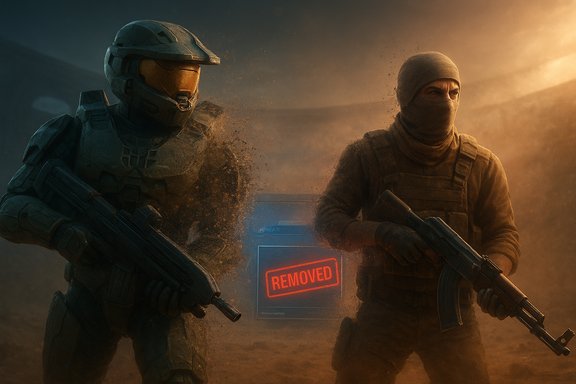 Background: what Project Misriah was and how it blew up
Project Misriah launched as a community-built mod collection that aimed to reproduce the look and feel of Halo 3 multiplayer inside Counter-Strike 2, packaging maps, weapons, sound effects, announcer lines, and movement tweaks into the Steam Workshop for one-click use. The mod quickly drew praise for nostalgia-accurate weapon behavior, Halo-style movement and gravity, and faithful map recreations such as Ghost Town, High Ground, and Homefront. The team behind the mod—identified publicly by handles like Froddoyo and a number of collaborators—published the workshop collection with a roadmap promising additional Halo weapons (rocket launcher, needler, plasma rifles) and powerups (Overshield, Active Camouflage). Community servers and thousands of enthusiastic players helped the mod go viral across social platforms within weeks. But the mod’s rapid ascent also put it directly in the crosshairs of copyright enforcement: Microsoft, citing unauthorized use of Halo game content, sent a takedown notice that led to Valve removing the Workshop items. The mod’s creators subsequently announced they would discontinue the project rather than pursue a counter-notice fight. Why Microsoft forced the removal: assets, EULAs, and the legal baseline
At the heart of Microsoft’s claim is a straightforward legal fact: Project Misriah included copyrighted assets taken from Halo games—models, audio, and map geometry—that Microsoft owns. Using those assets in a third-party workshop for Counter-Strike 2 without a license is precisely the kind of unauthorized reproduction that copyright law and standard EULAs are written to stop. The DMCA notice alleged the “unauthorized use of Halo game content in a workshop not associated with Halo games” and requested removal. That move aligns with explicit language Microsoft and 343 Industries published around modding of Halo: The Master Chief Collection (MCC). The MCC EULA and its public FAQ clarify what mod authors may and may not use: content contained in MCC is allowed for mods inside MCC, but assets from other Microsoft/343 titles or assets not included in the retail MCC build are not blanket-permitted for cross‑use. The EULA gives the publisher final say on what constitutes acceptable mod content and specifically draws lines around competing services and unauthorized distribution. In short: the legal framework for Halo modding permits community creativity, but it does not greenlight porting Halo assets wholesale into a different game’s workshop. This is important because fan projects live in a tension between community creativity and copyright enforcement. Some fan mods survive by recreating inspiration—building original assets and gameplay that evoke a franchise—rather than directly importing or ripping actual game files. Project Misriah’s creators were explicit that they used Halo assets, which removes much of the ambiguity. That decision made a legal takedown both predictable and, from Microsoft’s perspective, defensible.The DMCA process and why removal happens so quickly
Under U.S. law, platforms like Steam and Valve participate in the DMCA “notice-and-takedown” safe-harbor framework. When a platform receives a takedown notice that meets the statutory requirements, it typically must remove or disable access to the offending material promptly to preserve its safe-harbor protection. That often means Workshop items can vanish with little public preamble while the legal mechanics play out behind the scenes. The takedown process gives the alleged infringer a remedy—filing a DMCA counter-notice—but that remedy is expensive and risky compared with the initial removal. If the creator submits a counter-notice, the claimant (here, Microsoft) has a statutory window (commonly 10–14 business days) to file suit or else the platform must restore the material. In practice, few small creators choose the counter-notice route for projects that would require costly litigation to defend, especially when the claimant is a major publisher with deep legal resources. Valve’s Workshop processes—and platforms more broadly—also tilt the playing field toward rights-holders. Repeated or clear violations can trigger account or distribution penalties, and automated workflows and external enforcement partners can further accelerate removal. The result is a swift, legally defensible outcome for a rights-holder and a painful, often irreversible hit for the mod’s authors.What Project Misriah did technically — and why that matters
Project Misriah wasn’t a mere skin pack. The mod team rebuilt or ported multiple gameplay systems to approximate Halo 3’s mechanics inside CS2:- Weapons tuned with Halo-specific damage and sound effects.
- Armor models and announcer lines transplanted or recreated to match Halo’s audio identity.
- Map geometry and layouts mirroring Halo 3 arenas to preserve flow and sightlines.
- Movement and gravity tweaks to recreate the “moon-jumping” or verticality that defined classic Halo skirmishes.
The community reaction: disappointment, resignation, and a warning
The reaction across social platforms and modding communities was immediate and mixed. Many players expressed disappointment and lamented the loss of a high-quality, free fan experience. Others took a more tempered view: the outcome was inevitable given the project’s visible use of Halo assets and the commercial value of the Halo brand. Several creators pointed out that other mods survive by reinterpreting franchises while avoiding direct asset use, showing a practical alternative route. For mod authors, there are clear takeaways:- Back up your work and your community servers; a takedown can remove public distribution without warning.
- Prefer original assets or appropriately licensed third‑party content if your goal is durability.
- If using assets from a live franchise, understand you are taking on legal risk—even if the project is non-profit and community-driven.
Automation, third-party enforcement, and the rise of AI tools: an unsettled frontier
The broader backdrop to this takedown is the increasing use of automated brand-protection and copyright-enforcement tools. In recent years, publishers and contracted firms have deployed systems that scan user-generated content at scale for IP infringements and generate enforcement recommendations—including takedown notices. Some community discourse has named tools or firms (generically and sometimes by brand) that promise to shorten the detection-to-enforcement timeline using machine learning. That trend escalates the risk to modders because automated systems can flag matches that might have been manually reviewed and contextualized in the past. Caveat: for the Project Misriah takedown, public reporting attributes the notice to Microsoft. Claims that a specific AI vendor or automated webcrawler issued the notice on Microsoft’s behalf exist in community threads and speculative reporting, but there is no publicly released legal filing or Microsoft statement naming a third-party AI agent as the originator of the notice in this case. That specific linkage remains unverified in the public record, so caution is warranted when repeating those claims. The practical implication is clear: automation speeds enforcement, reduces review friction, and increases false positives in borderline cases. For modders that often operate in legal gray areas, that means their margin of error is shrinking.How Valve, Steam Workshop, and platforms typically respond
Platforms do not have discretion to ignore properly formatted DMCA notices without exposing themselves to liability. When a takedown arrives, platforms nearly always act quickly to disable access pending further legal steps. That’s why creators repeatedly describe the process as frustratingly blunt: content is removed before the substantive dispute is adjudicated, and the onus is on the creator to either accept the removal or file a legally binding counter-notice. If a creator files a counter-notice, the rights-holder has a limited legal window (roughly 10–14 business days) to file suit to keep the material offline. Otherwise, the platform must restore the content. Filing a counter-notice exposes the filer to potential legal liability under penalty of perjury, and suing a large publisher is expensive. For many modders—amateurs or hobbyists—those are prohibitive realities. This imbalance produces two predictable outcomes:- Many small creators accept takedowns rather than fight them.
- Publishers retain strong leverage over the long-term availability of fan projects.
The precedent question: what this means for other mods
Project Misriah’s removal sends a signal to every modder who builds with or borrows proprietary assets: if a project uses clearly identifiable, copyrighted game assets from a major IP and distributes them on a public platform, it risks takedown. That applies to popular series with active enforcement teams—Halo, Nintendo franchises, Rockstar’s GTA titles, and others—and it may also affect widely used workshop ecosystems like Garry’s Mod, Left 4 Dead 2, and Counter‑Strike 2. However, it is worth noting that the legal outcomes in this area are not uniform. Some fan projects survive for years by carefully avoiding direct asset reuse and instead rebuilding mechanics and aesthetics from scratch. Others have been restored after negotiation or remediation (removing infringing assets and replacing them with original equivalents). The slope is steeper for projects that replicate more than they evoke.Practical advice for mod authors who want to stay safe
- Use original or properly licensed assets. Rebuilding mechanics and style from the ground up is time-consuming but reduces legal exposure.
- Document your asset provenance. Keep records showing where models, textures, or sounds were obtained and whether they’re licensed for redistribution.
- Avoid distributing “Modded Versions” of other publishers’ games that include substantial parts of their copyrighted code or content unless you have explicit permission. MCC’s EULA specifically treats what you may do in MCC modding versus using MCC content elsewhere.
- Back up your work and community servers. If the Workshop version disappears, backups preserve the ability to rebuild or host privately.
- Consider community-driven remediation: if a takedown occurs, remove the disputed assets and replace them with original equivalents rather than engaging in protracted legal battles.
The broader picture: creativity vs. control in modern gaming
The Project Misriah takedown sits at a cultural inflection point for video-game communities. On one hand, modding is a vital engine of longevity for many games and a training ground for future creators. On the other, IP owners have legitimate, enforceable interests in protecting their franchises—especially when their commercial plans may include remasters, re-releases, or monetized expansions.Publishers and legal teams are more willing and able than ever to enforce those rights. The playbook that allowed decades of fan creativity to flourish in some corners of gaming is shifting, and automation and brand-protection services amplify that change. Mod authors who want sustainable, public-facing projects must navigate that new landscape deliberately and often conservatively.
Conclusion: an avoidable end, and a cautionary note
Project Misriah offered a vivid reminder of what passionate communities can build when tooling and enthusiasm align. Its removal is also a timely case study: when a fan project uses proprietary assets verbatim, even a non-commercial, lovingly crafted mod can be removed quickly and decisively under U.S. copyright law and platform policies. The takedown follows the letter of existing legal instruments and the EULA terms Microsoft has publicly published for the Halo franchise, even as it highlights the broader tensions between community creativity and corporate IP protection. For modders and community custodians, the practical lesson is simple but important: if long-term availability matters, invest in original content creation, provenance documentation, and conservative distribution strategies. For platform operators and rights-holders, the Project Misriah episode underscores the need for transparent, proportionate enforcement pathways that can distinguish honest fan creativity from clear infringement—especially as enforcement becomes increasingly automated. Until those systems mature, high-profile fan projects will continue to offer both a creative high and a legal cliff.Source: Windows Central https://www.windowscentral.com/gaming/halo/microsoft-dmca-takedown-project-misriah-halo-cs2-mod/
