

Microsoft, NVIDIA and Anthropic have announced a three‑way strategic alliance that reorders the AI supply chain: Anthropic has committed to buy an unprecedented block of Azure compute, NVIDIA will supply and co‑design next‑generation systems, and both Microsoft and NVIDIA are making multibillion‑dollar investments in Anthropic — a deal that changes how cloud capacity, chip supply and model development are coordinated across the industry.
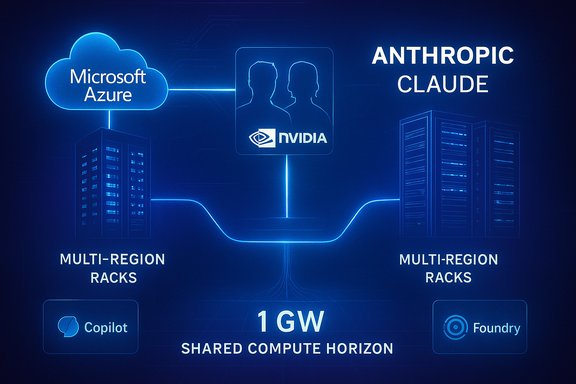
The collaboration brings together three different layers of the modern AI stack: a major cloud provider (Microsoft Azure), a dominant AI silicon and systems vendor (NVIDIA), and a frontier AI lab (Anthropic). The publicized terms are striking for scale and circularity: Anthropic has committed to purchasing roughly $30 billion of Azure compute capacity and may contract additional capacity up to one gigawatt; NVIDIA has pledged up to $10 billion in capital support, and Microsoft up to $5 billion. These commitments were announced publicly in coordinated statements and press coverage tied to Microsoft’s Ignite event. Those headline numbers are the most consequential piece of the deal: they lock Anthropic to large, long‑term cloud consumption on Azure while enabling NVIDIA to align its hardware roadmap to a major model customer. The move also formalizes an engineering partnership between Anthropic and NVIDIA to co‑optimize the Claude family of models to run on NVIDIA’s large‑scale systems — including the current Grace Blackwell family and the next‑generation Vera Rubin architecture.
Industry analysts also framed the move as a step to decrease the AI economy’s dependence on a single model provider (OpenAI), while giving NVIDIA another major channel to seed demand for next‑generation accelerators. That rebalancing of supply and demand is a central strategic effect of the deal.
The partnership’s strengths are concrete: faster time to capability, guaranteed hardware roadmaps tuned to real workloads, and immediate product integrations that enterprise customers can access through Azure and Microsoft Copilot. The risks are equally real: circular financing, regulatory exposure, energy and infrastructure strain, and potential lock‑in created by ultra‑tight hardware‑software co‑design.
Taken together, the deal is a decisive play in the 2025–2026 AI market: it accelerates model and systems innovation while reshaping the commercial battlefield. IT leaders and policymakers now need to treat compute, chips and models not as separate procurement lines, but as interconnected strategic assets whose governance will define the pace and safety of enterprise AI adoption.
Source: TECHi https://www.techi.com/ai-partnership-microsoft-nvidia-and-anthropic/
 Background
The collaboration brings together three different layers of the modern AI stack: a major cloud provider (Microsoft Azure), a dominant AI silicon and systems vendor (NVIDIA), and a frontier AI lab (Anthropic). The publicized terms are striking for scale and circularity: Anthropic has committed to purchasing roughly $30 billion of Azure compute capacity and may contract additional capacity up to one gigawatt; NVIDIA has pledged up to $10 billion in capital support, and Microsoft up to $5 billion. These commitments were announced publicly in coordinated statements and press coverage tied to Microsoft’s Ignite event. Those headline numbers are the most consequential piece of the deal: they lock Anthropic to large, long‑term cloud consumption on Azure while enabling NVIDIA to align its hardware roadmap to a major model customer. The move also formalizes an engineering partnership between Anthropic and NVIDIA to co‑optimize the Claude family of models to run on NVIDIA’s large‑scale systems — including the current Grace Blackwell family and the next‑generation Vera Rubin architecture. Overview: What the deal actually says
Key public commitments
- Anthropic: committed to a $30 billion Azure compute purchase, with the option to scale to up to one gigawatt of contracted capacity.
- NVIDIA: committed to invest up to $10 billion in Anthropic and to work directly with Anthropic on hardware and model co‑design.
- Microsoft: committed up to $5 billion in support to Anthropic and will make Anthropic models available across Azure AI Foundry and Microsoft’s Copilot family.
Product names and model availability — note on inconsistencies
Press reports agree Anthropic’s Claude family will be offered inside Microsoft’s enterprise products, including GitHub Copilot, Microsoft 365 Copilot, and Copilot Studio/Foundry channels — making Anthropic a first‑class model choice inside Microsoft’s Copilot ecosystem. Reuters specifically named Claude Sonnet 4 and Claude Opus 4.1 as models integrated into Copilot’s Researcher and Copilot Studio workflows; some outlets reported slightly different model version numbers (for example Sonnet 4.5 or Haiku 4.5). The model versioning in public coverage shows minor inconsistencies across outlets; the authoritative product listing from the companies’ own product pages should be treated as the final source for exact model version numbers.Why the numbers matter: scale, cost and supply
The meaning of "one gigawatt" in AI computing
A contract that allows an AI company to scale up to one gigawatt of compute capacity is operationally enormous. One gigawatt of IT load corresponds to tens of thousands of GPU accelerators at full utilization, and building that capacity requires multi‑year planning across data‑center real estate, electrical substations, utility contracts, and liquid‑cooling infrastructure. Industry analysis included in the coverage points out that the capital cost of provisioning a gigawatt of usable AI compute can run in the tens of billions of dollars once facility, networking and cooling investments are included. In short, this is not a single‑data‑center procurement — it’s a multi‑region, long‑horizon industrial commitment.What $30 billion of cloud purchases buys Anthropic
A multi‑billion dollar compute commitment from Anthropic to Microsoft translates into:- Guaranteed priority access to Azure capacity and preferential deployment windows.
- Economies of scale that can lower per‑token or per‑inference costs for Anthropic’s customers.
- A predictable revenue stream for Microsoft Azure, useful for long‑term planning and capacity expansion.
Technical architecture and NVIDIA’s role
Hardware platforms: Grace Blackwell today, Vera Rubin tomorrow
NVIDIA’s recent systems — notably the Grace Blackwell family — are already optimized for large model training and inference at scale. At GTC 2025 NVIDIA previewed a next generation stack (Vera Rubin) that pairs a custom CPU (Vera) with a new Rubin GPU architecture to dramatically increase memory capacity, memory bandwidth and inference throughput. The Anthropic alliance specifically calls out Grace Blackwell and upcoming Vera Rubin systems as the platforms Anthropic intends to use initially and as it scales. Optimizing large models like Claude for these systems will be a central technical activity of the partnership.Co‑design: why it matters
Co‑design means joint work across:- Model architecture choices (sparsity, sharding strategies, precision formats).
- Software stacks (optimizers, distributed training orchestration, quantization).
- System topologies (fabric, NVLink/NIC choices, memory hierarchies).
Microsoft’s strategic calculus: diversify Copilot and Azure
Microsoft’s decision to integrate Anthropic alongside OpenAI and other third‑party providers is a strategic diversification of its model supply. Microsoft still maintains a deep financial and engineering relationship with OpenAI, but the company has been explicit about wanting multiple “frontier” models in its ecosystem. Adding Anthropic to Copilot, Foundry and Azure AI offerings accomplishes several objectives for Microsoft:- Product resilience: reduces operational and reputational risk tied to any single model provider.
- Customer choice: gives enterprise customers alternative model behaviors and performance profiles within the Copilot product line.
- Cloud differentiation: Azure becomes a place where enterprises can test and deploy multiple frontier models under the same contract and governance controls.
Competition and market dynamics: a new axis of rivalry
Circular financing and the "ecosystem of mutual commitments"
The announcement drew immediate commentary about circularity: cloud providers, chip suppliers and model houses investing in each other while committing to buy compute from one another. Critics argue this can hide the underlying economics — money flows that shore up demand for partners rather than reflect independent market valuation. The circular nature of some of these commitments raises questions about long‑term sustainability if model economics (revenue per compute dollar) don’t improve materially.Industry analysts also framed the move as a step to decrease the AI economy’s dependence on a single model provider (OpenAI), while giving NVIDIA another major channel to seed demand for next‑generation accelerators. That rebalancing of supply and demand is a central strategic effect of the deal.
Competitive pressure on OpenAI, Google and others
Anthropic’s newly guaranteed access to Azure and NVIDIA systems means it can accelerate Claude’s roadmap and enterprise reach — a direct competitive pressure on other frontier labs. At the same time, Microsoft’s multi‑model strategy can reduce the lock‑in value of any single provider and force other cloud and chip vendors to pursue similar agreements. Expect a period of intense deal‑making and capacity announcements as competitors attempt to replicate or counterbalance the market access and compute guarantees in this pact.Enterprise implications: what IT leaders should track
- Model choice and governance: Organizations will gain more model options inside their existing Microsoft contracts; they should update vendor selection frameworks to evaluate not just model performance but also data governance, residency and service level commitments.
- Cost predictability: Large compute purchases can create long‑term price and capacity guarantees; procurement and finance teams must ensure contract terms (term length, termination, usage tiers) align with expected revenue and deployment schedules.
- Multicloud posture: Anthropic’s multicloud availability reduces single‑vendor lock‑in risk for customers who require redundancy, but enterprises should validate how data access, logging, and compliance features vary across cloud hosts.
- Operational readiness: Deploying models at the scale claimed will require integrated practices for monitoring, fine‑tuning, model auditing, and incident response.
Regulatory, ethical and systemic risks
Market concentration and antitrust scrutiny
The combination of cloud, chip and model vendor intimacy is precisely the pattern regulators monitor for market concentration. When a small set of vendors control supply, hardware, and distribution layers, it can raise antitrust questions — especially for cross‑border enterprise customers and public sector procurement. Several outlets noted these potential concerns and the likelihood of future regulatory attention as similar tie‑ups become more common.Financial risk: valuation and profitability
Large headline valuations and investment commitments in the AI sector have outpaced profits. Public reporting on similar firms shows limited profitability despite massive revenue growth. Some outlets quoted valuation increases for Anthropic in connection with the round; these are market estimates and should be treated cautiously because they rely on the specific terms of private fundraising and the circular investment structure. Financial sustainability for model providers ultimately comes down to margins on model inference and enterprise contracts — not just headline valuation.Safety, auditability and vendor risk
Tighter collaboration between silicon vendors and model developers may accelerate performance, but it also raises questions about independent auditability. If models are heavily tuned for proprietary hardware stacks and deep integration, reproducibility and external verification become technically harder. Enterprises in regulated industries (finance, health, government) will have to demand stronger audit trails and model documentation to meet compliance standards.Technical and operational risks for Anthropic, Microsoft and NVIDIA
- Energy and infrastructure: Scaling to gigawatt levels places enormous demand on grid capacity, cooling and water usage. These are long‑lead infrastructure projects that can be slowed by permitting and utility constraints.
- Supply chain: NVIDIA’s ability to deliver at scale (HBM memory, GPUs, interconnects) depends on wafer supply, substrate capacity and global logistics; shortages could bottleneck Anthropic deployments.
- Model hardware lock‑ins: Deep co‑optimizations with NVIDIA could create performance differentials that make migration to alternative accelerators costly for Anthropic later.
- Execution risk: Converting a multi‑billion compute commitment into reliable, performant and secure services requires seasoned cloud engineering at scale; missing that execution can raise costs and damage customer trust.
Strengths of the alliance
- Speed of innovation: Co‑optimization across silicon, systems and models shortens the feedback loop for performance improvements.
- Enterprise reach: Microsoft’s platform reach and enterprise contracts accelerate Anthropic’s commercial adoption at scale.
- Demand signal for NVIDIA: NVIDIA secures a major, high‑margin customer to justify continued R&D investment in high‑end datacenter hardware.
- Mitigation of single‑vendor dependency: Microsoft gains real flexibility by not being dependent on a single model provider.
Recommendations for CIOs and IT buyers
- Reassess model selection frameworks to include provider diversification, cross‑cloud availability, and third‑party auditability.
- Negotiate predictable pricing and exit clauses in any long‑term model or compute contracts to avoid circular dependency traps.
- Build internal benchmarks that compare cost per business‑unit inference across providers and hardware families.
- Require stronger documentation and model cards for safety, provenance and compliance.
- Monitor regulatory developments; large cross‑layer deals are increasingly likely to draw antitrust review.
What to watch next
- The detailed contract terms that define how Anthropic’s $30 billion commitment will be deployed (time horizon, payment terms, and region allocations). Coverage at announcement disclosed headline numbers but not the contractual fine print.
- NVIDIA’s cadence for delivering Vera Rubin systems and the timelines for putting racks into cloud provider regions; those schedules will determine when Anthropic can realistically scale model sizes and throughput.
- How Microsoft maps Anthropic models into Copilot experiences (choice, governance toggles, tenant isolation) versus the current OpenAI integrations. Reuters and Microsoft commentary indicate Anthropic will be an option inside Copilot’s Researcher and Copilot Studio flows, but exact enterprise controls will be productized over time.
- Regulatory filings or antitrust signals from U.S., EU or other authorities that monitor the concentration of AI infrastructure and cross‑investment behaviors.
Cautions and unverifiable claims
Several specific items reported around the announcement show inconsistent details across outlets and deserve cautious treatment:- Some press pieces listed model versions such as Claude Sonnet 4.5 and Claude Haiku 4.5; other reputable outlets listed Claude Sonnet 4 and Claude Opus 4.1. The variation suggests that exact model version labeling was not harmonized in early coverage; product pages and vendor blogs should be consulted for the final, authoritative names.
- Valuation figures for Anthropic reported after the announcement vary across outlets and appear to be market estimates linked to the new capital commitments; they are not an official, audited market capitalization and should be treated as speculative until the companies disclose firm financing terms.
Final analysis: a structural pivot in the AI era
This three‑way alliance is more than a single deal; it’s a blueprint for the next phase of AI industrialization. It ties compute demand, chip supply and model IP into longer‑term industrial contracts and engineering cooperation. For enterprises, the immediate benefit is more model choice inside major clouds and productivity products. For the industry, the long‑term effect will be fewer, larger channels that dominate compute, chips and distribution — a consolidation that can speed capability deployment but also concentrates systemic risk.The partnership’s strengths are concrete: faster time to capability, guaranteed hardware roadmaps tuned to real workloads, and immediate product integrations that enterprise customers can access through Azure and Microsoft Copilot. The risks are equally real: circular financing, regulatory exposure, energy and infrastructure strain, and potential lock‑in created by ultra‑tight hardware‑software co‑design.
Taken together, the deal is a decisive play in the 2025–2026 AI market: it accelerates model and systems innovation while reshaping the commercial battlefield. IT leaders and policymakers now need to treat compute, chips and models not as separate procurement lines, but as interconnected strategic assets whose governance will define the pace and safety of enterprise AI adoption.
Source: TECHi https://www.techi.com/ai-partnership-microsoft-nvidia-and-anthropic/
