

Microsoft, Nvidia and Anthropic have announced a landmark three‑way alliance that reshapes the competitive map of generative AI and hyperscale cloud infrastructure: Anthropic has committed to purchase roughly $30 billion of compute from Microsoft Azure and to initially deploy up to one gigawatt of Nvidia‑based capacity, while Nvidia and Microsoft will make jointly meaningful equity and strategic investments in Anthropic — Nvidia up to $10 billion; Microsoft up to $5 billion. This arrangement couples guaranteed long‑term demand for hardware and cloud services with a technical co‑design pact that aims to optimize Claude models for Nvidia’s next‑generation architectures and to broaden Claude’s availability across major cloud platforms.
Anthropic, founded by former OpenAI researchers and best known for the Claude family of large language models, has grown into one of the most consequential independent model developers. The company’s traction with enterprise customers and the rapid iteration of its Claude releases made it a natural partner for hyperscalers and chipmakers looking to guarantee supply and diversify model choices beyond a single provider ecosystem.
The newly announced pact is notable for three tightly coupled elements:
But the partnership also sharpens classic trade‑offs of the era: enormous capital intensity versus uncertain monetization timelines; supply‑chain and vendor‑lock benefits versus concentration and bubble risk; technical co‑design efficiencies versus governance and auditability concerns. The most material market questions now are empirical: will enterprise adoption of monetized AI services convert at a pace and margin high enough to justify the trillions of dollars of projected infrastructure spending? And will a small number of tightly integrated alliances deliver durable competitive moats or create unsustainable financial circularities?
Practically, expect:
Source: XTB.com Strategic AI Offensive: Microsoft, Nvidia, and Anthropic Join Forces!
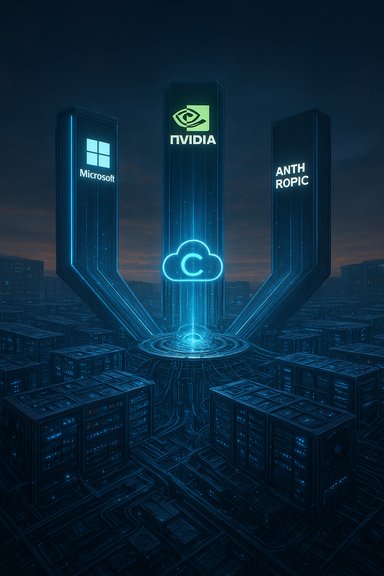 Background / Overview
Anthropic, founded by former OpenAI researchers and best known for the Claude family of large language models, has grown into one of the most consequential independent model developers. The company’s traction with enterprise customers and the rapid iteration of its Claude releases made it a natural partner for hyperscalers and chipmakers looking to guarantee supply and diversify model choices beyond a single provider ecosystem.The newly announced pact is notable for three tightly coupled elements:
- A multi‑billion dollar compute commitment by Anthropic to Microsoft Azure — effectively a long‑term revenue stream for Azure and a validation of Microsoft’s push to be a leading AI cloud platform.
- A technical partnership with Nvidia to optimize Anthropic’s models for Nvidia’s Grace Blackwell and Vera Rubin platforms, starting with an initial scale of up to 1 gigawatt of Nvidia compute.
- Direct capital commitments: Nvidia will invest up to $10 billion in Anthropic, Microsoft up to $5 billion, while Anthropic will retain multicloud flexibility — notably remaining a customer and strategic partner of Amazon Web Services (AWS).
What exactly was announced?
Deal components and headline numbers
- $30 billion: Anthropic’s announced committed spend on Microsoft Azure compute capacity.
- Up to 1 gigawatt: The initial scale of compute Anthropic will contract on Nvidia‑powered platforms, built on Nvidia’s Grace Blackwell and Vera Rubin families. This is an operational-scale metric; industry participants translate a gigawatt of AI compute into tens of thousands to hundreds of thousands of GPUs and associated networking and power infrastructure.
- Capital commitments: Nvidia up to $10 billion; Microsoft up to $5 billion — positioned as strategic investments or commitments as part of Anthropic’s next funding round.
- Multicloud stance preserved: Anthropic remains a primary AWS customer and training partner while making Azure a major deployment and commercial channel. AWS itself has increased its stake in Anthropic in recent rounds, totaling about $8 billion in investments to date.
Where Claude will appear
Beyond raw compute, the alliance immediately changes distribution: Anthropic’s frontier Claude models will be made available to Azure customers through Microsoft’s enterprise AI packaging and, according to the announcements, will also be integrated across Microsoft’s Copilot family and Azure AI Foundry offerings. That means Claude variants will be offered as a mainstream enterprise option alongside other frontier models across multiple clouds.Why each party signed up — strategic rationale
Anthropic — scale, resilience and distribution
Anthropic’s gains are obvious and immediate:- Guaranteed compute and financing: A long‑term compute contract and fresh capital commitments materially derisk large‑model training plans and deployment ambitions. The scale of capacity promised (up to 1 GW, plus $30B Azure buys) gives Anthropic headroom to train larger, faster, and more commercially robust Claude variants.
- Broader go‑to‑market: Making Claude available across Azure (in addition to AWS and other clouds) expands enterprise reach and eases procurement for corporate buyers that are normalized on Microsoft stacks.
- Operational hedging: By retaining AWS as a primary training partner while adding Azure and deep Nvidia alignment, Anthropic reduces single‑vendor risk and keeps flexibility for chip/price/latency tradeoffs.
Microsoft — diversify model supply, accelerate Azure’s AI growth
For Microsoft the deal accomplishes multiple strategic goals:- Reduce model concentration risk: Microsoft’s deep relationship with OpenAI has been a cornerstone of Azure’s AI story. Broader access to Anthropic helps Microsoft avoid overreliance on any single frontier model supplier and increases its option value across enterprise scenarios.
- Fill Azure with enterprise‑grade models: Adding Claude to Azure AI Foundry and Copilot offerings enhances Azure’s competitive pitch to enterprises that want a range of frontier models under a single cloud contract.
- Lock in demand for Azure infrastructure: A $30 billion compute agreement is the kind of sticky revenue that helps justify ongoing multibillion dollar capital commitments to data center expansion and liquid cooling and power projects.
Nvidia — hardware demand certainty and co‑design upside
Nvidia’s reasoning is straightforward:- Secure long‑term demand for next‑gen platforms: The Grace Blackwell and Vera Rubin platforms are strategic product lines; a gigawatt commitment tied to those architectures is a multiyear revenue and demand anchor.
- Technical co‑design benefits: Joint engineering with Anthropic can yield software optimizations and architecture tweaks that improve throughput, reduce total cost of ownership for customers and boost adoption of Nvidia’s chips.
Technical implications — the compute, the chips, the logistical scale
What does “one gigawatt of compute” mean in practice?
One gigawatt of deployed AI compute is not a single product; it’s an entire data center fleet measured by peak power draw. Industry observers often equate a gigawatt of AI data center capacity with the hardware, networking and cooling necessary to run hundreds of thousands of high‑end accelerator cards operating continuously. The price tag for building, powering and operating that capacity runs into the tens of billions of dollars over time — a figure industry participants place in the low‑to‑mid tens of billions for a gigawatt class deployment. That is why Anthropic’s $30B Azure purchase and the Nvidia co‑deal have such commercial heft: they match the scale of the infrastructure problem with contractual revenue and technical co‑investment.Grace Blackwell and Vera Rubin: what they matter
Nvidia’s Grace Blackwell and Vera Rubin lines represent the company’s ongoing migration toward architectures designed for large‑scale training and inference across massive models: memory‑centric, high‑bandwidth interconnects, and power‑efficient accelerators tuned to transformer workloads. Optimizing Claude to run efficiently on these platforms can materially reduce training time and per‑token inference cost, improving Anthropic’s margin profile on deployed services. The announced engineering collaboration aims to deliver those gains through joint software and hardware tuning.Market and competitive impact
Cloud market positioning: Azure’s momentum versus AWS
Recent corporate reporting shows Azure growing at a very high single‑digit to double‑digit pace for Microsoft’s cloud stack; Microsoft reported Azure growth in the high 30s percent range in recent fiscal disclosures, reflecting strong enterprise adoption of AI‑centric services. AWS’s growth rate in key 2025 quarters was lower by comparison — around 17–20% in recent reporting periods — even as AWS remains the largest cloud by revenue. Those different growth dynamics help explain why Microsoft is aggressively locking in model supply and making Azure a more attractive place to deploy enterprise LLM workloads. The direct commercial effect of making Claude available on Azure is a modest but meaningful expansion of marketplace choice for enterprise customers evaluating models under operational, regulatory and procurement constraints.Competitive ripple effects
- OpenAI and Google: The deal increases model diversity available to hyperscalers and corporate buyers, reducing the extent to which any single model (e.g., ChatGPT/GPT series) becomes the default across all clouds. That will spur further product differentiation and potentially force OpenAI and Google to sharpen their commercial propositions.
- AWS and chip rivals: AWS’s expanded investment in Anthropic earlier this year — and public commitments around custom silicon (Trainium/Inferentia) — make for parallel strategic plays. The Anthropic multicloud posture means hyperscalers remain in a vendor battle for model access and deployment economics.
Financial scale and macro risks
Capital intensity of modern AI
The arms race for AI compute is indisputably capital intensive. Recent analyst and bank forecasts put hyperscaler and broader AI infrastructure spending in the hundreds of billions for the immediate term and project cumulative trillions over a multi‑year horizon. Wall Street analyses and consulting firm studies highlight wide ranges — but the headline takeaway is unambiguous: hyperscalers and large model developers are committing to capex at a scale more commonly associated with energy or telecom infrastructure projects rather than software launches. These investments create very large ongoing fixed costs that depend on steady, high‑margin monetization of models and services to pay back.Forecasts and the wide range of estimates
Analyst forecasts vary: some projections put global AI infrastructure spending at or above $400 billion in 2025, while broader studies of the economic value of generative AI indicate $2.6–4.4 trillion of productivity or economic value by 2030 from generative AI applications. That difference matters: one set of numbers measures infrastructure spending and the other measures economic value or productivity gains; conflating the two overstates the immediate revenue that will be available to pay for the infrastructure. The headlines — large numbers and trillions — are real, but the interpretation and the timing are disputed by reputable forecasters. Readers should treat multi‑trillion forecasts as plausible upside scenarios rather than guaranteed returns.Circular investments and bubble risk
A recurring criticism from commentators is that “circular” investments — where cloud providers, chipmakers and model companies invest in each other in ways that sleeve revenue from one party back into the partner — can paper over demand shortfalls and exacerbate valuation bubbles. The Microsoft/Nvidia investments into Anthropic and Anthropic’s guaranteed spend commitments introduce exactly this dynamic: they secure supply and demand in the near term but raise legitimate questions about how much of the value is purely financial engineering versus genuine market growth. Market participants will watch revenue conversion and gross margins closely as capital flows are recognized.Operational and governance risks
- Data sovereignty and regulatory complexity: Running frontier models across multiple clouds exposes enterprises and providers to divergent compliance regimes, cross‑border data controls and auditability requirements. Choosing where a model is trained and where data moves will have real contract, legal and latency ramifications.
- Vendor lock‑in via co‑design: While co‑design optimizes performance, it can increase lock‑in risk if model codebases or optimizations tightly couple to proprietary accelerator features.
- Profitability timelines for Anthropic: Public filings and reporting about Anthropic’s monetization pathway are limited; some market write‑ups suggest extended timelines to profitability. The specific assertion that Anthropic “does not expect to achieve profitability before 2028” appears in secondary commentary but lacks a clear, attributable company filing or executive quote available in major public statements at the time of writing and should be considered unverified unless the company confirms it in official financial disclosures. This is a material point: if Anthropic must burn capital for years to build and train larger models, its valuation and the durability of partner commitments will be tested against revenue growth and cash flow dynamics.
What this means for enterprise customers and IT decision makers
- Model choice expands: Enterprises will gain smoother access to Anthropic’s Claude models via Azure AI Foundry and Microsoft’s Copilot lineup. For businesses that standardize on Microsoft tooling, that lowers friction to evaluate alternative frontier models.
- Multicloud deployment becomes realistic: Anthropic’s multicloud posture helps enterprises keep options open for training vs serving workloads — a potential performance and cost lever for architects and procurement teams.
- Cost visibility and negotiation leverage: Long‑term compute deals mean Microsoft can amortize infrastructure costs and offer differentiated pricing, but enterprises should still scrutinize TCO (total cost of ownership) on per‑token or per‑inference metrics when locking consumption contracts.
Broader strategic takeaways and risks for investors
- This deal is a clear indication that the AI stack is consolidating into an ecosystem of a small number of hyperscalers, a dominant accelerator vendor, and a set of leading model providers. That concentration drives scale benefits but multiplies systemic risk.
- The headline dollar figures and gigawatt metrics are signals: companies are building industrial‑scale AI capacity and expecting enterprise demand to absorb it. The critical question for investors is whether monetization (enterprise licensing, API usage, vertical applications) will keep up with capital deployment and operating costs.
- Financial risk from “funding the runway”: Anthropic’s growth will likely need continued capital to fund model training cycles. Strategic investments from Microsoft and Nvidia are stabilizing, but they are not unconditional guarantees of profitability. The market must judge whether the endpoint economics justify the massive near‑term capital outlays.
Regulatory, ethical and national security angles
- Governments and regulators will examine cross‑border compute commitments, dual‑use implications of advanced LLMs, and concentration risk in critical AI infrastructure. Co‑ownership, co‑investment and tight engineering relationships can raise antitrust or national security questions if they create de facto chokepoints for future innovation or resilience.
- Ethical control and auditability: the more integrated model optimization becomes with specific hardware, the harder it may be for independent auditors to reproduce model behavior or to verify claims about alignment and safety without access to proprietary stacks.
Conclusion — the immediate and the long view
The Microsoft–Nvidia–Anthropic alliance is the most consequential three‑way alignment in the generative AI sector since the early OpenAI‑Microsoft era. In the near term it guarantees Anthropic the compute and capital needed to scale Claude aggressively while giving Microsoft expanded model choice and Nvidia steady demand for its next‑gen hardware. For enterprise customers, the deal expands options and lowers friction to evaluate Claude across major clouds.But the partnership also sharpens classic trade‑offs of the era: enormous capital intensity versus uncertain monetization timelines; supply‑chain and vendor‑lock benefits versus concentration and bubble risk; technical co‑design efficiencies versus governance and auditability concerns. The most material market questions now are empirical: will enterprise adoption of monetized AI services convert at a pace and margin high enough to justify the trillions of dollars of projected infrastructure spending? And will a small number of tightly integrated alliances deliver durable competitive moats or create unsustainable financial circularities?
Practically, expect:
- Faster time‑to‑market for Anthropic’s larger models and Claude SDK features across Azure customers.
- Ongoing rivalry among hyperscalers to secure exclusive or non‑exclusive partnerships with frontier model developers, coupled with increases in capex and power‑infrastructure projects.
- Investor scrutiny to shift from growth headlines to per‑token economics, margins and realistic profitability timelines for model vendors. Claims about profitability timelines for Anthropic should be treated cautiously until confirmed in formal disclosures.
Source: XTB.com Strategic AI Offensive: Microsoft, Nvidia, and Anthropic Join Forces!
