

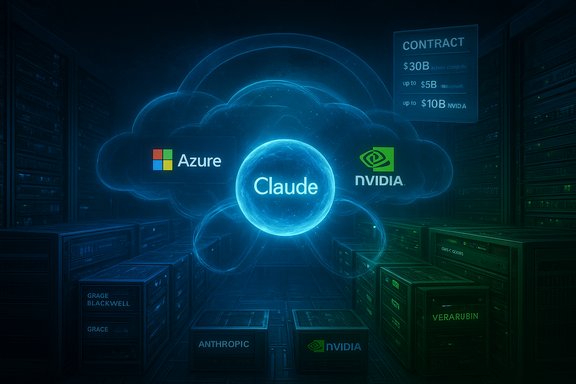
Microsoft, NVIDIA and Anthropic have stitched together one of the most consequential — and circular — technology deals of the AI era: Anthropic will commit tens of billions to run Claude on Microsoft Azure while Microsoft and NVIDIA pledge up to $5 billion and $10 billion respectively in funding and technical collaboration, and Anthropic will gain access to massive NVIDIA-powered compute capacity to accelerate model training and deployment.
Background
The announcement, timed with Microsoft’s Ignite developer conference, formalizes a tripartite relationship that blurs supplier, customer and investor roles. Under the deal, Anthropic — the San Francisco AI startup behind the Claude family of models — committed to buying roughly $30 billion worth of compute capacity on Microsoft Azure. NVIDIA said it would invest up to $10 billion in Anthropic, and Microsoft said it would invest up to $5 billion. Anthropic will likewise gain access to significant NVIDIA compute capacity — described by the companies as up to one gigawatt worth of specialized hardware — and will work closely with NVIDIA on co-designing chip and software optimizations for Claude. This is not an isolated move: Anthropic has been expanding multi-cloud and hardware relationships throughout 2025, including multi‑billion commitments with Google and Amazon. The new Microsoft–NVIDIA agreement positions Claude as a frontier model available across the three largest cloud providers, while creating a new cross-dependency between major AI platform and chip players.What the deal actually says — the concrete terms
Financial commitments and investments
- Anthropic commits to purchase approximately $30 billion in Azure compute capacity.
- NVIDIA has pledged up to $10 billion to invest in Anthropic, reportedly as part of Anthropic’s next funding round.
- Microsoft has pledged up to $5 billion in a corresponding investment.
Compute and hardware specifics
- Anthropic will run Claude models on Azure infrastructure powered by NVIDIA hardware, and the companies described potential access to up to one gigawatt of NVIDIA compute capacity (using Grace Blackwell and Vera Rubin systems). Industry observers estimate that bringing 1 GW of AI compute online represents tens of billions of dollars in capital and chips.
Product and cloud availability
- Microsoft will surface Anthropic’s Claude models to Azure AI customers (via Azure AI Foundry and other enterprise offerings), making Claude the first “frontier” model intentionally available across Amazon, Google and Microsoft clouds. Anthropic will continue to use Amazon as a primary cloud partner for training while expanding on Azure for deployment and enterprise reach.
Why this matters: strategic context
1) A new, circular pattern of investment and dependence
The announcement exemplifies a new pattern in AI: large platform and chip vendors are not merely suppliers, they are investors and customers of the very companies that produce frontier models. Microsoft, NVIDIA and Anthropic are creating reciprocal relationships — Anthropic buys compute from Microsoft (and uses NVIDIA chips), Microsoft and NVIDIA invest in Anthropic, and Anthropic’s models run in Microsoft products. That circularity blurs commercial lines and deepens interdependence among a few super‑scale players. Reuters and AP both highlighted the circular nature of the deal.2) Competition and diversification away from OpenAI
Microsoft has been the largest partner and investor in OpenAI, but OpenAI’s cloud strategy evolved in 2025 as it sought alternative cloud capacity from Oracle, SoftBank and others. Microsoft’s deal with Anthropic signals a deliberate diversification: bringing another strong frontier model — Claude — into Microsoft’s enterprise portfolio reduces exclusive reliance on a single external provider for frontier AI capabilities. Analysts framed this as Microsoft hedging and broadening its AI supply chain.3) The compute arms race accelerates
The practical implication is a stepped-up arms race for compute capacity. Announcements in 2025 from Anthropic, OpenAI and others laid bare staggering infrastructure obligations: multi‑gigawatt intentions, multi‑hundred‑billion dollar commitments over time, and intense competition for the newest generations of chips. NVIDIA’s roadmap (Blackwell family, Vera Rubin systems) and Google’s TPU offerings are both central to how these models will be trained and served. The one‑gigawatt figure cited in this deal is especially notable as an order‑of‑magnitude benchmark for a single vendor‑aligned deployment.Technical implications for enterprise customers and developers
Claude on Azure: model choice and latency
Making Claude available on Azure gives enterprise customers more model choice and potentially better latency and compliance options for Azure-hosted data. Enterprises that already standardize on Azure for identity, storage and networking can now evaluate Claude alongside other models without moving workloads off‑platform. Microsoft said Azure AI Foundry customers will be able to access the latest Claude models, and Microsoft has indicated integration with Microsoft 365 Copilot and developer tooling is coming. This matters for organizations building Copilot-powered workflows, internal generative agents, or proprietary data connectors — model choice can materially affect cost, response quality, and fine‑tuning options.Co‑engineering with NVIDIA: performance and TCO
NVIDIA and Anthropic pledged a deeper technical partnership to optimize models and chips together. That co‑engineering can yield meaningful improvements in throughput, energy efficiency, and cost per token — all critical to enterprise Total Cost of Ownership (TCO) for inference and training. NVIDIA’s newer Blackwell family and the Vera Rubin systems promise higher token throughput and memory bandwidth; if Anthropic’s stack is optimized for these GPUs, customers could see latency and pricing benefits for high-volume inference workloads. CNBC’s coverage of NVIDIA’s chip roadmap outlines the technical expectations for Blackwell and Vera Rubin systems.Data residency, compliance, and vendor lock-in risks
Enterprises must weigh the compliance implications: running Claude on Azure may be attractive for data residency and contractual protections, but closer integration can also increase dependency on Microsoft’s ecosystem. Conversely, Anthropic’s multi-cloud posture (with Amazon and Google ties) is intended to reduce single‑vendor lock‑in — yet the circular investment relationships may steer product roadmaps in vendor-favorable directions. Organizations should assess contractual terms, model governance, and portability options before adopting a single provider’s bundled AI services.Business analysis: strengths and opportunities
Strengths for Microsoft
- Product diversification: Adding Claude expands the portfolio available to Microsoft 365 Copilot, Azure AI Foundry and developer tools, giving customers clear model choice.
- Enterprise reach: Microsoft’s massive installed base in enterprises provides Anthropic with an accelerated GTM channel.
- Control of stack: The compute commitment and investments help Microsoft secure more of the cloud-to-inference stack at scale.
Strengths for NVIDIA
- Demand lock for next‑gen chips: Deeper partnership and co-design ensures demand for NVIDIA’s most advanced architectures and validates its software stack for frontier models.
- Revenue uplift and influence: Investing in model producers aligns NVIDIA’s revenue growth with the continued scaling of large language models.
Strengths for Anthropic
- Capital and compute access: The combination of Microsoft’s cloud capacity plus NVIDIA hardware access, and additional investor capital, materially de‑risks capital constraints around compute.
- Wider enterprise distribution: Being made available across three major clouds and surfaced in Azure enterprise products accelerates enterprise adoption and sales velocity.
Risks, contradictions and points of caution
1) Circular finance raises bubble concerns
Several journalists and analysts flagged the circularity — where suppliers buy compute from customers who in turn are invested in the suppliers — as a factor that can inflate revenue visibility without improving unit economics. Wall Street has been cautious about valuations versus realistic, sustainable profitability for AI model firms. Reuters and AP highlighted analysts’ concern that circular deals may artificially prop up perceived demand.2) Conflicting public figures — valuation and revenue claims vary
Media outlets report differing figures for Anthropic’s valuation and revenue run rates. Some reporting cites a post‑money valuation of $183 billion and an ARR run‑rate approaching several billions; other outlets have referenced larger or more speculative valuations. These variations reflect timing, private round terms, and differing reporter access to internal documents. Any single valuation figure should be treated cautiously until definitive financial statements or regulatory filings are available. Reporters and the companies themselves have not published standardized audited financials that reconcile all public claims.3) Overlap and redundancy in compute commitments
Anthropic already struck major multi‑cloud compute deals earlier in 2025 with Google (TPUs) and Amazon (Trainium), with public reporting of one‑gigawatt scale commitments. The new Microsoft/NVIDIA pact introduces additional overlapping compute obligations; it is not yet clear how Anthropic will balance utilization across Google TPUs, Amazon Trainium, and NVIDIA-powered Azure systems. This multi‑front approach may optimize price-performance but also creates complex operational and contractual management burdens — and adds cost if unused capacity is contracted.4) Regulatory and geopolitical scrutiny
Massive, concentrated infrastructure partnerships are likely to attract regulatory attention. European and U.S. regulators scrutinize dominant cloud providers and the strategic importance of critical infrastructure to finance and national security. Tighter integration of cutting‑edge models with national cloud players may prompt questions around competition, data sovereignty, and export controls. Public policy risk is non‑trivial for companies building global AI platforms at this scale.5) Environmental and local grid impact
The one‑gigawatt and multi‑gigawatt ambitions across companies translate into enormous electricity demands and can generate local political backlash in regions hosting data centers. Deploying high-density GPU farms places stress on local transmission infrastructure and often requires complex negotiations for power, tax incentives and environmental permits. Prior disclosures around the cost of building 1 GW of AI data center capacity highlight the scale of capital and energy involved.Practical guidance for organizations and IT leaders
- Evaluate model portability and exportability: insist on contractual terms that permit migration or replication of agent logic and data connectors if you need to switch models or clouds.
- Monitor cost-per-inference and latency: test Claude on Azure against competitors using representative workloads to validate price-performance and SLA claims.
- Negotiate strong data protection and audit rights: ensure your agreements include clear provisions for data handling, model auditing, and incident response related to model outputs.
- Plan for multi-cloud resiliency: if your architecture requires guaranteed availability or compliance across regions, design abstractions that decouple agent logic from cloud vendor APIs.
- Treat vendor investment as a strategic factor: an investor relationship may speed product roadmaps but can also create commercial expectations; assess how such investments affect pricing and commercial independence.
What this means for Windows users, developers and Microsoft’s product roadmap
For Windows and Microsoft 365 users, the immediate impact is one of improved choice. Microsoft is increasingly positioning Copilot and enterprise AI tooling as model-agnostic platforms that can orchestrate different frontier models tuned for business work. Developers building Copilot-integrated apps or enterprise agents on Azure will have the option to test Claude alongside OpenAI and in‑house models, allowing application teams to pick the model that best matches their tradeoffs between capability, cost, and safety. Microsoft has already indicated steps toward integrating Anthropic’s Claude models into Microsoft 365 Copilot and developer tools. This could lead to differentiated Copilot behavior depending on tenant preferences and regulatory constraints.Big-picture implications: consolidation, choice, and the future of frontier AI
This deal furthers an industry trend toward consolidation around a small set of hyperscalers and chip vendors that own or control the critical supply lines for frontier models: data center real estate, networking, compliant cloud contracts, GPUs and software stacks. At the same time, it increases product choice for enterprise customers by bringing more models into mainstream cloud marketplaces. That tension — consolidation of infrastructure versus diversification of model vendors — will shape both competitive dynamics and regulatory attention in 2026 and beyond.Verifiability and open questions
- The headline financial figures ($30B commit by Anthropic; $10B from NVIDIA, $5B from Microsoft) are reported by multiple reputable outlets and rest on company statements. These are treated here as factual disclosures.
- The valuation of Anthropic and exact dilution effects of the announced investments differ across outlets; some press reporting cites a $183B post‑money valuation while other pieces referenced much higher or more speculative numbers. Those differences reflect either new private fundraising rounds, differing reporting windows, or interpretation; they should be treated cautiously until company filings or investor notices reconcile them.
- The operational mechanics for how Anthropic will balance TPU/Trainium/NVIDIA capacity and what portion of the $30B Azure commitment will be actively consumed versus optional are not public. Those are material operational details enterprises and investors will watch.
Conclusion
The Microsoft–NVIDIA–Anthropic announcements mark a turning point in enterprise AI economics and vendor strategy. The deal deepens the strategic ties among a chip vendor, a major cloud platform, and a frontier‑model company — creating real benefits in distribution, technical optimization and product choice for enterprise customers. Yet it also crystallizes systemic risks: circular financing that may cloud unit economics, overlapping compute commitments that could raise costs, and growing regulatory scrutiny over concentrated infrastructure. For IT decision makers and developers, the immediate wins are model choice and potentially improved performance for Azure-based workloads; the longer-term imperative is to evaluate vendor commitments, contractual protections and architectural portability as the next waves of frontier models and infrastructure scale up.The era where frontier‑AI capability can be neatly separated from cloud and chip strategy is ending. Organizations that navigate the next 12–36 months with careful contractual guardrails, multi‑cloud contingency plans and a clear measurement of cost-per-inference will be best positioned to benefit from the expanded model ecosystem while avoiding the traps of vendor entanglement and opaque economics.
Source: TechPowerUp Microsoft, NVIDIA and Anthropic Announce Strategic Partnerships | TechPowerUp}
