

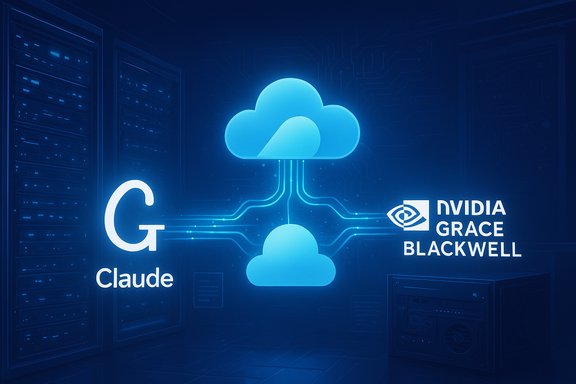
Microsoft, NVIDIA and Anthropic have stitched together one of the largest and most consequential AI alliances of the decade — a three‑way pact that pairs Anthropic’s Claude family of models with Microsoft’s Azure cloud and NVIDIA’s next‑generation hardware, anchored by headline commitments that reshape compute, product distribution and chip‑level co‑design across the industry.
Anthropic emerged as a high‑velocity challenger to existing frontier model vendors by focusing on model safety, large context windows and enterprise readiness. Over the last two years the company has pursued a deliberate multi‑cloud posture — running substantial workloads on Amazon Web Services and Google Cloud while keeping options open for tightly negotiated Azure deployments. The newly announced agreements formalize a much deeper alignment between Anthropic, Microsoft and NVIDIA, converting technical cooperation and commercial experimentation into long‑term commitments and co‑engineering obligations. At a glance, the public headlines are stark:
But the announcement is also a reminder that the current AI landscape is equal parts engineering challenge and industrial logistics problem. Headline numbers ($30B, 1 GW, $10B/$5B investments) convert into value only when executed cleanly through contracts, hardware delivery, systems integration and operational discipline. The technical gains from co‑engineering can be substantial, yet they trade off against portability and concentration risks that enterprises and regulators will scrutinize.
For IT leaders, the practical takeaway is to treat this as both an opportunity and a governance challenge: an opportunity because Claude becomes another production‑grade model inside Azure and Copilot surfaces; a challenge because adopting it at scale means rethinking procurement, model routing, compliance and vendor lock‑in mitigation strategies. The next 12–24 months will reveal how much of the promise turns into measurable business outcomes and how the industry adapts to the new, circular economics of AI infrastructure.
Anthropic, Microsoft and NVIDIA have placed a big bet on mutual dependence: the deal’s public commitments are clear and verifiable in their broad outlines, but the devil is in the execution details and tranche mechanics that remain to be published. Treat the headline figures as strategic signals that require careful contractual and technical follow‑through before declaring the pact a win for customers, investors or the broader AI ecosystem.
Source: TechRound Microsoft, NVIDIA And Anthropic Set Up New Partnership - TechRound
 Background
Anthropic emerged as a high‑velocity challenger to existing frontier model vendors by focusing on model safety, large context windows and enterprise readiness. Over the last two years the company has pursued a deliberate multi‑cloud posture — running substantial workloads on Amazon Web Services and Google Cloud while keeping options open for tightly negotiated Azure deployments. The newly announced agreements formalize a much deeper alignment between Anthropic, Microsoft and NVIDIA, converting technical cooperation and commercial experimentation into long‑term commitments and co‑engineering obligations. At a glance, the public headlines are stark:- Anthropic has committed to purchasing roughly $30 billion of Azure compute capacity.
- The company plans to contract additional dedicated compute capacity up to one gigawatt, a facilities‑scale electrical capacity target used today as shorthand for hyperscale AI deployments.
- NVIDIA has pledged up to $10 billion of staged investment and an engineering partnership. Microsoft has pledged up to $5 billion in investment and will surface Claude variants across Azure’s enterprise tooling.
What the companies announced — the essentials
A large, multi‑layered pact
The alliance is structured across three tightly linked domains:- Capital and commitments: Anthropic’s long‑term Azure spend and the two tech partners’ investment pledges create reciprocal commercial ties that reduce capacity risk for model development and create customer‑and‑supplier circularity.
- Hardware co‑design: NVIDIA and Anthropic will work together on model architecture and low‑level tuning so Claude runs efficiently on Grace Blackwell and the forthcoming Vera Rubin line of systems. This is framed as a model‑to‑silicon engineering partnership, intended to improve throughput, energy efficiency and total cost of ownership (TCO).
- Distribution and product embedding: Microsoft will make Claude models available through Azure AI Foundry and integrate them into the Copilot family (GitHub Copilot, Microsoft 365 Copilot, Copilot Studio), giving enterprise customers an additional frontier model choice inside familiar productivity tools.
Which Claude models are involved
Public product materials name the most recent Claude variants as being part of the Azure rollout: Claude Sonnet 4.5, Claude Haiku 4.5 and Claude Opus 4.1. Microsoft says these will be available in public preview through Foundry and selectable inside Copilot surfaces for enterprise users. Anthropic’s own product pages also describe these model tiers and their intended workload targeting (Sonnet for agentic coding and reasoning, Haiku for lower‑cost high‑throughput scenarios, Opus for highly focused reasoning tasks).The scale: $30 billion and “one gigawatt” explained
Those two figures — $30 billion in Azure purchases and up to one gigawatt of contracted compute — are the most load‑bearing parts of the announcement. They are also easy to misread without context.- $30 billion of cloud spend should be read as a multi‑year reserved consumption commitment. Reserved cloud purchases typically include price guarantees, capacity reservations and allocation windows, and they are often executed over several years with phased billing and delivery. For a model vendor, such an arrangement secures priority access to desirable instance types and rack topologies; for the cloud provider it justifies large capex spend on specialized racks and data‑center expansions.
- One gigawatt is an electrical capacity metric, not a GPU count. One GW of IT load implies multiple AI‑dense data halls with substantial substations, advanced cooling (often liquid cooling at scale), and the networking fabric to stitch thousands of accelerators into tightly coupled training clusters. Turning that electrical headroom into usable GPU or superchip capacity requires months to years of permitting, procurement and staged hardware delivery. The public announcements treat 1 GW as an upper bound for dedicated capacity they may contract as deployments scale, not as immediate on‑day availability.
Why NVIDIA matters here (and what Grace Blackwell / Vera Rubin bring)
NVIDIA is no longer just a GPU vendor — the company now sells integrated systems and rack designs and plays a central role in shaping how frontier models are trained and served.- Grace Blackwell is the generation of NVIDIA systems that combines Grace CPUs with Blackwell GPUs in rack‑level designs optimized for large models. The architecture emphasizes memory bandwidth and rack‑scale coherence to support extremely large context windows and efficient distributed training.
- Vera Rubin (and the Vera CPU / Rubin GPU pairing) was unveiled as NVIDIA’s next wave of systems designed to push further on memory capacity and inference throughput; public presentations describe significant improvements in memory bandwidth and token‑per‑second performance relative to earlier families. Anthropic’s stated intention to target these families means Claude will be tuned to extract performance from NVIDIA’s newest rack topologies.
How Microsoft is placing Claude across its products
Microsoft framed this as an expansion of model choice inside its Copilot stack and Azure Foundry marketplace. Practically this means:- Foundry: Claude Sonnet 4.5, Haiku 4.5 and Opus 4.1 are being offered in public preview for Foundry customers to build production applications and enterprise agents. Foundry deployments will permit serverless and managed patterns that let enterprises use Claude under Azure’s billing and compliance regimes.
- Copilot family: Microsoft will keep Claude inside the Copilot portfolio — GitHub Copilot, Microsoft 365 Copilot and Copilot Studio — allowing organizations to choose Anthropic’s models for tasks like complex research (Researcher agent), code generation and Excel agentic automations. This is a material shift from a single‑provider Copilot strategy to a multi‑model orchestration approach.
Anthropic’s multi‑cloud posture — and its ties to AWS and Google
Anthropic will not be exclusive to Azure. The company has long been a major tenant of AWS (including collaborations around Trainium chips and the Project Rainier UltraCluster), and it has engaged with Google Cloud’s TPU families as well. The Microsoft agreement anchors a large dedicated footprint on Azure, but Anthropic’s strategy remains multi‑cloud — training and some inference will continue on AWS and Google while Azure becomes another major production deployment venue. Important nuance: Anthropic’s AWS relationship includes significant infrastructure projects and investment cooperation (Project Rainier and Trainium2 UltraServers among them). That means Anthropic is simultaneously optimizing for multiple hardware ecosystems — NVIDIA racks on Azure and custom Trainium clusters on AWS — which increases redundancy but raises engineering complexity for model portability and cost optimization.Financial geometry: who pays, who invests, and why
The investment pledges ($10B from NVIDIA, $5B from Microsoft) and the $30B Azure purchase are not purely transactional; they are strategic levers:- Microsoft secures model diversity for Azure and Copilot, and its up‑to‑$5B investment is positioned to deepen product and go‑to‑market ties while preserving its ongoing relationship with other model vendors.
- NVIDIA locks a marquee, model‑scale customer to validate new systems and to justify future product road maps; its up‑to‑$10B investment is both defensive and growth‑oriented.
- Anthropic obtains predictable capacity and capital that can accelerate model development and enterprise distribution at scale; the $30B Azure commitment acts as a guaranteed demand anchor that eases capacity planning and can lower effective per‑token costs when paired with co‑designed hardware.
Strengths and immediate benefits
- Enterprise readiness and choice. Making Claude available across Microsoft Foundry and Copilot surfaces gives enterprises practical, managed pathways to deploy frontier models inside established governance frameworks. This reduces friction and speeds time to production.
- Guaranteed scale for model builders. Anthropic gains prioritized access to capacity and predictable economics that can sustain continued model scaling and rapid iteration. That can shorten the cycle time for new model releases and commercial features.
- Hardware‑software optimization. Joint engineering with NVIDIA can materially improve performance and TCO for production deployments, delivering faster responses, lower latency and lower cost per inference when done well.
Risks, caveats and potential downsides
- Execution risk on industrial scale. Converting a $30B reserved spend and a 1 GW ceiling into working capacity requires multi‑year facility planning — permits, substations, liquid cooling, staged hardware delivery and software integration. Any delay or mismatch in these steps could compress the expected benefits.
- Increased vendor coupling and portability loss. Deep co‑engineering with NVIDIA will yield gains on NVIDIA systems — but it risks making the most‑efficient Claude variants less portable to alternative accelerators (AWS Trainium, Google TPUs), increasing lock‑in for certain deployments. Enterprises that value multi‑vendor flexibility may face new migration costs.
- Market concentration and circularity concerns. The pattern of suppliers investing in customers who then commit to buy from them can inflate apparent demand and valuations, raising questions about sustainable unit economics and whether returns will keep pace with the capital being deployed. Several commentators have used the term “bubble” to describe this environment; that’s a cautionary framing, not a prediction, but the risk merits scrutiny.
- Regulatory and antitrust scrutiny potential. Large, circular cross‑investments and supply commitments among the biggest AI vendors will attract attention from competition authorities and industrial policy makers, especially where they affect market access, pricing or the dynamics of cloud choice for enterprise customers. This is more likely in jurisdictions with active tech oversight.
What this means for enterprise customers and IT decision makers
- More model choice inside Microsoft tooling. Organizations using Microsoft 365, Azure and GitHub now have an additional frontier‑grade model to evaluate inside existing admin and governance controls. That reduces the cross‑vendor procurement overhead for pilots and early production deployments.
- Procurement questions to prioritize. IT leaders negotiating long‑term cloud commitments must clarify SLA terms, geo‑residency, data governance, chargeback mechanics and exit clauses for reserved capacity. A $30B headline is only useful if contracts include sensible protections and transparent pricing mechanics.
- Model routing and governance complexity. Multi‑model orchestration (choosing Claude for some tasks, OpenAI or others for others) increases the need for clear AgentOps practices, data lineage controls and security review processes. Model selection should be a governed choice, not an ad hoc developer toggle.
What to watch next — timelines and verification points
- Tranche details and regulatory filings. The “up to” investment and purchase figures will be executed over time. The market should watch for tranche schedules, any related securities filings, and details that clarify whether the investments include equity, convertible instruments, or preferred financing. Major outlets reported valuation speculation (some pegged Anthropic’s implied valuation near $350 billion), but such secondary estimates should be treated cautiously until official documents appear.
- Data‑center buildouts and GW milestones. Track permits, colocation agreements and Azure data‑center announcements that indicate when the 1 GW allocations begin to convert into usable racks. Expect phased rollouts rather than instant availability.
- Model performance benchmarks and portability testing. Independent benchmarks comparing Claude variants running on NVIDIA Blackwell/Rubin families versus Anthropic’s optimized runs on AWS Trainium or Google TPUs will reveal real tradeoffs between performance, cost and portability. Many of the technical promises hinge on measurable TCO and throughput improvements.
- Contract mechanics for enterprise customers. Watch Microsoft’s Foundry pricing, MACC eligibility, and the practical admin controls that let enterprises enforce data residency and governance when using third‑party models inside Copilot surfaces. The details — not the headlines — will determine enterprise uptake.
Final assessment: a watershed moment — but not a fait accompli
This three‑way alliance is a strategic inflection point for enterprise AI procurement. It bundles compute guarantee, capital support and product distribution in a way that materially reduces short‑term capacity risk for Anthropic and accelerates Claude’s route into Microsoft’s productivity ecosystem, while giving NVIDIA an unusually close co‑engineering partner for its next‑generation systems. Those are powerful advantages.But the announcement is also a reminder that the current AI landscape is equal parts engineering challenge and industrial logistics problem. Headline numbers ($30B, 1 GW, $10B/$5B investments) convert into value only when executed cleanly through contracts, hardware delivery, systems integration and operational discipline. The technical gains from co‑engineering can be substantial, yet they trade off against portability and concentration risks that enterprises and regulators will scrutinize.
For IT leaders, the practical takeaway is to treat this as both an opportunity and a governance challenge: an opportunity because Claude becomes another production‑grade model inside Azure and Copilot surfaces; a challenge because adopting it at scale means rethinking procurement, model routing, compliance and vendor lock‑in mitigation strategies. The next 12–24 months will reveal how much of the promise turns into measurable business outcomes and how the industry adapts to the new, circular economics of AI infrastructure.
Anthropic, Microsoft and NVIDIA have placed a big bet on mutual dependence: the deal’s public commitments are clear and verifiable in their broad outlines, but the devil is in the execution details and tranche mechanics that remain to be published. Treat the headline figures as strategic signals that require careful contractual and technical follow‑through before declaring the pact a win for customers, investors or the broader AI ecosystem.
Source: TechRound Microsoft, NVIDIA And Anthropic Set Up New Partnership - TechRound
