

Microsoft and NVIDIA announced RTX Spark for Windows PCs at Computex 2026, with the Arm-based platform set to arrive this fall in premium laptops and compact desktops from Microsoft Surface, ASUS, Dell, HP, Lenovo, MSI, and later other manufacturers. The announcement is being sold as a turning point for local AI, but the more interesting story is that NVIDIA is finally stepping onto turf long defended by Intel, AMD, Qualcomm, and Apple. Windows is getting another silicon reset, and this one comes with CUDA, RTX graphics, unified memory, and a promise that AI agents will make the PC feel less like a collection of apps and more like a machine that works on your behalf.
For decades, NVIDIA’s role in the PC was both central and contained. It provided the graphics muscle, the CUDA acceleration, the gaming halo, and increasingly the AI credibility, but the CPU platform belonged to someone else. RTX Spark changes that relationship because NVIDIA is no longer merely bolting acceleration onto a Windows PC; it is pitching the whole machine around its own Arm-based compute platform.
That matters because PC history is full of companies trying to redefine the center of gravity. Intel once owned the performance story so thoroughly that “Windows PC” and “x86 PC” felt interchangeable. AMD broke that monopoly on performance-per-dollar and, later, multi-core credibility. Apple then showed what could happen when CPU, GPU, memory, media engines, software frameworks, and industrial design were treated as one product rather than a parts list.
NVIDIA’s argument is different but related. The company is betting that the next premium PC is not defined primarily by spreadsheet speed, battery benchmarks, or even frame rates. It is defined by how much AI work it can run locally, how large a model it can keep in memory, and how comfortably it can move between developer workloads, creative tools, games, and agentic software.
The RTX Spark spec sheet is designed to make that case in one glance. NVIDIA is advertising up to 20 CPU cores, a Blackwell-class RTX GPU with up to 6,144 CUDA cores, up to 128GB of unified memory, and up to 1 petaflop of FP4 AI performance. Those numbers are partly marketing architecture, as all platform launches are, but they also signal the kind of machine NVIDIA wants Windows buyers to imagine: not a thinner gaming laptop, not a workstation squeezed into a backpack, but a local AI box with a keyboard attached.
RTX Spark gives Microsoft a more dramatic object lesson. The Surface Laptop Ultra, presented as the first RTX Spark Windows PC, is the kind of flagship device that makes the strategy legible. It says local AI is not just about background effects in video calls or a few convenience features in Windows; it is about running larger models, accelerating creative pipelines, and giving developers a portable box that can plausibly do work they previously associated with desktops, cloud GPUs, or specialized workstations.
This is why Microsoft’s participation matters more than the Surface badge alone. Surface has often functioned as Microsoft’s stage prop for the Windows ecosystem, a way to show OEMs what the company thinks the platform should become. If the Surface Laptop Ultra is real in the way Microsoft is positioning it, it is less a volume seller than a permission structure for the rest of the market.
The risk, of course, is that Microsoft has been here before. Windows on Arm has had several “this time it’s different” moments, from early Qualcomm-powered always-connected PCs to the more recent Snapdragon X Elite wave. Compatibility has improved, emulation has improved, and native Arm64 software has become more plausible, but Windows users have long memories. They remember the app that would not install, the driver that did not exist, the game that failed because anti-cheat software did not cooperate.
That is why NVIDIA’s reported claim that RTX Spark systems will run the Windows app universe is not a footnote. It is the load-bearing promise. If that promise holds, RTX Spark becomes a credible new high-end Windows lane. If it fails in visible ways, the platform risks being treated as another impressive Arm PC that asks buyers to keep a compatibility checklist in their heads.
That changes the conversation around privacy, latency, cost, and control. A local model does not need to send every prompt to a remote data center. A local coding assistant can work against a private repository without turning every interaction into a governance debate. A local image or video workflow can iterate without waiting on a cloud queue or watching metered tokens pile up.
It also changes the practical expectations placed on a laptop. Memory becomes strategic because local models are hungry. GPU architecture matters outside games because inference and generation are now consumer-facing workloads. Software stacks matter because developers care less about theoretical TOPS than whether their tools, frameworks, drivers, and libraries actually work.
This is where NVIDIA has a genuine advantage. CUDA is not just a feature; it is an ecosystem with years of developer habit behind it. For AI developers, researchers, creators, and technically ambitious users, the ability to run familiar NVIDIA-accelerated workflows on a slim Windows laptop is a more compelling pitch than a generic NPU number.
But that advantage also narrows the real audience. Most Windows users do not need a petaflop-class AI laptop. They need battery life, reliable apps, a good screen, a fair price, and a machine that does not become obsolete when the next model family arrives. RTX Spark’s early value will be clearest for creators, developers, AI experimenters, and professionals who can translate local compute into saved time or avoided cloud spend.
Windows compatibility is not one thing. It is native apps, emulated apps, kernel drivers, plug-ins, enterprise agents, VPN clients, anti-cheat systems, peripherals, old line-of-business software, developer toolchains, and the strange utilities that keep real organizations running. A premium consumer may forgive a missing niche driver. An IT department may not.
This is where RTX Spark enters a different market from Apple Silicon. Apple controlled the hardware transition, the operating system, the developer rules, and the customer expectation that older software might need updates. Microsoft has to carry the whole history of Windows with it. That history is the platform’s strength and its burden.
NVIDIA’s presence helps because the company brings enormous software leverage. If CUDA, RTX, DLSS, Reflex, G-SYNC, TensorRT, and the broader NVIDIA stack behave well on these systems, RTX Spark can feel less like an Arm compromise and more like a specialized Windows machine with a strong reason to exist. The question is whether the rest of the Windows world follows quickly enough.
Gaming will be the sharpest public test. NVIDIA can promise RTX-class graphics and advanced AI features, but Windows gaming is not just a GPU benchmark. It is launchers, anti-cheat systems, mods, controller software, overlays, capture tools, old DirectX titles, and a culture that notices every incompatibility. If RTX Spark laptops are marketed as game-ready, gamers will judge them as gaming PCs, not as elegant proofs of AI strategy.
The named designs also tell us something about positioning. NVIDIA’s own product page points to machines such as ASUS ProArt, Dell XPS, HP OmniBook, Lenovo Yoga Pro, Microsoft Surface Laptop Ultra, and MSI Prestige. These are not bargain-bin systems. They sit in the same psychological aisle as MacBook Pro, mobile workstations, creator notebooks, and executive ultralights.
That is sensible because the first generation of a new platform usually needs margin. High-end buyers are more tolerant of early-adopter pricing if the capability is unusual. Developers and creators are more likely to experiment if the machine solves a real workflow problem. OEMs can use premium chassis, better displays, larger batteries, and improved thermals to keep the first impression from being defined by compromise.
Still, OEM breadth is not the same as market adoption. PC makers have backed plenty of initiatives that later became stickers on boxes rather than durable categories. Ultrabooks mattered because they aligned Intel subsidies, thin-and-light design, SSD adoption, and changing consumer expectations. Netbooks boomed and faded. 3D laptops, VR-ready branding waves, and many “creator” sub-brands left less of a mark than their launch events suggested.
RTX Spark will need more than impressive partner logos. It needs applications that visibly run better because of the platform. It needs Microsoft to make Windows feel coherent on Arm at the high end. It needs NVIDIA’s drivers to be boringly reliable. It needs OEMs to avoid undercooling the silicon in the name of thinness. And eventually, it needs pricing that does not make local AI feel like a luxury science project.
But Apple is not the only target. Qualcomm has been working hard to make Windows on Arm credible with Snapdragon X systems, and those machines already occupy the “efficient Arm Windows laptop” lane. RTX Spark appears aimed above that, with heavier GPU and AI ambitions, but buyers and IT departments will still compare them. If one Arm Windows platform is optimized for battery life and mainstream productivity while another is optimized for CUDA-heavy local AI and RTX graphics, Microsoft has to explain the difference without confusing the market.
Intel and AMD, meanwhile, are not standing still. Both are adding AI acceleration across their client roadmaps, both have deep relationships with OEMs, and both retain the enormous advantage of native x86 compatibility. For many organizations, “runs everything we already have” remains a stronger pitch than “runs the future locally.”
That makes RTX Spark less a guaranteed conquest than a wedge. NVIDIA does not need to replace x86 Windows PCs to succeed. It needs to own the prestige tier of AI-native Windows machines and make developers build for the capabilities it exposes. If that happens, the rest of the ecosystem will adjust around it.
The old Wintel bargain was that Windows ran everywhere and Intel made the best default chip for it. The new bargain Microsoft is exploring is more pluralistic and messier: Qualcomm for efficient Arm PCs, Intel and AMD for continuity and breadth, NVIDIA for local AI and graphics-heavy premium systems. That may be healthier for innovation, but it also makes the Windows buying decision more complicated.
The Surface brand needs that jolt. In recent years, Surface has often seemed trapped between design elegance and performance caution. Microsoft produced beautiful hardware, but the most demanding Windows users frequently bought elsewhere because Surface devices rarely offered the top-end GPU, thermals, or workstation-class options they wanted.
Surface Laptop Ultra gives Microsoft a chance to reclaim the aspirational high ground. If it performs as advertised, it could become the Windows machine that reviewers use when comparing local AI workflows against MacBook Pro and high-end x86 creator laptops. That would be valuable even if the device sells in modest volume.
But the “Ultra” label raises expectations. Users will expect excellent sustained performance, not just bursty demos. They will expect battery life that survives real work, not just video playback. They will expect Windows on Arm to feel invisible. They will expect the premium display, memory, storage, keyboard, ports, and thermals to justify whatever premium price Microsoft attaches.
That is a high bar because Surface buyers are not just buying components. They are buying Microsoft’s own interpretation of Windows. If the first RTX Spark Surface feels like a prototype, the whole platform takes a reputational hit. If it feels like a polished flagship, Microsoft finally has a convincing AI PC story that is not entirely dependent on cloud Copilot.
For consumers, local AI may mean faster creative tools, offline assistants, smarter search, better game features, and less anxiety about sending personal data to remote servers. For developers, it can mean testing models, running agents against code, and prototyping without renting GPU time. For enterprises, it can mean keeping sensitive data closer to the endpoint while still giving workers more capable automation.
The endpoint, however, is not a data center. Heat, battery, noise, and memory limits still matter. A laptop that can run a large model briefly is not the same as a workstation that can sustain heavy inference all day. NVIDIA’s challenge is to turn impressive peak numbers into credible daily workflows.
This is where compact RTX Spark desktops may be just as important as laptops. A small, efficient desktop running personal AI agents 24/7 is less constrained by battery and thinness. It could appeal to developers, small businesses, creators, and enthusiasts who want local AI capacity without building a tower or buying a full workstation.
If the laptop is the symbol, the desktop may be the more honest first home for heavy local AI. Microsoft and NVIDIA appear to understand that, which is why the platform is being framed across slim laptops and small form factor PCs rather than as a single Surface story.
That does not make the claims hollow. It means buyers should read them correctly. RTX Spark’s advertised petaflop figure is a platform signal, not a universal promise that every AI task will run with workstation-like grace. The same is true of RTX 5070-class graphics comparisons that may depend on workload, power envelope, chassis design, and NVIDIA’s software features.
The more serious question is sustained performance per watt. If RTX Spark can run meaningful AI, creator, and gaming workloads while staying quiet and efficient in premium laptops, it will deserve attention. If it mostly shines in staged demos and throttles under mixed real-world use, early adopters will say so quickly.
Battery life is another area where the launch language will need testing. “All-day battery life” can mean very different things depending on whether the user is writing documents, editing 4K footage, compiling code, generating images, running a local LLM, or gaming with RTX features enabled. The first independent reviews will matter more than any keynote slide.
The same skepticism should apply to software readiness. NVIDIA has an extraordinary track record in drivers and developer tools, but first-generation platforms are where edge cases live. Windows users will want to know whether sleep works reliably, external displays behave, docks function, drivers update cleanly, and enterprise management tools see these systems as first-class Windows PCs.
Enterprise adoption will likely begin in targeted groups rather than broad refresh cycles. AI developers, data teams, design departments, and executive technology pilots are natural early candidates. They have clearer use cases and more tolerance for platform novelty.
The harder sale is the general corporate fleet. Most knowledge workers do not need 128GB of unified memory or Blackwell-class graphics. They need secure, manageable, repairable, predictable laptops with long battery life and standard software support. RTX Spark will have to prove that its advantages are not wasted on the majority of employees.
Management tooling will matter as much as raw capability. If RTX Spark systems behave like normal Windows endpoints in Intune, Defender, update rings, compliance reporting, VPN deployment, and peripheral support, IT resistance softens. If they require exceptions and tribal knowledge, they become special-purpose machines.
Security teams will also ask a different set of questions about local AI agents. A more capable endpoint can do more useful work, but it can also automate mistakes faster. Organizations will need policies for model access, data boundaries, prompt logging, local storage, and agent permissions. The AI PC is not just a hardware purchase; it is a governance problem with a nicer screen.
But the category still has to earn its name. An AI PC should not merely be a PC that can run an AI demo. It should enable work that feels meaningfully faster, more private, more capable, or more personal because intelligence is available locally. Otherwise, “AI-first” becomes the next premium sticker in a long line of industry stickers.
For Windows enthusiasts, the most intriguing possibility is that RTX Spark forces the ecosystem to modernize. Developers may have more reason to ship native Arm64 builds. Microsoft may have more reason to polish Windows on Arm at the edges. OEMs may have more reason to design around unified memory, local inference, and sustained GPU compute instead of chasing thinness alone.
For the broader market, the price will decide how revolutionary this feels. If RTX Spark systems arrive as expensive halo devices, they can still influence the industry but will not immediately change everyday PC buying. If the platform scales down over time, it could become a new default for high-performance Windows laptops in the way Apple Silicon became the default for Macs.
That is the long game NVIDIA is playing. The first generation does not have to be perfect, but it has to be convincing enough that developers, OEMs, and buyers believe there will be a second and third generation worth preparing for.
NVIDIA has one of the few software ecosystems strong enough to create that pull. CUDA remains a default language of acceleration in AI and scientific computing. RTX features remain deeply embedded in games and creative tools. DLSS, Reflex, OptiX, TensorRT, and Studio drivers give NVIDIA a stack that users recognize even when they do not understand every layer.
Microsoft’s job is to make Windows the least annoying place to use that stack. That means compatibility, developer tooling, Store policies, driver reliability, PowerToys-level polish, and AI APIs that do not feel like a parallel universe. It also means resisting the temptation to turn every local AI capability into a funnel for cloud subscriptions.
The most compelling version of RTX Spark is not one where Windows simply copies the MacBook Pro. It is one where Windows becomes the more open, more varied, more developer-friendly AI workstation platform, spanning laptops, mini desktops, creator machines, and eventually more affordable systems. That would play to Windows’ historic strength: breadth.
The weakest version is more familiar. A few beautiful premium laptops launch with huge promises, reviews find rough edges, enterprise buyers wait, developers hesitate, and the platform becomes a niche for enthusiasts. NVIDIA and Microsoft have enough leverage to avoid that outcome, but leverage is not execution.
The practical buying calculus is straightforward. If your work already depends on NVIDIA acceleration, local models, creative rendering, or GPU-heavy development, RTX Spark may offer something genuinely new. If your work is Office, Teams, browser tabs, light photo editing, and occasional gaming, the smarter move may be to wait for reviews and second-generation designs.
A few concrete points should guide the first wave of attention:
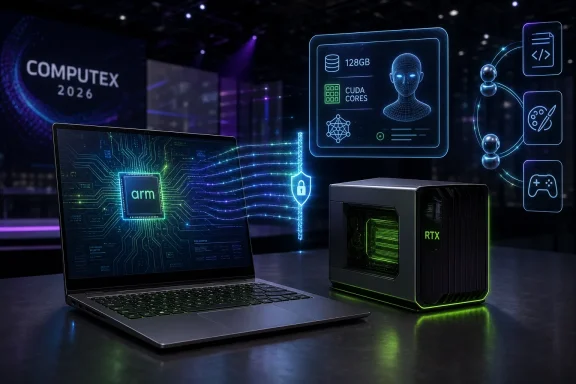 NVIDIA Is Not Just Supplying the GPU Anymore
For decades, NVIDIA’s role in the PC was both central and contained. It provided the graphics muscle, the CUDA acceleration, the gaming halo, and increasingly the AI credibility, but the CPU platform belonged to someone else. RTX Spark changes that relationship because NVIDIA is no longer merely bolting acceleration onto a Windows PC; it is pitching the whole machine around its own Arm-based compute platform.That matters because PC history is full of companies trying to redefine the center of gravity. Intel once owned the performance story so thoroughly that “Windows PC” and “x86 PC” felt interchangeable. AMD broke that monopoly on performance-per-dollar and, later, multi-core credibility. Apple then showed what could happen when CPU, GPU, memory, media engines, software frameworks, and industrial design were treated as one product rather than a parts list.
NVIDIA’s argument is different but related. The company is betting that the next premium PC is not defined primarily by spreadsheet speed, battery benchmarks, or even frame rates. It is defined by how much AI work it can run locally, how large a model it can keep in memory, and how comfortably it can move between developer workloads, creative tools, games, and agentic software.
The RTX Spark spec sheet is designed to make that case in one glance. NVIDIA is advertising up to 20 CPU cores, a Blackwell-class RTX GPU with up to 6,144 CUDA cores, up to 128GB of unified memory, and up to 1 petaflop of FP4 AI performance. Those numbers are partly marketing architecture, as all platform launches are, but they also signal the kind of machine NVIDIA wants Windows buyers to imagine: not a thinner gaming laptop, not a workstation squeezed into a backpack, but a local AI box with a keyboard attached.
Microsoft Gets the AI PC It Kept Trying to Describe
Microsoft has spent the last two years insisting that the PC is entering an AI-first era. The problem is that the first wave of AI PCs often felt like the old PC with a neural processing unit and a new sticker. Copilot+ PCs gave Microsoft a hardware baseline for on-device AI, but the early story was messy: promising silicon, uneven app support, controversial features, and a public that still mostly understood “AI PC” as a branding exercise.RTX Spark gives Microsoft a more dramatic object lesson. The Surface Laptop Ultra, presented as the first RTX Spark Windows PC, is the kind of flagship device that makes the strategy legible. It says local AI is not just about background effects in video calls or a few convenience features in Windows; it is about running larger models, accelerating creative pipelines, and giving developers a portable box that can plausibly do work they previously associated with desktops, cloud GPUs, or specialized workstations.
This is why Microsoft’s participation matters more than the Surface badge alone. Surface has often functioned as Microsoft’s stage prop for the Windows ecosystem, a way to show OEMs what the company thinks the platform should become. If the Surface Laptop Ultra is real in the way Microsoft is positioning it, it is less a volume seller than a permission structure for the rest of the market.
The risk, of course, is that Microsoft has been here before. Windows on Arm has had several “this time it’s different” moments, from early Qualcomm-powered always-connected PCs to the more recent Snapdragon X Elite wave. Compatibility has improved, emulation has improved, and native Arm64 software has become more plausible, but Windows users have long memories. They remember the app that would not install, the driver that did not exist, the game that failed because anti-cheat software did not cooperate.
That is why NVIDIA’s reported claim that RTX Spark systems will run the Windows app universe is not a footnote. It is the load-bearing promise. If that promise holds, RTX Spark becomes a credible new high-end Windows lane. If it fails in visible ways, the platform risks being treated as another impressive Arm PC that asks buyers to keep a compatibility checklist in their heads.
The Real Product Is Local AI, Not Another Premium Laptop
The conventional way to read RTX Spark is as a challenge to Intel, AMD, Qualcomm, and Apple. That is true, but it undersells the more disruptive ambition. NVIDIA and Microsoft are trying to make local AI feel like a normal PC workload rather than a cloud service accessed through a browser tab.That changes the conversation around privacy, latency, cost, and control. A local model does not need to send every prompt to a remote data center. A local coding assistant can work against a private repository without turning every interaction into a governance debate. A local image or video workflow can iterate without waiting on a cloud queue or watching metered tokens pile up.
It also changes the practical expectations placed on a laptop. Memory becomes strategic because local models are hungry. GPU architecture matters outside games because inference and generation are now consumer-facing workloads. Software stacks matter because developers care less about theoretical TOPS than whether their tools, frameworks, drivers, and libraries actually work.
This is where NVIDIA has a genuine advantage. CUDA is not just a feature; it is an ecosystem with years of developer habit behind it. For AI developers, researchers, creators, and technically ambitious users, the ability to run familiar NVIDIA-accelerated workflows on a slim Windows laptop is a more compelling pitch than a generic NPU number.
But that advantage also narrows the real audience. Most Windows users do not need a petaflop-class AI laptop. They need battery life, reliable apps, a good screen, a fair price, and a machine that does not become obsolete when the next model family arrives. RTX Spark’s early value will be clearest for creators, developers, AI experimenters, and professionals who can translate local compute into saved time or avoided cloud spend.
The Arm Question Has Not Gone Away
The most important word in the RTX Spark launch may not be NVIDIA, RTX, Blackwell, or AI. It may be Arm. Windows on Arm has improved enough that dismissing it out of hand is lazy, but it has not improved enough that the issue can be waved away by executive confidence.Windows compatibility is not one thing. It is native apps, emulated apps, kernel drivers, plug-ins, enterprise agents, VPN clients, anti-cheat systems, peripherals, old line-of-business software, developer toolchains, and the strange utilities that keep real organizations running. A premium consumer may forgive a missing niche driver. An IT department may not.
This is where RTX Spark enters a different market from Apple Silicon. Apple controlled the hardware transition, the operating system, the developer rules, and the customer expectation that older software might need updates. Microsoft has to carry the whole history of Windows with it. That history is the platform’s strength and its burden.
NVIDIA’s presence helps because the company brings enormous software leverage. If CUDA, RTX, DLSS, Reflex, G-SYNC, TensorRT, and the broader NVIDIA stack behave well on these systems, RTX Spark can feel less like an Arm compromise and more like a specialized Windows machine with a strong reason to exist. The question is whether the rest of the Windows world follows quickly enough.
Gaming will be the sharpest public test. NVIDIA can promise RTX-class graphics and advanced AI features, but Windows gaming is not just a GPU benchmark. It is launchers, anti-cheat systems, mods, controller software, overlays, capture tools, old DirectX titles, and a culture that notices every incompatibility. If RTX Spark laptops are marketed as game-ready, gamers will judge them as gaming PCs, not as elegant proofs of AI strategy.
OEM Support Gives the Platform a Shot at Scale
One reason this launch feels larger than a Surface experiment is the OEM list. ASUS, Dell, HP, Lenovo, Microsoft, and MSI are all expected to ship RTX Spark systems, with compact desktops also part of the push and additional manufacturers following. That gives the platform a real runway, at least in the premium market.The named designs also tell us something about positioning. NVIDIA’s own product page points to machines such as ASUS ProArt, Dell XPS, HP OmniBook, Lenovo Yoga Pro, Microsoft Surface Laptop Ultra, and MSI Prestige. These are not bargain-bin systems. They sit in the same psychological aisle as MacBook Pro, mobile workstations, creator notebooks, and executive ultralights.
That is sensible because the first generation of a new platform usually needs margin. High-end buyers are more tolerant of early-adopter pricing if the capability is unusual. Developers and creators are more likely to experiment if the machine solves a real workflow problem. OEMs can use premium chassis, better displays, larger batteries, and improved thermals to keep the first impression from being defined by compromise.
Still, OEM breadth is not the same as market adoption. PC makers have backed plenty of initiatives that later became stickers on boxes rather than durable categories. Ultrabooks mattered because they aligned Intel subsidies, thin-and-light design, SSD adoption, and changing consumer expectations. Netbooks boomed and faded. 3D laptops, VR-ready branding waves, and many “creator” sub-brands left less of a mark than their launch events suggested.
RTX Spark will need more than impressive partner logos. It needs applications that visibly run better because of the platform. It needs Microsoft to make Windows feel coherent on Arm at the high end. It needs NVIDIA’s drivers to be boringly reliable. It needs OEMs to avoid undercooling the silicon in the name of thinness. And eventually, it needs pricing that does not make local AI feel like a luxury science project.
Apple Is the Shadow Rival, but Qualcomm Is the Immediate Problem
The obvious comparison is Apple Silicon. NVIDIA is effectively saying that Windows can have its own integrated high-performance architecture with unified memory, powerful graphics, long battery life, and a software stack tuned for modern workloads. That is a direct challenge to the MacBook Pro’s dominance among many developers, creators, and AI-curious professionals.But Apple is not the only target. Qualcomm has been working hard to make Windows on Arm credible with Snapdragon X systems, and those machines already occupy the “efficient Arm Windows laptop” lane. RTX Spark appears aimed above that, with heavier GPU and AI ambitions, but buyers and IT departments will still compare them. If one Arm Windows platform is optimized for battery life and mainstream productivity while another is optimized for CUDA-heavy local AI and RTX graphics, Microsoft has to explain the difference without confusing the market.
Intel and AMD, meanwhile, are not standing still. Both are adding AI acceleration across their client roadmaps, both have deep relationships with OEMs, and both retain the enormous advantage of native x86 compatibility. For many organizations, “runs everything we already have” remains a stronger pitch than “runs the future locally.”
That makes RTX Spark less a guaranteed conquest than a wedge. NVIDIA does not need to replace x86 Windows PCs to succeed. It needs to own the prestige tier of AI-native Windows machines and make developers build for the capabilities it exposes. If that happens, the rest of the ecosystem will adjust around it.
The old Wintel bargain was that Windows ran everywhere and Intel made the best default chip for it. The new bargain Microsoft is exploring is more pluralistic and messier: Qualcomm for efficient Arm PCs, Intel and AMD for continuity and breadth, NVIDIA for local AI and graphics-heavy premium systems. That may be healthier for innovation, but it also makes the Windows buying decision more complicated.
The Surface Laptop Ultra Is a Flagship With a Compatibility Asterisk
Microsoft’s Surface Laptop Ultra is being positioned as the lead device for this new era, reportedly pairing RTX Spark with up to 128GB of LPDDR5X unified memory and a bright mini-LED display. On paper, that sounds like the Surface many power users have wanted for years: not a thin productivity-first laptop with polite performance, but a machine that can credibly serve creators, developers, and AI professionals.The Surface brand needs that jolt. In recent years, Surface has often seemed trapped between design elegance and performance caution. Microsoft produced beautiful hardware, but the most demanding Windows users frequently bought elsewhere because Surface devices rarely offered the top-end GPU, thermals, or workstation-class options they wanted.
Surface Laptop Ultra gives Microsoft a chance to reclaim the aspirational high ground. If it performs as advertised, it could become the Windows machine that reviewers use when comparing local AI workflows against MacBook Pro and high-end x86 creator laptops. That would be valuable even if the device sells in modest volume.
But the “Ultra” label raises expectations. Users will expect excellent sustained performance, not just bursty demos. They will expect battery life that survives real work, not just video playback. They will expect Windows on Arm to feel invisible. They will expect the premium display, memory, storage, keyboard, ports, and thermals to justify whatever premium price Microsoft attaches.
That is a high bar because Surface buyers are not just buying components. They are buying Microsoft’s own interpretation of Windows. If the first RTX Spark Surface feels like a prototype, the whole platform takes a reputational hit. If it feels like a polished flagship, Microsoft finally has a convincing AI PC story that is not entirely dependent on cloud Copilot.
The Cloud AI Backlash Creates an Opening
RTX Spark arrives at a useful cultural moment. Users and companies are increasingly aware that cloud AI is not frictionless. It can be expensive, opaque, privacy-sensitive, latency-bound, and dependent on service availability. The idea of running useful AI locally is no longer a hobbyist fantasy; it is becoming a practical desire.For consumers, local AI may mean faster creative tools, offline assistants, smarter search, better game features, and less anxiety about sending personal data to remote servers. For developers, it can mean testing models, running agents against code, and prototyping without renting GPU time. For enterprises, it can mean keeping sensitive data closer to the endpoint while still giving workers more capable automation.
The endpoint, however, is not a data center. Heat, battery, noise, and memory limits still matter. A laptop that can run a large model briefly is not the same as a workstation that can sustain heavy inference all day. NVIDIA’s challenge is to turn impressive peak numbers into credible daily workflows.
This is where compact RTX Spark desktops may be just as important as laptops. A small, efficient desktop running personal AI agents 24/7 is less constrained by battery and thinness. It could appeal to developers, small businesses, creators, and enthusiasts who want local AI capacity without building a tower or buying a full workstation.
If the laptop is the symbol, the desktop may be the more honest first home for heavy local AI. Microsoft and NVIDIA appear to understand that, which is why the platform is being framed across slim laptops and small form factor PCs rather than as a single Surface story.
Performance Claims Will Meet the Physics Department
The phrase “desktop-class AI performance” is seductive, but the PC industry has abused variations of it for years. Thin laptops cannot escape thermodynamics. Unified memory is powerful, but capacity and bandwidth are not magic. FP4 AI performance is meaningful for certain workloads, but users will still care about real models, real apps, and real response times.That does not make the claims hollow. It means buyers should read them correctly. RTX Spark’s advertised petaflop figure is a platform signal, not a universal promise that every AI task will run with workstation-like grace. The same is true of RTX 5070-class graphics comparisons that may depend on workload, power envelope, chassis design, and NVIDIA’s software features.
The more serious question is sustained performance per watt. If RTX Spark can run meaningful AI, creator, and gaming workloads while staying quiet and efficient in premium laptops, it will deserve attention. If it mostly shines in staged demos and throttles under mixed real-world use, early adopters will say so quickly.
Battery life is another area where the launch language will need testing. “All-day battery life” can mean very different things depending on whether the user is writing documents, editing 4K footage, compiling code, generating images, running a local LLM, or gaming with RTX features enabled. The first independent reviews will matter more than any keynote slide.
The same skepticism should apply to software readiness. NVIDIA has an extraordinary track record in drivers and developer tools, but first-generation platforms are where edge cases live. Windows users will want to know whether sleep works reliably, external displays behave, docks function, drivers update cleanly, and enterprise management tools see these systems as first-class Windows PCs.
IT Departments Will See Opportunity and Another Support Matrix
For sysadmins, RTX Spark is both exciting and inconvenient. Local AI could reduce cloud dependency, improve privacy posture, and enable new workflows for developers, analysts, engineers, and creative teams. It could also introduce another architecture, another driver stack, another set of app compatibility questions, and another premium hardware class to justify.Enterprise adoption will likely begin in targeted groups rather than broad refresh cycles. AI developers, data teams, design departments, and executive technology pilots are natural early candidates. They have clearer use cases and more tolerance for platform novelty.
The harder sale is the general corporate fleet. Most knowledge workers do not need 128GB of unified memory or Blackwell-class graphics. They need secure, manageable, repairable, predictable laptops with long battery life and standard software support. RTX Spark will have to prove that its advantages are not wasted on the majority of employees.
Management tooling will matter as much as raw capability. If RTX Spark systems behave like normal Windows endpoints in Intune, Defender, update rings, compliance reporting, VPN deployment, and peripheral support, IT resistance softens. If they require exceptions and tribal knowledge, they become special-purpose machines.
Security teams will also ask a different set of questions about local AI agents. A more capable endpoint can do more useful work, but it can also automate mistakes faster. Organizations will need policies for model access, data boundaries, prompt logging, local storage, and agent permissions. The AI PC is not just a hardware purchase; it is a governance problem with a nicer screen.
The First RTX Spark PCs Will Tell Us Whether AI PCs Are a Category or a Costume
The launch gives Microsoft and NVIDIA a rare chance to make the AI PC feel concrete. Instead of vague promises about intelligence arriving someday, RTX Spark ties the claim to silicon, memory, graphics, software libraries, and named hardware partners. That is the strongest version of the AI PC argument so far.But the category still has to earn its name. An AI PC should not merely be a PC that can run an AI demo. It should enable work that feels meaningfully faster, more private, more capable, or more personal because intelligence is available locally. Otherwise, “AI-first” becomes the next premium sticker in a long line of industry stickers.
For Windows enthusiasts, the most intriguing possibility is that RTX Spark forces the ecosystem to modernize. Developers may have more reason to ship native Arm64 builds. Microsoft may have more reason to polish Windows on Arm at the edges. OEMs may have more reason to design around unified memory, local inference, and sustained GPU compute instead of chasing thinness alone.
For the broader market, the price will decide how revolutionary this feels. If RTX Spark systems arrive as expensive halo devices, they can still influence the industry but will not immediately change everyday PC buying. If the platform scales down over time, it could become a new default for high-performance Windows laptops in the way Apple Silicon became the default for Macs.
That is the long game NVIDIA is playing. The first generation does not have to be perfect, but it has to be convincing enough that developers, OEMs, and buyers believe there will be a second and third generation worth preparing for.
The Spark That Matters Is Whether Windows Developers Follow
The most durable platform shifts are not created by hardware alone. They happen when developers start assuming the hardware exists. Apple Silicon became powerful not just because Apple shipped excellent chips, but because developers eventually treated Arm Macs as the normal Mac. RTX Spark needs a similar gravitational pull inside the Windows ecosystem.NVIDIA has one of the few software ecosystems strong enough to create that pull. CUDA remains a default language of acceleration in AI and scientific computing. RTX features remain deeply embedded in games and creative tools. DLSS, Reflex, OptiX, TensorRT, and Studio drivers give NVIDIA a stack that users recognize even when they do not understand every layer.
Microsoft’s job is to make Windows the least annoying place to use that stack. That means compatibility, developer tooling, Store policies, driver reliability, PowerToys-level polish, and AI APIs that do not feel like a parallel universe. It also means resisting the temptation to turn every local AI capability into a funnel for cloud subscriptions.
The most compelling version of RTX Spark is not one where Windows simply copies the MacBook Pro. It is one where Windows becomes the more open, more varied, more developer-friendly AI workstation platform, spanning laptops, mini desktops, creator machines, and eventually more affordable systems. That would play to Windows’ historic strength: breadth.
The weakest version is more familiar. A few beautiful premium laptops launch with huge promises, reviews find rough edges, enterprise buyers wait, developers hesitate, and the platform becomes a niche for enthusiasts. NVIDIA and Microsoft have enough leverage to avoid that outcome, but leverage is not execution.
The First Buyers Should Look Past the Keynote
The initial RTX Spark machines will attract exactly the kind of users who like being early: developers, creators, AI hobbyists, Windows loyalists who envy Apple Silicon, and professionals who can justify premium hardware. They should be excited, but not uncritical. This is a first-generation Windows platform with big claims attached.The practical buying calculus is straightforward. If your work already depends on NVIDIA acceleration, local models, creative rendering, or GPU-heavy development, RTX Spark may offer something genuinely new. If your work is Office, Teams, browser tabs, light photo editing, and occasional gaming, the smarter move may be to wait for reviews and second-generation designs.
A few concrete points should guide the first wave of attention:
- RTX Spark is important because NVIDIA is entering the Windows PC processor market with an Arm-based platform built around local AI, RTX graphics, and unified memory.
- The first systems are expected this fall from Microsoft Surface, ASUS, Dell, HP, Lenovo, and MSI, with compact desktops also part of the platform strategy.
- The headline specifications include up to 20 CPU cores, up to 6,144 Blackwell RTX CUDA cores, up to 128GB of unified memory, and up to 1 petaflop of FP4 AI performance.
- The biggest unanswered questions are real-world battery life, sustained thermals, Windows on Arm compatibility, gaming behavior, enterprise manageability, and pricing.
- The Surface Laptop Ultra will matter less as a mass-market product than as Microsoft’s proof that Windows can host a premium local-AI flagship.
- The platform’s long-term success depends on whether developers and software vendors treat RTX Spark as a serious Windows target rather than a novelty.
References
- Primary source: thewincentral.com
Published: 2026-06-02T08:36:07.458836
Loading…
thewincentral.com - Related coverage: axios.com

Microsoft debuts Nvidia-powered Microsoft Surface Ultra laptop
Microsoft is trying again to redefine the PC for the AI era.www.axios.com
- Related coverage: tomshardware.com

Nvidia unveils RTX Spark Superchip for laptops and desktop PCs at Computex 2026 – new platform promises to turn Windows into an agentic AI OS with Arm CPU, Blackwell GPU, and 128GB unified memory
Over 30 laptops and 10 desktops coming this fall with "the most efficent platform ever built"www.tomshardware.com
- Related coverage: windowscentral.com
Loading…
www.windowscentral.com - Related coverage: pcgamer.com
Loading…
www.pcgamer.com - Related coverage: nvidia.com

NVIDIA RTX Spark — Slim Laptops & Small Desktops
The fusion of NVIDIA AI and RTX graphics.www.nvidia.com
- Related coverage: techspot.com
Loading…
www.techspot.com - Related coverage: gizmochina.com

Microsoft announces Surface Laptop Ultra with NVIDIA RTX Spark and its brightest display yet
Microsoft Surface Laptop Ultra launches with 2000-nit display, NVIDIA RTX Spark, 128GB RAM, and big Windows 11 upgrades. www.gizmochina.com
- Related coverage: arstechnica.com

Nvidia RTX Spark comes to Windows PCs with Arm CPU, RTX GPU, and unified memory
Nvidia's new chips will power laptop workstations and mini desktop PCs at first. arstechnica.com
- Related coverage: pcworld.com

Nvidia's RTX Spark chip 'reinvents' laptops for agentic AI
Nvidia launched its RTX Spark platform, "purpose-built for personal agents," in advance of Computex Sunday night, pairing an N1X CPU along with its own Blackwell RTX GPU. Does it reinvent the PC for agentic AI, or is it just another gaming laptop? www.pcworld.com
- Official source: blogs.windows.com

Introducing a powerful new chapter for Windows PCs, accelerated by NVIDIA RTX Spark
Today at NVIDIA GTC, Microsoft and NVIDIA announced the world’s most powerful and efficient thin-and-light Windows PCs ever. Accelerated by NVIDIA RTX Spark blogs.windows.com
- Related coverage: winbuzzer.com
Loading…
winbuzzer.com - Related coverage: techtimes.com

Nvidia RTX Spark Superchip: Windows PC Chip With Full CUDA Stack Targets Dell, Microsoft This Fall
Nvidia RTX Spark Superchip launched at Computex 2026 as Nvidia’s first Windows PC processor, co-developed with Microsoft, pairing a Blackwell GPU with 6,144 CUDA cores and 128 GB unified memory in a thin Windows on Arm laptop. Devices from Dell, HP, ASUS, Lenovo, MSI, and Microsoft Surface are www.techtimes.com
- Related coverage: delltechnologies.com
Loading…
www.delltechnologies.com - Related coverage: nvidianews.nvidia.com
Loading…
nvidianews.nvidia.com