

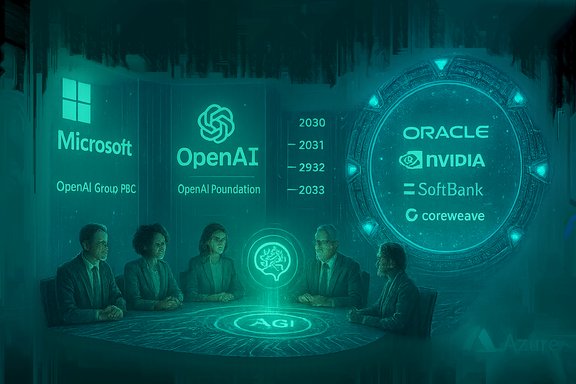
Microsoft and OpenAI have executed a far‑reaching definitive agreement that recasts their decade‑long alliance: OpenAI’s commercial arm is being recapitalized as a Public Benefit Corporation (PBC), Microsoft will hold roughly a 27% stake valued by the companies at about $135 billion, major IP and exclusivity windows have been extended through the early 2030s, an independent expert panel must now verify any declaration of Artificial General Intelligence (AGI), and OpenAI gains the flexibility to diversify compute through a massive infrastructure program known as Stargate while committing very large incremental Azure purchases.
That said, the deal’s true success depends on disciplined implementation: transparent governance of the verification panel, realistic timelines and cost control for the Stargate infrastructure, clear accounting for the headline financial figures, and proactive engagement with regulators and national security stakeholders. The arrangement reframes the race for AI dominance as a combined contest of capital, infrastructure, talent, and governance — not only of algorithms.
Enterprises, developers, and Windows users can feel cautiously reassured about product continuity and future innovation, but they should prepare for increased complexity: multi‑cloud deployments, new procurement paths, and a regulatory environment that is likely to become more intrusive. The next 12–24 months will reveal whether the structural balances struck in this deal deliver the promised benefits without destabilizing the market dynamics they aim to manage.
The partnership has reached a new level — but the hard work of turning headline commitments into reliable compute, safe model deployments, and transparent governance begins now.
Source: Gagadget.com Microsoft and OpenAI have signed a new long-term agreement: the partnership reaches a new level
 Background
How we got here
The Microsoft–OpenAI relationship began with a milestone 2019 investment that deepened into product integrations (notably Microsoft 365 Copilot and GitHub Copilot), preferential cloud arrangements on Azure, and revenue‑sharing and IP mechanisms that underpinned Microsoft’s broader AI strategy. Over the past few years, OpenAI’s appetite for compute, capital, and partner flexibility outpaced a single‑vendor model, prompting negotiations to rebalance exclusivity, governance, and financing while preserving the commercial benefits that made the original partnership strategic for both sides.The public announcements
Microsoft published a joint blog summarizing the “next chapter” of the partnership and disclosed the core terms: support for an OpenAI recapitalization as a PBC, Microsoft’s post‑recapitalization stake (~27% at a post‑deal valuation cited at roughly $135 billion), extended IP windows, an AGI verification mechanism, and a large Azure services commitment by OpenAI. Major outlets including Reuters, The Verge, and financial press corroborated the main headlines and added reporting on the broader Stargate infrastructure program and participant list.Overview of the deal — what materially changed
Corporate structure and valuation
- OpenAI’s operating company has been recapitalized as OpenAI Group PBC, with governance preserved under the nonprofit OpenAI Foundation.
- Microsoft holds an equity position in the newly recapitalized PBC representing about 27% on an as‑converted diluted basis, which Microsoft values at approximately $135 billion. These figures appear in Microsoft’s announcement and were independently reported by multiple outlets.
IP, exclusivity, and time windows
- Microsoft’s IP rights for models and products are extended through 2032 and explicitly include models developed after an AGI declaration, subject to safety guardrails. Microsoft’s research‑category IP (narrowly defined methods used in model development) remains with Microsoft until the earlier of AGI verification by the independent panel or 2030. The agreement expressly excludes OpenAI consumer hardware from Microsoft’s IP rights.
AGI verification: an external gate
- Crucially, any unilateral OpenAI declaration that it has achieved AGI will now be subject to verification by an independent expert panel before AGI‑linked contractual changes (such as exclusivity or IP exit clauses) can take effect. This replaces a previously ambiguous trigger and inserts external evaluation into a milestone with enormous legal and commercial consequences.
Compute, Azure commitments, and the end of raw exclusivity
- OpenAI is reported to have committed to a very large incremental purchase of Azure services (public reporting and Microsoft’s post reference an incremental $250 billion figure), while the explicit right of first refusal or strict exclusivity Microsoft once enjoyed has been replaced with a recalibrated arrangement that allows OpenAI to procure compute from other partners or infrastructure programs.
- OpenAI’s high‑scale infrastructure initiative, Stargate, remains a separate but closely aligned program: a multi‑partner project that aims to deploy gigawatts of AI‑optimized capacity in the U.S. and internationally, with initial participants including Oracle, SoftBank, Nvidia and others. Stargate’s published ambition runs into the hundreds of billions (OpenAI and partners publicly described a $500 billion program over several years).
Product and distribution flexibility
- OpenAI can now jointly develop products with third parties. API products developed jointly will remain exclusive to Azure, but non‑API products may be hosted or distributed on other clouds. OpenAI may also release open‑weight models that meet specified capability criteria, and OpenAI is permitted to provide API access to U.S. national security customers regardless of which cloud they use.
Cross‑checked verification of the most important claims
To make sure the load‑bearing figures and clauses cited above are accurate and not misreported, the key claims were verified across multiple, independent sources:- Microsoft’s official blog confirms the corporate recapitalization, the 27% stake / $135B valuation, 2032/2030 IP windows, and the independent AGI verification mechanism.
- Reuters, The Verge, and major financial outlets reported the public details and repeated the valuation, the AGI verification clause, and the broad Azure commitment while noting differences in some reporting of exact dollar figures and governance mechanics.
- OpenAI’s own communications about Stargate and partner agreements (Oracle, SoftBank) corroborate the infrastructure buildout and its multi‑hundred‑billion scale. Coverage by Reuters, FT, CNBC and SoftBank’s press release confirms site locations and partner roles.
- Internal briefings and forum summaries available in industry datasets likewise describe the same overarching balance between preserved Microsoft product exclusivity and OpenAI’s newfound compute flexibility.
What this means for Microsoft, Azure, and Windows users
For Microsoft: hedging while doubling down
Microsoft preserves durable commercial advantages: extended IP windows, Azure exclusivity for OpenAI API products, and a giant economic stake that aligns its balance sheet with OpenAI’s upside. At the same time, Microsoft’s loss of strict exclusivity on compute and the dilution of control (governance resting with the OpenAI Foundation) means Microsoft has bought a long‑dated option on OpenAI’s economics rather than unconstrained operational control. The deal is a hedge: protect product moats while allowing OpenAI the flexibility it needs to scale compute.For Azure: predictable consumption, but new competition dynamics
The reported incremental Azure commitment provides a predictable, long tail of consumption that Azure’s CFOs and investors will value. But OpenAI’s ability to source training capacity from other partners (Oracle, CoreWeave, CoreWeave’s partners, and Stargate participants) introduces multi‑cloud reality into the equation. Strategically, Azure keeps the higher‑value receive streams (API distribution, enterprise integrations) while opening competition for raw training hours and specialized hardware.For Windows, Office, GitHub and end users
Because Microsoft retains exclusive API rights and extended IP access through 2032, features that rely on OpenAI models — notably Copilot experiences built into Windows, Microsoft 365, and GitHub — are likely to remain differentiated for enterprises and consumers for years. Users can expect the incremental refinement of AI assistants and tighter OS‑level integrations, but the broader market will see more diverse deployment models and alternative model sources appear in third‑party services.Strategic strengths of the deal
- Scale‑aligned flexibility: OpenAI gets the freedom to access thousands of megawatts of compute through Stargate and partner deals, reducing single‑vendor bottlenecks that previously slowed model rollouts.
- Economic alignment: Microsoft’s sizeable stake ties its incentives to OpenAI’s commercial success while preserving product advantages that protect Microsoft’s ecosystem.
- Governance and safety signal: Requiring independent verification for an AGI claim is a governance innovation that could calm some investor and regulator concerns by inserting technical oversight before sweeping contractual triggers are released.
- Product continuity: Enterprises dependent on Azure OpenAI Service and Microsoft Copilot will enjoy legal and contractual continuity for critical integrations, reducing immediate migration risk.
Key risks, caveats, and unanswered questions
1. Regulatory and antitrust exposure
The deal tightens Microsoft’s economic exposure to frontier AI while simultaneously loosening compute exclusivity. That duality could attract regulatory scrutiny: antitrust authorities may assess whether Microsoft’s extended IP windows and preferential API distribution foreclose competition or raise barriers for rival clouds, and national security authorities will scrutinize Stargate and cross‑border infrastructure decisions. Public reporting already highlights political sensitivity around building U.S. AI capacity and national security customers.2. Valuation and financial engineering ambiguity
The headline $135 billion valuation figure and the reported $250 billion Azure purchase commitment are load‑bearing numbers that depend heavily on accounting definitions, payment timing, and contingent mechanics. Independent auditors and regulators will likely want to see the definitive agreements and schedules; investors should anticipate revisions as detailed terms and amortization schedules are disclosed. Several outlets note variance in how these amounts are presented. Treat headline dollar figures as directional until audited filings are published.3. Operational and supplier concentration risks
Stargate is an extraordinary construction program but brings operational risk: building gigawatt‑scale data centers, securing power, chip supply (NVIDIA GB‑series commitments), and qualified labor at scale is nontrivial. Delays, cost overruns, or geopolitical friction (supply chains, export controls) could materially affect OpenAI’s capacity plans and the economic calculus behind the Azure commitments.4. Independent AGI panel composition and authority
An independent panel is only as credible and effective as its membership, mandate, and enforcement powers. The announcement does not fully detail who selects panelists, what technical thresholds they will apply, or how disputes will be adjudicated — all of which are crucial to prevent gaming or legal challenges around an AGI determination. This is a governance gap to watch closely.5. Data, model release, and open‑weight tradeoffs
Allowing open‑weight releases under capability criteria is a welcome nod to research transparency, but it raises difficult operational safety tradeoffs: when and which models are released, how to vet capabilities, and how to handle misuse. The agreement’s broad permissions leave implementation details and safety guardrails to later policy design.Implications for developers, enterprises, and the cloud market
Developers and startups
Startups building on the OpenAI API will see continuity for Azure‑hosted APIs, but the entry of multiple infrastructure partners may lower training costs, enable specialized hardware access, and create new service options. The multi‑cloud shift could open negotiated opportunities but also complicate procurement, compliance, and portability decisions. Microsoft’s extended product IP windows mean deep, long‑term integrations with Microsoft products will remain strategically valuable.Enterprises and procurement
Enterprises should interpret the deal as preserving stability for Microsoft‑centric roadmaps while signaling that OpenAI’s operational footprint will be widely distributed. Procurement teams must map new vendor relationships (Oracle, SoftBank, CoreWeave, etc., reassess SLAs for model availability, and update contractual language for data use, model governance, and national security access where relevant.Cloud competition
This framing shifts the competitive axis from “who hosts the models” to “who captures the distribution, integration, and enterprise control points.” Azure retains privileged API distribution and product IP, but large training capacity can be sourced elsewhere — creating a bifurcated market: hyperscalers and specialized infrastructure providers will compete on raw compute economics, while platform owners compete on product integration, identity, and enterprise channels. Expect increased infrastructure investment by Oracle, Google, AWS partners, and hardware suppliers.Technical and safety considerations
Model scale and compute thresholds
The agreement references compute thresholds for Microsoft‑used models and constraints on AGI‑class uses prior to a verified AGI declaration. These thresholds are described as materially larger than present training runs, which suggests a calculus that ties capability to compute scale. However, compute alone is an imperfect proxy for capability — architectures, data, and training regimen also matter. Oversimplifying AGI triggers to “GPU hours” would be risky; the independent panel’s role must include multi‑factor technical assessment.Open weights and research transparency
OpenAI’s permission to release open‑weight models under capability gating is a constructive move for reproducibility if implemented with robust safety testing. But releasing large weights without coordinated mitigation strategies (watermarking, user access controls, staged rollout) poses misuse risks that regulators and critical infrastructure operators will watch closely.What to watch next — milestones and likely timelines
- Formation and charter of the independent AGI verification panel — members, selection process, and public charter.
- Publication of definitive agreements and financial annexes that clarify the structure of Microsoft’s stake and the schedule/payment mechanics for the Azure commitment.
- Regulatory inquiries or filings (antitrust regulators, national security reviews) that could require remediations or conditional approvals.
- Stargate buildout schedules and early benchmark workloads showing how new capacity actually reduces training timelines.
- Practical product changes in Windows and Microsoft 365 Copilot based on post‑deal model licensing and IP treatments.
Final assessment — pragmatic optimism with guarded realism
This definitive agreement is both evolutionary and transformational. It preserves the core commercial and product advantages that make Microsoft’s AI narrative compelling while giving OpenAI the compute, capital, and partnership flexibility required to accelerate frontier model development. The independent AGI verification clause is an important governance innovation, and the PBC model aims to reconcile mission and market incentives.That said, the deal’s true success depends on disciplined implementation: transparent governance of the verification panel, realistic timelines and cost control for the Stargate infrastructure, clear accounting for the headline financial figures, and proactive engagement with regulators and national security stakeholders. The arrangement reframes the race for AI dominance as a combined contest of capital, infrastructure, talent, and governance — not only of algorithms.
Enterprises, developers, and Windows users can feel cautiously reassured about product continuity and future innovation, but they should prepare for increased complexity: multi‑cloud deployments, new procurement paths, and a regulatory environment that is likely to become more intrusive. The next 12–24 months will reveal whether the structural balances struck in this deal deliver the promised benefits without destabilizing the market dynamics they aim to manage.
The partnership has reached a new level — but the hard work of turning headline commitments into reliable compute, safe model deployments, and transparent governance begins now.
Source: Gagadget.com Microsoft and OpenAI have signed a new long-term agreement: the partnership reaches a new level
