

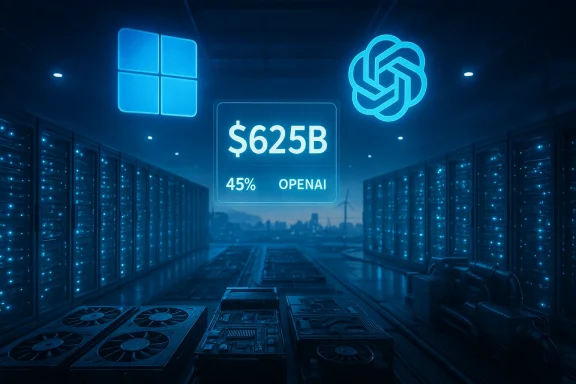
Microsoft’s December quarter left little doubt about one thing: Azure’s future is deeply entangled with OpenAI today, and that entanglement is reshaping Microsoft’s capital plan, product strategy, and investor narrative. The company reported $81.3 billion in revenue for Q2 FY26, a 17 percent year‑over‑year gain, and revealed that commercial remaining performance obligations (RPO) for the cloud have swelled to $625 billion — roughly 45 percent of which Microsoft attributes to OpenAI, a concentration that converts to about $281.3 billion of committed cloud spending tied to one partner. Those numbers helped the market appreciate the scale of Microsoft’s AI bet, but they also crystallized a central strategic risk: Microsoft is more exposed to OpenAI than OpenAI is to Microsoft.
Background / Overview
Microsoft’s second quarter results (quarter ended December 31, 2025) were headline‑driven for three reasons: revenue and earnings beats, record capital spending, and the disclosure of a very large cloud backlog. The company posted $81.3 billion in revenue and $38.5 billion GAAP net income, with an accounting gain tied to OpenAI of about $7.6 billion, reflecting the fallout from OpenAI’s October 2025 recapitalization. Microsoft also disclosed $37.5 billion in capital expenditures for the quarter, reflecting a sustained, multiquarter buildout of datacenter and accelerator capacity to meet AI demand.A defining development in late 2025 was OpenAI’s restructuring into a for‑profit public benefit corporation and Microsoft’s resulting 27 percent equity position in the newly formed OpenAI Group PBC. That deal included a broad commercial relationship — OpenAI committed to purchase large amounts of Azure services — but it also gave OpenAI a freer hand to buy from other cloud providers going forward. The October restructure moved Microsoft from being primarily a financier and preferred partner to being a major equity holder with new contractual rights and limits. Reports at the time valued Microsoft’s stake at roughly $135 billion on the implied valuation, and described a $250 billion Azure commitment tied to that deal.
The Q2 disclosures forced two unavoidable questions: how much of Microsoft’s future Azure revenue is already contracted to OpenAI, and how does that contract geometry affect Microsoft’s massive datacenter spending program and long‑term margin profile?
What the numbers actually say
The headline items (verified)
- Revenue (Q2 FY26): $81.3 billion, up 17% year over year.
- Net income (GAAP): $38.5 billion, boosted in part by a $7.6 billion mark related to Microsoft’s OpenAI investment.
- Microsoft Cloud revenue (Microsoft’s cloud delivery + SaaS): $51.51 billion, up 26% year over year.
- Azure and other cloud services growth (infrastructure and platform): 39% in the quarter.
- Commercial remaining performance obligation (RPO): $625 billion, roughly 45% (≈ $281.3 billion) attributable to OpenAI.
- Quarterly capital expenditures: $37.5 billion, with Microsoft saying roughly two‑thirds of that spend was on short‑lived assets (GPUs and CPUs) while the remainder went to long‑life facilities and finance leases.
How the RPO math plays out
When a company reports a commercial RPO of $625 billion and attributes 45 percent of that to a single customer, the arithmetic is straightforward: 0.45 × $625B = $281.25 billion. Microsoft and its investors are treating that number as a committed stream of cloud consumption over a range of contract durations; CFO Amy Hood told analysts the weighted average duration of the commercial RPO was about 2.5 years, and that roughly a quarter of the balance will be recognized as revenue within 12 months. Those two facts together imply heavy near‑term demand for capacity.But here’s the critical nuance: RPO is a contract accounting metric, not a cash‑collected figure or a guarantee of perpetual revenue. It represents committed future billing under contracts on the books today and — while meaningful — it is subject to change, renegotiation, or reallocation across cloud providers when commercial terms allow. Microsoft’s Q2 commentary emphasized that much of the hardware being purchased has already been sold against long‑dated contract periods, which is management’s answer to concerns about “will you recover this capex over the useful life of the hardware?” Microsoft sells capacity across different time horizons, but that does not eliminate concentration risk.
Asymmetry: Why Microsoft depends on OpenAI more than the reverse
The clearest strategic asymmetry is this: Microsoft reports a significant portion of its contracted cloud backlog tied to OpenAI, while OpenAI — by design and by need — is diversifying where it runs training and inference workloads. The October 2025 restructuring gave Microsoft equity in OpenAI and extended model access through existing contractual terms, but it also freed OpenAI to buy compute from other suppliers. Public reporting since the restructure shows OpenAI using a multi‑vendor compute strategy, engaging with Oracle, CoreWeave, Nvidia‑backed partners, and others for training capacity. That bargaining power and vendor diversity reduce OpenAI’s dependency on Azure the way a single large software consumer could still shift workloads across clouds depending on price, performance, or geographic constraints.This is a classic “who holds the leverage?” problem:
- If Microsoft owes OpenAI capacity (i.e., Microsoft must deliver for its own product roadmap and internal use), Microsoft can redirect internal capacity; but if OpenAI owes Microsoft contracted consumption, Microsoft still bears the infrastructure build cost up front while recognition of revenue happens over time.
- The more Microsoft commits capex and land/power to be Azure‑ready, the more Microsoft’s near‑term cash outlays increase; but if OpenAI or other customers change their consumption mix, Microsoft bears the stranded cost risk — or at least the timing mismatch.
Capex, data centers and the “AI factory” buildout
Microsoft’s $37.5 billion quarterly capex is extraordinary by normal standards; it marks a multiyear, hyperaccelerated buildout of both powered space (real estate and facilities) and short‑lived compute (GPUs/accelerators). Management has stated plans to materially expand AI capacity: Microsoft said it will increase total AI capacity by over 80 percent in FY26 and roughly double its global datacenter footprint over the next two years. That sort of velocity is an operational as well as financial challenge: power contracts, permits, site construction, grid upgrades, and supply chain for accelerators all must keep pace.Key operational points to remember:
- Microsoft capitalizes servers over a six‑year useful life for depreciation, while the weighted average duration of the RPO is around 2.5 years. That mismatch in timing — long depreciation vs. relatively short revenue recognition horizons — is a core investor concern. Microsoft’s management counters that much GPU capacity is already contracted over the useful life of the hardware, and that continuous software and fleet management improve utilization and margin over time. But the mismatch remains material and is a driver of margin and return on invested capital considerations.
- Building power and land capacity is long‑lead; Microsoft is using a mix of owned construction and leases (finance leases were highlighted in the quarter) to accelerate deployment. A significant share of the quarter’s capex was financed through finance leases tied to long‑life assets.
- Short‑lived assets (GPUs/CPUs) are being purchased at scale and will be iterated inside those long‑lived facilities. Microsoft says its GPU allocations for Azure are already reserved out over the useful life of the cards in many large customer deals — another management argument to reduce perceived stranded‑asset risk.
The immediate market reaction and investor calculus
Even with the revenue beat, Microsoft shares dropped on the day of the print because investors were focused on two connected items:- Capex is rising fast, pressuring near‑to‑medium‑term free cash flow and margin expansion; and
- Azure growth, while strong (39 percent), showed slight deceleration sequentially, and the market wants to see the incremental return from the capex materialize into higher and more predictable margins.
- Will the massive capex produce higher gross margins for Microsoft Cloud once capacity is scaled?
- Does the concentration of contracted demand with OpenAI represent a revenue guarantee or a counterparty concentration risk?
- Can Microsoft sustainably monetize first‑party Copilot, Foundry, and other AI services at high enough price points to justify both the capex and the accelerated depreciation of accelerators?
Strengths in Microsoft’s position
- Breadth of monetization channels. Microsoft is not just a hyperscaler; it owns Windows, Office, GitHub, LinkedIn, Dynamics, gaming, and enterprise security — a portfolio that can embed LLM capabilities and drive multi‑product customer stickiness. Microsoft Cloud crossed $50 billion quarterly for the first time, showing broad demand beyond pure infrastructure.
- Deep pockets and integrated sales motion. Microsoft can cross‑sell OpenAI enhanced features across commercial customers (M365 Copilot, security copilots, Foundry) and capture incremental revenue from long‑term enterprise contracts that combine SaaS and infrastructure. Management argues that this integrated strategy improves lifetime value.
- Preferential model/IP access plus equity kicker. Even after the restructure, Microsoft retains extended IP rights and an equity position in OpenAI — a structural arrangement that provides both product advantage and financial upside if OpenAI scales profitably. Those two levers — product integration and capital stake — are powerful in combination.
Risks and downsides
- Concentration risk in contracted backlog. Roughly 45 percent of $625 billion being linked to one partner is a concentration that investors and boards dislike. It exposes Microsoft to a counterparty that has both commercial options to split workloads and a history of rapid strategy shifts. If OpenAI shifts material workloads away from Azure, Microsoft faces timing and utilization risk.
- Timing mismatch between capex depreciation and revenue recognition. Capitalizing servers over six years while recognizing a substantial share of the RPO over ~2.5 years compresses the timeframe to recover spending, particularly if not all contracted revenue flows into gross profit at the expected margins. Microsoft’s management response — that many GPUs are already sold over their useful life — helps, but it does not remove the fundamental mismatch.
- Competition for talent and compute supply. The same cloud and chip vendors Microsoft relies on for GPU and networking capacity (Nvidia, AMD, TSMC, specialized colo providers) are being courted by OpenAI and its other suppliers. OpenAI’s ability to source non‑Azure capacity creates real competition for the same scarce accelerators and hosted megawatts. That can increase Microsoft’s procurement costs and push up industry TCO if capacity supply remains tight.
- Execution risk on global datacenter build. Doubling footprint in two years is operationally daunting. Power procurement, local permitting, and supply chain shocks could delay delivery and increase cost. Microsoft’s finance leases and long‑life land/power investments hedge some of this, but operational bottlenecks remain a live risk.
What the NextPlatform piece got right — and where to be cautious
The NextPlatform perspective (the piece that prompted this analysis) argued that Microsoft is more dependent on OpenAI than vice‑versa, used the public backlog numbers to quantify that exposure, and suggested the OpenAI portion of the backlog is the principal coverage for Microsoft’s datacenter spend. Those are fair points: the reported $625 billion RPO and the 45 percent OpenAI share are non‑trivial facts that anyone should weigh when assessing Microsoft’s AI financing.Where to be cautious:
- NextPlatform — like several other outlets — speculates about the length of time the OpenAI Azure commitment will be recognized and implies that the bulk of the $281 billion will be spent on Azure across seven years (through 2032). That specific temporal distribution is not a public Microsoft disclosure and is thus an assumption rather than a verified fact. Analysts and journalists can estimate recognition curves, but any claim that that entire OpenAI allocation will flow straight into Azure revenues through 2032 must be labeled as speculative unless sourced to contract text or authoritative filings. Treat time‑horizon extrapolations as scenarios, not facts.
- Public statements about OpenAI’s total spending plans (the often‑repeated “$250 billion” Azure commitment or other trillion‑scale numbers tied to OpenAI’s overall planned investment) are derived from the October 2025 restructure reporting and subsequent reporting by journalists. Those headline numbers represent deal architectures and carry caveats — including the possibility of multi‑vendor sourcing and contingent revenue share terms — so they require careful reading before you assume they translate into Azure topline in a fixed way.
Scenarios: How this plays out over the next 24 months
- Best case (Microsoft captures upside): Microsoft executes the datacenter buildout on time, keeps utilization high through a mix of OpenAI contracts and broad enterprise demand, and monetizes Copilot and Foundry effectively. Azure gross margins recover as scale and efficiency improve, and Microsoft converts higher retention into higher LTV. In this scenario, the RPO concentration is a short‑term headline and a long‑term competitive advantage.
- Mid case (balanced outcome): Microsoft builds capacity more slowly than planned, but secures enough recurring enterprise and first‑party consumption to amortize much of the capex. Azure growth stabilizes in the high‑30s, margins are pressured near term but improve over the next 2–3 years, and Microsoft’s equity stake in OpenAI remains a meaningful upside to be realized later.
- Downside (concentration pain): OpenAI shifts a large share of training workloads away from Azure over time, or OpenAI’s commercial cadence slows materially, leaving Microsoft with underutilized capacity and depressed near‑term gross margins. Investor scrutiny re‑intensifies around capex discipline, and Microsoft must show clear economics or slow expansion. This is the scenario markets signaled fear about immediately after the Q2 release.
What Microsoft should do (practical recommendations)
- Increase transparency. Provide more granular disclosure about Azure RPO composition and the duration buckets for large customers. Investors need clarity on how much of contracted backlog is recognized over 12 months, 24 months, and beyond.
- Publish utilization and gross‑margin bridging. Help investors see the arithmetic of capex → capacity → utilization → gross margin over the useful life of the assets (the six‑year depreciation window Microsoft uses). Concrete scenarios would reduce headline surprise.
- Manage supplier relationships strategically. If Microsoft can secure preferential TCO on accelerators and power through longer‑term arrangements, it can maintain a competitive cost advantage even if OpenAI sources some training elsewhere.
- Protect against concentration. Diversify the set of long‑term, large‑contract customers across industries (financial services, healthcare, public sector) so that the cloud backlog is less exposed to any single company’s procurement decisions.
For Windows users, developers, and enterprise buyers: what to watch
- Expect more AI‑first features in Windows and Office that are powered by cloud and model access. Even if you disable Copilot features locally, Microsoft’s product roadmap is increasingly designed around cloud models and subscription monetization. That means the product experience you buy is more tightly bound to Azure AI economics than it used to be.
- For enterprise architects: consider vendor diversification for large scale model training. Organizations that treat AI compute as an operational commodity will likely hedge across providers to avoid vendor lock‑in and to manage latency/geography/policy constraints. Microsoft will remain a core vendor for many customers, but multi‑cloud model strategies are now realistic for the biggest customers.
- For ISVs and partners: Microsoft’s scale and integrated stack remain attractive for building AI‑enhanced offerings, but partner economics and go‑to‑market motions may change as licensing and Copilot tie‑ins deepen. Watch for new partner programs and updated pricing models through FY26 and FY27.
Conclusion
Microsoft’s Q2 FY26 disclosure—$81.3 billion in revenue, $37.5 billion in capex, and a $625 billion commercial backlog with ~45 percent tied to OpenAI—captures the essence of the current AI era: massive opportunity paired with real concentration and timing risks. Management’s case is coherent: build capacity now, monetize with integrated products over time, and hold an equity stake in the platform that creates strategic alignment. The market’s caution is equally rational: this strategy requires flawless execution across construction, supply chain, sales, and productization, and the concentrated nature of the backlog elevates the consequences of any misstep.The simplest, truest takeaway is this: Microsoft is betting the company’s cloud future on AI, and OpenAI is a central — but not an exclusive — engine in that plan. For investors, customers, and partners, the right frame is scenario planning: don’t treat the headline backlog as immutable revenue; treat it as a set of commitments and flex points that will determine Microsoft’s returns over the coming years. The company’s ability to convert that massive — and concentrated — promise into stable, profitable growth will define the next chapter of both Microsoft’s and OpenAI’s stories.
Source: The Next Platform Microsoft Is More Dependent On OpenAI Than The Converse
