

Microsoft Has Been Chasing the Same Assistant for Thirty Years
Microsoft’s assistant problem has never been a shortage of ambition. Bob tried to make the PC feel like a friendly household space. Clippy tried to infer what the user needed from context, often with comic mistiming. Cortana tried to become a cross-device assistant before mobile platforms and privacy realities boxed it in. Copilot, in its many incarnations, has been more useful than those predecessors, but it still mostly waits to be asked.
OpenClaw points at a different model. The idea is not another chat box living inside a ribbon, sidebar, or search pane. It is a persistent system of agents that can watch signals, maintain context, propose work, and eventually perform tasks across a user’s digital life.
That distinction matters because the personal assistant dream was never really about conversation. Users do not need a computer that can make small talk about their calendar. They need one that notices the calendar conflict, drafts the apology, finds a better slot, prepares the briefing document, and asks for approval before sending anything irreversible.
Shahine’s reported framing is revealing: a chief-of-staff agent, an executive-assistant agent, and specialist agents working continuously within Microsoft 365. That sounds less like a feature and more like a new layer of work infrastructure. If Microsoft can make it trustworthy, the assistant becomes an operating model. If it cannot, it becomes Clippy with credentials.
OpenClaw Is Attractive Because It Is Not Polite Software
The conventional enterprise software model is still largely transactional. A user clicks a button, submits a request, opens a file, starts a meeting, or sends a prompt. Even the current wave of AI copilots mostly preserves that rhythm: the human initiates, the machine responds, and the boundary of responsibility remains legible.
OpenClaw is exciting precisely because it blurs that boundary. It is designed around agentic workflows that can persist, observe, and chain actions together. Instead of asking a model to summarize a document, the user can imagine asking a system to keep an eye on an inbox, prepare tomorrow’s priorities, chase an overdue response, and surface only the decisions that actually require judgment.
That is why a Microsoft 365 version is so tempting. Microsoft sits on Outlook, Teams, Word, Excel, SharePoint, OneDrive, Graph, Entra, Defender, Windows, and the administrative control plane that already governs much of corporate computing. No independent assistant startup has comparable access to the raw material of knowledge work.
The open-source nature of OpenClaw adds another accelerant. Microsoft does not have to invent every pattern from scratch, and developers do not have to wait for a polished platform team to bless each workflow. In the old Microsoft, that might have been viewed as chaos. In the AI platform race, it looks like distribution waiting to be organized.
But “not polite software” is also another way of saying “not safely domesticated.” A passive chatbot can hallucinate a bad answer. A persistent agent can hallucinate a bad action.
Nadella’s Virus Analogy Was Blunt, Not Wrong
Satya Nadella’s reported description of OpenClaw-like behavior as a security risk akin to “a virus” sounds harsh until you strip away the rhetoric. A system that runs continuously, ingests untrusted input, holds credentials, interprets instructions, and can act across applications has an attack surface that looks uncomfortably familiar to defenders.
The old malware model was simple enough to explain to executives: malicious code gets onto a machine, persists, phones home, escalates privileges, moves laterally, and performs actions the user did not authorize. An agent framework is not malware by definition, but it can reproduce some of the same operational characteristics in a sanctioned package.
The uncomfortable innovation is prompt injection becoming action injection. If an agent reads email, web pages, documents, chats, and tickets, then every one of those inputs becomes a possible instruction-bearing surface. The security question is no longer only whether the model can distinguish trusted from untrusted text. It is whether the entire runtime can enforce that distinction when a model is under pressure to be helpful.
This is why the Defender guidance quoted in the GeekWire piece lands with unusual force. Treating OpenClaw as untrusted code execution with persistent credentials is not bureaucratic paranoia. It is the minimum sane posture for a tool whose point is to bridge intent and action.
The irony is that Microsoft understands this better than almost anyone. The company spent decades absorbing the lessons of macro viruses, ActiveX, Outlook worms, browser exploits, local admin sprawl, OAuth consent abuse, and identity-based attacks. OpenClaw does not erase that history. It replays it at AI speed.
The Assistant Becomes Real Only When It Gets an Identity
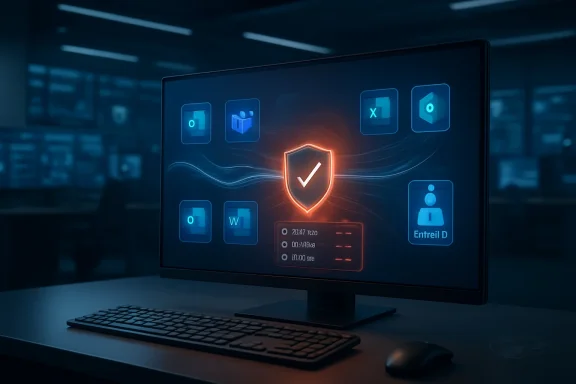
The most important technical detail in Shahine’s reported plan is not the desktop environment. It is the idea that prototype agents could receive their own Microsoft 365 identities, with their own Entra IDs, mailboxes, Teams presence, governance hooks, and Graph integration.
That is the difference between a clever demo and an enterprise architecture. If an agent acts only as a ghost inside a user session, administrators inherit a nightmare. Audit logs blur human and machine behavior. Least privilege becomes wishful thinking. Incident response becomes archaeology.
Giving agents first-class identities does not magically solve the problem, but it makes the problem administrable. An agent can be provisioned, scoped, reviewed, disabled, monitored, and investigated. Its permissions can be narrower than the user’s permissions. Its activity can be separated from the employee’s own actions.
That is also where Microsoft has a structural advantage. Entra, Purview, Defender, Intune, Conditional Access, and Microsoft 365 audit tooling are boring in the best possible sense. They are the machinery through which enterprise IT turns chaos into policy. If OpenClaw-style agents are going to survive outside hobbyist workstations and skunkworks labs, they need to become boring too.
The real bet is that Microsoft can make autonomous software feel like another managed identity class. That is a much less glamorous story than a lobster-riding Ninja Cat, but it is the story that decides whether CIOs permit this thing anywhere near production.
Copilot Tasks and Copilot Cowork Leave a Gap Big Enough for Lobster
Microsoft is not entering agentic work from a standing start. Copilot Tasks moves the consumer Copilot experience toward recurring jobs. Copilot Cowork brings longer-running, multi-step work into Microsoft 365, reportedly with Anthropic technology in the mix. Agent 365 and Entra Agent ID point toward a control plane for the coming sprawl of autonomous software.
Those are serious pieces. They also do not quite add up to the personal assistant many users imagine when they hear the word “agent.”
Copilot Tasks sounds like a scheduled helper. Copilot Cowork sounds like a delegated workbench for business processes. The OpenClaw vision is more intimate and more invasive: a persistent runtime that knows the user’s life well enough to prepare, triage, nudge, and negotiate across personal and professional contexts.
That difference may look subtle in a product grid, but it is enormous in practice. A task system can compile listings every Friday. A coworking agent can draft a plan or run a workflow. A true assistant has to know that the 4:30 p.m. call is a bad idea because a child’s recital starts at 5:30, traffic is terrible, and the meeting can be handled asynchronously.
Microsoft has tried to draw the line between work and life before, often awkwardly. The company sells to enterprises, but Windows PCs and Microsoft accounts live in households too. Outlook contains both board decks and dentist appointments. Teams chats bleed into mobile notifications during dinner. The assistant people actually want is not neatly confined to a tenant boundary.
That is where Lobster becomes strategically interesting and politically dangerous. A Microsoft 365 assistant that never leaves corporate data is easier to secure but less magical. A full-life assistant is more useful, but it forces Microsoft into the hardest questions of privacy, consent, liability, and control.
The Desktop Is Back Because Agents Need a Place to Stand
For years, the industry talked as if the operating system mattered less with every browser tab and cloud service. AI agents are reversing that logic. If software is going to observe context, manipulate applications, coordinate files, and survive across workflows, the desktop becomes valuable terrain again.
That explains why ClawPilot as a Mac and Windows desktop environment matters even if it is still an internal prototype. Agents need surfaces. They need notification channels, credential stores, app bridges, sandbox boundaries, file access rules, and a way to move between local and cloud context. The assistant cannot live entirely in a chat pane if the work it performs spans the machine.
Windows should, in theory, be Microsoft’s natural advantage here. It owns the shell, the application model, the security stack, the enterprise management story, and the developer ecosystem. If Microsoft can make Windows a “fantastic environment” for OpenClaw and other agentic systems, as Shahine reportedly suggested, it could reframe Windows as the agent runtime for work.
That would be a bigger deal than another Copilot button. The question for Windows in the AI era is not whether it can host a chatbot. It is whether it can safely host semi-autonomous actors that operate across applications without turning the PC into an ungovernable mess.
This is also why any Build appearance by OpenClaw-related Windows work would be worth watching. Developers do not need another inspirational keynote about agents. They need primitives: permissions, isolation, activity trails, user-consent models, background execution rules, and ways to make agent actions inspectable after the fact.
The Mascot Is Cute; the Trust Boundary Is Not
The OpenClaw story has the kind of internet-native texture that big companies usually envy from a distance. It has a fast-moving open-source project, a founder with hacker credibility, forced renaming drama, lobster iconography, viral adoption, and now corporate interest from the largest platform companies in AI.
That mythology is useful, but it can obscure the harder truth. OpenClaw is not a productivity toy once it plugs into enterprise identity and Microsoft Graph. It becomes an actor inside the organization.
Actors need constraints. They need rules of engagement. They need revocation. They need logs that are readable by humans and parsable by security tools. They need a way to say, “This instruction came from an email, this decision came from a model, this approval came from a user, and this action was executed by this agent identity at this time.”
Without that chain, the assistant is not an assistant. It is plausible deniability wrapped in automation.
The most serious enterprise buyers will not ask whether the agent can order lunch or reschedule a call. They will ask what happens when it emails confidential data to the wrong person, accepts a malicious calendar invite, follows instructions hidden in a document, or books travel in violation of policy. They will ask who pays when the assistant acts confidently and incorrectly.
That is the gap between a delightful demo and a platform. The demo shows agency. The platform proves accountability.
Microsoft’s Real Competitor Is the Admin Console
It is tempting to frame this as Microsoft versus OpenAI, Microsoft versus Anthropic, or Microsoft versus Google. Those rivalries matter, but the immediate fight is more prosaic. Microsoft must convince administrators that agents can be governed without making every IT department a full-time AI safety lab.
That is harder than shipping features. Enterprise IT already lives under tool fatigue, alert fatigue, compliance fatigue, and licensing fatigue. If every department spins up its own agents, and every agent has its own scopes, prompts, memory, tools, connectors, and exception paths, the resulting sprawl will make SaaS shadow IT look quaint.
Microsoft’s answer appears to be the familiar one: bring the chaos into the tenant, assign identities, govern access, monitor behavior, and charge for the control plane. This is the same basic playbook that turned unmanaged devices into Intune-managed endpoints and ad hoc cloud usage into Azure and Microsoft 365 governance.
The risk is that the agent layer moves faster than the control layer. Open-source agent frameworks can mutate in days. Business users can discover shortcuts faster than security teams can model them. Executives who see a working assistant may demand deployment before the governance story has caught up.
That tension is visible in the reported OpenClaw guidance. On one side, internal Microsoft users are testing a compelling prototype. On the other, Microsoft security guidance reportedly says not to run it on a standard personal or enterprise workstation. Both can be true. In fact, both being true is the whole story.
Personal Assistants Fail When They Are Too Timid or Too Creepy
Every generation of Microsoft assistant has fallen into one of two traps. The timid assistant is safe but forgettable. The creepy assistant is powerful but unwelcome. The winning product has to live in the narrow corridor between them.
Clippy was intrusive without being competent enough to justify the interruption. Cortana arrived in a world where phone ecosystems, smart speakers, and cloud accounts were already contested territory. Copilot is useful, but its safest forms often feel like enhanced search, summarization, or drafting rather than genuine delegation.
OpenClaw’s promise is that it may be competent enough to justify deeper access. That is why the stakes are higher. A system that can prepare your day before you wake up feels magical if it is right and menacing if it is wrong.
The user-experience problem is inseparable from the security problem. A good assistant must know when to act, when to ask, when to wait, and when to explain itself. Those are not merely product-design choices. They are policy decisions expressed through software.
The approval loop will be crucial. If every action requires confirmation, the assistant becomes a nagging workflow engine. If too few actions require confirmation, the assistant becomes an unlicensed employee with bad judgment. Microsoft’s challenge is to build a graduated model of autonomy that ordinary users can understand and administrators can enforce.
Open Source Gives Microsoft Speed and Denies It Control
Microsoft’s embrace of open source is no longer surprising, but OpenClaw tests the limits of that comfort. The company can benefit from a fast-moving community and still be unable to dictate the project’s direction. That is a feature for developers and a complication for enterprise product managers.
Open source also changes the trust equation. Security teams can inspect code, contribute fixes, and build reference patterns. Attackers can do the same inspection for different reasons. The openness that accelerates adoption also accelerates adversarial learning.
For Microsoft, the pragmatic route is not to “own” OpenClaw in the old proprietary sense. It is to make Microsoft 365, Windows, and Azure the best-governed places to run OpenClaw-like agents. The company does not need every agent to be branded Copilot if the agent’s identity, data access, runtime policy, and audit trail all flow through Microsoft infrastructure.
That is a very Microsoft strategy. Let the ecosystem generate variety, then make the enterprise control plane indispensable.
But the company should be careful. Developers can smell a platform tax disguised as safety. If Microsoft overreaches, the open-source agent community will route around it. If Microsoft underreaches, corporate security teams will block the technology outright. The winning move is to make the secure path easier than the reckless path.
The Lobster Test Is Whether It Can Survive Procurement
Internal adoption numbers make for good headlines, but enterprise software becomes real when it survives procurement, risk review, pilot deployment, security exceptions, legal scrutiny, compliance mapping, and the first ugly incident.
That is where Project Lobster’s future will be decided. Not in a demo where an agent gracefully triages a friendly inbox, but in a tenant full of messy permissions, shared mailboxes, stale SharePoint sites, contractors, executives, legal holds, sensitive HR documents, and users who click things they should not click.
The product also has to survive the sociology of the workplace. If an agent sends a follow-up note in your name, is that helpful or weird? If it declines a meeting, who owns the relationship cost? If it drafts a performance review, does the manager become more efficient or less accountable? If an assistant attends to one employee’s needs by creating work for another, whose productivity did it improve?
Microsoft’s pitch will likely lean on augmentation rather than replacement, and rightly so. But agents that operate 24/7 inevitably redistribute labor. They decide what gets attention, what gets deferred, and which requests receive polished machine-generated urgency. In a company already drowning in digital communication, that could either reduce noise or industrialize it.
The personal assistant challenge is therefore not only technical. It is organizational. Microsoft must build an assistant that improves work without making work feel more automated, surveilled, and adversarial.
The Lobster Leaves Microsoft With Five Hard Truths
The OpenClaw effort should be read less as a quirky side project and more as a preview of where personal computing is headed. If the assistant finally becomes real, it will not arrive as a cartoon paperclip. It will arrive as a managed, persistent, identity-bearing actor that sits between users, applications, and policy.
- Microsoft’s OpenClaw experiment is significant because it targets continuous delegation, not just better chat or scheduled prompts.
- Enterprise adoption depends on agent identity, least privilege, auditability, and revocation more than on model quality alone.
- The same persistent access that makes a personal assistant useful also makes it a serious prompt-injection and credential-risk problem.
- Windows could regain strategic importance if it becomes a secure runtime for agentic systems rather than merely a host for AI sidebars.
- Open-source momentum gives Microsoft speed, but enterprise trust will require guardrails that the broader OpenClaw ecosystem may not naturally provide.
- The hardest product question is not whether an agent can act, but when it should act without making the user feel either burdened or bypassed.
Microsoft has spent decades trying to make the PC feel less like a tool cabinet and more like a competent partner, and Project Lobster suggests the company now sees a path that is finally powerful enough to matter. The danger is that a useful personal assistant must be allowed close enough to do damage. If Microsoft can turn OpenClaw’s unruly agency into governed autonomy, it may finally build the assistant it has been promising since the 1990s; if not, the lobster will join Bob, Clippy, and Cortana as another reminder that the future of computing is easy to demo and hard to trust.