

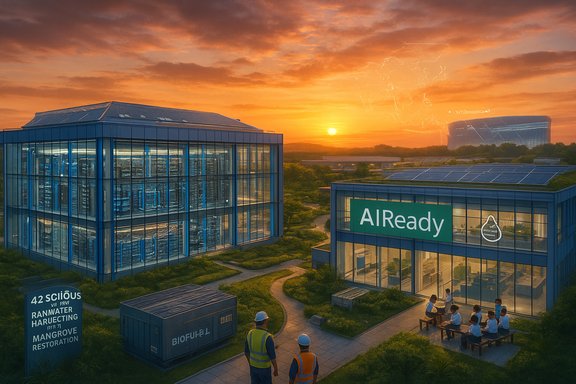
Microsoft’s decision to open a new Azure cloud region in Johor Bahru — announced as the “Southeast Asia 3” region — marks the next phase of an already sizable push into Malaysia and Southeast Asia, expanding on the Malaysia West launch earlier this year and reinforcing the company’s positioning in the race to deliver AI-ready cloud infrastructure across the region.
Background
Microsoft’s announcement frames Southeast Asia 3 in Johor Bahru as a region built for “AI-ready” and data-intensive workloads, intended to serve both Malaysian customers and multinational enterprises operating across Southeast Asia. This new region will sit alongside the Malaysia West cloud region that went live in Greater Kuala Lumpur earlier in 2025, and joins Microsoft Azure’s global footprint, which the company describes as “more than 70” regions worldwide.The Johor project is presented not just as raw capacity, but as a broader package combining infrastructure, sustainability measures, community investments, and skills programs. The technical posture emphasises high-availability designs and low-latency connectivity to Microsoft’s global backbone, while the social and sustainability messaging includes rainwater-harvesting installations for local schools, mangrove restoration work, and training initiatives to build local talent pipelines for datacentre jobs.
This article synthesises the announcement and contemporaneous reporting, confirms key technical and numeric claims where publicly verifiable, and analyses the strategic implications for Malaysia, for regional cloud competition, and for enterprises and governments that will rely on Azure infrastructure in Southeast Asia.
What Microsoft announced
- The Johor Bahru location will be designated as Southeast Asia 3, an Azure cloud region designed to host advanced, data-intensive workloads and to support the region’s AI growth.
- Microsoft positions this as a complement to the earlier Malaysia West region (Greater Kuala Lumpur), expanding capacity and geographic redundancy within the country.
- The Johor region will feature sustainability-focused engineering choices: renewable biofuel-powered backup generators, closed-loop chip-level cooling designed to achieve zero-water evaporation during normal operations, and water-efficiency measures across the campus.
- In parallel to the datacentre build, Microsoft says it will partner with local organisations to install rainwater-harvesting systems across 42 Johor schools, benefitting roughly 20,000 people and conserving an estimated 8.4 million litres annually.
- The company also reiterated its national skilling push in Malaysia under the AIForMYFuture program, which aims to equip Malaysians with AI skills (the target figure is 800,000 people by the end of 2025, and Microsoft reports progress toward that goal).
- The expansion is part of a larger multi-year investment in Malaysia; Microsoft previously committed a multi-hundred-million-dollar to multi-billion-dollar investment program to deepen cloud and AI infrastructure and local capabilities.
Overview: technical design and capacity profile
AI-ready region architecture
Microsoft is positioning Southeast Asia 3 as a “regional-scale” cloud region with the architectural characteristics expected for modern hyperscale AI deployments:- Multiple availability zones and regional network connectivity to reduce latency and provide redundancy for production AI workloads and multinational customers.
- High-density racks and GPU-capable infrastructure to support training and inference at scale, though Microsoft has not published a public per-region GPU count or exact megawatt capacity for the Johor campus.
- Integration into Microsoft’s global backbone network, enabling low-latency connectivity to other Azure regions and services.
Sustainability-focused engineering
Microsoft’s materials and reporting highlight a trio of sustainability interventions that deserve technical scrutiny:- Backup power on renewable biofuel: Using renewable biofuel (versus conventional diesel) for generators can materially lower lifecycle emissions from backup generation, but the net benefit depends on fuel sourcing, supply-chain emissions, and how often generators run. Backup systems are typically for short-duration or emergency use; if they are used for longer periods (for example, due to grid outages), emissions and fuel logistics become more important operational variables.
- Closed-loop chip-level cooling with zero-water evaporation design: A closed-loop liquid-cooling approach that minimizes or eliminates evaporative cooling towers can drastically reduce operational freshwater withdrawal — often a critical metric in water-stressed regions. The claim of “zero-water evaporation” refers to eliminating traditional evaporative cooling losses; in practice, closed-loop systems still require occasional makeup water and careful maintenance, but they are significantly more water-efficient than open evaporative designs.
- Rainwater harvesting and ecosystem restoration: Rainwater harvesting in 42 schools with reported annual conservation of 8.4 million litres and local mangrove restoration represent community-focused mitigation measures that pair infrastructure with local resilience investments.
What Microsoft did not disclose (and why it matters)
- No published megawatt (MW) figure for the Johor campus: Microsoft has not provided public details on site capacity in terms of MW, which is a key metric for data centre scale. Without a disclosed MW number, exact compute density, expected server counts, and prospective customer capacity cannot be precisely estimated from public statements.
- No detailed timeline for full commercial availability: The announcement outlines intent and design but does not publish an exact operational date for the Johor region. For enterprises planning migrations, a lack of firm availability dates complicates migration scheduling.
- No specific service catalogue: Microsoft typically enables its core Azure services in new regions incrementally. The precise subset of Azure services (for example, Azure OpenAI Service, Fabric, or specific VM SKUs) to be available at general availability was not enumerated in the initial announcement.
Community and skills investments
A recurring theme in Microsoft’s approach to new datacentre regions is the combination of infrastructure investment with local community programs. The Johor announcement highlighted several initiatives:- Skills2Work Datacentre Foundations Programme: Training pathways to prepare locals for datacentre operations jobs; Microsoft says the initial cohort target is 150 participants through partnerships with local universities and NGOs.
- Partnerships with UNDP and local social-enterprise networks to upskill trainers and extend impact to thousands of community members.
- Rainwater harvesting installations at 42 schools (estimated to benefit >20,000 people), coupled with training for conservation and maintenance.
Cross-checking the headline claims
Multiple public announcements and industry reporting align on the major claims about the Johor expansion:- Microsoft’s Malaysia West region was launched earlier in 2025 and included three availability zones in Greater Kuala Lumpur.
- Southeast Asia 3 is being developed in Johor Bahru as an additional Azure region to serve regional AI and cloud demand.
- The company has described Azure as operating in “more than 70” global regions.
- The sustainability and community commitments — including renewable biofuel generators, closed-loop cooling, rainwater harvesting for 42 schools, and mangrove restoration — were part of Microsoft’s publicised package.
- The precise water savings figure (8.4 million litres annually) and the beneficiary count (20,000 people) are stated by Microsoft and amplified in reporting. They are plausible when aggregated across 42 schools, but the actual realised conservation will depend on system design, school usage patterns, and local rainfall variability.
- The “zero-water evaporation” phrasing describes an engineering goal tied to closed-loop cooling design. In practice, “zero” is often used as shorthand for eliminating evaporative cooling towers — while closed-loop systems greatly reduce water evaporation, small amounts of makeup water and controlled bleed-off can remain. Treat that claim as an aspirational engineering target rather than a literal guarantee for every operational scenario.
- The duration and frequency of generator use on biofuel will determine the climate and air-quality impacts of on-site backup power. If generators are used frequently to make up for grid shortfalls, the carbon and particulate implications will differ from short, emergency-only runs.
Strategic analysis: why Johor Bahru?
Geographic and commercial logic
Johor Bahru sits at the southern tip of Peninsular Malaysia, with close proximity to Singapore and established subsea and terrestrial network links across the region. Placing a region in Johor provides several advantages:- Regional latency benefits for multinational customers operating across Malaysia, Singapore, and parts of Indonesia.
- Scalable land parcels and cluster development opportunities: Johor has become a focal point for hyperscaler land acquisitions and datacentre campuses, driven by more available brownfield and greenfield sites relative to Kuala Lumpur–area constraints.
- Connectivity to regional fibre and subsea networks, enabling Microsoft to integrate Johor into its global backbone for cross-region traffic and transnational services.
Competitive positioning in Southeast Asia
Microsoft’s Johor push is part of a broader hyperscaler race in Southeast Asia — a region that several providers view as strategically vital for AI services, cloud adoption, and sovereign data-residency requirements. Microsoft’s approach combines physical infrastructure expansion with local skill programs and national-level partnership positioning. The move stakes a claim to:- Enterprise and government customers seeking local data residency and regulated workloads.
- AI platform demand: as regional companies adopt large models and AI services, proximity to GPU-enabled infrastructure becomes a tangible performance and cost lever.
- Differentiation through sustainability: by foregrounding water-efficient and lower-carbon design, Microsoft seeks to address environmental concerns that have become politically salient in the region.
Economic impact and job creation
Microsoft and affiliated economic studies forecast material economic benefits from new cloud regions — including revenue generation in local supply chains and job creation in operations, integration, and cloud services. Those macroeconomic projections should be seen as directional; actual job creation patterns depend on local supply-chain development, partner ecosystems, and whether skill programs transition participants into durable, well-paid roles.Risks and challenges
While the announcement is strategically promising, several risks and practical concerns merit attention:- Water stress and resource trade-offs: Johor and surrounding states have experienced water management challenges. Although closed-loop cooling reduces operational freshwater use, construction use, makeup water needs, and local hydrology still matter. Rainwater harvesting in schools is a positive community measure, but it does not replace the need for broader water governance that addresses municipal and industrial demand.
- Energy and grid resilience: backup generators and biofuel use mitigate outage risks, but grid reliability and the carbon intensity of on-grid power will determine the site’s overall emissions profile. Long generator runs or dependence on non-firm renewables without adequate storage could erode sustainability claims.
- Supply-chain and geoeconomic pressures: hyperscale datacentres for AI rely on high-end accelerators and specialized cooling hardware. Export controls, chip availability, and global competition for GPUs and silicon can affect deployment timelines and service rollout in the region.
- Local stakeholder expectations: community benefits and training programs are helpful but can fall short if promised pathways to employment do not materialise at scale. Sustained local engagement and transparent reporting are necessary to maintain social licence to operate.
- Vendor concentration and market dynamics: more capacity from a single hyperscaler can be positive for digital transformation, but it also concentrates influence. Governments and large enterprises must balance resiliency, vendor diversity, and regulatory requirements as cloud usage increases.
- Verification and transparency: sustainability claims (like “zero-water evaporation” and biofuel usage) require ongoing public reporting and third-party verification to be fully credible. Without continuous disclosure of operational metrics, public trust is harder to maintain.
Practical guidance for enterprises and IT buyers
For organisations evaluating Azure services and planning cloud migrations in Southeast Asia, consider the following practical steps:- Validate service availability for required SKUs and regions. New regions often bring a phased service rollout; confirm the exact Azure services and GPU SKU availability for Southeast Asia 3 before scheduling migrations.
- Plan for hybrid and multi-region resilience. Use availability zones and region pairs to design for high availability; consider multi-cloud approaches for critical workloads that require vendor diversification.
- Incorporate sustainability and compliance metrics into procurement. Ask hyperscalers for transparent operational metrics (water use effectiveness, GHG emissions, uptime statistics) to evaluate true environmental performance.
- Engage with local skilling and hiring pipelines. If local workforce development matters, coordinate with Microsoft’s training initiatives and academic partners to identify talent and transition pathways.
- Watch timeline signals. If project timing affects migrations or product launches, require firm availability dates in contractual discussions or use staged rollouts to avoid schedule risk.
The environmental lens: cautious optimism
Microsoft’s sustainability design choices for Johor — renewable biofuel backups, closed-loop chip cooling, and community water programs — align with industry best practice directions for reducing water intensity and emissions at datacentres. These measures are meaningful and, if implemented and operated transparently, will reduce certain environmental impacts compared with conventional designs.However, the environmental payoff is conditional: real-world outcomes will depend on operational practices, local grid decarbonisation, and rigorous external audits. “Zero-water evaporation” should be read as a design target linked to closed-loop cooling rather than an outright, unconditional guarantee. Independent monitoring and public reporting will be the best clarity mechanism for stakeholders who need to assess sustainability performance over time.
Regional geopolitics and resilience
Cloud infrastructure expansion in Southeast Asia has a geopolitical dimension: national data-residency policies, cross-border flows of regulated data (financial, healthcare, government), and international export controls on advanced semiconductor technology all shape how quickly regions can be provisioned and how customers deploy workloads.For governments and critical infrastructure operators in the region, the Johor announcement underscores two imperatives:
- Policy clarity on cross-border data flows and cloud sovereignty, to ensure that national security and privacy goals are compatible with cloud adoption.
- Investment in local energy and water resilience, so that datacentre growth does not compete deleteriously with municipal resources or create long-term vulnerability.
What to watch next
- Service SKU rollouts and GPU availability in Southeast Asia 3: enterprises will be watching which Azure services and accelerator types arrive first, and whether Microsoft prioritises Azure OpenAI and Fabric services in the region.
- Operational metrics and sustainability disclosures: water usage effectiveness (WUE), greenhouse gas emissions data, and backup generator run hours will be vital signals.
- Workforce transitions: whether Skills2Work and related programs scale into durable employment outcomes for graduates and community members.
- Competitive responses from other hyperscalers and regional cloud providers, which will shape pricing, enterprise bargaining power, and multi-cloud strategies in the region.
Conclusion
Microsoft’s Johor Bahru region announcement is strategically significant: it adds regional capacity tailored for AI workloads, deepens Microsoft’s Malaysia commitment, and pairs physical infrastructure with a set of sustainability and community initiatives. For enterprises, the region promises lower-latency access, in-country data residency, and additional capacity for AI projects. For Malaysia and Johor, the development offers job pathways and community investments — alongside the usual obligations of managing environmental and resource impacts.The technical and sustainability designs are aligned with modern datacentre best practice, but the claims that matter most — water savings, emissions reductions, service availability, and long-term job creation — will only be proven over time through transparent operational reporting and independent verification. In the meantime, organisations planning cloud migrations should treat the Johor region as a compelling option while continuing to verify SKU availability, timelines, and performance SLAs as the region moves from announcement to operation.
Source: capacityglobal.com Microsoft expands cloud presence in Asia with Johor Bahru region - Capacity
