

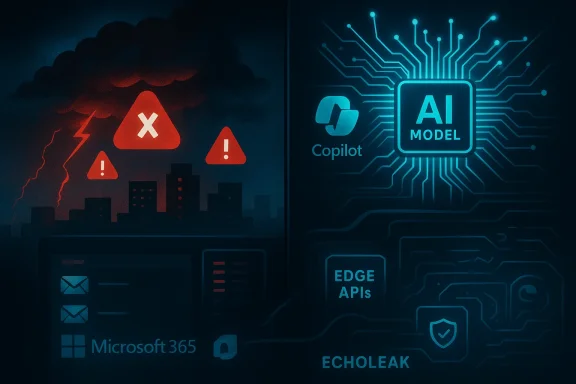
Microsoft’s sudden spike in search and social activity on January 23, 2026 boiled down to two overlapping storylines: an operational incident that disrupted Microsoft 365 and Outlook for large numbers of users, and a concentrated burst of AI‑centric headlines — executive soundbites, model and product launches, and a high‑profile security disclosure — that together created a media and search storm. The outage produced immediate, tangible pain for businesses and individuals; the AI headlines produced debate about strategy, safety and the long‑term direction of Windows and Microsoft’s cloud services. Both threads amplified each other, driving the company back onto the front pages and Google Trends lists.
Microsoft is operating at the intersection of two high‑visibility domains: cloud productivity services (Microsoft 365, Exchange Online, OneDrive, Teams) that every business depends on, and next‑generation generative AI work that touches product strategy, chips and data‑center economics. When a cloud provider’s infrastructure falters it creates immediate operational headlines; when the same provider pushes a bold AI narrative (new models, hardware baselines, assertive executive commentary), it generates technical controversy. The convergence of an outage and an AI news cycle is the textbook recipe for trending status — search engines and social feeds amplify both short‑term outages and sustained narrative arcs about company direction.
Microsoft’s broader context matters. Windows 10 reached end of support in October 2025, accelerating upgrade pressure for many organizations and households. At the same time Microsoft has been promoting an “AI‑first” posture across Windows, Microsoft 365 and Azure, rolling out Copilot integrations, launching Copilot+ PC guidelines, and publishing in‑house models intended for on‑device and server scenarios. That mix of product transition, marketing, and technical change is fertile ground for both excitement and pushback.
For IT professionals and decision makers the takeaways are practical and strategic: treat AI features as part of your attack surface, test outage and recovery procedures now, and evaluate Copilot‑era upgrades by outcome and governance — not by marketing alone. For Microsoft, the challenge is to convert bold AI narratives into consistently reliable, auditable products that earn trust; until then, the company will remain in the spotlight — trending because it moves so many parts of enterprise and consumer computing at once.
Source: LatestLY Why is microsoft Trending in Google Trends on January, 23 2026: Check Latest News on microsoft Today from Google and LatestLY
 Background / Overview
Microsoft is operating at the intersection of two high‑visibility domains: cloud productivity services (Microsoft 365, Exchange Online, OneDrive, Teams) that every business depends on, and next‑generation generative AI work that touches product strategy, chips and data‑center economics. When a cloud provider’s infrastructure falters it creates immediate operational headlines; when the same provider pushes a bold AI narrative (new models, hardware baselines, assertive executive commentary), it generates technical controversy. The convergence of an outage and an AI news cycle is the textbook recipe for trending status — search engines and social feeds amplify both short‑term outages and sustained narrative arcs about company direction.Microsoft’s broader context matters. Windows 10 reached end of support in October 2025, accelerating upgrade pressure for many organizations and households. At the same time Microsoft has been promoting an “AI‑first” posture across Windows, Microsoft 365 and Azure, rolling out Copilot integrations, launching Copilot+ PC guidelines, and publishing in‑house models intended for on‑device and server scenarios. That mix of product transition, marketing, and technical change is fertile ground for both excitement and pushback.
The Outage: What Happened and Why It Mattered
The incident in brief
On January 22–23, 2026 Microsoft acknowledged a service disruption affecting multiple Microsoft 365 services, including Exchange Online (Outlook), SharePoint, OneDrive and several admin and security portals. Many users reported seeing “451 4.3.2 temporary server issue” errors when trying to send or receive mail; telemetry and public status messages indicated a portion of dependent infrastructure in North America was not processing traffic as expected. The problem produced thousands of reports on monitoring services and widespread user complaints.Scale and immediate impacts
The outage was not a localized blip. Downdetector maps and regional reports showed cities across the U.S. and Canada reporting issues, and organizations experienced mail delivery problems, delayed message traces, and disruptions to collaboration tooling and admin portals. For enterprises that rely on timely email and automated alerts, the incident meant lost productivity, missed notifications, and operational friction. For help desks and channel partners the outage created waves of support tickets and pressured incident response processes.Microsoft’s response
Microsoft’s incident updates described identification of an impacted service subset and teams applying traffic‑balancing mitigations to restore normal processing. Most public updates emphasized that mitigation and progressive recovery were underway and, importantly for many tenants, that the company had not (at the time of these messages) reported data loss. That language mattage erodes confidence but is survivable; data loss or persistent service degradation would be far more consequential.Why outages amplify trends
Cloud outages trigger both immediate searches (why is Outlook down? and longer conversations about vendor reliability, vendor lock‑in and contingency planning. Because Microsoft sits at the center of many organizations’ productivity stacks, any visible disruption produces disproportionate news coverage and social chatter — enough to push “Microsoft” onto trending lists by itself. When that outage coincides with other headline threads, the combined effect is exponential.The AI Cluster: Leadership, Models, and Messaging
Executive soundbites that travel
In late 2025 and into January 2026 a series of executive comments attracted attention. Microsoft AI chief Mustafa Suleyman made blunt, widely‑reported remarks about the scale of investment required to remain competitive in frontier AI, warning that the next five to ten years could require “hundreds of billions of dollars” in investment for companies that aim to lead. That quantification reframes AI from a product feature to a capital‑intensive strategic arms race — a message that resonates with business and policy audiences as well as technologists. Multiple outlets captured and repeated the figure, and Suleyman’s tone (and subsequent social posts) created moments that were easy to quote and share. At the same time, CEO Satya Nadella published a widely‑circulated post urging the industry to “get beyond the arguments of slop vs sophistication” — a call to judge AI systems by measurable, real‑world impact rather than demos and spectacle. That framing influenced the debate because it moved the conversation from marketing to engineering and governance. Nadella’s essay was read as a CEO‑level nudge to customers, partners and regulators. Finally, Mustafa Suleyman’s social reaction to consumer backlash over Windows AI messaging — calling some reactions “mind‑blowing” and pushing back against skeptics — became headline copy because it highlighted a tension between executive enthusiasm and user frustration. Those tensions are inherently newsworthy and fuel a trending arc when combined with product announcements and security questions.Product and model moves: Phi‑4, MAI, and Copilot+
Microsoft’s model roadmap — including the Phi‑4 family (with Phi‑4‑mini) and in‑house MAI models — has been positioned to enable both server and on‑device scenarios, emphasizing multimodal inputs and more efficient footprints for PCs and edge devices. Microsoft also announced experimental APIs to expose on‑device models to web apps in Edge, which broadens the reach of oes developer experimentation. Those technical moves generate benchmarking, third‑party comparison and developer curiosity — all of which drive search and conversation. Parallel to model work Microsoft has pushed the Copilot+ PC specification: Windows 11 devices built around an NPU‑enabled baseline optimized for local AI workloads, with OEMs and silicon vendors aligning to ship machines with stronger on‑device acceleration. The Copilot+ narrative reframes PC refresh decisions and ties hardware upgrades to Microsoft’s AI vision — a strategic shift that raises questions about who benefits from the transition and how quickly enterprises should act.The net effect: attention, scrutiny, and skepticism
Executive claims, new models, and hardware narratives attract both enthusiasm and scrutiny. Supporters point to improved responsiveness, privacy benefits for on‑device processing, and lower latency; critics highlight marketing over delivery, poor demos, and the risks of deep platform integration without maturity in governance. The resulting media churn elevates Microsoft in trending feeds because it hits multiple audiences — tech consumers, enterprise buyers, regulators and investors — simultaneously.Security Drama: EchoLeak and the New Attack Surface
EchoLeak — a watershed for AI security
Security researchers disclosed a high‑severity, zero‑click vulnerability dubbed EchoLeak (assigned CVE‑2025‑32711) that showed how agentic AI behaviors combined with retrieval mechanisms (RAG) could be abused to exfiltrate sensitive data without explicit user interaction used prompt injection techniques and metadata vectors to trick Copilot into retrieving and forwarding privilegedeged content. Microsoft issued server‑side mitigations and stated there was no evidence of active exploitation at the time the fix rolled out. EchoLeak crystallized a new class of attack — LLM scope violations — and forced enterprises to revisit threat models for AI‑augmented productivity tools.Why EchoLeak mattered to trending conversations
Security stories travel fast and spike searches because they carry immediate impact for risk managers and admins. EchoLeak reframed AI coverage: the narrative shifted from capability and product launches to safety, governance and the need for auditable controls. That change of angle brought a different set of outlets and commentators into the conversation, broadening the trending signal beyond pureendra.The practical consequence for customers
Enterprises must treat AI components as part of the attack surface. That includes:- Reassessing RAG deployments and retrieval policies.
- Tightening content redaction and link‑resolution controls.
- Applying zero‑trust network segmentation and data‑access minimization for AI agents.
Strategic and Market Implications
Product, partner and upgrade cycles
Windows 10’s end of support on October 14, 2025 created urgency for upgrades. Coupled with Copilot+ messaging and hardware baselines, Microsoft’s product posture pushed many customers to evaluate Windows 11 upgrades and new PCs. That market dynamic turns product marketings into buying signals — and that matters to OEMs, channel partners and enterprise procurement.Regulatory and public policy attention
When executives publicly frame AI as a capital‑intensive race and when an enterprise tool displays a novel security weakness, regulators and lawmakers take notice. Conversations about data residengy consumption and market concentration intensify. Microsoft’s scale means policy decisions affecting it have outsized implications for competitors and partners, which in turn keeps the company in the news.Shareholder and market signals
Executive statements about the scale of investment, plus product rollouts and high‑severity security disclosures, are scrutinized by analysts and investors. When the narrative suggests rising costs (infrastructure, talent, energy) and shifting revenue levers (Copilot monetization, Azure AI ses and research firms respond — adding another vector that feeds trending status. Several analyst and news pieces (echoed in aggregated pages) picked up the “hundreds of billions” framing and the Copilot monetization story.Critical Analysis — Strengths, Risks, and What to Watch
Notable strengths
- Scale and integration: Microsoft controls a full stack — OS, productivity apps, cloud infrastructure and OEM relationships — enabling product continuity that rivals cannot easily match. That integration accelerates feature rollout and creates stickiness.
- **Developer and partner reach: model APIs (Edge) and official Copilot SDKs encourages a broad ecosystem of apps and enterprise extensions, which helps adoption and innovation.
- Operational muscle: Large engineering organizations and global data centers allow Microsoft to patch, mitigate and recover at scale — a competitive advantage in both security and feature deployment.
Key risks and weaknesses
- Operational fragility at scale: Large, distributed systems are complex; a portion of failed infrastructure produced a high‑impact outage. The more services are integrated, the more a single incident can cascade across productivity workflows.
- Perception vs. delivery gap: Aggressive marketing of agentic features outpaces consistent, reliable user experience for many customers. That perception gap fuels backlash and meme culture (e.g., “Microslop”) which can hurt trust.
- New security surfaces: Agentic AI and RAG architectures introduce novel exfiltration paths; EchoLeak illustrates that attacker techniques are adapting quickly to AI behaviors. Fixes are possible, but trust will depend on independent audits, robust redaction and improved threat‑modeling.
What to watch next (short list)
- Independent benchmark and audit reports for Phi‑4 and MAI family models (accuracy, hallucination/hazard rates).
- Microsoft’s published mitigation and hardening guidance for RAG, Copilot agents and on‑device model access.
- Any changes in default behaviors (opt‑in vs opt‑out) for Copilot integrations in Office and Windows.
- Regulatory scrutiny or formal third‑party certification programs for deployed AI assistants.
- Service health progress and post‑incident RCA (root cause analysis) for the January outage.
Practical Guidance for IT Pros and Windows Users
- Audit your Copilot and RAG exposures now. Map which workflows rely on retrieval, external links or agented automation and apply least‑privilege controls.
- Verify your incident response runbooks for cloud service outages. Test failover procedures for mail routing, alerts and external notification channels. Downtime can be managed if preparation is real and tested.
- Balance upgrade timing. Windows 10 end of support removed the security cushion for older devices; but the Copilot+ hardware story does not mean every user needs a new NPU‑equipped machine today. Prioritize devices that must meet compliance and security requirements first.
- Demand auditability. When evaluating Copilot capabilities for the enterprise, ask vendors for measurable reliability metrics, redaction guarantees, and independent verification of mitigations for known vulnerabilities like EchoLeak.
Caveats and Unverifiable Claims
- Some aggregated reports and social posts summarize executive remarks and provide figures that come from interviews or podcasts. Where a direct, published transcript is unavailable, those figures (e.g., “hundreds of billions”) are reported by multiple outlets but should be treated as paraphrase of the speaker’s emphasis rather than a rigorously calculated cost projection. The underlying point — AI at frontier scale is capital‑intensive — is verifiable; the exact dollar figure is an executive framing and not a company budget document.
- Post‑incident technical root cause details published by Microsoft or later independent RCAs should be treated as the authoritative account for the outage. Early public updates describe mitigations and progressive recovery; full technical causation may be documented later in formal post‑mortems. Until that material is published, some technical hypotheses about cascading dependencies should be considered provisional.
Conclusion
Microsoft’s place on Google Trends on January 23, 2026 reflected the collision of immediate operational pain (a Microsoft 365 / Outlook service disruption) with a sustained, high‑stakes narrative about AI: model launches, Copilot hardware positioning, executive headlines about the scale of investment required, and a major AI security disclosure. Each element alone would have been news; together they produced a concentrated wave that search engines, social platforms and news aggregators amplified.For IT professionals and decision makers the takeaways are practical and strategic: treat AI features as part of your attack surface, test outage and recovery procedures now, and evaluate Copilot‑era upgrades by outcome and governance — not by marketing alone. For Microsoft, the challenge is to convert bold AI narratives into consistently reliable, auditable products that earn trust; until then, the company will remain in the spotlight — trending because it moves so many parts of enterprise and consumer computing at once.
Source: LatestLY Why is microsoft Trending in Google Trends on January, 23 2026: Check Latest News on microsoft Today from Google and LatestLY
