Microsoft’s AI leadership is trending not because of a single dramatic event but because several high‑visibility threads converged at once: blunt public remarks from Microsoft AI chief Mustafa Suleyman, a strategic reframing by CEO Satya Nadella that invoked the cultural backlash term “slop,” new in‑house model and on‑device announcements, and a high‑severity security finding that put AI‑centric product behavior under a microscope. Those items — executive soundbites, product rollouts, and a security scare — combined to create a rapid spike in search, social chatter, and industry coverage.
Microsoft positioned AI at the center of its product and corporate strategy across Azure, Microsoft 365, Windows, Edge and developer tools over the last 18–24 months. That broad bet produced steady product news (Copilot features, Copilot+ hardware guidance, and model launches), high‑profile leadership statements, and — in one instance — a security disclosure that exposed how agentic AI behaviors can alter threat models for enterprises. Combined, those developments create a continuous media loop that keeps “Microsoft AI” and the names of its executives in trending lists.
This article explains the specific triggers behind the trend, verifies the technical claims where possible, assesses the strategic strengths and risks for Microsoft and its customers, and offers practical guidance for IT pros and Windows users navigating the next phase of AI in the platform.
The current trend reflects not a collapse of Microsoft’s AI ambitions but a classic pivot point: technical capability has outpaced operational maturity in some places, and the company now faces the task of proving that systems — not just models or demos — deliver reliable, auditable value at scale.
Source: LatestLY Why is microsoft ai ceo Trending in Google Trends on January, 11 2026: Check Latest News on microsoft ai ceo Today from Google and LatestLY
 Background / Overview
Microsoft positioned AI at the center of its product and corporate strategy across Azure, Microsoft 365, Windows, Edge and developer tools over the last 18–24 months. That broad bet produced steady product news (Copilot features, Copilot+ hardware guidance, and model launches), high‑profile leadership statements, and — in one instance — a security disclosure that exposed how agentic AI behaviors can alter threat models for enterprises. Combined, those developments create a continuous media loop that keeps “Microsoft AI” and the names of its executives in trending lists.This article explains the specific triggers behind the trend, verifies the technical claims where possible, assesses the strategic strengths and risks for Microsoft and its customers, and offers practical guidance for IT pros and Windows users navigating the next phase of AI in the platform.
What actually happened — the immediate triggers
1) A visible executive backlash moment: Mustafa Suleyman’s social post
Mustafa Suleyman, CEO of Microsoft AI, posted a blunt reaction on social media after a wave of user backlash to Microsoft’s “agentic OS” messaging. He expressed astonishment that people would be unimpressed by modern conversational and generative AI, using the phrase that the reaction was “mind‑blowing” and calling out what he described as widespread cynicism. That post circulated widely and was quoted and summarized across mainstream tech outlets. Why this matters: Suleyman is the public face of Microsoft’s consumer AI push (Copilot, Bing, Edge and related experiences). When the head of a major vendor publicly frames skeptics as “cynics” it escalates the media narrative because it signals confidence — and possibly tone‑deafness — at the same time. That contrast between executive enthusiasm and user frustration is inherently newsworthy.2) Satya Nadella’s strategic nudge — “get beyond the arguments of slop vs sophistication”
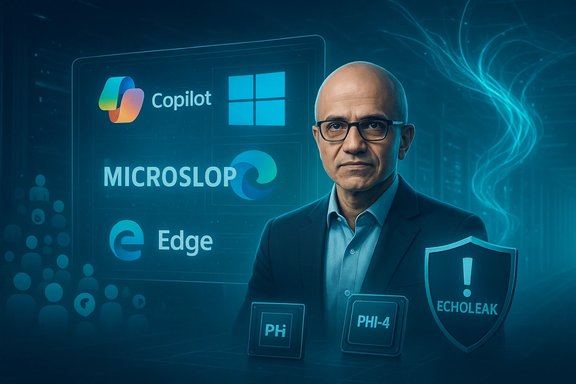
Satya Nadella published an essay on his personal sn scratchpad page urging the industry to move from spectacle to substance and to “get beyond the arguments of slop vs sophistication.” The timing amplified the reaction because “slop” had already become a cultural shorthand (Merriam‑Webster’s 2025 Word of the Year) for low‑value AI output. Nadella reframed the problem as an engineering and governance challenge: models → systems, orchestration and measurable real‑world impact. Why this matters: a CEO‑level intervention reframing the debate becomes a signal to enterprise customers, regulators and media that Microsoft expects AI to be judged by real‑world outcomes rather than demo moments. That provoked both policy and cultural responses — including the mocking meme “Microslop,” which aggregated disparate complaints into a single viral label.3) A high‑severity AI security finding — EchoLeak (CVE‑2025‑32711)
In mid‑2025 security researchers disclosed a zero‑click prompt‑injection style exploit, widely reported as “EchoLeak,” which Microsoft attributed to a prompt‑injection/LLM scope violation in Microsoft 365 Copilot. The flaw carried a critical score and Microsoft issued server‑side mitigations; public reporting says there’s no evidence of active exploitation. Multiple independent outlets documented the technical mechanics (hidden prompts in documents or metadata, RAG pipelines being tricked into exfiltration) and assigned the CVE ID CVE‑2025‑32711. Why this matters: EchoLeak reframes AI from a feature conversation to a security one. When an assistant embedded in productivity software can be induced to leak internal data, enterprises and security teams suddenly prioritize threat analysis, telemetry, and the operational readiness of AI features — and that generates both headlines and examination of the product roadmap.4) Product and model telemetry: Phi‑4 family and Microsoft’s MAI models
Microsoft Research published Phi‑4 family technical reports (including Phi‑4‑Mini and multimodal variants) and Microsoft announced first‑party MAI models intended to reduce reliance on third‑party models in Copilot experiences. The Phi‑4 line is explicitly constructed for multimodal use and for deployment across cloud and edge environments; on‑device SLM work (Phi‑4‑mini and derivatives) was highlighted as a path to faster, privacy‑minded assistant features. Those model announcements generated developer experimentation, benchmarks and additional coverage — all of which increase visibility. Why this matters: model launches are inherently newsworthy, but they are magnifiers when they coincide with executive soundbites and a security story. New models invite benchmark comparisons, pricing questions, and speculation about vendor independence from partners and competitors.Timeline: how the pieces interacted to produce a trend
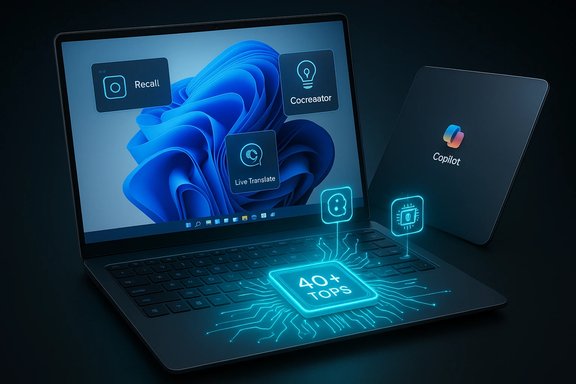
- Microsoft accelerates Copilot feature rollouts and publishes device‑level guidance (Copilot+ class, NPU performance targets), increasing product exposure and user touch points.
- Analysts, hands‑on reviewers, and community testers reproduce reliability and hallucination problems in some Copilot surfaces; those reports appear in outlets such as The Verge and hands‑on community threads.
- Social reaction solidifies around the term “slop,” already a mainstream cultural reference after Merriam‑Webster’s 2025 choice; users and creators craft the meme “Microslop” to lampoon perceived low‑quality integrations.
- Suleyman publicly pushes back on the critics (calling them “cynics” / “mind‑blowing”), Nadella posts his systems‑first essay, and the EchoLeak disclosure circulates — the overlapping timeframe creates a high concentration of search and social queries.
Critical analysis: strengths, commitments and strategic leverage
- Microsoft’s scale is a real advantage. The company operates from an integrated stack — Azure compute, Microsoft 365 distribution, Windows reach and a massive enterprise sales engine — that can drive adoption and build product economics that few competitors can match. The shift to proprietary models (MAI family) reduces licensing risk and creates vertical integration advantages.
- The models → systems framing is pragmatic. Nadella’s emphasis on orchestration, memory, entitlements and tool safety matches sound engineering practice for productionizing probabilistic components at scale. This viewpoint recognizes that raw model capability does not equal dependable product utility.
- Rapid productization and on‑device work (Phi‑4‑mini, Edge on‑device APIs) are technically sensible. Smaller, efficient multimodal models reduce latency and privacy exposure for many use cases, and they enable features on lower‑power devices. Microsoft Research papers and platform announcements back this direction.
- The company has the economic firepower to invest where competitors cannot, which supports long runway for reliability engineering, datacenter expansion, and model research — crucial when Sundry security and governance issues require sustained attention.
Risks, missteps and open questions
- Messaging and optics risk: when executives publicly dismiss wide‑ranging user complaints as mere cynicism, it raises reputational risk. Tone matters: apparent defensiveness or disconnection from user pain points can crystallize into long‑lasting brand damage (as happened with the “Microslop” meme).
- Operational security and RAG risks: EchoLeak demonstrates how Retrieval‑Augmented Generation (RAG) pipelines and agentic behaviors open new attack surfaces. Traditional security tools and controls are not sufficient; enterprises must consider model‑aware threat detection and tighter isolation of untrusted inputs. The technical disclosures show prompt injection through metadata and hidden prompts can be weaponized against assistants.
- Product reliability vs. pace: Microsoft’s very public cadence of feature launches — Copilot integrations across many surfaces — increases the chance that imperfect implementations will be exposed to millions of users. When marketing demos set expectations higher than the practical, repeatable experience, backlash accelerates and trust degrades. Independent hands‑on reviews have already reported brittle or inconsistent behavior in certain Copilot features.
- Concentration and competition: Suleyman’s remark about the scale of investment and Nadella’s emphasis on systems both signal a capital‑intensive trajectory. That invites regulatory and policy scrutiny about dominant players controlling critical compute, talent and data pathways — particularly when mission‑critical enterprise workflows rely on the same providers.
- Unverified or evolving claims: Some corporate usage metrics and certain internal assertions (for example, adoption numbers or precise economic outcomes of Copilot deployments) are proprietary or aggregated. Those should be treated cautiously until confirmed by independent audits or regulatory filings.
What this means for Windows admins, IT leaders and regular users
Short checklist (practical steps)
- Review Copilot and AI feature enablement policies in tenants. Treat early‑access or experimental Copilot features as opt‑in until they meet your reliability and governance standards.
- Apply principle of least privilege to RAG sources: isolate untrusted content and prevent automatic ingestion of external metadata into privileged contexts. EchoLeak-style attacks exploit trust boundaries in retrieval pipelines.
- Require audit trails and observability for AI agent actions in production. If an assistant can take actions (edit files, send messages, call APIs), that activity needs to be logged, reversible, and subject to RBAC constraints.
- Pressure vendors for measurable SLAs and third‑party audits. Nadella’s own public posture calls for measurable “real‑world eval impact”; request the metrics and independent proofs that demonstrate those claims in your context.
- Start low‑risk pilots for on‑device or local inference patterns to reduce egress and RAG sensitivity, while building a return‑on‑value case for broader rollout. Phi‑4‑mini and on‑device APIs are explicitly designed for such scenarios.
Longer‑term governance items
- Establish a cross‑functional AI risk committee that includes security, legal, privacy and product representatives.
- Require red‑team testing specifically for prompt injection, metadata attacks and agentic exploitation.
- Design staging environments that mirror production retrieval contexts to surface RAG perimeter failures before rollout.
- Negotiate contractual protections around data residency, audit access, and incident response timelines for AI features.
Strategic implications for Microsoft and the market
- Microsoft’s integration strategy — embedding Copilot across Windows and Microsoft 365 and building in‑house MAI models — is a deliberate bet to capture both the infrastructure and product revenue associated with generative AI. If Microsoft can translate model capability into dependable systems that produce measurable outcomes, it stands to reap large enterprise economics.
- The immediate reputational headwind (Microslop, social backlash) is a solvable engineering and product problem — provided the company leans into transparency, governance, and measured rollouts. Overconfidence in messaging, or an apparent dismissal of legitimate UX complaints, will prolong the controversy and could slow enterprise procurement cycles.
- The EchoLeak incident is a cautionary tale for all providers: AI integration multiplies the attack surface. Expect increased regulatory and audit interest, especially from enterprise customers in regulated industries. Vendors that demonstrate robust, independently verifiable security practices will have a competitive advantage.
Verifications and cross‑checks performed
- EchoLeak/CVE: Verified across multiple independent reports and security writeups documenting the zero‑click prompt injection behavior and the CVE attribution. The vulnerability carried high severity and Microsoft performed server‑side mitigations; no confirmed exploitation in the wild was reported publicly.
- Phi‑4 family & Phi‑4‑mini: Confirmed in Microsoft Research technical reports and product coverage describing on‑device and multimodal goals for Phi‑4 variants. Edge announced experimental APIs to expose on‑device model capabilities to web apps.
- Nadella’s “slop” framing: Confirmed via the CEO’s sn scratchpad post dated Dec 29, 2025 and corroborated by multiple outlets parsing the messaging and timing alongside Merriam‑Webster naming slop as Word of the Year.
- Mustafa Suleyman’s post and tone: Verified across multiple mainstream outlets that quoted his social post and summarized the language (calling critics “cynics,” expressing astonishment). Independent reporting captured the X post text and the surrounding context of Windows AI backlash.
Bottom line — why “Microsoft AI CEO” is trending right now
The trend is the visible result of a high‑concentration of attention vectors: leadership soundbites that made easy headlines, product and model announcements that invited technical comparison, and a security disclosure that reframed the public conversation around risk. Each element alone would generate coverage; together they created a concentrated burst of search queries, social memes, and industry analysis. Microsoft has the engineering depth and economic scale to make the agent‑first vision work, but the company must now demonstrate that its systems can be audited, secured, and consistently useful — or risk losing the social license that Nadella explicitly acknowledged.What to watch next
- Independent benchmark and audit reports for Phi‑4 and MAI models (accuracy, hallucination rates, RAG safety).
- Microsoft’s follow‑up on EchoLeak mitigations and any published security hardening guidance specifically for RAG and agentic flows.
- Product rollout cadence and whether Microsoft changes defaults or opt‑in behavior in Copilot surfaces as a response to the backlash.
- Regulatory interest and vendor commitments to third‑party audits or certification programs for deployed AI assistants.
The current trend reflects not a collapse of Microsoft’s AI ambitions but a classic pivot point: technical capability has outpaced operational maturity in some places, and the company now faces the task of proving that systems — not just models or demos — deliver reliable, auditable value at scale.
Source: LatestLY Why is microsoft ai ceo Trending in Google Trends on January, 11 2026: Check Latest News on microsoft ai ceo Today from Google and LatestLY