

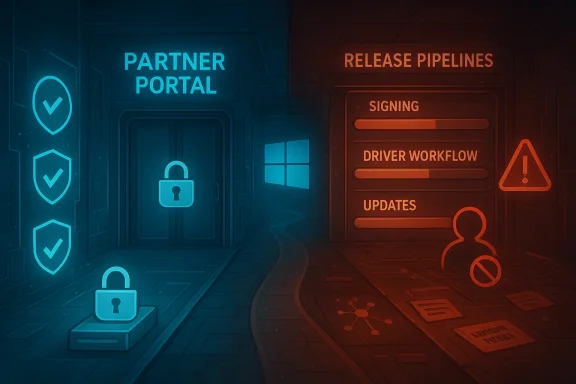
Microsoft’s latest security hardening drive has collided with one of the most sensitive parts of the Windows ecosystem: the developers who build the tools people rely on to protect themselves. Reports indicate that accounts tied to VeraCrypt, Windscribe, WireGuard, and other Windows software projects were suspended inside Microsoft’s partner systems, leaving maintainers temporarily unable to ship updates or manage driver-signing workflows. That is more than an administrative inconvenience; for security software, a broken developer pipeline can quickly become a user-facing protection problem. The episode is also a reminder that in modern platform governance, security enforcement without resilient appeals and support can itself become a security risk.
Microsoft has spent the last year tightening identity and access controls across Partner Center and the broader Windows developer ecosystem. The company publicly announced mandatory account verification for the Windows Hardware Program in October 2025, warning that partners who failed verification would face rejection and suspension, and it later updated that notice to say that accounts that did not successfully complete verification were suspended from the program. Microsoft’s own documentation also states that the Hardware Developer Program covers hardware submissions, code signing, and driver distribution, meaning any access disruption can block release pipelines that depend on Microsoft-managed signing and certification.
That context matters because Windows security tooling often lives in the same administrative lanes as drivers, signing certificates, and program enrollment. Microsoft’s current verification guidance says the Hardware Developer program is part of the developer-program umbrella, and that if verification is not completed and authorized, many Partner Center functions become inaccessible. In plain terms, a business can be fully legitimate and still lose access to the same machinery it needs to ship updates if the account status changes or the verification state becomes invalid.
The concern intensified after developers publicly said they were suspended without notice and had trouble reaching a human at Microsoft. That narrative runs directly into Microsoft’s own published process, which says verification notices should be sent to a monitored primary contact and that support should be available through documented escalation paths. The gap between the official process and reported developer experience is where this story becomes more than a routine compliance event; it becomes a trust issue for the Windows ecosystem.
There is also a structural reason these suspensions draw so much attention. VeraCrypt is a disk-encryption tool, Windscribe is a VPN service, and WireGuard is a modern VPN protocol and implementation used widely by consumers and enterprises. These are not casual apps that can wait a week for a hand-wave from support. Their users expect security, continuity, and timely fixes when Windows updates or policy changes break compatibility. When the account layer fails, the risk is not only delayed patching; it is the possibility that millions of users sit on stale binaries longer than they should.
The story also lands in a climate of fatigue. Windows users have already spent months debating Microsoft’s AI pushes, UI churn, and recurring rough edges in system management. In that environment, a sudden suspension involving security software feels less like a narrowly targeted compliance action and more like evidence that the platform’s governance model has become too brittle.
The company also says the verification process usually takes 3–5 business days, and that if more than five days pass, partners should contact support. Microsoft’s documentation further notes that hardware submissions, driver code signing, and shipping-label distribution depend on authorization in the Hardware program. That makes the program a gatekeeper not just for onboarding, but for ongoing operational access to core development functions.
What is notable is that Microsoft framed the process months in advance. The October 2025 announcement said the company would begin mandatory verification on October 16, 2025 for partners that had not completed verification since April 2024. The March 2026 update said accounts that failed to complete verification were suspended and that appeals must include evidence or a business justification. That means the policy itself is not new; the controversy is about execution, visibility, and support quality.
That is why this particular suspension wave drew more attention than a garden-variety partner-portal complaint. The users of these tools don’t just expect maintenance; they depend on it to preserve confidentiality, integrity, and availability. When the platform provider controls the release lane, the provider also inherits part of the responsibility for continuity.
What made the issue especially alarming was the perception that the developers were not merely inconvenienced but effectively trapped. According to the reports, they were unable to issue critical updates and had trouble getting meaningful support responses. That combination — no update path and no reliable escalation — is what transforms a back-office suspension into a software supply-chain risk.
The reputational danger cuts both ways. If Microsoft can suspend security vendors without clear communication, developers may start to view Partner Center as an operational liability rather than a support channel. That is not just a bad customer experience; it can reshape platform behavior as teams look for alternate build, signing, or distribution strategies to reduce dependency on Microsoft-managed workflows.
That distinction matters for public confidence. Users do not care whether a suspension was technically justified if it prevented a critical patch from being issued. They care that the service remained trustworthy enough to keep them safe, and right now the optics suggest the opposite.
Microsoft’s official guidance says support should be available through Partner Center and documented assistance paths. But if those channels yield only templated replies, the policy effectively becomes self-enforcing without meaningful appeal, and that is exactly what developers say they experienced. In a high-stakes developer environment, silence is often worse than an adverse answer because silence blocks planning.
There is also a human factor. A support process that feels robotic can encourage public escalation, because public posts are sometimes the only way to get a visible response. That dynamic creates a perverse incentive: the more important the product, the more likely the team is to go public, because private escalation appears ineffective.
That paradox is especially serious in the Windows driver and hardware ecosystem, where the same system that protects users can also block the people trying to protect them. The lesson is not that verification is wrong. The lesson is that verification systems need graceful failure modes, clearer messaging, and a support stack that does not collapse under the weight of its own automation.
For consumers, the risk is more diffuse but still serious. A home user may not understand Partner Center, but they will notice when a VPN client cannot update or when an encrypted-volume tool lags behind a Windows change. In consumer land, trust is built on continuity: the app should just work, and updates should arrive without drama.
Consumers have even fewer buffers. They typically install software and expect the security relationship to remain invisible in the background. When it doesn’t, the user experience shifts from convenience to anxiety very quickly. A missing update for a VPN is not abstract; it feels like a broken promise.
Rivals will notice. Competing platforms and ecosystems will use this episode as proof that too much dependence on a single gatekeeper is dangerous. For Microsoft, the strategic cost is that even a justified security policy can be reframed by competitors as evidence of platform fragility.
Still, the regime is only as good as its failure handling. A system that can suspend quickly but reinstate slowly creates operational uncertainty, and uncertainty is the enemy of software maintenance. That is why the process feels harsher to developers than it may look in policy memos.
The documentation also suggests that appeals are limited and may require evidence or a business justification. That may reduce abuse, but it also means legitimate teams could spend days proving what should have been visible in the first place. The best security systems are strict at the perimeter and humane at the recovery layer; this looks strict at both ends.
That is not a plea for weaker controls. It is a plea for better ones. Security that breaks the update chain can become security theater, because the system looks hardened while the ecosystem around it silently loses resilience.
For Microsoft, that perception is dangerous because it cuts across both consumer and enterprise narratives. Consumers care about convenience and confidence. Enterprises care about predictability and governance. A partner-suspension story that spreads widely can unsettle both groups at once.
Security vendors may also become more cautious about where they place their operational dependencies. If an app can be blocked from release by one account state change, teams will look for redundant mechanisms, additional distribution layers, and more formal escalation contracts. That increases cost and complexity, but it also reduces platform lock-in.
The result is a reputational tax. Every future enforcement action will now be judged against this one. If Microsoft wants the community to believe the next suspension is routine, it will need to show a faster, clearer, and more accountable recovery story.
The key question is not whether Microsoft has the right to verify its partners. It does. The question is whether it can do so without interrupting the delivery of security software that Windows users rely on every day. That balance between control and continuity will define how developers judge this episode long after the immediate noise fades.
Source: MakeUseOf Microsoft’s New Security Sweep Just Accidentally Crippled Your Favorite VPN
 Background
Microsoft has spent the last year tightening identity and access controls across Partner Center and the broader Windows developer ecosystem. The company publicly announced mandatory account verification for the Windows Hardware Program in October 2025, warning that partners who failed verification would face rejection and suspension, and it later updated that notice to say that accounts that did not successfully complete verification were suspended from the program. Microsoft’s own documentation also states that the Hardware Developer Program covers hardware submissions, code signing, and driver distribution, meaning any access disruption can block release pipelines that depend on Microsoft-managed signing and certification.That context matters because Windows security tooling often lives in the same administrative lanes as drivers, signing certificates, and program enrollment. Microsoft’s current verification guidance says the Hardware Developer program is part of the developer-program umbrella, and that if verification is not completed and authorized, many Partner Center functions become inaccessible. In plain terms, a business can be fully legitimate and still lose access to the same machinery it needs to ship updates if the account status changes or the verification state becomes invalid.
The concern intensified after developers publicly said they were suspended without notice and had trouble reaching a human at Microsoft. That narrative runs directly into Microsoft’s own published process, which says verification notices should be sent to a monitored primary contact and that support should be available through documented escalation paths. The gap between the official process and reported developer experience is where this story becomes more than a routine compliance event; it becomes a trust issue for the Windows ecosystem.
There is also a structural reason these suspensions draw so much attention. VeraCrypt is a disk-encryption tool, Windscribe is a VPN service, and WireGuard is a modern VPN protocol and implementation used widely by consumers and enterprises. These are not casual apps that can wait a week for a hand-wave from support. Their users expect security, continuity, and timely fixes when Windows updates or policy changes break compatibility. When the account layer fails, the risk is not only delayed patching; it is the possibility that millions of users sit on stale binaries longer than they should.
Why this particular incident landed hard
The incident resonated because the affected tools sit in a category people associate with privacy, encryption, and network security. If Microsoft’s own platform administration blocks the ability to update those tools, users can read that as a contradiction: the platform is tightening security while weakening the channels that deliver security software. That tension is especially awkward for Windows, where Microsoft has spent years encouraging developers to adopt stronger identity controls, code-signing discipline, and secure supply-chain practices.The story also lands in a climate of fatigue. Windows users have already spent months debating Microsoft’s AI pushes, UI churn, and recurring rough edges in system management. In that environment, a sudden suspension involving security software feels less like a narrowly targeted compliance action and more like evidence that the platform’s governance model has become too brittle.
- Microsoft had already announced stricter verification for hardware partners.
- The Hardware Developer Program controls important signing and distribution workflows.
- The affected apps are security-adjacent, not generic consumer utilities.
- Reported support friction magnified the impact.
- The event highlights how trust can fail at the administrative layer, not just in code.
What Microsoft Says the Policy Requires
Microsoft’s official guidance is fairly explicit. For developer programs, the company says the primary contact information must be current, the email address must be a monitored work account, and identity verification may be required for the Hardware Developer program. It also warns that if identity verification is rejected and there is no Fix now option, the account is suspended. In other words, suspension is not an undocumented edge case; it is an expected enforcement outcome when verification does not complete.The company also says the verification process usually takes 3–5 business days, and that if more than five days pass, partners should contact support. Microsoft’s documentation further notes that hardware submissions, driver code signing, and shipping-label distribution depend on authorization in the Hardware program. That makes the program a gatekeeper not just for onboarding, but for ongoing operational access to core development functions.
The official verification path
The current flow is not subtle. Microsoft says partners should monitor status in Partner Center > Legal info, and the verification status can be Passed, Rejected, or Challenged depending on the step. If an account is rejected and no remediation path exists, Microsoft says the account is suspended; if the state is challenged, the user must present verifiable credentials to prove identity. This design is meant to reduce fraud and impersonation, but it also creates a single point of failure when contact data, IDs, or internal routing go wrong.What is notable is that Microsoft framed the process months in advance. The October 2025 announcement said the company would begin mandatory verification on October 16, 2025 for partners that had not completed verification since April 2024. The March 2026 update said accounts that failed to complete verification were suspended and that appeals must include evidence or a business justification. That means the policy itself is not new; the controversy is about execution, visibility, and support quality.
- The company requires monitored work email for the primary contact.
- Identity verification can fail with little room for remediation.
- Hardware access is tightly coupled to signing and submission workflows.
- Microsoft says appeals are possible, but only with evidence or business justification.
- The process is predictable on paper but apparently uneven in practice.
Why this matters more for security software
Security tools often depend on fast, repeated update cycles. An encryption utility, VPN client, or driver-based protection component can’t simply wait for bureaucratic clarity while users remain exposed. If a developer loses access to publishing or signing channels, the downstream effect can be delayed patching, broken compatibility after a Windows update, or a gap in response to a newly discovered vulnerability.That is why this particular suspension wave drew more attention than a garden-variety partner-portal complaint. The users of these tools don’t just expect maintenance; they depend on it to preserve confidentiality, integrity, and availability. When the platform provider controls the release lane, the provider also inherits part of the responsibility for continuity.
Why VeraCrypt, Windscribe, and WireGuard Became Symbols
The reported impact on VeraCrypt, Windscribe, and WireGuard turned a dry compliance matter into a widely shared warning sign. Each of these names carries a lot of reputational weight in the Windows ecosystem, and each serves users who are already sensitive to security and privacy. If any of them appears frozen out of Microsoft’s ecosystem, people assume the problem could hit others next.What made the issue especially alarming was the perception that the developers were not merely inconvenienced but effectively trapped. According to the reports, they were unable to issue critical updates and had trouble getting meaningful support responses. That combination — no update path and no reliable escalation — is what transforms a back-office suspension into a software supply-chain risk.
The security-trust angle
Users trust these tools with highly sensitive data and traffic. VeraCrypt protects disks and containers, Windscribe helps users route traffic through encrypted tunnels, and WireGuard underpins modern VPN deployments that value simplicity and speed. Any interruption in their ability to ship fixes can translate into real exposure for end users, especially on a platform like Windows where kernel-level changes, driver policies, and signing requirements can break things unexpectedly.The reputational danger cuts both ways. If Microsoft can suspend security vendors without clear communication, developers may start to view Partner Center as an operational liability rather than a support channel. That is not just a bad customer experience; it can reshape platform behavior as teams look for alternate build, signing, or distribution strategies to reduce dependency on Microsoft-managed workflows.
- Security tools need fast and dependable update channels.
- Delay in publishing can expose users to known vulnerabilities.
- Platform trust is damaged when support looks automated or absent.
- Repeated incidents encourage diversification away from single-vendor gates.
- Security ecosystems depend on predictable administrative access.
What users see versus what Microsoft sees
From Microsoft’s point of view, this may look like routine enforcement of a verification regime. From the developer’s perspective, it may look like a sudden blackout with no workable human contact. Both views can be true at once, which is exactly why the episode is so disruptive. A policy can be valid and still be operationally mishandled.That distinction matters for public confidence. Users do not care whether a suspension was technically justified if it prevented a critical patch from being issued. They care that the service remained trustworthy enough to keep them safe, and right now the optics suggest the opposite.
The Support Problem Is the Real Story
The most damaging part of the reports is not the suspension itself. It is the claim that developers struggled to get any clear explanation, faced automated replies, and had to resort to social media to reach someone who could move the issue forward. In platform operations, that is usually the moment a procedural issue becomes a brand problem.Microsoft’s official guidance says support should be available through Partner Center and documented assistance paths. But if those channels yield only templated replies, the policy effectively becomes self-enforcing without meaningful appeal, and that is exactly what developers say they experienced. In a high-stakes developer environment, silence is often worse than an adverse answer because silence blocks planning.
Why support latency matters
Every day a developer waits for an answer is a day users sit on older builds. For security software, that means vulnerabilities remain unpatched longer than necessary, and compatibility problems persist after Windows updates. The cost is not just reputational; it is technical debt that compounds with every missed release window.There is also a human factor. A support process that feels robotic can encourage public escalation, because public posts are sometimes the only way to get a visible response. That dynamic creates a perverse incentive: the more important the product, the more likely the team is to go public, because private escalation appears ineffective.
- Automated replies may satisfy ticket metrics but not operational needs.
- Security vendors need escalation paths that reach humans quickly.
- Delayed responses can block release trains and QA schedules.
- Public complaints become a substitute for support when normal channels fail.
- Lack of transparency invites speculation about hidden policy changes.
The irony of a security-first rollout
The irony is hard to miss. Microsoft’s stated reason for the changes is security, identity assurance, and platform integrity. Yet the outcome reported by developers is friction, uncertainty, and an inability to perform security-critical work. When security policy itself reduces the cadence of security updates, the platform has created a paradox.That paradox is especially serious in the Windows driver and hardware ecosystem, where the same system that protects users can also block the people trying to protect them. The lesson is not that verification is wrong. The lesson is that verification systems need graceful failure modes, clearer messaging, and a support stack that does not collapse under the weight of its own automation.
Enterprise Impact Versus Consumer Impact
For enterprise customers, the concern is straightforward: if a VPN or encryption vendor loses access to release mechanisms, internal security teams inherit the risk. Enterprises rely on consistent updates, especially when managing fleets, device compliance, and remote access. A delay of even a few days can matter when the issue involves authentication bugs, driver stability, or compatibility with a Windows patch cycle.For consumers, the risk is more diffuse but still serious. A home user may not understand Partner Center, but they will notice when a VPN client cannot update or when an encrypted-volume tool lags behind a Windows change. In consumer land, trust is built on continuity: the app should just work, and updates should arrive without drama.
Different users, same dependency chain
Enterprise customers often have backup controls, such as alternate VPN paths, software escrow, or endpoint management systems. But those fail-safes do not eliminate the dependency on the vendor’s update pipeline. If the vendor is blocked from shipping, enterprise IT can only do so much.Consumers have even fewer buffers. They typically install software and expect the security relationship to remain invisible in the background. When it doesn’t, the user experience shifts from convenience to anxiety very quickly. A missing update for a VPN is not abstract; it feels like a broken promise.
- Enterprises can absorb some disruption, but not indefinitely.
- Consumers have fewer remediation options.
- Security updates matter more when software touches networking or encryption.
- Support opacity increases both groups’ frustration.
- The credibility cost extends beyond the affected vendors.
Market behavior after an event like this
The likely market response is not immediate abandonment of Microsoft’s ecosystem. Instead, vendors may hedge more aggressively. They may diversify signing arrangements, strengthen redundant support contacts, and document fallbacks for customers in case Partner Center access disappears again. That is rational risk management, but it is also a sign that Microsoft’s trust premium has been dented.Rivals will notice. Competing platforms and ecosystems will use this episode as proof that too much dependence on a single gatekeeper is dangerous. For Microsoft, the strategic cost is that even a justified security policy can be reframed by competitors as evidence of platform fragility.
A Closer Look at the Verification Regime
The Microsoft documentation suggests the company has been moving toward more formal identity assurance for some time. It now treats verification as a prerequisite not just for account setup, but for ongoing access to important program capabilities. That approach aligns with broader industry efforts to reduce impersonation and bad actors, especially in ecosystems where code signing and distribution rights can be abused.Still, the regime is only as good as its failure handling. A system that can suspend quickly but reinstate slowly creates operational uncertainty, and uncertainty is the enemy of software maintenance. That is why the process feels harsher to developers than it may look in policy memos.
Security goals versus operational reality
Microsoft’s logic is understandable. If the company wants to prevent fraud, it must verify company details, contact identity, and program legitimacy. But security controls are not neutral when they are the only path to shipping trusted binaries and drivers. They become part of the developer’s critical path, and critical paths need better fault tolerance than a standard compliance checklist.The documentation also suggests that appeals are limited and may require evidence or a business justification. That may reduce abuse, but it also means legitimate teams could spend days proving what should have been visible in the first place. The best security systems are strict at the perimeter and humane at the recovery layer; this looks strict at both ends.
- Verification is now integral to the release workflow.
- Suspension can be triggered by incomplete or rejected checks.
- Appeals appear constrained and documentation-heavy.
- Recovery speed is as important as enforcement speed.
- Overly rigid controls can undermine the security objective they serve.
The platform-design lesson
The broader lesson is that security governance must be designed for real-world software operations. A modern platform should assume that developers may use monitored aliases, distributed teams, or long-lived organizational accounts. It should also assume that a critical security vendor cannot afford a release freeze caused by a help-desk bottleneck.That is not a plea for weaker controls. It is a plea for better ones. Security that breaks the update chain can become security theater, because the system looks hardened while the ecosystem around it silently loses resilience.
The Competitive and Ecosystem Fallout
This incident also has competitive consequences, even if those consequences are subtle. Windows already competes with other desktop ecosystems on trust, manageability, and developer friendliness. When a compliance event suddenly strands prominent security vendors, critics gain an easy argument: the platform is powerful, but it is also fragile and too centralized.For Microsoft, that perception is dangerous because it cuts across both consumer and enterprise narratives. Consumers care about convenience and confidence. Enterprises care about predictability and governance. A partner-suspension story that spreads widely can unsettle both groups at once.
Rivals will frame it differently
Competitors do not need to prove Microsoft acted maliciously. They only need to show that alternative ecosystems offer less disruption in similar circumstances. That is how trust marketing works: one side points to a failure of process, and the other side points to a promise of continuity.Security vendors may also become more cautious about where they place their operational dependencies. If an app can be blocked from release by one account state change, teams will look for redundant mechanisms, additional distribution layers, and more formal escalation contracts. That increases cost and complexity, but it also reduces platform lock-in.
- Competitive narratives are shaped by reliability, not just features.
- Trust losses can outlast the immediate policy dispute.
- Vendors may seek redundancy to reduce dependency risk.
- Microsoft’s ecosystem advantage depends on predictability.
- A support failure can ripple far beyond the original accounts.
Why the optics matter more than the paperwork
Microsoft may eventually show that its process was followed correctly. But user perception does not wait for the postmortem. In the real world, the story is already established: important security vendors were suspended, support was hard to reach, and updates were at risk. That is the kind of narrative that sticks, even if later clarified.The result is a reputational tax. Every future enforcement action will now be judged against this one. If Microsoft wants the community to believe the next suspension is routine, it will need to show a faster, clearer, and more accountable recovery story.
Strengths and Opportunities
The good news is that this episode also exposes where Microsoft can improve in ways that would benefit the entire Windows ecosystem. A better verification and appeal process would not weaken security; it would strengthen confidence in it. If Microsoft treats this as an operational lesson rather than a public-relations nuisance, it can turn a rough week into a platform upgrade.- Microsoft has a clear policy framework for verification and suspension.
- The company can improve trust by adding clearer pre-suspension notices.
- Faster human escalation would reduce public controversy.
- Better status visibility in Partner Center would cut confusion.
- Security vendors would benefit from documented emergency renewal paths.
- A more resilient appeal process would support legitimate partners.
- Microsoft can use this to refine identity and support workflows.
Risks and Concerns
The risks are bigger than a few delayed updates. If developers conclude that Microsoft can suspend critical accounts with insufficient notice or support, they may redesign their operational model around that assumption. That would weaken the platform’s central role in Windows software distribution and push important security vendors to build more distance between themselves and Microsoft-controlled workflows.- Delayed updates can expose users to known vulnerabilities.
- Driver and signing blocks can stall security maintenance.
- Poor support experiences erode developer trust.
- Public escalation can become the default support path.
- Repeated incidents encourage ecosystem fragmentation.
- Users may blame the vendors for a Microsoft-originated interruption.
- Microsoft’s enforcement credibility could suffer if reversals are slow.
Looking Ahead
The next few weeks should reveal whether this was a one-off enforcement mishap or a sign of a broader administrative tightening. If Microsoft restores access quickly and communicates clearly, the damage may be containable. If the company continues to rely on opaque automated responses, the story will harden into a cautionary tale about platform overreach.The key question is not whether Microsoft has the right to verify its partners. It does. The question is whether it can do so without interrupting the delivery of security software that Windows users rely on every day. That balance between control and continuity will define how developers judge this episode long after the immediate noise fades.
- Watch for official confirmations that the affected accounts are restored.
- Watch for changes to Partner Center notices and appeal guidance.
- Watch for new support commitments aimed at security vendors.
- Watch for whether other developers report the same failure mode.
- Watch for any policy clarifications on pre-suspension warnings.
Source: MakeUseOf Microsoft’s New Security Sweep Just Accidentally Crippled Your Favorite VPN
Last edited:
