

Microsoft’s brief retreat from its “AI‑everywhere” push is not a pivot — it’s a reset, and the difference matters for every Windows user, developer, and IT buyer watching how big tech responds when feature bloat collides with consumer reality. According to reporting this week, Microsoft has paused additional Copilot button rollouts inside built‑in apps and is re‑evaluating certain agentic features such as Recall, signalling a move away from blanket AI insertions toward a more selective, use‑case driven approach.
In November 2025, Pavan Davuluri — Microsoft’s President of Windows and Devices — posted a short, definitive line that crystallized the company’s AI ambition: “Windows is evolving into an agentic OS, connecting devices, cloud, and AI to unlock intelligent productivity and secure work anywhere.” The post was intended to frame new Windows experiences at Ignite, but it instead unleashed a torrent of criticism from the consumer community that called out perceived intrusiveness, performance regressions, and a sense that Microsoft was prioritizing AI brand presence over practical value.
That social reaction did not exist in a vacuum. For more than a year Microsoft has been rapidly embedding Copilot and related agent features across Windows and Microsoft 365, from deeper Copilot links in Edge to in‑app Copilot icons in File Explorer, Notepad, and Paint. For many users those placements felt additive in name only — extra chrome on a UI that already struggles with discoverability and occasional regressions — and the complaints have been loud and consistent across forums, social platforms, and even internal channels.
This episode also shows a healthy product discipline at work: listening, iterating, and pruning. In the best case, Windows will emerge leaner — with agentic capabilities that actually earn users’ trust and attention, rather than commandeer screen real estate for branding exercises.
That said, the real test will come in the next six to twelve months. Will Microsoft translate this pause into durable changes: clearer controls, fewer gratuitous brand placements, and better local/hybrid model support — or will it simply delay actions while preserving the same instincts under new skin? The right path is available: invest in developer tools, measure feature impact, and center privacy and usability in every agent decision.
For Windows users, admins, and developers, this is a welcome moment: a chance to demand smarter AI, not more AI. If Microsoft follows through, we’ll keep the good parts — smarter search, contextual assistance, safer automation — and lose the clutter. If it doesn’t, the backlash will only deepen, and competitors (or stricter regulators) will define the future for them.
Microsoft has the ingredients to make an AI‑powered Windows genuinely helpful. The company has also shown — in this instance — that it can listen. Now it must prove it can act.
Source: Android Headlines Microsoft Scales Back Its AI-First Plan After Consumer Pushback
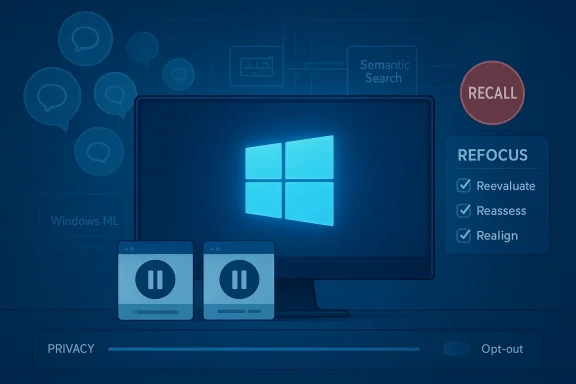 Background: the agentic OS moment that triggered the backlash
In November 2025, Pavan Davuluri — Microsoft’s President of Windows and Devices — posted a short, definitive line that crystallized the company’s AI ambition: “Windows is evolving into an agentic OS, connecting devices, cloud, and AI to unlock intelligent productivity and secure work anywhere.” The post was intended to frame new Windows experiences at Ignite, but it instead unleashed a torrent of criticism from the consumer community that called out perceived intrusiveness, performance regressions, and a sense that Microsoft was prioritizing AI brand presence over practical value. That social reaction did not exist in a vacuum. For more than a year Microsoft has been rapidly embedding Copilot and related agent features across Windows and Microsoft 365, from deeper Copilot links in Edge to in‑app Copilot icons in File Explorer, Notepad, and Paint. For many users those placements felt additive in name only — extra chrome on a UI that already struggles with discoverability and occasional regressions — and the complaints have been loud and consistent across forums, social platforms, and even internal channels.
What changed: the practical rollback Microsoft is reportedly considering
Two discrete changes are at the center of recent reporting:- Microsoft has paused work on rolling out additional Copilot buttons in built‑in Windows apps. Existing Copilot placements in apps such as Notepad and Paint are reportedly under review, with the company evaluating whether those buttons add measurable value or simply cause visual clutter.
- The company is reassessing Windows Recall and other agentic experiences. According to reporting, Recall’s current implementation “failed” to meet internal and external expectations and is being reconsidered; Microsoft may rework, rename, or radically alter the concept rather than scrap agentic ideas wholesale. This review appears aimed at separating promising platform‑level AI work (APIs, Windows ML, Semantic Search) from superficial UI insertions.
Why this matters: user trust, UX, and the limits of “AI everywhere”
Windows is different from a standalone app. It is the operating fabric that runs work and leisure for hundreds of millions of users worldwide. When system UI starts inserting persistent AI affordances that many users don’t understand or want, two predictable outcomes follow: frustration and distrust.- AI fatigue is real. Many users will try a promising AI feature once — particularly if it’s framed as a novelty or an extra button — and if it fails expectations (hallucinates, makes wrong assumptions, or feels slow) the negative impression compounds quickly. Repetitive UI prompts and new icons amplify that friction.
- Perception of bloat reduces perceived value. Adding visible Copilot buttons in every in‑box app risks turning the brand into mere marketing chrome. Users who already complain about startup prompts, required cloud accounts, or forced feature toggles see more icons as justification for switching platforms or seeking alternatives.
- Trust and privacy stakes are higher on the OS. Features that promise "agentic" behavior — proactive agents that run, fetch, summarize, or act on behalf of users — raise legitimate privacy and security questions. Recall, in particular, has been controversial for similar reasons, prompting a reassessment that appears to accept those concerns rather than double down defensively.
What Microsoft still intends to keep building
The reported re‑focus is not a withdrawal from AI. Microsoft’s strategy appears to be shifting from “broadcast” (Copilot icons everywhere) to “targeted” (invest in APIs and features that add measurable, defensible value). Specifically:- Windows AI APIs and Windows ML continue to be central to the platform strategy, enabling developers to build performant local and hybrid AI experiences. Those investments are critical to Windows’ competitiveness with other OSs that are also opening AI hooks to developers.
- Semantic Search and agentic frameworks intended for automation and developer integrations are still moving forward, but with more emphasis on enterprise and developer scenarios where the ROI is clearer.
- Copilot as a paid product for productivity remains intact. Microsoft still offers consumer Copilot Pro and enterprise Copilot tiers — pricing and subscription models that were rolled out to monetize high‑value Copilot features — and those business models do not appear to be undone by this UI rework. The Copilot Pro tier, for example, has been published at roughly $20 per user per month for consumers who want a deeper Copilot experience.
Strengths of Microsoft’s AI strategy (what to keep)
- Platform leverage. Microsoft’s advantage is that it controls OS, cloud, and productivity apps at scale. This makes it uniquely positioned to deliver integrated AI experiences that can be both local and cloud‑augmented. When done well, these experiences can save users real time and unify workflows across devices.
- Developer ecosystem and standards work. Investment in APIs (e.g., Windows AI APIs, Model Context Protocol or MCP discussions) empowers third‑party developers to create meaningful agents—or to avoid them—depending on user needs. Focused developer tooling is more durable than ephemeral UI affordances.
- Enterprise demand still strong. Large organizations continue to invest in AI‑powered productivity tooling, and Microsoft’s commercial Copilot offerings remain a growth vector. Enterprise adoption provides the revenue base to keep platform investments funded while allowing consumer UX to be iterated more cautiously.
- Willingness to course‑correct. The company’s reported pause signals a pragmatic product culture: iterate, measure, and if feedback is negative, pull back. That responsiveness — visible in this case — is a positive sign for long‑term product health.
Risks and weaknesses (what still keeps me worried)
- Reputational damage is sticky. Once users feel an OS is “bloating” or treating them as a distribution channel for features, that sentiment can harden. Microsoft will have to prove its restraint through actions, not announcements. Patching messaging alone won’t repair eroded trust.
- Execution complexity. Building agentic systems that are provably safe, private, and useful is hard. The Recall review highlights that Microsoft’s ambitions can outpace the maturity of the product. Agents that act autonomously must have reliable provenance, auditable actions, and granular controls — features that are nontrivial to engineer and explain.
- Monetization vs. user experience tension. Microsoft needs to monetize AI to meet investor expectations, but aggressive monetization (visible icons, prompts to upgrade) must be reconciled with the need for a clean baseline experience. The Copilot Pro subscription ($20/month) and bundled Microsoft 365 Premium options show the company is serious about paid AI features, but making those features optional, obvious, and genuinely superior is the only long‑term path to acceptance.
- Competitive pressure and regulatory scrutiny. Google, Apple, and others are evolving their AI strategies, and regulators are increasingly focused on hallucinations, privacy, and security. A misstep on any of these fronts risks not only consumer dissatisfaction but also legal and policy interventions.
Practical implications for users, IT admins, and developers
For consumers and enthusiasts
- Expect fewer gratuitous Copilot icons in the near future, but anticipate continued AI features in places that clearly add value (file search, Outlook summarization, image‑to‑text tasks). If you dislike Copilot, now is a good time to audit settings — Microsoft is more likely to make opt‑out controls clearer in future updates.
For enterprise IT
- Treat the change as an opportunity. Evaluate where agentic capabilities deliver measurable ROI and pilot conservatively. Keep an eye on Windows AI APIs and Windows ML: those under‑the‑hood investments are where enterprise differentiation will appear. Also, review your compliance and data governance policies as Microsoft iterates on agent behavior and cloud‑local hybrid models.
For developers and ISVs
- Invest in robust UX and sensible defaults. The market will reward thoughtfully integrated AI features that are transparent, debuggable, and optional. Use the platform APIs to build experiences that run locally where latency, cost, or privacy matter, and reserve cloud models for tasks that require extra reasoning power.
Recommendations: how Microsoft should proceed (and what a good outcome looks like)
- Prioritize usefulness over visibility. Only add a Copilot affordance when it demonstrably reduces steps or cognitive load. Less is more — start with problem‑first design.
- Ship clear opt‑outs and provenance. Users must be able to control agent behavior, see why an agent did something, and remove or disable agent histories. Privacy controls should be front and center.
- Double down on local and hybrid models. Where confidentiality or latency matter, ensure AI can run on‑device using Windows ML or with controlled cloud escape hatches. Hybrid models lower friction and regulatory risk.
- Measure impact, publicly. Publish adoption and quality metrics for major AI features (engagement, task‑completion rates, error rates). Transparency will earn back trust faster than marketing.
- Segment consumer vs. enterprise roadmaps. Enterprise customers often want automation and governance; consumers want simplicity and responsiveness. Don’t force enterprise features onto consumer UIs.
What this shift says about the broader AI product cycle
Microsoft’s response is a microcosm of a larger pattern: many companies moved from “explore AI” to “inject AI everywhere” and are now learning that presence without utility creates backlash. The current phase of product maturity demands tighter measurement, stronger defaults, and honest tradeoffs between monetization and baseline experience quality.This episode also shows a healthy product discipline at work: listening, iterating, and pruning. In the best case, Windows will emerge leaner — with agentic capabilities that actually earn users’ trust and attention, rather than commandeer screen real estate for branding exercises.
Final assessment: cautious optimism, but hold Microsoft to the work
Microsoft’s decision to pause Copilot button rollouts and re‑evaluate Recall is a responsible course correction that recognizes the limits of hype when stacked against everyday user experience. It’s an acknowledgment that agents, prompts, and paid tiers have to solve real problems or they erode the platform’s value.That said, the real test will come in the next six to twelve months. Will Microsoft translate this pause into durable changes: clearer controls, fewer gratuitous brand placements, and better local/hybrid model support — or will it simply delay actions while preserving the same instincts under new skin? The right path is available: invest in developer tools, measure feature impact, and center privacy and usability in every agent decision.
For Windows users, admins, and developers, this is a welcome moment: a chance to demand smarter AI, not more AI. If Microsoft follows through, we’ll keep the good parts — smarter search, contextual assistance, safer automation — and lose the clutter. If it doesn’t, the backlash will only deepen, and competitors (or stricter regulators) will define the future for them.
Microsoft has the ingredients to make an AI‑powered Windows genuinely helpful. The company has also shown — in this instance — that it can listen. Now it must prove it can act.
Source: Android Headlines Microsoft Scales Back Its AI-First Plan After Consumer Pushback
