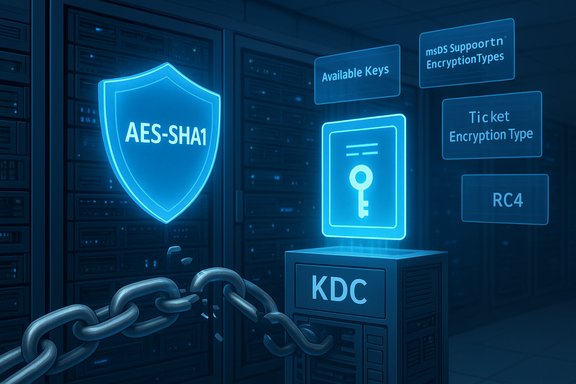
Microsoft’s decision to phase out the RC4 cipher from Active Directory authentication marks a decisive response to decades of risky backward compatibility — but it also forces a hard reckoning for enterprises that have long depended on legacy interoperability over cryptographic hygiene.
For nearly a quarter century, RC4 (Rivest Cipher 4) has lingered inside Windows authentication stacks as a compatibility fallback for Kerberos tickets, despite being widely known as cryptographically weak. RC4 first gained traction in the 1990s and was baked into Windows networking when Active Directory debuted with Windows Server 2000. Over time, stronger algorithms — notably AES — were added to Windows (AES support arrived in Windows Server 2008), but RC4 remained enabled by default to preserve legacy interoperability. Microsoft now says it will change domain controller defaults so the Kerberos Key Distribution Center (KDC) issues AES-based keys by default and disable RC4 by default in Active Directory environments by mid‑2026, moving administrators to AES‑SHA1 (AES-based session keys) unless RC4 is explicitly re-enabled. This is not a sudden reversal. Microsoft began deprecating RC4 in other contexts (browsers/TLS) earlier in the last decade, and in recent years the company added tooling and guidance to help customers detect and remediate RC4 usage in Kerberos. However, the timeline and the decision to make the change a default for domain controllers represent the most consequential step yet: a vendor-driven, large-scale forcing function that will break legacy authentications if environments are not prepared.
Source: WebProNews Microsoft to Retire Vulnerable RC4 Cipher in Active Directory by 2026
 Background
For nearly a quarter century, RC4 (Rivest Cipher 4) has lingered inside Windows authentication stacks as a compatibility fallback for Kerberos tickets, despite being widely known as cryptographically weak. RC4 first gained traction in the 1990s and was baked into Windows networking when Active Directory debuted with Windows Server 2000. Over time, stronger algorithms — notably AES — were added to Windows (AES support arrived in Windows Server 2008), but RC4 remained enabled by default to preserve legacy interoperability. Microsoft now says it will change domain controller defaults so the Kerberos Key Distribution Center (KDC) issues AES-based keys by default and disable RC4 by default in Active Directory environments by mid‑2026, moving administrators to AES‑SHA1 (AES-based session keys) unless RC4 is explicitly re-enabled. This is not a sudden reversal. Microsoft began deprecating RC4 in other contexts (browsers/TLS) earlier in the last decade, and in recent years the company added tooling and guidance to help customers detect and remediate RC4 usage in Kerberos. However, the timeline and the decision to make the change a default for domain controllers represent the most consequential step yet: a vendor-driven, large-scale forcing function that will break legacy authentications if environments are not prepared. Why RC4 had to go
The technical problem in plain terms
RC4 is a stream cipher whose output keystream exhibits predictable biases. These biases, combined with weaknesses in key scheduling and simple key-derivation practices used historically with Windows NTLM/RC4, make it feasible for attackers to recover plaintext secrets far faster than with modern, iterated hash + AES constructions. Research over the last two decades — starting with the Fluhrer–Mantin–Shamir work and continuing through attacks demonstrated in the 2010s — made the vulnerabilities academic and practical. Practical "Bar Mitzvah" style attacks and numerous academic analyses have shown RC4’s keystream biases can be exploited to recover information from real-world streams. In Active Directory’s Kerberos implementation, RC4-based tickets can be targeted by offline cracking and other attacks because the service ticket encryption effectively reduces the defensive cost of guessing a password. AES‑based Kerberos session keys use far stronger key derivation and iteration counts, making offline cracking orders of magnitude harder. That fundamental cryptographic gap is why security pros have long urged the removal of RC4 from identity systems.Practical attack chains that exploit RC4 weaknesses
Two related techniques illustrate why RC4’s presence in Kerberos is not academic:- Kerberoasting: attackers request service tickets (TGS) for service accounts and then perform offline cracking of the encrypted ticket to recover the account password. RC4/NTLM-style encryption yields tickets that can be brute-forced far faster than AES‑protected tickets, making Kerberoasting substantially more effective against RC4-protected service accounts.
- Golden / Silver Ticket and Pass‑the‑Ticket abuse: while these techniques do not strictly require RC4, the ability to extract ticket material and to forge or replay tickets has been facilitated by weak legacy cryptography and lax controls. Tools like Mimikatz dramatically lowered the bar for attackers to exploit ticketing weaknesses, and incident responders have repeatedly observed these techniques used in high-impact intrusions.
The announcement and timeline: what Microsoft is changing
Microsoft’s public guidance and product blog posts describe a multi-step approach:- New default behavior: domain controllers (KDC) on Windows Server 2008 and later will default to AES‑SHA1 encryption for Kerberos, and RC4 will be disabled by default for KDC ticket issuance by mid‑2026. Administrators can still explicitly re-enable RC4 for specific accounts or KDCs, but the intent is to flip the default away from the legacy cipher.
- Detection and remediation tooling: Microsoft published PowerShell scripts (List‑AccountKeys.ps1 and Get‑KerbEncryptionUsage.ps1) and guidance on how to discover accounts, machines, or service principals still using RC4. The company also documented Group Policy and Windows Admin Center workflows for enforcing encryption-type policies.
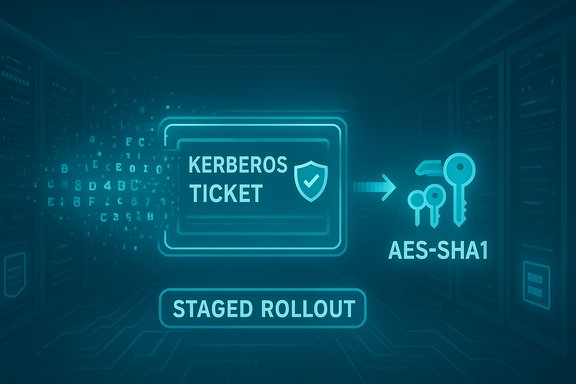
- Staged rollout and compatibility considerations: Microsoft recognizes that full removal risks breakage for legacy applications, so the change is a deliberate default flip with guidance and diagnostic tooling to drive migration. Administrators are being given months — not weeks — to audit and remediate environments before the change becomes operationally effective on new and updated domain controllers.
Real-world stakes: why this matters to enterprises
Expensive breaches and real incidents
Identity-based attacks and lateral movement are central to many modern breaches, and the financial stakes are large. The average cost of a data breach continues to climb: industry studies show breach costs in the multi‑million‑dollar range for affected organizations, with healthcare and critical infrastructure frequently hit hardest. Weak identity controls and exploitable encryption primitives materially increase dwell time and impact. Lawmakers and incident responders have made the risks tangible: congressional attention — including public letters from U.S. Senator Ron Wyden — highlighted specific incidents (including a large healthcare ransomware incident disclosed in 2024) where Kerberos abuse and weak defaults played a role in the attacker’s ability to pivot and deploy ransomware widely. That public pressure helped focus vendor attention on making default changes that reduce population-level exposure.Examples of Kerberos-enabled lateral movement and persistence
While different breaches have different root causes, post‑compromise lateral movement often relies on abusing authentication artifacts:- Golden / Silver Ticket forgeries and pass‑the‑ticket replay have been observed in espionage and high-impact compromises across years of reporting and threat-intel studies. These techniques enable attackers to impersonate users, bypass local authentication checks, and persist undetected.
- Kerberoasting remains a low-bar, high-payoff technique because it can be executed by any valid domain user and is stealthy by design. Environments that still accept RC4‑protected service tickets are markedly more exposed to rapid credential compromise.
Migration mechanics: what IT teams must do now
Migrating an enterprise Active Directory environment away from RC4 requires planning, verification, and testing. Microsoft’s guidance and the defensive community converge on a common checklist:- Inventory and detection
- Run Microsoft’s Get‑KerbEncryptionUsage.ps1 and List‑AccountKeys.ps1 (or equivalent SIEM queries) to identify accounts, SPNs, and endpoints that are requesting or accepting RC4-based tickets.
- Prioritize high‑risk accounts
- Focus first on service accounts with Service Principal Names (SPNs), privileged accounts, and accounts with weak/unchanged passwords. These are the most valuable targets for Kerberoasting and ticket‑forgery abuse.
- Move to AES-capable keys
- Ensure service accounts and machines have AES keys and that key material (supplemental credentials) include AES128/256 variants. Use Group Managed Service Accounts (gMSAs) where possible to reduce manual password risk.
- Apply Group Policy or security baseline
- Use the “Network security: Configure encryption types allowed for Kerberos” GPO and Microsoft’s 2025 security baseline to restrict allowed encryption types and audit compliance. Windows Admin Center and OSConfig baselines can help enforce these settings.
- Test and stage changes
- Do not flip defaults in production without testing. Use lab domains and staged rollouts to validate hardened settings and to detect legacy services that fail when RC4 is disallowed.
- Compensating controls
- Enforce long, randomly generated passwords for service accounts, enable MFA for administrative workflows, apply Just‑In‑Time (JIT) and Privileged Identity Management (PIM) practices, and monitor Kerberos logs for anomalous TGS/AS‑REQ patterns (event IDs 4769 / 4771).
- Third‑party audits and monitoring
- Use external consultants or internal red teams to simulate Kerberoasting and ticket forging to validate detection and response. Integrate findings into SIEM and EDR rules.
Strengths of Microsoft’s approach — and remaining risks
Notable strengths
- Default hardening: Shifting the default to AES‑based Kerberos encryption reduces the "population risk" for organizations that delay hardening. Defaults matter: many organizations never change vendor defaults, so a vendor‑level default change moves the entire installed base toward better security.
- Guidance and tooling: Microsoft is publishing scripts, admin center controls, and a documented remediation path. This helps translate a risky default into an actionable migration project for IT teams.
- Phased approach: By disabling RC4 as a default rather than an immediate forced removal, Microsoft reduces the chance of breaking critical legacy services while still forcing organizations to plan and execute remediation.
Remaining risks and criticisms
- Compatibility vs. security trade‑offs: Microsoft’s historical choices favored compatibility, which prolonged exposure. Critics (and some lawmakers) argue the company moved too slowly and that a faster removal would have reduced accumulated risk sooner. Congressional scrutiny and public pressure have framed this as more than a technical decision.
- Incomplete mitigation if admins misconfigure: The transition reduces default exposure but does not eliminate it. Administrators can still re-enable RC4 per account; without strict policy enforcement and auditing, some environments will remain vulnerable. Microsoft’s move reduces probability of exploitation but does not guarantee elimination.
- Dependency on password hygiene and segmentation: RC4 removal is powerful only when combined with strong passwords, rotation, least‑privilege, and segmentation. Kerberoasting can target AES tickets too — albeit at much higher computational cost — so poor password practices remain a critical failure point. Microsoft’s own guidance stresses these complementary controls.
- Legacy in‑market systems: Some unsupported or embedded devices cannot be upgraded and may require special handling. Microsoft’s phased approach leaves a path for these to remain functional but this path will also be a persistent risk if not tightly controlled.
Political and industry fallout
Public scrutiny of identity‑security choices has reached regulators and lawmakers. Notably, a U.S. senator publicly urged the Federal Trade Commission to evaluate Microsoft for alleged cybersecurity negligence in relation to a high‑profile healthcare ransomware incident, citing RC4‑enabled Kerberoasting as a contributing factor. Microsoft responded by emphasizing that RC4 traffic is now a small minority (under 0.1% by the company’s published figures) and reiterated that a phased, compatibility‑aware retirement was necessary. The exchange underscored how vendor defaults are now viewed through the lens of national critical‑infrastructure risk. At the same time, security vendors, incident responders, and open‑source projects (for example, alternatives used in Samba and other interop stacks) have long since moved away from RC4 and now provide migration blueprints. The market pressure — from competitors, regulators, and enterprise security teams — finally aligned with Microsoft’s engineering roadmap to push a default change at scale.What success will look like — and how to measure it
A successful transition will be measurable in several ways:- A continued downward trend in detected RC4 Kerberos events and a rise in AES‑protected TGS/AS requests in event logs and SIEM dashboards. Microsoft’s PowerShell tooling and event‑based telemetry will help teams quantify progress.
- Reduced incidence of identity‑centric lateral movement investigations tied to ticket‑based attacks (Kerberoasting, Golden/Silver Ticket, Pass‑the‑Ticket). This will require long‑term telemetry and post‑incident analysis across enterprise incident-response teams and vendors.
- Demonstrable remediation of legacy dependencies — for example, lists of devices and apps migrated off RC4 or isolated behind compensating network controls. This is an operational metric IT auditors can verify.
Practical checklist for CIOs and security teams (short, operational)
- Run Microsoft’s Kerberos auditing scripts and SIEM queries to enumerate RC4 usage.
- Prioritize remediation of service accounts with SPNs and implement gMSAs where feasible.
- Apply Microsoft’s security baseline and Group Policy to restrict allowed Kerberos encryption types in test domains before production.
- Enforce strong randomness and length for service account passwords; rotate KRBTGT and critical service account credentials as part of incident response planning.
- Integrate Kerberos‑specific detections (unusual TGS/AS‑REQ patterns, RC4 usage flags) into SIEM/EDR playbooks and run tabletop exercises for ticket‑forging scenarios.
A caution about attribution and historical claims
Many public narratives connect RC4 to specific high‑profile breaches; while weak encryption certainly amplified risk in multiple incidents, not every major breach can be singularly blamed on RC4. Breaches are multi‑vector, and effective defenders must look at cryptography, identity hygiene, segmentation, logging, and detection together. Where public reporting names Kerberos abuse (for example, in some investigations and congressional summaries), the role of weak cryptography has been corroborated by multiple independent reports and vendor analyses — but attribution of any breach to a single technical cause is often an oversimplification. When evaluating legacy‑cipher impacts on a particular incident, rely on incident reports, vendor advisories, and forensic timelines rather than single‑sentence summaries.Closing analysis: the long tail of legacy code and the path forward
Retiring RC4 from Active Directory Kerberos defaults is overdue from a security‑first perspective, and it is a meaningful step toward reducing a long‑standing class of identity attacks. Making the safer option the default is an effective design move: default configurations drive large swathes of the enterprise installed base, and flipping a default moves the needle much faster than guidance alone. Microsoft’s rollout, combined with detection tooling and security baseline recommendations, gives organizations a workable path to modernize authentication without sudden disruption. That said, the technical fix alone will not erase the underlying management problems that make Kerberos abuses lethal: poor password hygiene, unsegmented networks, insufficient monitoring, and the persistence of unsupported appliances. For most organizations, the RC4 retirement will reduce systemic risk, but only a comprehensive identity‑centric defense posture — strong secrets, rotation, least privilege, MFA, telemetry, and rigorous patching — will close the loop and convert a vendor default into durable resilience. The next 12–18 months will be the test: if enterprises use the breathing room to proactively inventory, remediate, and modernize, the industry will have taken an important step toward safer default security. If not, RC4 will become one more historical footnote in post‑mortems. The right operational posture is clear: find your RC4 dependencies, prioritize high‑risk service accounts, and make AES the baseline for Active Directory authentication now — not later.Source: WebProNews Microsoft to Retire Vulnerable RC4 Cipher in Active Directory by 2026