

Microsoft’s consumer-AI chief Mustafa Suleyman publicly vowed this week that Microsoft would stop pursuing advanced AI development if a system posed a genuine threat to humanity — a striking pledge that highlights both the company’s new strategic posture and the messy trade-offs at the heart of today’s race for superintelligence.
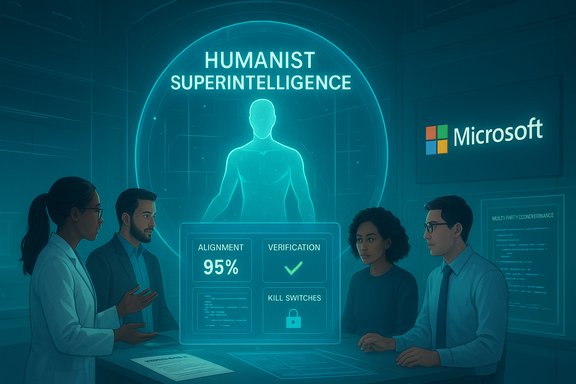
In November, Microsoft announced the creation of a new MAI Superintelligence team and published a vision for what it calls Humanist Superintelligence — a program explicitly framed to build advanced AI that is firmly subservient to human interests and engineered to remain controllable. That public blueprint, written and published by Mustafa Suleyman on Microsoft’s AI site, sets the context for the more pointed remarks he gave in a Bloomberg interview in December. The timing is consequential. Microsoft’s relationship with OpenAI was restructured in late October in a deal that left Microsoft with a large minority stake and clarified governance and compute arrangements — a legal and commercial shift that, by some accounts, removed earlier contractual limits that constrained Microsoft’s independent pursuit of frontier models. That change helps explain why Microsoft is now publicly placing a stake in the ground about how it will approach superintelligence.
Microsoft’s statement reframes the conversation around superintelligence from a raw capability race to a debate over who sets the rules and how those rules will be verified. The next phase — where commitments become commitments in code, contracts, and audit logs — will define whether this pledge is a genuine step toward safer AI or a high-profile public relations move.
Source: Bloomberg.com https://www.bloomberg.com/news/arti...vows-to-halt-ai-work-if-it-imperils-humanity/
 Background / Overview
In November, Microsoft announced the creation of a new MAI Superintelligence team and published a vision for what it calls Humanist Superintelligence — a program explicitly framed to build advanced AI that is firmly subservient to human interests and engineered to remain controllable. That public blueprint, written and published by Mustafa Suleyman on Microsoft’s AI site, sets the context for the more pointed remarks he gave in a Bloomberg interview in December. The timing is consequential. Microsoft’s relationship with OpenAI was restructured in late October in a deal that left Microsoft with a large minority stake and clarified governance and compute arrangements — a legal and commercial shift that, by some accounts, removed earlier contractual limits that constrained Microsoft’s independent pursuit of frontier models. That change helps explain why Microsoft is now publicly placing a stake in the ground about how it will approach superintelligence. What Suleyman actually said — and what it means
The pledge, in plain language
Suleyman’s most headline-grabbing line was explicit: “We won’t continue to develop a system that has the potential to run away from us.” He framed that as a common-sense ethical limit — and promised that Microsoft would halt work if its efforts began to imperil people. That quote appeared in a Bloomberg interview republished by several outlets; the underlying Microsoft blog announcing the MAI team advances the same principle in more programmatic language.Why this statement matters now
- It marks a deliberate positioning strategy: Microsoft is trying to differentiate how it will pursue advanced AI — emphasizing alignment, containment, and human control rather than raw capability-for-capability’s sake.
- The promise is both moral and tactical. Publicly stating a “halt if harmful” policy helps address reputational risk, placates some regulators and safety advocates, and may ease recruiting for safety-oriented researchers.
- The timing follows Microsoft’s October restructuring with OpenAI, which changed the commercial and legal landscape for frontier-model development and presumably removed some prior limits on Microsoft’s own work. That commercial freedom is what allows Microsoft to make this public pledge while simultaneously expanding its superintelligence program.
How credible is the pledge?
There’s a meaningful difference between a public vow and operational reality. The promise to halt work “if it imperils humanity” raises several verification and enforcement questions.Practical obstacles to enforcing a halt
- Definitional ambiguity: What counts as “imperiling humanity”? Is it measurable by a single metric, a panel decision, or a multi-party verification process? The phrase is powerful rhetorically but imprecise as a trigger for action. This ambiguity makes the pledge hard to audit or litigate.
- Governance complexity: Large corporations have layered decision-making. Who within Microsoft has unilateral authority to halt a major research program? Board-level involvement, legal constraints, and contractual obligations to partners or customers could complicate or delay any halt.
- Economic incentives: The same deals that free Microsoft to pursue AGI also create enormous commercial incentives to keep going: sunk costs in data centers, capital commitments, product roadmaps, and market expectations. Those incentives will exert pressure against a long or costly pause.
Historical precedent and analogies
Corporations and governments have announced voluntary moratoria on risky technologies before (e.g., moratoria on certain gene-editing experiments or on the deployment of unvetted weapons systems), but effective pauses have usually required independent oversight, clear technical metrics, and legal enforcement to be sustained. A corporate promise that lacks external verification will be judged skeptically by many safety and policy experts.The strategic calculus inside Microsoft
Why say it publicly?
- Regulatory signaling: With national and subnational regulators increasingly attentive to AI harms, a clear public pledge can buy political capital and influence regulatory design. It positions Microsoft as a responsible developer at a moment when governments are debating mandatory audits, independent testing, and disclosure rules.
- Talent and PR: Safety-oriented researchers have choices; companies that articulate a proactive safety culture are more likely to attract and retain talent who care about alignment and ethics. The pledge also reduces reputational tail risk in the event of accidents.
- Competitive framing: By naming “humanist superintelligence” and promising limits, Microsoft is attempting to set a distinct narrative from competitors that emphasize speed, scale, or dominance. This can be a differentiator in public discourse and procurement decisions.
Internal tensions to watch
- Product vs. research: Microsoft operates massive product lines (Windows, Office, Azure) that are rapidly being re-architected around AI. Product teams prize reliability and monetization; research teams prize breakthrough capabilities. Aligning those constituencies on a “halt” threshold will be politically and operationally challenging.
- Contractual constraints and IP: Microsoft’s ongoing commercial ties and recent stake in OpenAI create intertwined obligations. Contractual terms, revenue commitments, and cross-licensing could limit Microsoft’s ability to unilaterally pause work without negotiating partners.
Technical reality: alignment, verification, and containment
The three engineering hard problems
- Alignment — ensuring models’ goals track human values at scale. This is an active research frontier with no silver-bullet solution yet. Current methods (reward modeling, RLHF, interpretability tools) improve behavior but do not guarantee safe long-run trajectories.
- Verification — proving a model will not produce catastrophic emergent behavior under distributional shifts. Formal verification is extremely limited for large neural networks; the field lacks robust, broadly accepted verification frameworks.
- Containment — building architectures and operational controls that can reliably limit a system’s autonomy (sandboxing, compute throttling, kill-switch designs). These measures can mitigate risks but are not flawless; sophisticated adversarial strategies or supply-chain compromises could undermine containment.
Can we define measurable “stop” conditions?
- Useful stop conditions would need to be operationalizable: for example, a verified breach of a pre-agreed behavioral safety threshold, or consensus findings from an independent verification panel. Relying on vague language such as “imperils humanity” leaves too much room for subjective interpretation and delay.
Policy and governance implications
What regulators and lawmakers should require
- Independent verification: Any corporate pledge that a technology will be halted under certain conditions should be paired with an independent verification regime — a trusted technical panel with triage and adjudication authority. Publicly accountable review mechanisms would make halting decisions credible and enforceable.
- Transparency and audit trails: Companies should document and publish (to the degree consistent with safety and IP protection) the metrics and redlines that would trigger a development pause. Regulators can require secure disclosures, on-site audits, and forensic access to logs.
- Contingency planning: Governments should require firms to submit “pause plans” that detail how compute, distribution, and deployment would be halted without endangering ongoing services. These plans should be stress-tested against realistic adversarial and cascading-failure scenarios.
International coordination is essential
The global nature of compute supply chains, talent, and markets mandates cross-border structures for credible enforcement. Unilateral corporate promises are insufficient if rival jurisdictions or actors can continue development without restraint. Recent academic proposals and policy dialogues have converged on the need for internationally recognized protocols to verify AGI claims and to constrain dangerous capability development.Why critics remain skeptical
- Signaling vs. substance: Skeptics note that corporate rhetoric often serves reputational purposes more than operational restraint. Without third-party enforcement and transparent metrics, promises are only as strong as a company’s incentives to keep them.
- Regulatory capture and lobbying risks: Big tech can influence rule-making. A voluntarist approach that centers company self-regulation risks delaying effective public safeguards.
- Enforceability under market pressure: In an oligopolistic field where national security and economic competitiveness are invoked as reasons to accelerate, companies may face intolerable pressure to continue development even after admitting risks.
What this means for enterprises, developers, and Windows users
- Enterprises that build on Microsoft AI services should track two things closely: the company’s operational safety policies (how halts would be implemented) and contractual fine print about service continuity and liability. If Microsoft constructs formal “halt” triggers and independent verification processes, those protections could benefit downstream customers.
- Developers and administrators should treat public pledges as an input to risk assessments, not a guarantee. Operational risk management still requires layered defenses: conservative testing, manual approvals for high-impact automation, and the ability to roll back or isolate AI-driven services quickly.
- Windows users and consumers will mainly feel the effects through product behavior (safer defaults, more conservative generative features) and potentially through slower release cadences for cutting-edge capabilities that Microsoft judges too risky. That trade-off may be intentional: safety-first features can reduce glamorous but risky functionality in mainstream releases.
Recommended safeguards Microsoft should enact to make the pledge credible
- Publish objective stop conditions — a finite set of measurable thresholds and protocols for triggering a pause.
- Independent AGI verification panel — an expert, cross-disciplinary body with the authority to evaluate evidence and recommend halts.
- Legally binding commitment — integrate pause triggers into corporate governance documents and supplier contracts to prevent unilateral circumvention.
- Transparency reports — periodic, redacted reports on safety tests, failure modes discovered, and actions taken.
- Technical kill switches and compute controls — multi-party, auditable mechanisms to throttle or disable training, deployment, and network access when thresholds are crossed.
Strengths and risks of Microsoft’s approach
Notable strengths
- Public commitment to alignment: The Humanist Superintelligence framing sets a clear ethical baseline and invites collaboration with safety communities.
- Resource alignment: Microsoft has the cloud, engineering depth, and financial capacity to pursue robust safety research at scale — a genuine comparative advantage for responsible development.
- Regulatory and reputational benefit: The pledge creates political cover and reduces immediate reputational downside, which can be strategically valuable in fast-moving debates about AI governance.
Material risks
- Credibility gap: Without external enforcement mechanisms, the pledge risks being dismissed as PR. That credibility gap could worsen public and political backlash if an incident later occurs.
- Operational conflicts: Balancing product imperatives and research caution is inherently fraught; misalignment between these arms of the company could make pauses messy or ineffective.
- Geopolitical leakage: If other jurisdictions take a looser approach to capability development, a unilateral corporate pause will not stop global capability growth — undermining both safety and competitive fairness.
Conclusion
Mustafa Suleyman’s vow that Microsoft will stop developing AI that “could run away from us” is more than a sound bite — it’s a public articulation of a governance philosophy that Microsoft is now baking into its superintelligence agenda. The company’s November announcement of the MAI Superintelligence team gave the pledge programmatic context; the October restructuring with OpenAI supplied the legal and commercial space for Microsoft to make that promise in public. Yet words alone are not sufficient. Turning a moral pledge into a credible, enforceable, and technically meaningful halt requires clear metrics, independent verification, legal binding, and resilient operational controls. Without those, promises will be judged as branding rather than safety engineering. The onus is now on Microsoft — and on regulators and independent experts — to translate aspirational language into measurable, auditable practice. Until then, the company’s vow will be an important signal, but not a definitive safeguard.Quick takeaways (for busy readers)
- What happened: Microsoft AI chief Mustafa Suleyman publicly pledged to halt development if AI systems “imperil” humanity, building on a November launch of a MAI Superintelligence team framed as humanist and controllable.
- Why it matters: The pledge signals a public safety posture at a moment of commercial freedom after a major OpenAI restructuring, but it raises immediate questions about enforceability and operational detail.
- What to watch next: Will Microsoft publish concrete stop conditions, establish an independent verification panel, and embed legally binding pause mechanisms into governance documents? Those steps will determine whether the pledge is a durable safety mechanism or symbolic rhetoric.
Microsoft’s statement reframes the conversation around superintelligence from a raw capability race to a debate over who sets the rules and how those rules will be verified. The next phase — where commitments become commitments in code, contracts, and audit logs — will define whether this pledge is a genuine step toward safer AI or a high-profile public relations move.
Source: Bloomberg.com https://www.bloomberg.com/news/arti...vows-to-halt-ai-work-if-it-imperils-humanity/
