

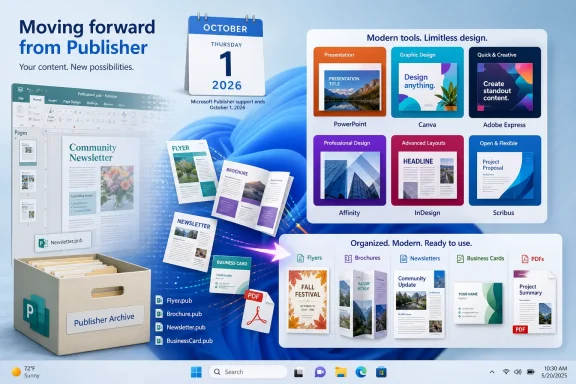
Microsoft Publisher is approaching a hard transition point, and Windows users who have relied on it for flyers, church bulletins, club newsletters, business cards, brochures, calendars, and simple marketing collateral should start planning now. Microsoft 365 subscribers lose access to Publisher on October 1, 2026, while supported perpetual Office editions reach end of support on the same date. The familiar
For many Publisher users, that sounds more alarming than it needs to be. Publisher has always occupied a pragmatic middle ground between word processing and professional desktop publishing: it offers more freedom than Word, but it avoids the intimidating complexity of Adobe InDesign. Its replacement is therefore unlikely to be one single product. The right successor depends on whether the priority is offline editing, easy templates, team collaboration, professional printing, AI-assisted design, or long-form layout control.
The encouraging news is that Microsoft Publisher alternatives are stronger than Publisher in several important ways. The less encouraging news is that there is no universally reliable one-click conversion path from
Publisher has survived because it solved a very specific Windows productivity problem. It let non-designers place text boxes, logos, photos, shapes, and decorative elements precisely where they wanted them. That made it more approachable than professional page-layout software and more flexible than a conventional word processor.
However, Publisher is also a legacy Windows application with a distinctly older approach to file compatibility, templates, typography, and collaboration. It does not align especially well with Microsoft’s current focus on cloud-connected Microsoft 365 apps, collaborative document workflows, and AI-assisted creation.
Microsoft’s own replacement guidance points users primarily toward Word and PowerPoint for traditional Publisher tasks. That recommendation is sensible for simple documents, but it should not be treated as proof that Word or PowerPoint can replace every Publisher workflow without compromise.
A folded newsletter with linked text boxes, multiple pages, print bleed requirements, complex graphics, and strict brand typography is fundamentally different from a one-page community flyer. The former may need a dedicated page-layout application. The latter may actually be easier to produce in Canva, Adobe Express, or PowerPoint.
Publisher files can hold years of reusable templates, seasonal event programs, mailing lists, price sheets, donor brochures, menus, event signage, and publications whose original images may no longer be easy to locate. Even if a document will never be edited again, it may need to remain viewable for legal, historical, or branding reasons.
PDF preserves the visual result much more reliably than attempting to turn every Publisher document into a Word file. It is ideal for:
The resulting Word document can shift line breaks, rearrange images, change spacing, alter page flow, and simplify complicated visual arrangements. Those differences are especially likely in documents with:
For many familiar Publisher tasks, PowerPoint can feel immediately understandable. Instead of thinking in terms of slides for a presentation, think of each slide as a printed page, sign, postcard, flyer, or brochure panel.
PowerPoint is especially effective for:
That gives organizations a practical template system. A designer or capable staff member can create approved layouts, while everyday users edit only the title, body copy, photo, event date, or contact information.
Google Docs provides real-time collaboration, comments, suggestions, automatic saving, revision history, tables, image insertion, and PDF export. That makes it easier for committees, volunteer organizations, remote teams, and small businesses to maintain a single current version of a document.
Google Docs works best for:
Google Docs replaces that confusion with shared editing and version history. Users can see changes, restore earlier versions, add comments, and avoid passing attachments back and forth.
It is best treated as a Publisher replacement for documents, not for design-heavy publications.
The platform is capable of producing:
It also fits organizations already using Adobe products. A team that eventually needs Photoshop, Illustrator, Acrobat, or InDesign can use Adobe Express as a less intimidating starting point.
Before canceling a paid plan, teams should ensure that their working designs do not rely on premium assets that will prevent future export or editing under the free tier.
Canva is particularly strong for:
Its drag-and-drop editor has the same basic appeal that made Publisher popular. Users can move elements around freely, swap colors, change fonts, resize photos, and export finished work with little technical training.
It also remains a cloud platform. For highly confidential material, strict offline requirements, or documents requiring print-production controls, Canva should be evaluated carefully before it becomes the default publishing system.
It is useful when the goal is to move quickly from a rough idea to several visual directions. Instead of starting with a blank document, users can describe what they want and refine suggested layouts, graphics, images, text, and styles.
Designer is suitable for:
That makes it a useful complement to PowerPoint rather than a full replacement for multi-page desktop publishing. Its strength is rapid ideation and creation, not complex, print-controlled document production.
Organizations should also examine current account, commercial-use, and plan terms before using Designer for client work, regulated communications, or business-critical materials. AI tools evolve quickly, and a feature available under one account type may not be available under another.
For former Publisher users, the relevant strength is page-layout capability. Affinity’s publishing tools offer a far more serious environment for brochures, books, magazines, catalogs, and design-intensive documents.
Affinity is a strong fit for:
That is not a flaw. It is the trade-off for gaining much better creative control. An organization that currently struggles to create a consistent annual report or polished multi-page publication in Publisher may find the learning curve worthwhile.
The software may be an outstanding Publisher replacement for ambitious users, but it deserves a proper pilot project rather than a blind migration.
InDesign is the right option for:
For an organization that regularly sends materials to a commercial printer, InDesign can reduce avoidable production mistakes. It allows creators to work with document specifications and output settings that more closely match professional printing requirements.
The most effective deployment model is often hybrid:
Scribus is best for:
It also provides more serious print features than PowerPoint, Word, Google Docs, or many template-driven design platforms.
It is an excellent choice for users willing to learn desktop publishing concepts. It is less suitable for teams where the primary requirement is that anyone can edit a flyer in five minutes with no training.
Still, the retirement deadline also creates an opportunity to fix old problems: inconsistent templates, scattered file versions, outdated logos, low-resolution images, weak branding, hard-to-edit documents, and workflows that depend on one aging PC with Publisher installed.
PowerPoint is the sensible continuation for many Microsoft 365 households and offices. Canva and Adobe Express are the accessible choices for modern template-based design. Google Docs is ideal for collaborative text-first material. Microsoft Designer offers a fast AI-assisted companion for digital visuals. Affinity, Adobe InDesign, and Scribus provide the more capable desktop publishing paths for users who need true layout and print-production control.
The most important action is not finding a perfect Publisher clone, because none exists. It is preserving the publications that matter, rebuilding active templates intentionally, and choosing tools that fit the work people actually need to produce after Publisher is gone.
.pub format is not disappearing from drives or OneDrive, but the application most people use to open and edit those files is being retired.For many Publisher users, that sounds more alarming than it needs to be. Publisher has always occupied a pragmatic middle ground between word processing and professional desktop publishing: it offers more freedom than Word, but it avoids the intimidating complexity of Adobe InDesign. Its replacement is therefore unlikely to be one single product. The right successor depends on whether the priority is offline editing, easy templates, team collaboration, professional printing, AI-assisted design, or long-form layout control.
The encouraging news is that Microsoft Publisher alternatives are stronger than Publisher in several important ways. The less encouraging news is that there is no universally reliable one-click conversion path from
.pub to an editable modern design file. A successful migration requires preserving old work, identifying the documents that still need updating, and selecting a replacement that matches the actual publishing workflow rather than simply the familiar Publisher interface.
 Why Microsoft Publisher Is Being Retired
Publisher has survived because it solved a very specific Windows productivity problem. It let non-designers place text boxes, logos, photos, shapes, and decorative elements precisely where they wanted them. That made it more approachable than professional page-layout software and more flexible than a conventional word processor.However, Publisher is also a legacy Windows application with a distinctly older approach to file compatibility, templates, typography, and collaboration. It does not align especially well with Microsoft’s current focus on cloud-connected Microsoft 365 apps, collaborative document workflows, and AI-assisted creation.
Microsoft’s own replacement guidance points users primarily toward Word and PowerPoint for traditional Publisher tasks. That recommendation is sensible for simple documents, but it should not be treated as proof that Word or PowerPoint can replace every Publisher workflow without compromise.
A folded newsletter with linked text boxes, multiple pages, print bleed requirements, complex graphics, and strict brand typography is fundamentally different from a one-page community flyer. The former may need a dedicated page-layout application. The latter may actually be easier to produce in Canva, Adobe Express, or PowerPoint.
The October 1, 2026 deadline matters
The important date is October 1, 2026. Before then, Publisher continues to function with its current feature set. After that date:- Microsoft 365 subscribers will no longer be able to install, download, open, or edit documents in Microsoft Publisher.
- Existing
.pubfiles remain stored wherever they already live, including local folders, OneDrive, and SharePoint. - A perpetual, non-subscription copy of Publisher may continue to run after support ends, but it will no longer receive support or updates.
- Unsupported software creates a long-term operational risk, particularly where business data, security policies, new Windows releases, and printer-driver compatibility are involved.
Start With File Preservation, Not App Shopping
The first migration step is not choosing a shiny new design service. It is building an archive.Publisher files can hold years of reusable templates, seasonal event programs, mailing lists, price sheets, donor brochures, menus, event signage, and publications whose original images may no longer be easy to locate. Even if a document will never be edited again, it may need to remain viewable for legal, historical, or branding reasons.
Create a Publisher inventory
Search local drives, shared folders, OneDrive, and SharePoint for.pub files. Then separate them into three categories:- Archive-only files
Old documents that only need to be preserved for future viewing or recordkeeping. - Occasionally updated files
Annual programs, holiday flyers, reusable newsletters, certificates, mailing labels, and event material. - Actively maintained templates
Files edited frequently by staff members, volunteers, departments, or clients.
Export every important publication to PDF
For archive purposes, PDF is the safest immediate destination. Export the finished Publisher layout as a PDF while Publisher is still installed and functioning. Keep both the original.pub file and the PDF in a well-organized archive.PDF preserves the visual result much more reliably than attempting to turn every Publisher document into a Word file. It is ideal for:
- Records and historical archives
- Print-ready copies of completed jobs
- Approved versions of brochures and forms
- Reference copies when rebuilding templates elsewhere
- Sharing documents that recipients should not edit
Treat Word conversion as content recovery
Microsoft’s suggested workflow of converting a Publisher file to PDF and then opening that PDF in Word can be useful, but it should be understood correctly. It is primarily a way to recover editable text, not a guaranteed way to preserve the exact original design.The resulting Word document can shift line breaks, rearrange images, change spacing, alter page flow, and simplify complicated visual arrangements. Those differences are especially likely in documents with:
- Multi-column layouts
- Background images
- Rotated text
- Layered objects
- Decorative frames
- Complex tables
- Folded brochure panels
- Numerous graphic elements
The Eight Strongest Microsoft Publisher Alternatives
The best Microsoft Publisher replacement is not necessarily the most powerful app. It is the one that lets the people responsible for the publication create accurate, consistent work without turning every small change into a design emergency.1. Microsoft PowerPoint: The Closest Microsoft 365 Layout Substitute
PowerPoint may seem like an odd choice for brochures and newsletters, but it is often the most practical Publisher alternative for Microsoft 365 users. It uses a freeform canvas, supports text boxes, images, shapes, guides, themes, and templates, and handles object placement more naturally than Word.For many familiar Publisher tasks, PowerPoint can feel immediately understandable. Instead of thinking in terms of slides for a presentation, think of each slide as a printed page, sign, postcard, flyer, or brochure panel.
PowerPoint is especially effective for:
- One-page flyers
- Posters and signs
- Certificates
- Event programs
- Simple brochures
- Business cards
- Social graphics
- Printable announcements
- Branded internal templates
Why PowerPoint works
PowerPoint supports custom slide dimensions, so a document can be configured for letter-size, legal-size, tabloid-size, A4, banners, or a custom canvas. Its Slide Master system also provides an unexpectedly capable way to lock down recurring elements such as logos, headers, footers, brand colors, and placeholder areas.That gives organizations a practical template system. A designer or capable staff member can create approved layouts, while everyday users edit only the title, body copy, photo, event date, or contact information.
Where PowerPoint falls short
PowerPoint is still presentation software, not dedicated desktop publishing software. It is weaker when a document needs:- Long, flowing text across multiple pages
- Automated page numbering for large publications
- Sophisticated text styles and typographic controls
- Professional print-preflight checks
- CMYK and advanced color-management workflows
- Complex master-page publishing systems
2. Google Docs: Best for Collaborative, Text-First Publications
Google Docs is not a true design application, yet it can be an excellent Publisher alternative for groups that value shared editing over visual freedom. It is particularly useful when newsletters, programs, informational sheets, and announcements are primarily about the text rather than elaborate page composition.Google Docs provides real-time collaboration, comments, suggestions, automatic saving, revision history, tables, image insertion, and PDF export. That makes it easier for committees, volunteer organizations, remote teams, and small businesses to maintain a single current version of a document.
Google Docs works best for:
- Text-led newsletters
- Community announcements
- Meeting packets
- Club updates
- Basic event programs
- Letterhead-based documents
- Forms and information sheets
The collaboration advantage
Publisher’s offline-first approach is one of its charms, but it can create version-control problems. It is easy for multiple staff members to end up with files namedNewsletter_Final.pub, Newsletter_Final2.pub, and Newsletter_ReallyFinal.pub.Google Docs replaces that confusion with shared editing and version history. Users can see changes, restore earlier versions, add comments, and avoid passing attachments back and forth.
The limitations are real
Google Docs should not be chosen because it looks like Publisher; it does not. It has limited page-layout precision, few advanced print controls, and a largely linear document model. Users who require exact object placement or sophisticated graphic composition will find it restrictive.It is best treated as a Publisher replacement for documents, not for design-heavy publications.
3. Adobe Express: Strong Templates With a More Polished Finish
Adobe Express is a beginner-friendly online design platform that offers a substantial template and asset ecosystem. It is well suited to individuals and teams that want cleaner, more professional-looking marketing material without learning a professional Adobe application.The platform is capable of producing:
- Flyers
- Invitations
- Posters
- Social media graphics
- Simple brochures
- Presentations
- Brand assets
- Short-form promotional content
Where Adobe Express shines
Adobe Express has a stronger visual-design pedigree than a conventional office program. It can help a small organization move away from the dated look often associated with older Publisher templates while remaining accessible to non-designers.It also fits organizations already using Adobe products. A team that eventually needs Photoshop, Illustrator, Acrobat, or InDesign can use Adobe Express as a less intimidating starting point.
Potential risk: cloud and subscription dependence
Adobe Express is primarily a web-based workflow. That means users should consider internet availability, account access, subscription changes, storage limits, and the use of premium stock elements before making it the sole home for essential templates.Before canceling a paid plan, teams should ensure that their working designs do not rely on premium assets that will prevent future export or editing under the free tier.
4. Canva: The Easiest General-Purpose Design Platform
For many former Publisher users, Canva is likely to be the smoothest lifestyle upgrade. It is template-driven, visually approachable, and broad enough to create print documents, social content, presentations, signage, simple websites, and event materials from one interface.Canva is particularly strong for:
- Marketing flyers
- Social media campaigns
- Posters
- Menus
- Invitations
- Business cards
- Basic newsletters
- Event signage
- Presentation decks
- Reusable branded templates
Why Canva replaces Publisher well
Canva encourages users to begin with a professionally designed template rather than a blank page. That is a major advantage for small organizations where nobody is a trained designer but everyone needs materials that look credible.Its drag-and-drop editor has the same basic appeal that made Publisher popular. Users can move elements around freely, swap colors, change fonts, resize photos, and export finished work with little technical training.
The Canva caveat
Canva can produce attractive designs quickly, but template-first workflows can lead to generic results. Organizations should invest time in creating a small set of branded templates rather than letting every contributor choose unrelated fonts, colors, icons, and visual styles.It also remains a cloud platform. For highly confidential material, strict offline requirements, or documents requiring print-production controls, Canva should be evaluated carefully before it becomes the default publishing system.
5. Microsoft Designer: Best for Fast AI-Assisted Visuals
Microsoft Designer is the most obviously modern alternative in this list. It emphasizes AI-assisted design generation, image editing, quick social content, invitations, banners, collages, and prompt-based visual creation.It is useful when the goal is to move quickly from a rough idea to several visual directions. Instead of starting with a blank document, users can describe what they want and refine suggested layouts, graphics, images, text, and styles.
Designer is suitable for:
- Digital announcements
- Social posts
- Invitations
- Promotional images
- Banners
- Simple graphics for Word and PowerPoint
- Quick image edits
- Background removal and visual cleanup
A useful companion, not a full Publisher replacement
Microsoft Designer works best as part of a larger Microsoft 365 workflow. A user may create a campaign image or banner in Designer, then place it into Word, Outlook, Teams, or PowerPoint.That makes it a useful complement to PowerPoint rather than a full replacement for multi-page desktop publishing. Its strength is rapid ideation and creation, not complex, print-controlled document production.
Important licensing and output concerns
AI-generated content can be useful, but it demands careful human review. Generated images may include visual inconsistencies, unexpected details, inaccurate text, or branding that does not match the organization’s standards.Organizations should also examine current account, commercial-use, and plan terms before using Designer for client work, regulated communications, or business-critical materials. AI tools evolve quickly, and a feature available under one account type may not be available under another.
6. Affinity: A Powerful Upgrade for Serious Creators
Affinity is the most interesting option for Publisher users who want to move toward professional-level design without immediately committing to Adobe’s subscription ecosystem. Its broader design environment covers page layout, vector graphics, photo editing, and illustration work.For former Publisher users, the relevant strength is page-layout capability. Affinity’s publishing tools offer a far more serious environment for brochures, books, magazines, catalogs, and design-intensive documents.
Affinity is a strong fit for:
- Designers moving beyond templates
- Small businesses with frequent print needs
- Long-form publications
- Detailed brochures
- Catalogs and portfolios
- Multi-page newsletters
- Brand-driven design work
- Projects requiring photo and vector editing alongside layout
More power means more learning
Affinity is not as immediately friendly as Publisher, Canva, or PowerPoint. It introduces professional concepts such as linked assets, layers, styles, color profiles, reusable components, and more elaborate export settings.That is not a flaw. It is the trade-off for gaining much better creative control. An organization that currently struggles to create a consistent annual report or polished multi-page publication in Publisher may find the learning curve worthwhile.
Verify current availability and product strategy
Affinity’s ownership, licensing, branding, product packaging, and integration strategy have changed rapidly in recent years. Anyone selecting it as a long-term standard should verify the current Windows version, file compatibility, account requirements, feature availability, and commercial terms before committing an entire organization to the platform.The software may be an outstanding Publisher replacement for ambitious users, but it deserves a proper pilot project rather than a blind migration.
7. Adobe InDesign: The Professional Desktop Publishing Standard
Adobe InDesign is the strongest choice when the requirement is not merely to replace Publisher, but to adopt a true professional publishing workflow. It is built for multi-page layouts, fine typography, print preparation, preflight checks, PDF export, books, magazines, brochures, catalogs, and digital publications.InDesign is the right option for:
- Commercial print production
- Magazines and newspapers
- Long reports and annual publications
- Complex brochures
- Books and catalogs
- Brand-sensitive client work
- Publications requiring advanced typography
- Jobs involving printers, bleeds, and press-ready PDFs
The advantage is precision
InDesign provides the page-management, typographic, and print-output controls that Publisher never attempted to offer at the same level. It can handle master pages, paragraph styles, character styles, linked text frames, baselines, sophisticated page numbering, image links, and professional PDF workflows.For an organization that regularly sends materials to a commercial printer, InDesign can reduce avoidable production mistakes. It allows creators to work with document specifications and output settings that more closely match professional printing requirements.
The drawback is cost and complexity
InDesign requires both training and a subscription commitment. It is not the best choice for a volunteer who needs to change the date on a bake-sale flyer twice a year.The most effective deployment model is often hybrid:
- A designer creates the core InDesign publication.
- Approved PDFs are sent to the printer.
- Simpler editable materials are maintained in Canva, PowerPoint, or Word.
- Non-designers do not need full access to the professional production file.
8. Scribus: The Best Open-Source Desktop Publishing Option
Scribus remains the leading free and open-source desktop publishing alternative. It is a genuine page-layout application rather than a basic document editor, with support for frames, master pages, print-oriented PDF output, color management, font embedding, and prepress-related controls.Scribus is best for:
- Budget-conscious organizations
- Linux and cross-platform teams
- Print-focused community publications
- Users who want offline desktop publishing
- Designers comfortable learning a more technical interface
- Projects that need PDF/X-oriented output without commercial software costs
A real desktop publishing tool at no licensing cost
Unlike browser-based design platforms, Scribus is designed for offline layout work. That can be attractive to users who liked Publisher’s local, self-contained workflow and do not want essential documents tied to a subscription or cloud account.It also provides more serious print features than PowerPoint, Word, Google Docs, or many template-driven design platforms.
The usability trade-off
Scribus is powerful, but its interface and workflow can feel less polished than mainstream commercial design products. Templates, tutorials, integrations, and support resources are less unified than those around Canva, Adobe, or Microsoft 365.It is an excellent choice for users willing to learn desktop publishing concepts. It is less suitable for teams where the primary requirement is that anyone can edit a flyer in five minutes with no training.
Choosing the Right Replacement by Use Case
The easiest way to choose among these Microsoft Publisher alternatives is to stop thinking about applications and start thinking about document types.Choose PowerPoint or Word when
- The organization already pays for Microsoft 365.
- Documents are simple and office-oriented.
- Staff need familiar tools.
- Offline editing is important.
- Templates will be maintained internally.
- Print jobs are modest and not highly technical.
Choose Google Docs when
- Collaboration matters more than design precision.
- Content changes frequently.
- Multiple people need to review or edit text.
- Documents are primarily text-first newsletters, updates, and information sheets.
Choose Canva or Adobe Express when
- The team needs attractive templates quickly.
- Marketing, social media, and event materials are major priorities.
- Non-designers create visual content regularly.
- Cloud collaboration is acceptable.
- The goal is consistent branding with minimal design training.
Choose Microsoft Designer when
- Rapid AI-assisted visual concepts are useful.
- The work is primarily digital.
- The organization already uses Microsoft 365 personal tools.
- It is being used alongside PowerPoint, Word, Outlook, or Teams.
Choose Affinity, InDesign, or Scribus when
- Multi-page layouts are important.
- Commercial printing is routine.
- Fine typographic control matters.
- Brand standards are strict.
- A trained designer can own the workflow.
- The documents need to scale beyond Publisher’s practical limits.
A Safer Migration Plan for Windows Users
A Publisher migration should be treated as a controlled transition, not a mass conversion event.1. Preserve originals and PDFs
Keep original.pub files untouched. Export critical files to PDF, preferably in a clearly labeled archive structure.2. Identify active templates
Do not rebuild every old file. Focus first on the materials that will need changes after October 1, 2026.3. Select one primary tool
Avoid creating a chaotic situation where every department adopts a different app. A small organization may need only:- PowerPoint for printable office materials
- Canva for public-facing promotional designs
- PDF for archives and final print copies
4. Rebuild, do not merely convert
For documents that matter, recreate the layout in the chosen replacement application. Use the exported PDF as a visual reference and use the opportunity to improve consistency, accessibility, branding, and image quality.5. Test output before retiring Publisher
Print sample copies. Check margins, page folding, line breaks, photo resolution, colors, and fonts. If working with a commercial printer, submit a test PDF before relying on a new workflow for an important event or campaign.6. Train the actual editors
A brilliant template is useless if nobody knows where it is or how to update it safely. Create a short internal guide that explains:- Which app to use for which document
- Which templates are approved
- How to export a print-ready PDF
- Where logos and images are stored
- Which fonts and colors are permitted
- Who approves public-facing materials
Publisher’s Retirement Can Be an Upgrade
Microsoft Publisher’s end of life will inconvenience users who value its straightforward Windows desktop workflow. There is no reason to pretend that every replacement is better in every way. Publisher was unusually approachable for basic print layout, and its.pub files have been a quiet part of many organizations’ operations for decades.Still, the retirement deadline also creates an opportunity to fix old problems: inconsistent templates, scattered file versions, outdated logos, low-resolution images, weak branding, hard-to-edit documents, and workflows that depend on one aging PC with Publisher installed.
PowerPoint is the sensible continuation for many Microsoft 365 households and offices. Canva and Adobe Express are the accessible choices for modern template-based design. Google Docs is ideal for collaborative text-first material. Microsoft Designer offers a fast AI-assisted companion for digital visuals. Affinity, Adobe InDesign, and Scribus provide the more capable desktop publishing paths for users who need true layout and print-production control.
The most important action is not finding a perfect Publisher clone, because none exists. It is preserving the publications that matter, rebuilding active templates intentionally, and choosing tools that fit the work people actually need to produce after Publisher is gone.
References
- Primary source: PCMag
Published: 2026-07-22T11:42:03+00:00
Loading…
www.pcmag.com - Official source: support.microsoft.com
Microsoft Publisher will no longer be supported after October 2026 | Microsoft Support
Microsoft Publisher will no longer be supported after October 2026support.microsoft.com - Official source: learn.microsoft.com
Loading…
learn.microsoft.com