

Microsoft’s CVE-2026-26139 entry for Microsoft Purview is a textbook example of how modern cloud-era vulnerability reporting can be both precise and intentionally sparse. The Security Update Guide classifies it as an Elevation of Privilege issue, but the publicly visible framing gives security teams something else to notice first: this is not a speculative rumor, it is an acknowledged Microsoft CVE in a first-party advisory channel. That alone makes it more operationally significant than many vague “possible issue” reports, because defenders can begin planning around the assumption that the flaw exists and matters, even if the full technical mechanics are not yet broadly exposed.
What makes this case especially important is the combination of product scope and confidence signal. Purview sits in the center of Microsoft’s compliance, data governance, and information protection stack, which means an EoP issue there could have consequences well beyond a single endpoint or server role. In practice, that raises the stakes for tenant administrators, security operations teams, and compliance owners alike, because privilege boundaries in Purview often intersect with sensitive policy, discovery, retention, and classification workflows.
Microsoft has spent years shifting the Security Update Guide toward more structured and transparent vulnerability descriptions, moving from terse bulletin language to CVE-focused entries that help customers map risk more quickly. The company has also made clear that the guide is meant to reflect not only the vulnerability title, but the severity, impact, and technical framing of each issue in a way that can be consumed by defenders at scale. That evolution matters here because CVE-2026-26139 is being surfaced in a product family where customers increasingly rely on cloud-native controls rather than local patching alone.
Microsoft’s own documentation philosophy around CVEs has long emphasized that the description itself can reveal how certain the vendor is about a vulnerability’s existence and how much attacker knowledge may already exist. In other words, the advisory language is not just a label; it is a confidence indicator. When Microsoft assigns a CVE and publishes it in the update guide, that is materially different from a generic security rumor or a third-party suspicion because it signals a vendor-confirmed issue in scope for remediation.
Elevation-of-privilege flaws deserve special attention because they often sit on the path from initial access to meaningful compromise. Microsoft has repeatedly described EoP issues in its blog and advisories as vulnerabilities that can let a user or attacker move from one privilege level to another, sometimes requiring valid credentials and sometimes not, depending on the attack surface. The broader lesson is simple: even when an EoP does not provide initial access, it can turn a limited foothold into an administrative or tenant-wide problem.
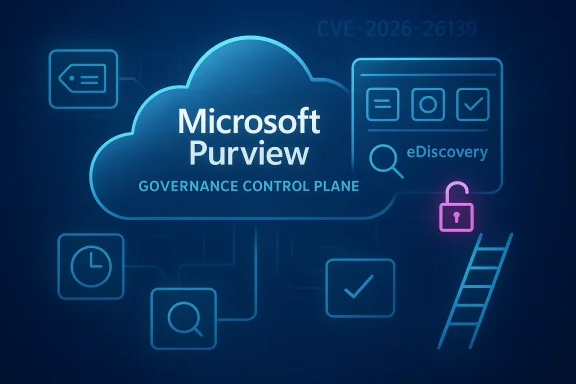
Purview amplifies that concern because its role is not peripheral. It touches governance, eDiscovery, data loss prevention, sensitivity labels, and other controls that often underpin regulatory posture as much as operational security. That makes any privilege escalation issue in Purview more than a routine software bug; it is potentially a control-plane problem. And control-plane problems tend to create outsized consequences compared with their exploit surface.
A final context point is the nature of Microsoft’s cloud CVE disclosure. In recent years the company has become more explicit about cloud-service CVEs, publishing them to improve visibility into issues that may not map neatly onto traditional patch cycles. That broader transparency push suggests that a Purview CVE should be read as an active governance artifact, not merely a historical record. For defenders, that means the advisory itself is part of the operational signal.
That classification also carries a subtle but important confidence message. In Microsoft’s model, a vulnerability description can reflect varying levels of certainty about root cause, but the presence of a CVE itself generally increases the credibility of the existence claim. For practitioners, that means the right question is no longer “Is there really a flaw?” but “What is the exposure path, and how quickly can it be contained?” This is a meaningful shift in mindset.
The practical risk is that a lower-privileged identity could potentially gain unauthorized access to administrative actions or internal data flows. In a SaaS platform, that could translate into policy tampering, broader inspection of content metadata, or access to workflows reserved for higher roles. The exact outcome depends on the vulnerable component, but the category alone is enough to justify close attention.
The strategic value of Purview lies in the fact that it often governs data about data. When an attacker can manipulate policy layers or administrative controls, they may not need to exfiltrate every file to create major harm. Changing a retention rule, exposing metadata, or weakening a policy can be enough to create long-term operational, legal, and security fallout.
That is why defenders should treat a Purview EoP as potentially broader than the words “elevation of privilege” might suggest. In a normal desktop context, EoP often means local admin. In a cloud governance context, it can mean the difference between being able to view your own data and being able to shape the rules that protect everyone else’s. That is a materially different risk profile.
For cloud products, the response model can differ from classic patch-and-reboot cycles. Microsoft increasingly uses service-side mitigation, coordinated disclosure, and advisory updates to reduce exposure even when customers do not have a traditional installer-based patch to deploy. That means the operational response for Purview may involve configuration changes, service-side fixes, or tenant-level guidance rather than a simple update package.
A disciplined response process would look like this:
Consumer-style blast radius is unlikely here, but that should not be misread as “low impact.” Enterprise compromise often has slower detection and higher downstream cost than consumer malware. Once an attacker affects compliance tooling, the damage may show up later as policy drift, audit failures, or privileged misuse that was difficult to reconstruct after the fact.
This is the kind of issue where legal and compliance teams should be looped in early. Not every security event needs that level of cross-functional attention, but anything touching data governance does. That is especially true when the platform is used across regions, subsidiaries, or regulated business units.
Attackers generally prefer flaws that reduce the amount of noisy activity they need to perform. A privilege escalation inside a governance platform can be quieter than ransomware or mass credential theft, because the attacker may be able to blend into normal administrative operations. That makes detection harder and post-incident reconstruction more complicated.
Defenders should remember that privilege escalation is often not the end goal. It is the enabler. A threat actor who gains higher privilege in Purview may use that foothold to suppress controls, identify valuable data, or prepare a more consequential attack later. In many real-world intrusions, that second phase is where the real damage begins.
This matters for CVE-2026-26139 because the public record is likely to evolve. Early advisory entries are often terse, then later updated with mitigation notes, affected-scope adjustments, or clarifications about exploitability. Security teams should treat the initial publication as the beginning of the story, not the end. That is a feature of modern disclosure, not a bug.
For most customers, that is a sensible balance. The job is not to satisfy curiosity; it is to shrink exposure. When the vendor has validated a CVE and published it in the update guide, the priority shifts to containment and verification.
It is also a chance to test whether security operations can see enough of the environment to notice anomalous admin behavior. If Purview is important enough to govern sensitive content, it is important enough to monitor like a crown-jewel system.
There is also the risk of over-correction. Organizations may respond by locking down Purview in ways that impair legitimate compliance work. The challenge is to reduce privilege abuse without breaking the workflows that business, legal, and security teams actually need.
Organizations should also watch their own telemetry. Even when the vulnerability details are limited, signs of unusual administrative activity, unexpected policy changes, or access patterns that do not match normal Purview operations can be early warning indicators. In the cloud, the best defense is often the ability to spot what should not be happening rather than waiting for a known exploit signature.
The bottom line is that CVE-2026-26139 should be treated as a meaningful security event even before every technical detail is public. A vendor-confirmed Elevation of Privilege in Microsoft Purview is exactly the kind of issue that can move from “interesting” to “urgent” once organizations realize how much trust they place in cloud governance tooling. For now, the smartest posture is disciplined vigilance: assume the control plane matters, assume the advisory will evolve, and treat least privilege as an immediate operational priority rather than a policy slogan.
Source: MSRC Security Update Guide - Microsoft Security Response Center
What makes this case especially important is the combination of product scope and confidence signal. Purview sits in the center of Microsoft’s compliance, data governance, and information protection stack, which means an EoP issue there could have consequences well beyond a single endpoint or server role. In practice, that raises the stakes for tenant administrators, security operations teams, and compliance owners alike, because privilege boundaries in Purview often intersect with sensitive policy, discovery, retention, and classification workflows.
 Background
Microsoft has spent years shifting the Security Update Guide toward more structured and transparent vulnerability descriptions, moving from terse bulletin language to CVE-focused entries that help customers map risk more quickly. The company has also made clear that the guide is meant to reflect not only the vulnerability title, but the severity, impact, and technical framing of each issue in a way that can be consumed by defenders at scale. That evolution matters here because CVE-2026-26139 is being surfaced in a product family where customers increasingly rely on cloud-native controls rather than local patching alone.Microsoft’s own documentation philosophy around CVEs has long emphasized that the description itself can reveal how certain the vendor is about a vulnerability’s existence and how much attacker knowledge may already exist. In other words, the advisory language is not just a label; it is a confidence indicator. When Microsoft assigns a CVE and publishes it in the update guide, that is materially different from a generic security rumor or a third-party suspicion because it signals a vendor-confirmed issue in scope for remediation.
Elevation-of-privilege flaws deserve special attention because they often sit on the path from initial access to meaningful compromise. Microsoft has repeatedly described EoP issues in its blog and advisories as vulnerabilities that can let a user or attacker move from one privilege level to another, sometimes requiring valid credentials and sometimes not, depending on the attack surface. The broader lesson is simple: even when an EoP does not provide initial access, it can turn a limited foothold into an administrative or tenant-wide problem.
Purview amplifies that concern because its role is not peripheral. It touches governance, eDiscovery, data loss prevention, sensitivity labels, and other controls that often underpin regulatory posture as much as operational security. That makes any privilege escalation issue in Purview more than a routine software bug; it is potentially a control-plane problem. And control-plane problems tend to create outsized consequences compared with their exploit surface.
A final context point is the nature of Microsoft’s cloud CVE disclosure. In recent years the company has become more explicit about cloud-service CVEs, publishing them to improve visibility into issues that may not map neatly onto traditional patch cycles. That broader transparency push suggests that a Purview CVE should be read as an active governance artifact, not merely a historical record. For defenders, that means the advisory itself is part of the operational signal.
What the CVE Classification Signals
The fact that Microsoft has assigned a CVE and placed it in the Security Update Guide is the first important clue. It means the issue is not just theoretical, and it has progressed far enough through Microsoft’s response process to become a named security item. Even when the public description is short, a CVE entry implies internal validation, triage, and a decision that customers need to know.That classification also carries a subtle but important confidence message. In Microsoft’s model, a vulnerability description can reflect varying levels of certainty about root cause, but the presence of a CVE itself generally increases the credibility of the existence claim. For practitioners, that means the right question is no longer “Is there really a flaw?” but “What is the exposure path, and how quickly can it be contained?” This is a meaningful shift in mindset.
Why Elevation of Privilege Matters in Purview
An EoP in a security and compliance platform is not equivalent to an EoP in a consumer app. Purview administrators may control information barriers, retention policies, audit settings, labels, and other sensitive governance controls. If privilege boundaries are broken there, the attacker may be able to alter data governance outcomes or gain access to capabilities that were deliberately restricted. That can be far more damaging than a simple misconfiguration.The practical risk is that a lower-privileged identity could potentially gain unauthorized access to administrative actions or internal data flows. In a SaaS platform, that could translate into policy tampering, broader inspection of content metadata, or access to workflows reserved for higher roles. The exact outcome depends on the vulnerable component, but the category alone is enough to justify close attention.
- Vendor-confirmed CVE status increases credibility.
- EoP issues are often stepping stones to broader compromise.
- Purview sits close to sensitive governance and compliance workflows.
- Cloud control-plane flaws can have tenant-wide implications.
Why Purview Is a High-Value Target
Microsoft Purview is not just another enterprise dashboard. It is a control hub for data governance, records management, classification, and compliance workflows that organizations depend on to enforce policy at scale. That makes it a natural target for attackers who want to bypass guardrails rather than break into a device one at a time. It also makes it a sensitive area for insiders or threat actors with limited access seeking to expand their reach.The strategic value of Purview lies in the fact that it often governs data about data. When an attacker can manipulate policy layers or administrative controls, they may not need to exfiltrate every file to create major harm. Changing a retention rule, exposing metadata, or weakening a policy can be enough to create long-term operational, legal, and security fallout.
The Control-Plane Problem
The control plane is where policy is defined, not where content merely sits. That distinction matters because threats against the control plane usually scale faster and farther than threats against a single endpoint. If a vulnerability grants elevated rights in that layer, one compromise can ripple across many assets, repositories, and users.That is why defenders should treat a Purview EoP as potentially broader than the words “elevation of privilege” might suggest. In a normal desktop context, EoP often means local admin. In a cloud governance context, it can mean the difference between being able to view your own data and being able to shape the rules that protect everyone else’s. That is a materially different risk profile.
- Policy integrity is as important as data confidentiality.
- Misused governance rights can persist longer than endpoint compromise.
- Metadata exposure can be valuable even when payloads remain protected.
- One control-plane flaw can outlive several endpoint incidents.
The Security Response Lens
Microsoft has a long history of using the Security Update Guide and MSRC blog posts to characterize vulnerability severity and exploitability in ways that help customers prioritize. Those descriptions are often the best early signal defenders get about whether a flaw is likely to require immediate action or careful monitoring. In the absence of full public technical detail, the advisories themselves become the first source of truth.For cloud products, the response model can differ from classic patch-and-reboot cycles. Microsoft increasingly uses service-side mitigation, coordinated disclosure, and advisory updates to reduce exposure even when customers do not have a traditional installer-based patch to deploy. That means the operational response for Purview may involve configuration changes, service-side fixes, or tenant-level guidance rather than a simple update package.
What Security Teams Should Infer
When details are limited, the safest assumption is that Microsoft believes the issue is real enough to deserve tracking and customer awareness. That does not mean exploitation is underway, but it does mean the issue merits inclusion in patch prioritization and threat modeling. Security teams should resist the temptation to down-rank it simply because the public description is short.A disciplined response process would look like this:
- Confirm whether the tenant uses Purview features that could intersect with the affected area.
- Review administrative and delegated access paths tied to Purview roles.
- Check whether any compensating controls, such as least privilege or conditional access, can reduce blast radius.
- Monitor MSRC updates for revised guidance or mitigation notes.
- Coordinate with identity and compliance teams before making changes that could break policy enforcement.
Enterprise Impact vs. Consumer Impact
Purview is fundamentally an enterprise product, so the impact profile is almost entirely organizational rather than personal. The primary victims are likely to be tenants that depend on Purview for governance, legal hold, information protection, or records management. That means the consequences can extend into regulatory, audit, and litigation contexts, not just technical incident response.Consumer-style blast radius is unlikely here, but that should not be misread as “low impact.” Enterprise compromise often has slower detection and higher downstream cost than consumer malware. Once an attacker affects compliance tooling, the damage may show up later as policy drift, audit failures, or privileged misuse that was difficult to reconstruct after the fact.
Practical Consequences for Large Organizations
Large organizations should think about this CVE in terms of governance resilience. If a threat actor could gain higher privileges in Purview, the attacker might not need to encrypt files or steal passwords to create serious disruption. They may only need to alter policies, silence alerts, or access administrative data that helps them move laterally.This is the kind of issue where legal and compliance teams should be looped in early. Not every security event needs that level of cross-functional attention, but anything touching data governance does. That is especially true when the platform is used across regions, subsidiaries, or regulated business units.
- Enterprises face policy and audit risk.
- Consumers are likely unaffected directly.
- Compliance teams may need to validate controls.
- Incident responders should plan for governance abuse scenarios.
How Attackers Might Think About It
Even without public exploit details, an attacker would view a Purview EoP as attractive because it may unlock the administrative layer rather than a single user account. That is the path from ordinary access to strategic access. If the flaw is reachable through a web workflow or delegated identity path, the barrier to exploitation could be even lower than defenders would like.Attackers generally prefer flaws that reduce the amount of noisy activity they need to perform. A privilege escalation inside a governance platform can be quieter than ransomware or mass credential theft, because the attacker may be able to blend into normal administrative operations. That makes detection harder and post-incident reconstruction more complicated.
Likely Abuse Patterns
The most plausible abuse patterns for an issue like this include unauthorized configuration changes, policy tampering, administrative impersonation, or access to sensitive metadata. If the vulnerability intersects with role assignment or workflow permissions, the attacker could use it as a launch pad for broader internal movement. If it affects API authorization or delegated trust, the threat could scale very quickly.Defenders should remember that privilege escalation is often not the end goal. It is the enabler. A threat actor who gains higher privilege in Purview may use that foothold to suppress controls, identify valuable data, or prepare a more consequential attack later. In many real-world intrusions, that second phase is where the real damage begins.
- Silent abuse is more likely than flashy malware.
- Administrative impersonation is a serious concern.
- API and role workflows deserve special scrutiny.
- Privilege escalation is usually a bridge, not a destination.
Microsoft’s Transparency Strategy
Microsoft has become more open about cloud-service vulnerabilities in response to the reality that customers need visibility into risks that do not always follow the old software-update model. The company’s recent blog posts about cloud CVEs and machine-readable security data show a broader commitment to making vulnerability information easier to consume programmatically and operationally. That’s good for defenders, because modern security operations depend on structured signals rather than isolated advisories.This matters for CVE-2026-26139 because the public record is likely to evolve. Early advisory entries are often terse, then later updated with mitigation notes, affected-scope adjustments, or clarifications about exploitability. Security teams should treat the initial publication as the beginning of the story, not the end. That is a feature of modern disclosure, not a bug.
Why Sparse Detail Can Be Helpful
Sparse detail can sometimes frustrate security pros, but it also reduces the odds of copycat exploitation before mitigations are in place. That tension is familiar in coordinated vulnerability disclosure. Microsoft’s approach suggests that it wants to arm defenders with enough information to act without turning the advisory into an attack recipe.For most customers, that is a sensible balance. The job is not to satisfy curiosity; it is to shrink exposure. When the vendor has validated a CVE and published it in the update guide, the priority shifts to containment and verification.
Strengths and Opportunities
The most useful way to think about CVE-2026-26139 is not as a headline, but as a forcing function for better governance hygiene. Even if the final remediation turns out to be straightforward, the advisory gives organizations an opportunity to tighten identity controls, review Purview roles, and improve incident readiness around one of the most sensitive layers in the Microsoft 365 stack.- Vendor acknowledgment provides high-confidence signal.
- Purview security reviews can be folded into broader governance audits.
- Least-privilege design becomes easier to justify with a concrete CVE.
- Cross-team coordination between security, compliance, and identity teams can improve.
- Service-side mitigation may reduce customer operational burden.
- Detection engineering can be tuned around abnormal admin behavior.
- Policy review cycles can be accelerated while the issue is fresh.
A Chance to Harden the Control Plane
A serious advisory often does more than expose risk; it exposes organizational assumptions. Many enterprises discover, during incidents like this, that their administrative roles are broader than intended or that delegated access has accumulated over time. That makes the CVE an opportunity to clean up technical debt in the governance stack.It is also a chance to test whether security operations can see enough of the environment to notice anomalous admin behavior. If Purview is important enough to govern sensitive content, it is important enough to monitor like a crown-jewel system.
Risks and Concerns
The biggest concern with a Purview EoP is not just the possibility of privilege gain, but the uncertainty that often surrounds cloud control-plane vulnerabilities at first disclosure. When the public description is short, organizations may underestimate the issue or delay validation. That is risky, because cloud governance issues can have broad impact even when the exploit chain appears narrow.- Under-prioritization is a real risk if teams focus only on endpoint CVEs.
- Incomplete role inventories can hide exposure.
- Delayed mitigation can leave governance controls in a fragile state.
- Audit and compliance implications may be discovered too late.
- Role sprawl increases the chance of misuse after escalation.
- Misconfiguration overlap can make root cause analysis harder.
- A quiet cloud EoP can be more dangerous than a noisy endpoint bug.
The Hidden Cost of Control-Plane Abuse
If a threat actor manipulates governance settings, the organization may not immediately recognize the issue as a security incident. It can look like normal administrative change until someone notices the downstream effects. That delay is particularly costly in regulated environments, where retention, labeling, and legal hold decisions can carry long-tail obligations.There is also the risk of over-correction. Organizations may respond by locking down Purview in ways that impair legitimate compliance work. The challenge is to reduce privilege abuse without breaking the workflows that business, legal, and security teams actually need.
What to Watch Next
The most important next step is not a dramatic disclosure, but a practical one: Microsoft may add details, mitigation guidance, or revised scope information to the CVE entry as investigation progresses. That is common for cloud advisories, especially when the vendor is balancing transparency with safe disclosure. Security teams should watch for changes in affected product coverage, exploitability language, and remediation guidance.Organizations should also watch their own telemetry. Even when the vulnerability details are limited, signs of unusual administrative activity, unexpected policy changes, or access patterns that do not match normal Purview operations can be early warning indicators. In the cloud, the best defense is often the ability to spot what should not be happening rather than waiting for a known exploit signature.
Priority Watch Items
- Microsoft updates to the CVE-2026-26139 advisory.
- Any clarification about affected Purview services or roles.
- Guidance on whether mitigation is service-side, configuration-based, or both.
- Alerts for abnormal privilege changes in Microsoft 365 or Purview.
- Correlation with identity logs, audit logs, and administrative change records.
The bottom line is that CVE-2026-26139 should be treated as a meaningful security event even before every technical detail is public. A vendor-confirmed Elevation of Privilege in Microsoft Purview is exactly the kind of issue that can move from “interesting” to “urgent” once organizations realize how much trust they place in cloud governance tooling. For now, the smartest posture is disciplined vigilance: assume the control plane matters, assume the advisory will evolve, and treat least privilege as an immediate operational priority rather than a policy slogan.
Source: MSRC Security Update Guide - Microsoft Security Response Center
Last edited:
