

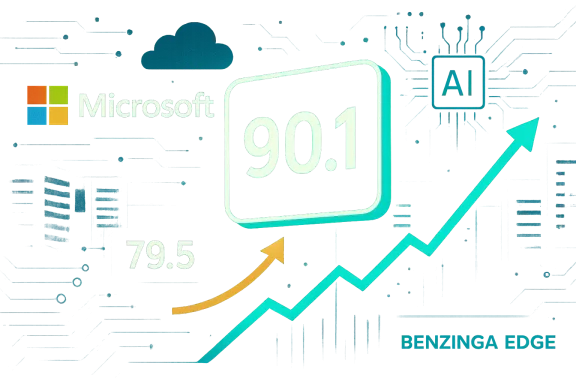
Microsoft's recent jump in the Benzinga Edge quality score — from 79.51 to 90.08 in a single week — has refocused a familiar market debate: can operational discipline and cash‑flow resilience outpace the headline noise around hyperscaler AI spending? The short answer is: for now, the narrative leans toward efficiency paying off, but the picture is complex, time‑sensitive, and full of trade‑offs investors and IT leaders must understand.
Microsoft’s quality‑score move landed in the middle of a broader industry pivot: hyperscalers are committing unprecedented capital to AI infrastructure, and investors are struggling to reconcile long‑term opportunity with near‑term cash conversion. Benzinga’s synthesis highlights Microsoft as a top decile performer on operational metrics even as price trends remain weak — a reminder that fundamentals and technicals can tell different stories at the same time.
At the center of the argument is free cash flow (FCF) resilience. BNP Paribas analysts — cited in coverage amplifying Benzinga’s take — project Microsoft’s FCF margin at roughly 22%, a figure used to contrast Microsoft’s cash profile with peers whose FCF is under pressure as they commit capital to chips, data centers and AI stacks. That projected margin is an analyst estimate, not a company disclosure, and should be read as a relative snapshot within a fast‑moving cycle.
Meanwhile, Amazon’s headline declaration of roughly $200 billion in capex for 2026 has crystallized investor anxiety around the financing and returns of the AI arms race. That one figure alone reshaped industry risk perceptions and amplified the “who can sustain low returns for scale” question across the cloud leaders.
Investors now face two related questions:
Key differences versus Microsoft:
In plain terms:
Microsoft’s recent quality‑score leap is an important clue in a larger story: efficiency and diversified monetization can indeed blunt the worst effects of a high‑capex AI arms race. But that truth is conditional — contingent on execution, on the pace at which Microsoft can monetize AI in high‑value enterprise products, and on how the cyclical layer of capex plays out across competitors. Short‑term price action may remain choppy, but the long‑run outcome will depend on whether Microsoft can translate disciplined spending into measurable returns at scale.
Source: AOL.com Microsoft's Quality Rank Surges As AI Spend Efficiency Calms Investor Nerves
 Background / Overview
Microsoft’s quality‑score move landed in the middle of a broader industry pivot: hyperscalers are committing unprecedented capital to AI infrastructure, and investors are struggling to reconcile long‑term opportunity with near‑term cash conversion. Benzinga’s synthesis highlights Microsoft as a top decile performer on operational metrics even as price trends remain weak — a reminder that fundamentals and technicals can tell different stories at the same time.At the center of the argument is free cash flow (FCF) resilience. BNP Paribas analysts — cited in coverage amplifying Benzinga’s take — project Microsoft’s FCF margin at roughly 22%, a figure used to contrast Microsoft’s cash profile with peers whose FCF is under pressure as they commit capital to chips, data centers and AI stacks. That projected margin is an analyst estimate, not a company disclosure, and should be read as a relative snapshot within a fast‑moving cycle.
Meanwhile, Amazon’s headline declaration of roughly $200 billion in capex for 2026 has crystallized investor anxiety around the financing and returns of the AI arms race. That one figure alone reshaped industry risk perceptions and amplified the “who can sustain low returns for scale” question across the cloud leaders.
What the Benzinga Edge quality score actually measures — and what jumped
The metric, in plain terms
Benzinga Edge’s “quality” ranking is a composite designed to capture operational efficiency and financial health across multiple quantitative inputs. It’s not a measure of product strength or market share; rather, it weights things like cash‑flow generation, earnings stability, and balance‑sheet durability to derive a relative score. That makes it useful when you want to gauge whether a company can stoically navigate capital cycles. Benzinga’s recent snapshot puts Microsoft into the top 10% of operational performers on that scale.Why a one‑week jump matters — and why it doesn’t tell the whole story
A movement from ~79.5 to 90.1 is statistically material in a rank‑based system: it signals an improvement in the inputs or a re‑weighting of recent data. But one week’s jump can reflect:- the release of new analyst projections or research notes,
- short‑term changes in modeled cash forecasts, or
- a correction to prior data inputs.
Why cash-flow resilience matters more in this AI cycle
The capital intensity of the AI transition
AI at hyperscale is a capital‑heavy business: compute clusters, bespoke chips, networking, and specialized facility buildouts all require long‑lead investment. Firms that front‑load capacity to win model training and inference contracts may see top‑line acceleration, but the path to reliable positive FCF can be stretched for quarters or even years.Investors now face two related questions:
- Which companies can invest aggressively without destroying near‑term cash conversion?
- Which companies will be rewarded for scale and early investments versus penalized for margin dilution?
Microsoft’s case: efficiency, diversification, and licensing leverage
Microsoft’s argument is multifaceted:- a broad revenue base across productivity, cloud, gaming, and professional networking provides multiple cash engines;
- strong enterprise licensing and subscription models convert revenue more predictably than pure‑play infrastructure sales;
- Microsoft’s ability to monetize AI as a platform and embed it across Office, Windows and Azure can produce higher incremental returns than raw compute contracts alone.
Comparing the hyperscalers: the divergence in strategy and cash outcomes
Amazon: scale, speed — and a near‑term cash squeeze
Amazon told investors it plans to spend about $200 billion in capital expenditures in 2026, concentrating largely on AWS and AI capacity. That scale is unprecedented and immediately raises the question of near‑term FCF implications: higher capex tends to suppress free cash flow until investments are utilized and monetized. Investors reacted accordingly, with volatility and fresh scrutiny of Amazon’s financing choices and expected timeframe for returns.Key differences versus Microsoft:
- Amazon’s model is historically capex‑intensive even before AI (fulfillment, logistics, retail), so incremental AI capex compounds that baseline.
- AWS monetizes raw capacity differently than Microsoft’s blend of SaaS and platform revenue; the margin waterfall is distinct and more dependent on capacity utilization.
Alphabet / Google: heavy AI bets plus an ad machine
Google’s Google Cloud and Gemini play represent a simultaneous push for infrastructure and differentiated AI services. Google’s ad business still produces substantial cash, but Google’s capital plans have also stepped up — and investors are watching the mix of capex, operating margins and ad‑demand cyclicality. The picture here is one of a strong cash base but higher near‑term investment intensity across the major players. Benzinga and peers fold these dynamics into their hyperscaler comparisons when highlighting Microsoft’s FCF resilience.Technical headwinds: why fundamentals and price action have diverged
Even as Benzinga’s quality metric turned bullish, Microsoft’s price action has been mixed to negative over multiple timeframes. Benzinga’s Edge flagged red signals across short‑, medium‑ and long‑term momentum indicators — a circumstance that has left the fundamental story somewhat out of sync with the technical reality.What the market has punished (and why)
- Multiple downgrades and cautious notes: Stifel’s rare downgrade to Hold and target cut to $392 highlighted worries about Azure capacity, margin pressure from higher capex, and near‑term growth visibility — a voice that amplified selling pressure even while many analysts remained constructive. Analysts raised future capex estimates for Microsoft, which in turn pressured margin forecasts.
- Rotation risk: When the market rotates out of expensive growth names or favors near‑term cash generation, even healthy multipliers can compress quickly.
- Macro sensitivity: Rising interest‑rate expectations and market volatility amplify the discount applied to long‑duration tech earnings, sensitizing share prices to even marginal shifts in forward guidance.
The numbers: what’s verifiable and what’s model‑dependent
Analyst projections vs. company reported FCF
- The figure widely attributed to BNP Paribas — that Microsoft can sustain an FCF margin of roughly 22% — is an analyst projection used to compare relative resilience across the Big Five hyperscalers. It is plausible given Microsoft’s diversified revenue mix and historical cash conversion, but it remains model‑dependent. Other databases and quarterly metrics show that FCF margins can vary materially quarter‑to‑quarter for Microsoft, driven by timing of capex and working‑capital swings. Always check the firm’s SEC filings for the final official numbers.
- Amazon’s $200B capex outlook is a management announcement and widely corroborated across major outlets; it is an operational fact (a budget guidance line item) rather than an analyst inference. That said, how that capex flows through to margins and FCF is inherently forward‑looking and uncertain.
Market moves and short‑term performance
Benzinga’s piece reports Microsoft down roughly 12.52% year‑to‑date in the cited window and specific intraday closes around $413––$414 in early February 2026. Those price levels can be independently verified via exchange‑reported historical data and market data vendors; small discrepancies (a few cents to a dollar) reflect delayed quotes, differing data vendors, or intraday prints, but the magnitude of recent YTD weakness is consistent across vendors.Strengths that validate the “quality” call
- Diversified monetization: Microsoft combines subscription SaaS, enterprise licensing, cloud infrastructure, gaming, and advertising to generate multiple, semi‑predictable cash streams. This diversification reduces single‑point‑of‑failure cash risk.
- Embedded AI monetization: Because Microsoft can fold AI value into existing products (Office, Teams, Windows), the company has potential to capture higher incremental prices without relying solely on raw compute monetization. This is structural leverage many peers lack.
- Strong enterprise relationships: Microsoft’s enterprise footprint enables cross‑sell, which can accelerate ROI on AI investments when packaged as productivity enhancements rather than commodity compute.
Risks that should temper enthusiasm
- Capital intensity and timing risk: Even disciplined spenders face timing mismatches. If Microsoft’s AI investments outpace early monetization cycles — or if Azure capacity bottlenecks persist longer than anticipated — margins and FCF could be pressured. Stifel and others explicitly flagged this scenario.
- Competition dynamics: Google Cloud, AWS, Anthropic and specialized AI firms are each inching forward in specific niches. Market share battles in model hosting, inference margins and enterprise AI services could erode expected returns on Microsoft’s AI capex.
- Execution and security exposures: Large, rapid AI deployments raise operational and security risks — from data governance to supply‑chain dependencies on accelerators — that can translate into reputational and financial drag if mishandled. The headline quality score doesn’t capture implementation risk.
Practical takeaways for investors and IT decision‑makers
For investors: reconcile the three horizons
- Short term (weeks to months) — be mindful of technical signals and sentiment: downgrades and capex headlines can sustain volatility even when fundamentals improve. Benzinga’s Edge shows red across multiple timeframes for Microsoft despite better quality metrics.
- Medium term (quarters) — monitor capex cadence, Azure capacity announcements, and reported cash conversion. Analyst projections like BNP Paribas’s ~22% FCF margin are useful baselines but update rapidly as companies publish guidance and as capex becomes capitalized and monetized.
- Long term (years) — focus on durable monetization: can Microsoft translate product integration into sustained structural advantage (higher ARPU, stickier enterprise contracts)? Competitive moat and execution matter most here.
For IT leaders and procurement teams
- Negotiate for managed service options where possible: moving from raw capacity purchase to managed AI services can convert capital expenditures into more predictable operating expenses.
- Assess hybrid architecture economics: balance on‑prem or colocation investments with cloud burst patterns to avoid stranded capex if demand shifts.
- Quantify ROI on AI pilots before scaling: vendors will offer fast access to models, but internal adoption and measurable productivity gains determine real returns.
What to watch next — trigger events and data points
- Quarterly capex and FCF releases from Microsoft, Amazon, and Alphabet (watch both reported figures and forward guidance).
- Azure capacity commentary and customer backlog disclosures: any sign that capacity bottlenecks ease or worsen will materially shift near‑term guidance and re‑rate expectations.
- Third‑party cloud procurement and enterprise AI contract announcements: enterprise wins that demonstrate pricing power on AI features will validate higher FCF expectations.
- Any large analyst re‑estimates (upgrades/downgrades) tied to capex assumptions — these shifts are the proximate cause of market momentum in 2026 so far.
How to interpret conflicting signals
When fundamentals and technicals diverge, the sensible posture is layered and probabilistic:- Treat quality and cash metrics (Benzinga’s score, analyst FCF estimates) as the baseline for structural resilience.
- Treat technical indicators and analyst downgrades as shorter‑window risk signals that can erode market value even when structural fundamentals remain intact.
- Blend both: allocate based on time horizon, and size positions to withstand quarter‑to‑quarter noise while capturing asymmetric upside if efficiency and monetization validate analyst optimism.
Final assessment and framing
Microsoft’s climb into the upper echelon of Benzinga Edge’s quality rankings is not a trivial datapoint — it reflects a consensus view among some analysts that Microsoft’s cash‑flow profile and product‑level monetization give it an advantage in a capital‑intensive AI race. At the same time, the market’s reaction — from notable downgrades to broad concern over hyperscaler capex — highlights that narrative control can flip quickly when capex pacing, capacity constraints, or competitive moves change expectations.In plain terms:
- Strengths: diversified cash engines; embedded monetization pathways for AI; a credible case for better normalized FCF than peers.
- Risks: elevated capex cycles industry‑wide (Amazon’s $200B is the poster child), execution and capacity timing, and competitive erosion that could compress realized margins.
Microsoft’s recent quality‑score leap is an important clue in a larger story: efficiency and diversified monetization can indeed blunt the worst effects of a high‑capex AI arms race. But that truth is conditional — contingent on execution, on the pace at which Microsoft can monetize AI in high‑value enterprise products, and on how the cyclical layer of capex plays out across competitors. Short‑term price action may remain choppy, but the long‑run outcome will depend on whether Microsoft can translate disciplined spending into measurable returns at scale.
Source: AOL.com Microsoft's Quality Rank Surges As AI Spend Efficiency Calms Investor Nerves
