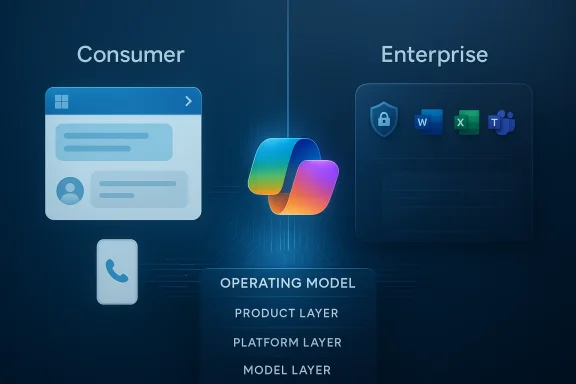
Microsoft is once again reshuffling its AI org, and this time the message is as much about concentration as it is about Copilot. By pulling together the engineering groups behind its consumer and commercial assistants, the company is effectively admitting that Copilot has become too fragmented to sell as one coherent product story. The move also elevates Jacob Andreou and frees Mustafa Suleyman to focus more narrowly on model-building, which is a polite corporate way of saying Microsoft wants cleaner lines of responsibility after a year of mixed Copilot momentum. The timing matters, too: in a market where ChatGPT, Gemini, and Claude are all racing ahead on user attention, Microsoft is trying to simplify the machine before competitors make the complexity look like drift.
Microsoft’s Copilot strategy began as an ambitious attempt to put a conversational layer across the company’s most important surfaces: Windows, Microsoft 365, Bing, Edge, GitHub, and an expanding list of enterprise tools. The idea was elegant in theory. In practice, it produced a product family that often felt more like a label than a platform, with separate experiences for consumers, workers, developers, and IT teams.
That tension has been visible for years. Microsoft launched Microsoft 365 Copilot as a premium work assistant, built consumer-facing Copilot experiences into Windows and Edge, and then expanded the brand into specialized products like GitHub Copilot and Dragon Copilot. The family resemblance helped with marketing, but it also created a branding maze that made it hard for users to know which Copilot did what, where, and for whom.
At the same time, Microsoft’s broader AI organization has been in constant motion. The company created Microsoft AI in 2024 to house consumer AI efforts under Mustafa Suleyman, and later formed CoreAI to unify platform and tooling work around the company’s developer and enterprise ambitions. In other words, Microsoft did not merely add Copilot features; it built a layered organizational structure around them, hoping the product lineup would eventually feel integrated enough to justify the complexity. It has not fully gotten there.
The result is a company that has impressive reach but uneven clarity. Microsoft’s annual report says its Copilot family surpassed 100 million monthly active users across both commercial and consumer in fiscal 2025, and that Microsoft 365 Copilot, Copilot Studio, GitHub Copilot, and consumer Copilot all remain central to the company’s AI story. That is not a failure by any normal corporate standard. But in the hyper-competitive AI assistant market, it can still look like underperformance if the highest-profile consumer product lags much larger rivals by an order of magnitude.
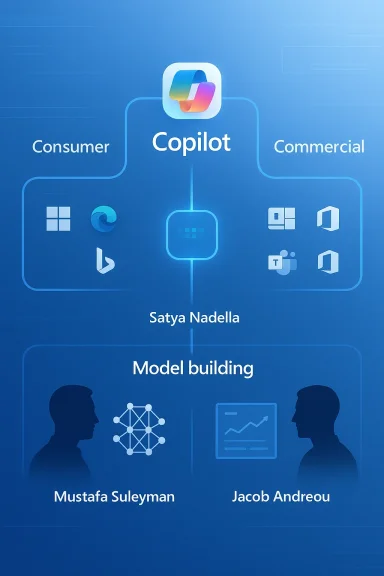
The other part of the change is the role of Mustafa Suleyman. Microsoft wants him more focused on model strategy and future systems work, especially what he has described as the company’s “Superintelligence” push. In effect, Microsoft is separating the product packaging problem from the model-building problem. That division is not a small administrative tweak; it is an architectural choice about where the company thinks the bottleneck actually is.
The reorganization also shows that Microsoft is not satisfied with merely being “in the race.” It wants a clearer command structure because the market is rewarding companies that can ship one recognizable assistant experience and iterate fast. The company may still have enormous enterprise leverage, but leverage is not the same thing as consumer love.
Microsoft does have a serious AI footprint. Its annual report says the company surpassed 100 million monthly active users across commercial and consumer Copilot experiences in fiscal 2025, and GitHub Copilot alone passed 20 million users. But those numbers are spread across different use cases and customer types, which makes them less impressive as a single consumer story than they would be if they belonged to one dominant assistant brand.
That fragmentation is not trivial. A consumer assistant succeeds when the user can answer, in one breath, what it is for and why it is better. ChatGPT has become the default answer for general AI chat, while Google is using its own ecosystem to push Gemini everywhere from Android to search. Microsoft’s breadth is an asset, but only if the company can make the breadth feel like one seamless product rather than five adjacent experiments.
But even there, adoption is not frictionless. Enterprises buy on procurement logic, not hype. They need governance, policy, security, measurable ROI, and integration into the workflows employees already use. Microsoft understands this well, which is why it keeps emphasizing security, observability, and data protection. Still, enterprise success is often slower and more incremental than consumer success, and it rarely produces the same cultural signal.
In that sense, Microsoft may be acknowledging a simple truth: the product can only be as good as the organizational clarity behind it. If Copilot has been held back by ambiguity, then separating model work from product glue could reduce internal drag. It might also help Microsoft compete more cleanly against vendors whose public identity is more focused.
That said, there is a softer political reading too. If a product effort is underdelivering, the company often responds by reassigning responsibility in ways that preserve talent while reducing exposure. “Freeing up” a senior executive is a classic corporate phrase because it sounds strategic rather than corrective. Whether this proves to be a true refocus or an elegant retreat will depend on execution over the next several quarters.
This is a classic platform-company problem. Microsoft wants the Copilot name to become as durable as Office or Windows, but those brands succeeded because the product boundaries were legible. Copilot, by contrast, is trying to be both a consumer brand and an enterprise framework, which means the company must explain its value over and over again.
That breadth can still win in the long run if Microsoft makes the experience feel native across its ecosystem. But if the company cannot turn that sprawl into coherence, the risk is that Copilot becomes a feature brand rather than a destination brand. And feature brands rarely become cultural defaults.
That matters because Microsoft’s consumer Copilot has not reached the same psychological status. Even with deep Windows and Microsoft 365 integration, Copilot is still more likely to be seen as a Microsoft feature than as the first-choice AI endpoint. That is not fatal, but it is a real handicap in a market where brand reflex matters.
Microsoft’s answer has been to build AI into its own ubiquitous surfaces, but the experience is less uniform than Google’s. Where Google can funnel attention through a tightly controlled consumer ecosystem, Microsoft has to bridge the worlds of work and personal computing, which complicates product design and adoption messaging.
That creates a troubling contrast for Microsoft. If a smaller rival can generate enthusiasm through a clearer product identity, then Microsoft has to ask whether its own breadth is diluting the very usefulness it is trying to sell. More copilots may not be the answer if the market is asking for one assistant it can trust.
Microsoft has some real consumer advantages, especially around Windows distribution and familiarity. But familiarity is not the same as love. If users associate Copilot with surprise pop-ups, inconsistent features, or vague value, the product will struggle to build repeat use. That is the kind of friction that kills momentum long before analysts start worrying about market share.
Still, the enterprise market is less forgiving than the consumer market in a different way. Buyers want measurable ROI, not just demos. They will ask whether Copilot saves time, reduces errors, or produces higher-quality work at scale. If Microsoft wants the enterprise story to carry the brand, it has to prove that Copilot is not just a smart interface but a reliable business system.
Microsoft’s strongest path forward is probably not to out-chat ChatGPT on the open internet, but to make Copilot unavoidable inside the workflows where Microsoft already rules. That means better integration, clearer value, more consistent behavior, and fewer identity crises. The company also needs to show that its model strategy and product strategy are finally aligned, because the AI market is punishing confusion and rewarding products that feel inevitable.
Source: spyglass.org Microsoft Adds More Copilots to Help Copilot Copilot
 Background
Microsoft’s Copilot strategy began as an ambitious attempt to put a conversational layer across the company’s most important surfaces: Windows, Microsoft 365, Bing, Edge, GitHub, and an expanding list of enterprise tools. The idea was elegant in theory. In practice, it produced a product family that often felt more like a label than a platform, with separate experiences for consumers, workers, developers, and IT teams.That tension has been visible for years. Microsoft launched Microsoft 365 Copilot as a premium work assistant, built consumer-facing Copilot experiences into Windows and Edge, and then expanded the brand into specialized products like GitHub Copilot and Dragon Copilot. The family resemblance helped with marketing, but it also created a branding maze that made it hard for users to know which Copilot did what, where, and for whom.
At the same time, Microsoft’s broader AI organization has been in constant motion. The company created Microsoft AI in 2024 to house consumer AI efforts under Mustafa Suleyman, and later formed CoreAI to unify platform and tooling work around the company’s developer and enterprise ambitions. In other words, Microsoft did not merely add Copilot features; it built a layered organizational structure around them, hoping the product lineup would eventually feel integrated enough to justify the complexity. It has not fully gotten there.
The result is a company that has impressive reach but uneven clarity. Microsoft’s annual report says its Copilot family surpassed 100 million monthly active users across both commercial and consumer in fiscal 2025, and that Microsoft 365 Copilot, Copilot Studio, GitHub Copilot, and consumer Copilot all remain central to the company’s AI story. That is not a failure by any normal corporate standard. But in the hyper-competitive AI assistant market, it can still look like underperformance if the highest-profile consumer product lags much larger rivals by an order of magnitude.
The Reorganization in Plain English
The most important takeaway from Microsoft’s latest move is that it is trying to reduce overlap between consumer and commercial Copilot development. The company appears to believe that the user experience, not just the underlying models, needs one stronger center of gravity. That is a sensible response to a product line that has grown organically but not always coherently.What Changed
According to the reporting reflected in the company’s recent organizational shifts, Jacob Andreou will oversee the consumer and commercial Copilot experience, while executives such as Ryan Roslansky, Perry Clarke, and Charles Lamanna now sit directly under Satya Nadella. That kind of reporting line is a signal. Microsoft is telling the org to stop acting like loosely connected AI fiefdoms and start acting like a single product company.The other part of the change is the role of Mustafa Suleyman. Microsoft wants him more focused on model strategy and future systems work, especially what he has described as the company’s “Superintelligence” push. In effect, Microsoft is separating the product packaging problem from the model-building problem. That division is not a small administrative tweak; it is an architectural choice about where the company thinks the bottleneck actually is.
- Consumer Copilot and commercial Copilot are being aligned more closely.
- Product experience leadership is being consolidated.
- Model-building is being separated from day-to-day product sprawl.
- Nadella is tightening top-level oversight over key AI workstreams.
Why It Matters
This matters because AI assistants are not just apps; they are interface layers. If the layer is confusing, fragmented, or duplicated across surfaces, users never build a durable habit. Microsoft has spent years learning that lesson in Office, Windows, and search, where adoption improves when the product is obvious and repeated often enough to become muscle memory. Copilot still lacks that kind of instinctive identity.The reorganization also shows that Microsoft is not satisfied with merely being “in the race.” It wants a clearer command structure because the market is rewarding companies that can ship one recognizable assistant experience and iterate fast. The company may still have enormous enterprise leverage, but leverage is not the same thing as consumer love.
User Adoption and the Visibility Problem
The adoption numbers circulating around the latest shake-up tell a straightforward story: Copilot is not yet a breakout consumer habit. By contrast, ChatGPT has scaled to a category-defining audience, Gemini has turned Google’s distribution into enormous reach, and Claude has enjoyed unusually strong momentum for a competitor that only recently entered the public mainstream. Even if some of the exact app-intelligence estimates vary, the directional picture is hard to miss.Microsoft does have a serious AI footprint. Its annual report says the company surpassed 100 million monthly active users across commercial and consumer Copilot experiences in fiscal 2025, and GitHub Copilot alone passed 20 million users. But those numbers are spread across different use cases and customer types, which makes them less impressive as a single consumer story than they would be if they belonged to one dominant assistant brand.
Consumer Demand Is Still the Hard Part
Consumer adoption is where Microsoft’s Copilot effort has looked weakest. The product sits in a strange middle space: more visible than enterprise software, but less beloved than dedicated consumer AI chat apps. Users can encounter Copilot in Windows, Edge, Bing, mobile apps, Microsoft 365, and other places, yet that broad presence has not translated into a singular consumer identity.That fragmentation is not trivial. A consumer assistant succeeds when the user can answer, in one breath, what it is for and why it is better. ChatGPT has become the default answer for general AI chat, while Google is using its own ecosystem to push Gemini everywhere from Android to search. Microsoft’s breadth is an asset, but only if the company can make the breadth feel like one seamless product rather than five adjacent experiments.
Enterprise Is Better, But Still Not Enough
The enterprise side is stronger, largely because Microsoft already owns the workplace context. Microsoft 365, Teams, Outlook, Word, Excel, and the broader Microsoft security stack give Copilot a distribution channel that rivals envy. Microsoft has also been steadily expanding Copilot for commercial customers, including offerings such as Microsoft 365 Copilot Chat and work-focused agents inside its productivity suite.But even there, adoption is not frictionless. Enterprises buy on procurement logic, not hype. They need governance, policy, security, measurable ROI, and integration into the workflows employees already use. Microsoft understands this well, which is why it keeps emphasizing security, observability, and data protection. Still, enterprise success is often slower and more incremental than consumer success, and it rarely produces the same cultural signal.
- Consumer Copilot lacks a clear default use case.
- Enterprise Copilot has distribution, but adoption is slower and more controlled.
- Product confusion weakens the brand across both audiences.
- AI assistants need habit, not just access.
The Suleyman Question
The biggest symbolic shift in the new structure may be the repositioning of Mustafa Suleyman. When Microsoft brought him in, it was a statement of intent: the company wanted a heavyweight AI leader with product ambition, model credibility, and startup-era intensity. That made sense when Copilot was still being assembled as a grand consumer-facing AI push. But the company now appears to believe that the next phase needs a different balance.From Product Operator to Model Strategist
Suleyman’s new emphasis on future models, including his “Superintelligence” framing, suggests Microsoft wants him closer to the technological core and less entangled in the day-to-day struggle of shipping a coherent assistant. That could be smart. Big AI organizations often fail because their leaders are forced to do both: shape the model roadmap and manage product execution across too many surfaces.In that sense, Microsoft may be acknowledging a simple truth: the product can only be as good as the organizational clarity behind it. If Copilot has been held back by ambiguity, then separating model work from product glue could reduce internal drag. It might also help Microsoft compete more cleanly against vendors whose public identity is more focused.
Why This Is Not Necessarily a Demotion
It would be easy to read this as a loss of confidence in Suleyman. That may be too blunt. In large tech companies, being reassigned toward foundational model work can be a sign of trust, not punishment. Microsoft is effectively saying that it still needs his technical leadership, but in a narrower, higher-leverage lane.That said, there is a softer political reading too. If a product effort is underdelivering, the company often responds by reassigning responsibility in ways that preserve talent while reducing exposure. “Freeing up” a senior executive is a classic corporate phrase because it sounds strategic rather than corrective. Whether this proves to be a true refocus or an elegant retreat will depend on execution over the next several quarters.
Microsoft’s Multi-Copilot Problem
Microsoft’s brand architecture has become one of the most interesting messes in tech. There is Microsoft Copilot for consumers, Microsoft 365 Copilot for work, GitHub Copilot for developers, Copilot Studio for building agents, and domain-specific variants in healthcare and security. The company has also layered in agents, modes, and model choices, which makes the whole thing feel powerful and confusing at the same time.Why the Naming Is Hurting the Story
The “Copilot” label was meant to unify Microsoft’s AI future. Instead, it has sometimes obscured it. Users do not encounter a single assistant so much as a family of adjacent assistants, each with different permissions, pricing, and expectations. That may make strategic sense inside Microsoft, but outside the company it can feel like one long menu of mostly related tools.This is a classic platform-company problem. Microsoft wants the Copilot name to become as durable as Office or Windows, but those brands succeeded because the product boundaries were legible. Copilot, by contrast, is trying to be both a consumer brand and an enterprise framework, which means the company must explain its value over and over again.
- The Copilot brand is powerful but overloaded.
- Different Copilot products serve different audiences and workflows.
- Product naming has become a strategic liability.
- Microsoft needs clarity more than ever.
The Competitive Risk of Being Too Broad
Competitors are not burdened by the same history. OpenAI can keep ChatGPT relatively simple. Google can fold Gemini into Search, Android, and Workspace. Anthropic can position Claude around intelligence, reliability, and, lately, enterprise credibility. Microsoft is trying to make one umbrella brand do the work of several separate products.That breadth can still win in the long run if Microsoft makes the experience feel native across its ecosystem. But if the company cannot turn that sprawl into coherence, the risk is that Copilot becomes a feature brand rather than a destination brand. And feature brands rarely become cultural defaults.
Competitive Pressure From ChatGPT, Gemini, and Claude
Microsoft’s internal restructuring lands in a market that is moving quickly and unevenly. ChatGPT remains the benchmark for consumer familiarity, Gemini benefits from Google’s scale, and Claude has recently gained surprising attention for both product quality and broader public debate around its use cases. Microsoft is competing not only on model quality but on user habit, distribution, and trust.ChatGPT Still Sets the Pace
OpenAI continues to dominate the consumer AI conversation. The company said in February 2026 that ChatGPT had reached 900 million weekly active users, which is the kind of scale that changes how people think about the category. In practical terms, that means many users now begin with ChatGPT as the default rather than as a novelty.That matters because Microsoft’s consumer Copilot has not reached the same psychological status. Even with deep Windows and Microsoft 365 integration, Copilot is still more likely to be seen as a Microsoft feature than as the first-choice AI endpoint. That is not fatal, but it is a real handicap in a market where brand reflex matters.
Gemini Has Distribution on Its Side
Google’s advantage is obvious: search, Android, Gmail, Chrome, and Workspace give Gemini enormous reach. A February 2026 report noted Gemini had 750 million monthly active users, underscoring how much scale Google can put behind a product when it chooses to do so.Microsoft’s answer has been to build AI into its own ubiquitous surfaces, but the experience is less uniform than Google’s. Where Google can funnel attention through a tightly controlled consumer ecosystem, Microsoft has to bridge the worlds of work and personal computing, which complicates product design and adoption messaging.
Claude Is the Wild Card
Claude’s rise is important because it shows that users will rally behind a product that feels especially useful or thoughtful even without the same platform reach as OpenAI or Google. Recent reporting suggested Claude’s daily active users have surged, with some estimates even placing it ahead of Copilot in daily engagement.That creates a troubling contrast for Microsoft. If a smaller rival can generate enthusiasm through a clearer product identity, then Microsoft has to ask whether its own breadth is diluting the very usefulness it is trying to sell. More copilots may not be the answer if the market is asking for one assistant it can trust.
Enterprise Versus Consumer: Different Wars, Same Brand
Microsoft’s Copilot strategy is really two strategies sharing one name. On the consumer side, the task is emotional and habitual: get people to open the app, try it often, and remember why they came back. On the enterprise side, the task is operational: reduce work, improve outputs, and prove that the assistant is worth the license and governance burden.The Consumer Test
For consumers, Copilot must compete with free or low-friction defaults. It must be obvious, useful, and fast enough to become a habit. It also has to feel distinct from the generic “chatbot” category, which is hard when the market leader already owns the most obvious chatbot brand.Microsoft has some real consumer advantages, especially around Windows distribution and familiarity. But familiarity is not the same as love. If users associate Copilot with surprise pop-ups, inconsistent features, or vague value, the product will struggle to build repeat use. That is the kind of friction that kills momentum long before analysts start worrying about market share.
The Enterprise Test
The enterprise case is stronger because Microsoft can embed Copilot directly in work that employees already do. It can sell into existing contracts, tie AI to security and compliance, and pitch productivity gains to IT and business leaders. Microsoft has already positioned Copilot around enterprise-grade controls, data protection, and workflow integration.Still, the enterprise market is less forgiving than the consumer market in a different way. Buyers want measurable ROI, not just demos. They will ask whether Copilot saves time, reduces errors, or produces higher-quality work at scale. If Microsoft wants the enterprise story to carry the brand, it has to prove that Copilot is not just a smart interface but a reliable business system.
Strengths and Opportunities
Microsoft still has enormous advantages even in a moment when the Copilot story looks messy. It controls the desktop, owns a huge share of business productivity workflows, and has the cash, distribution, and engineering capacity to keep iterating. The reorganization may be less a sign of weakness than a recognition that the company must convert that structural power into a cleaner user experience.- Distribution depth across Windows, Microsoft 365, Edge, Bing, and GitHub remains unmatched.
- Enterprise trust gives Microsoft a stronger starting point with security-conscious customers.
- Platform leverage lets Copilot reach users inside the apps they already use.
- Cross-sell potential across productivity, security, and developer tools is still substantial.
- Model flexibility allows Microsoft to mix its own models with partners as the market evolves.
- Agent workflows could make Copilot more valuable than a plain chatbot if executed well.
- Organizational consolidation may reduce internal duplication and speed product decisions.
Risks and Concerns
The same scale that gives Microsoft an advantage also creates complexity, and complexity is Copilot’s most obvious enemy. If the company cannot simplify the brand and improve the experience, it risks letting better-focused rivals define what AI assistants should look like. The market is moving too fast for a product family that requires too much explanation.- Brand confusion may continue to weaken consumer adoption.
- Internal fragmentation could slow shipping velocity even after the reorg.
- Competitive pressure from ChatGPT, Gemini, and Claude is intensifying.
- Consumer usage gaps make it harder to justify the Copilot umbrella as a category leader.
- Enterprise adoption may grow, but slowly, and not fast enough to offset consumer weakness.
- Executive churn can create uncertainty if product ownership remains too diffuse.
- User trust is fragile when AI products feel inconsistent or overly promotional.
Looking Ahead
The next phase will be judged less by org charts and more by whether Microsoft can make Copilot feel like a single, dependable product. If the company uses this restructuring to sharpen the experience, simplify the naming, and reduce friction between consumer and work use cases, it can still turn Copilot into a durable AI layer. If not, the brand may remain a sprawling umbrella covering products that are individually useful but collectively hard to love.Microsoft’s strongest path forward is probably not to out-chat ChatGPT on the open internet, but to make Copilot unavoidable inside the workflows where Microsoft already rules. That means better integration, clearer value, more consistent behavior, and fewer identity crises. The company also needs to show that its model strategy and product strategy are finally aligned, because the AI market is punishing confusion and rewarding products that feel inevitable.
- Watch for whether Jacob Andreou brings tighter consumer-product discipline.
- Watch for whether Mustafa Suleyman’s model focus improves Copilot quality.
- Watch for clearer branding across consumer and commercial Copilot surfaces.
- Watch for enterprise usage metrics, not just licenses or announcements.
- Watch for whether Microsoft can narrow the gap in daily engagement.
- Watch for deeper Copilot integration in Windows and Microsoft 365.
- Watch for any further consolidation under Nadella’s direct oversight.
Source: spyglass.org Microsoft Adds More Copilots to Help Copilot Copilot