

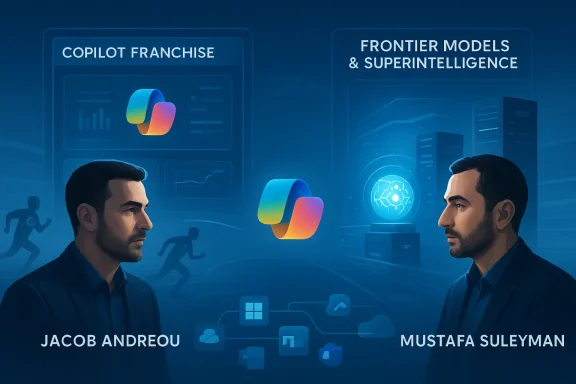
Microsoft’s AI reorganization is less a cosmetic reshuffle than a declaration that the company believes the Copilot brand needs a reset. By moving Mustafa Suleyman away from day-to-day consumer and product orchestration and putting Jacob Andreou in charge of the full Copilot franchise, Microsoft is signaling that it wants faster execution, tighter product focus, and a clearer line between model-building and product shipping. The timing matters: Microsoft is under pressure from Google Gemini and OpenAI’s ChatGPT, while its own commercial and consumer AI momentum has not matched the ambition of its early lead. Microsoft’s latest move suggests the company is no longer content to rent the future of AI from a partner. It wants to own more of it.
Microsoft’s current AI strategy did not emerge overnight. It was built in stages, beginning with a deepened partnership with OpenAI, then expanding into consumer-facing Copilot products, and finally broadening into enterprise workflows, agents, and infrastructure. When Mustafa Suleyman joined Microsoft in March 2024 to lead a new Microsoft AI organization, the company framed the move as a way to accelerate Copilot and other consumer AI products while continuing to lean on OpenAI’s foundation models.
That structure made sense when the market was still sorting out what generative AI would become. Microsoft had the distribution: Windows, Edge, Microsoft 365, Azure, GitHub, and an enormous installed base of enterprise customers. OpenAI had the model momentum. For a while, the partnership looked like a classic division of labor, with Microsoft providing the platform and OpenAI providing the intelligence. But as AI matured, the weaknesses of that arrangement became more visible, especially where product coherence, cost control, and roadmap independence were concerned.
The company’s internal architecture also became more complex. In January 2025, Microsoft created CoreAI – Platform and Tools to unify parts of Dev Div, AI Platform, and other teams around an end-to-end AI stack for apps and agents. That was an important clue: Microsoft was not just building features, it was reorganizing itself around the belief that AI would permeate the entire software estate. The new Copilot leadership changes can be read as the consumer and commercial product layer being adjusted to fit that larger system-level bet.
Microsoft also spent 2025 refining the product experience itself. The company rolled out a more human-centered Copilot direction, added personalization, and continued pushing Copilot deeper into Windows, Edge, and Microsoft 365. Yet even with those changes, the market picture remained uneven. Microsoft could still claim enormous reach, but reach is not the same as daily habit, and habit is what ultimately determines whether an AI assistant becomes indispensable or merely installed.
Andreou’s background also tells us something about Microsoft’s priorities. A former Snap executive with product-and-growth experience, he is the kind of leader companies often bring in when they want sharper consumer engagement, better retention, and faster iteration on user experience. Microsoft appears to be betting that Copilot’s challenge is not merely model quality, but the entire funnel from discovery to daily use. In other words, the problem may be as much product-market fit as it is raw AI performance.
It also implies that Microsoft is trying to move faster than its organizational inertia. Once a product family becomes tied to multiple executives, multiple roadmaps, and multiple business lines, shipping slows down. A cleaner chain of command can help, but only if the underlying strategy is coherent and the teams remain willing to make hard tradeoffs. That is the real test, not the org chart itself.
The enterprise picture is more complicated but not necessarily more comforting. Microsoft says it has more than 450 million commercial paid seats in Microsoft 365, yet only 15 million of those are paying for Microsoft 365 Copilot. That conversion rate is low enough to raise questions about price, product value, workflow fit, and competitive urgency. Microsoft clearly has the distribution advantage, but it has not yet fully turned that distribution into a default AI habit.
The danger is that Copilot ends up squeezed from both sides. ChatGPT is culturally stronger in consumer usage, while Gemini is increasingly strong across Google’s ecosystem and enterprise accounts. Microsoft’s answer cannot just be parity features; it needs a differentiated workflow story, especially if it wants Copilot to feel like the indispensable layer across Windows, Microsoft 365, and Teams.
That arrangement was workable while Microsoft could frame itself as the platform owner and OpenAI as the model provider. But once Microsoft began competing more directly for enterprise deals, the overlap became harder to ignore. A customer shopping for AI-enabled productivity tools does not necessarily care who supplies the model, but it does care whether the platform vendor can guarantee continuity, pricing stability, and future innovation without being hostage to another company’s roadmap.
The flip side is that independence is expensive. Building frontier models at a world-class level requires enormous compute, elite talent, and patience. Microsoft can afford all three, but it must still decide whether the marginal gain from custom models is worth the opportunity cost of not leaning as heavily on OpenAI’s ecosystem. That is a hard strategic tradeoff, not a vanity project.
That matters because AI assistants live or die by usage loops. A great demo does not equal a great product. Users need a reason to come back tomorrow, and then next week, and then every workday after that. Andreou’s background suggests Microsoft is trying to bring stronger growth discipline to a product family that has often looked more like a strategic platform than a consumer app with a sharp identity.
He also inherits a challenge that goes beyond branding. Copilot needs to feel faster, more accurate, more consistently helpful, and more predictably embedded in the tasks people already do. In practical terms, that means better defaults, fewer dead ends, and less cognitive overhead. If users feel they need to learn a new assistant every few months, Microsoft will keep losing momentum to rivals with simpler narratives.
That emphasis also aligns with the broader industry reality: model capability is still advancing, and companies that own more of the stack can better control latency, cost, safety, and product customization. For Microsoft, the frontier-model effort is a hedge against dependence, but it is also a statement of ambition. The company does not want to remain a toll collector on someone else’s breakthrough. It wants to be a source of the breakthrough itself.
The strategic upside is equally obvious. A proprietary model stack can create tighter integration with agents, security controls, data governance, and vertical solutions. It can also reduce the awkwardness of competing with a partner whose models you still rely on. Owning the engine becomes especially valuable if AI interfaces eventually become the primary way users interact with software.
But enterprise adoption has not automatically followed distribution. The gap between 450 million commercial seats and 15 million Copilot seats suggests that many businesses are still in a pilot mindset, not a scaling mindset. Some may be waiting for better proof of return on investment, while others may be wrestling with governance, change management, security reviews, or simple user indifference. The truth is likely a combination of all of these.
There is also a segmentation problem. Large enterprises, regulated industries, and frontline-heavy organizations do not evaluate AI the same way. A single Copilot narrative will not be enough. The company must show that it can adapt across industries while preserving the consistency buyers expect from Microsoft. That is a classic Microsoft challenge: broad enough to scale, specific enough to convince.
The company has tried to make Copilot more personal and more human-centered, including a fall release that emphasized memory, personalization, and a more companion-like identity. That approach may improve affinity, but it also risks confusion if the assistant’s personality changes too much or its utility becomes harder to explain. People may like a friendly AI, but they still return for usefulness.
The company’s distribution advantages remain substantial. It can reach users through OS, browser, productivity apps, and enterprise accounts. But distribution is only a starting point. The real battle is whether Copilot becomes the assistant people choose instinctively, not just the one they are nudged into using.
Microsoft’s emphasis on better model ownership and clearer architecture suggests it wants to reduce operating costs at scale. That makes sense, because a company with Microsoft’s reach cannot afford to let AI economics remain a black box forever. The more Copilot is used across work and consumer contexts, the more efficiency matters.
This is also where the model strategy, product strategy, and infrastructure strategy converge. Better models are not just about benchmark scores; they are about delivering useful output at lower cost, with fewer retries, and with enough reliability that users trust them in real workflows. That is the hidden battleground in enterprise AI.
The opportunity is not just to catch up with rivals, but to define a different kind of AI platform: one that sits inside the tools people already use every day and quietly becomes indispensable.
There is also a danger that Microsoft overcommits to a superintelligence narrative before the consumer and enterprise product layers have fully matured. Ambition is useful; distraction is not.
Watch for changes in pricing, bundling, model sourcing, and workflow integration. Also watch whether Microsoft starts speaking more plainly about where Copilot is winning, where it is not, and which product lines deserve the most investment.
Microsoft’s latest AI shake-up is best understood as a bet that the next phase of the AI race will reward companies that can both build and distribute at scale. The company already has the distribution; now it is trying to prove it can build the missing core with enough independence, speed, and technical quality to matter. If Andreou brings the product discipline Copilot needs and Suleyman delivers credible frontier-model progress, Microsoft could finally turn its AI advantage into something more enduring than early momentum. If not, the company may find that even a giant ecosystem is not enough to outrun faster-moving rivals with clearer products and stronger user gravity.
Source: trendingtopics.eu Microsoft Shakes Up AI Division As Copilot Falls Behind Google and OpenAI
 Background
Microsoft’s current AI strategy did not emerge overnight. It was built in stages, beginning with a deepened partnership with OpenAI, then expanding into consumer-facing Copilot products, and finally broadening into enterprise workflows, agents, and infrastructure. When Mustafa Suleyman joined Microsoft in March 2024 to lead a new Microsoft AI organization, the company framed the move as a way to accelerate Copilot and other consumer AI products while continuing to lean on OpenAI’s foundation models.That structure made sense when the market was still sorting out what generative AI would become. Microsoft had the distribution: Windows, Edge, Microsoft 365, Azure, GitHub, and an enormous installed base of enterprise customers. OpenAI had the model momentum. For a while, the partnership looked like a classic division of labor, with Microsoft providing the platform and OpenAI providing the intelligence. But as AI matured, the weaknesses of that arrangement became more visible, especially where product coherence, cost control, and roadmap independence were concerned.
The company’s internal architecture also became more complex. In January 2025, Microsoft created CoreAI – Platform and Tools to unify parts of Dev Div, AI Platform, and other teams around an end-to-end AI stack for apps and agents. That was an important clue: Microsoft was not just building features, it was reorganizing itself around the belief that AI would permeate the entire software estate. The new Copilot leadership changes can be read as the consumer and commercial product layer being adjusted to fit that larger system-level bet.
Microsoft also spent 2025 refining the product experience itself. The company rolled out a more human-centered Copilot direction, added personalization, and continued pushing Copilot deeper into Windows, Edge, and Microsoft 365. Yet even with those changes, the market picture remained uneven. Microsoft could still claim enormous reach, but reach is not the same as daily habit, and habit is what ultimately determines whether an AI assistant becomes indispensable or merely installed.
The New Leadership Map
The headline change is straightforward: Jacob Andreou is now taking over the full Copilot division, spanning both consumer and commercial surfaces, while Mustafa Suleyman shifts toward Microsoft’s own frontier models and superintelligence efforts. That separation is important because it divides the company’s AI ambitions into two distinct jobs: one group ships the product, the other builds the intelligence layer beneath it.Andreou’s background also tells us something about Microsoft’s priorities. A former Snap executive with product-and-growth experience, he is the kind of leader companies often bring in when they want sharper consumer engagement, better retention, and faster iteration on user experience. Microsoft appears to be betting that Copilot’s challenge is not merely model quality, but the entire funnel from discovery to daily use. In other words, the problem may be as much product-market fit as it is raw AI performance.
Why this matters now
This reshuffle suggests that Microsoft sees Copilot as too important to remain fragmented. The company’s consumer assistant, Microsoft 365 Copilot, and adjacent experiences have often felt like overlapping pieces of a broader promise rather than one obvious daily companion. A unified leader can simplify the roadmap, align teams more tightly, and reduce the internal drift that usually happens when an ambitious platform grows faster than its product discipline.It also implies that Microsoft is trying to move faster than its organizational inertia. Once a product family becomes tied to multiple executives, multiple roadmaps, and multiple business lines, shipping slows down. A cleaner chain of command can help, but only if the underlying strategy is coherent and the teams remain willing to make hard tradeoffs. That is the real test, not the org chart itself.
- Copilot is being treated as a single franchise, not a collection of isolated experiments.
- Product execution is being separated from frontier-model research.
- Microsoft appears to be prioritizing clarity over sprawling optionality.
- A consumer-growth leader may be better suited to a retention problem than a pure research leader.
Copilot’s Competitive Problem
The competitive pressure is real, and it is not subtle. Microsoft’s consumer Copilot app reportedly has around 150 million monthly active users, while Google’s Gemini has reached 750 million monthly active users and ChatGPT has reportedly surpassed 700 million weekly active users in OpenAI’s own published materials and reporting. Even if those numbers are not perfectly comparable, the direction of travel is clear: Microsoft is not setting the pace in consumer AI.The enterprise picture is more complicated but not necessarily more comforting. Microsoft says it has more than 450 million commercial paid seats in Microsoft 365, yet only 15 million of those are paying for Microsoft 365 Copilot. That conversion rate is low enough to raise questions about price, product value, workflow fit, and competitive urgency. Microsoft clearly has the distribution advantage, but it has not yet fully turned that distribution into a default AI habit.
The market context
This is where the Copilot story becomes strategically interesting. In consumer AI, the winner is often the assistant that becomes the reflexive first stop, not the one with the deepest enterprise integration. In enterprise AI, the winner is often the tool that gets embedded into actual work, reduces friction, and passes the procurement test. Microsoft has pieces of both, but the company still needs to prove that it can own both categories at once.The danger is that Copilot ends up squeezed from both sides. ChatGPT is culturally stronger in consumer usage, while Gemini is increasingly strong across Google’s ecosystem and enterprise accounts. Microsoft’s answer cannot just be parity features; it needs a differentiated workflow story, especially if it wants Copilot to feel like the indispensable layer across Windows, Microsoft 365, and Teams.
- Consumer scale is not yet translating into consumer leadership.
- Enterprise reach is not yet translating into enterprise monetization.
- Competitors have clearer brand associations in key use cases.
- Microsoft needs sticky workflows, not just added capabilities.
The OpenAI Dependency Question
Microsoft’s relationship with OpenAI has always been both a strength and a constraint. The partnership gave Microsoft early access to breakthrough models and a halo of innovation, but it also meant that a core part of Microsoft’s AI story depended on another company’s technical trajectory and strategic decisions. Microsoft’s own statement in October 2025 said the company’s investment in OpenAI Group PBC was valued at roughly $135 billion, representing about 27 percent on an as-converted diluted basis, and its February 2026 joint statement emphasized that the relationship’s terms remained unchanged despite OpenAI’s new funding and partnerships.That arrangement was workable while Microsoft could frame itself as the platform owner and OpenAI as the model provider. But once Microsoft began competing more directly for enterprise deals, the overlap became harder to ignore. A customer shopping for AI-enabled productivity tools does not necessarily care who supplies the model, but it does care whether the platform vendor can guarantee continuity, pricing stability, and future innovation without being hostage to another company’s roadmap.
Why independence matters
This is why Suleyman’s push for “genuine independence” is strategically important, even if the details are not all public. Owning frontier models gives Microsoft more leverage in negotiations, more control over performance tuning, and more freedom to optimize for its own products rather than a partner’s broader market strategy. It also creates the possibility of lower long-term inference costs if Microsoft can build model infrastructure that is better tailored to its own stack.The flip side is that independence is expensive. Building frontier models at a world-class level requires enormous compute, elite talent, and patience. Microsoft can afford all three, but it must still decide whether the marginal gain from custom models is worth the opportunity cost of not leaning as heavily on OpenAI’s ecosystem. That is a hard strategic tradeoff, not a vanity project.
- Independence reduces strategic vulnerability.
- It increases capex and operational complexity.
- It may improve integration with Microsoft products.
- It also raises the bar for in-house model quality.
Why Jacob Andreou Matters
Andreou’s appointment is a signal that Microsoft wants a more consumer-native operating style inside Copilot. Product leaders from social platforms often think differently from traditional enterprise software executives. They tend to focus on activation, retention, frequency, and the emotional mechanics of habit formation, which are exactly the pressures Microsoft needs to address if Copilot is to become part of daily behavior rather than an occasional novelty.That matters because AI assistants live or die by usage loops. A great demo does not equal a great product. Users need a reason to come back tomorrow, and then next week, and then every workday after that. Andreou’s background suggests Microsoft is trying to bring stronger growth discipline to a product family that has often looked more like a strategic platform than a consumer app with a sharp identity.
Product discipline over product sprawl
A unified product leader can make harder decisions about what Copilot is, and what it is not. Microsoft has occasionally seemed to release overlapping experiences across Edge, Windows, the standalone Copilot app, and Microsoft 365 surfaces without always making the distinctions obvious to users. That can be powerful when it works, but confusing when it does not. Andreou’s job may be to collapse that confusion into a more obvious product story.He also inherits a challenge that goes beyond branding. Copilot needs to feel faster, more accurate, more consistently helpful, and more predictably embedded in the tasks people already do. In practical terms, that means better defaults, fewer dead ends, and less cognitive overhead. If users feel they need to learn a new assistant every few months, Microsoft will keep losing momentum to rivals with simpler narratives.
- Stronger consumer growth instincts may improve adoption.
- A single executive can enforce clearer product standards.
- Usage loops matter more than feature counts.
- Copilot must become habitual, not merely available.
Frontier Models and Superintelligence
Suleyman’s move toward frontier models and superintelligence is more than a portfolio change. It is Microsoft acknowledging that the next competitive phase may be decided by the quality of the company’s own foundational models, not just by how well it packages other people’s models into enterprise workflows. Microsoft has already said it wants to intensify efforts around superintelligence and associated compute capacity, and Suleyman has framed the work as a five-year roadmap with substantial technical prerequisites already in place.That emphasis also aligns with the broader industry reality: model capability is still advancing, and companies that own more of the stack can better control latency, cost, safety, and product customization. For Microsoft, the frontier-model effort is a hedge against dependence, but it is also a statement of ambition. The company does not want to remain a toll collector on someone else’s breakthrough. It wants to be a source of the breakthrough itself.
The economics of owning the stack
There is a straightforward economic argument here. The more Microsoft relies on third-party models, the more it exposes itself to external pricing, product constraints, and roadmap shifts. The more it builds its own models, the more it can optimize for scale economics, enterprise tuning, and the specific constraints of Microsoft 365, Windows, and Azure. That does not guarantee better models, but it can improve the business case if the company executes well.The strategic upside is equally obvious. A proprietary model stack can create tighter integration with agents, security controls, data governance, and vertical solutions. It can also reduce the awkwardness of competing with a partner whose models you still rely on. Owning the engine becomes especially valuable if AI interfaces eventually become the primary way users interact with software.
- Proprietary models can improve margin control.
- They can also create more consistent product behavior.
- They may reduce dependency risk over time.
- They require sustained compute and research investment.
Enterprise Copilot: Promise and Friction
Microsoft’s enterprise story is where the tension is most visible. On paper, the company should be dominant. It already owns the daily tools of work for a massive share of the global knowledge economy, and its AI can be embedded directly into Word, Excel, Outlook, Teams, and adjacent business applications. Microsoft has repeatedly positioned Copilot as a productivity multiplier inside the workflow layer, which is exactly where enterprise buyers want AI to live.But enterprise adoption has not automatically followed distribution. The gap between 450 million commercial seats and 15 million Copilot seats suggests that many businesses are still in a pilot mindset, not a scaling mindset. Some may be waiting for better proof of return on investment, while others may be wrestling with governance, change management, security reviews, or simple user indifference. The truth is likely a combination of all of these.
The conversion challenge
Microsoft has to prove that Copilot justifies not only its price, but its place in the workflow. Enterprise software buyers are increasingly asking whether AI is truly additive or just a premium feature wrapped around functionality they already have. If Copilot is to accelerate, Microsoft needs clearer evidence on time saved, quality improved, and process simplified.There is also a segmentation problem. Large enterprises, regulated industries, and frontline-heavy organizations do not evaluate AI the same way. A single Copilot narrative will not be enough. The company must show that it can adapt across industries while preserving the consistency buyers expect from Microsoft. That is a classic Microsoft challenge: broad enough to scale, specific enough to convince.
- Enterprise buyers want measurable ROI.
- Governance and compliance slow adoption.
- Some customers still treat Copilot as experimental.
- Value proof must be industry-specific, not generic.
Consumer Copilot and the Habit Problem
Consumer AI is a brutal arena because users have little patience and many alternatives. If Copilot feels slower, less charming, or less useful than ChatGPT, many people will simply drift away. If Gemini is more embedded in the Google ecosystem they already use, that can also become the default choice. Microsoft cannot win consumer AI by sheer presence alone.The company has tried to make Copilot more personal and more human-centered, including a fall release that emphasized memory, personalization, and a more companion-like identity. That approach may improve affinity, but it also risks confusion if the assistant’s personality changes too much or its utility becomes harder to explain. People may like a friendly AI, but they still return for usefulness.
What consumer AI actually rewards
Consumers reward assistants that are fast, reliable, and context-aware. They also reward products that answer a clear question: why this assistant, and why now? Microsoft’s challenge is to make Copilot feel like the natural extension of Windows, Edge, and mobile workflows without turning it into a muddled catch-all.The company’s distribution advantages remain substantial. It can reach users through OS, browser, productivity apps, and enterprise accounts. But distribution is only a starting point. The real battle is whether Copilot becomes the assistant people choose instinctively, not just the one they are nudged into using.
- Consumer preference is driven by habit, not corporate strategy.
- Brand clarity matters almost as much as model quality.
- Personalization must improve utility, not just tone.
- Microsoft’s ecosystem is an advantage only if it feels seamless.
The Cost and Compute Equation
One of the least discussed but most important reasons for this reorganization is cost. AI is expensive, and not just in the obvious compute sense. It also requires product support, inference optimization, model experimentation, safety reviews, and ongoing prompt and workflow tuning. If Copilot remains a collection of loosely connected experiences, the cost curve can become harder to control.Microsoft’s emphasis on better model ownership and clearer architecture suggests it wants to reduce operating costs at scale. That makes sense, because a company with Microsoft’s reach cannot afford to let AI economics remain a black box forever. The more Copilot is used across work and consumer contexts, the more efficiency matters.
Why scale economics are now central
At low usage levels, almost any AI product can look magical. At high usage levels, the economics become unforgiving. If Microsoft can improve model efficiency, inference routing, and service integration, it can potentially support broader rollout with better margins. If not, Copilot risks becoming a prestige product with a difficult unit economics story.This is also where the model strategy, product strategy, and infrastructure strategy converge. Better models are not just about benchmark scores; they are about delivering useful output at lower cost, with fewer retries, and with enough reliability that users trust them in real workflows. That is the hidden battleground in enterprise AI.
- Inference cost shapes pricing power.
- Model efficiency affects rollout speed.
- Better architecture can improve margins.
- AI scale without efficiency can become a liability.
Strengths and Opportunities
Microsoft still has a remarkably strong hand. It controls one of the world’s most valuable productivity ecosystems, has enormous enterprise reach, and now appears willing to reorganize aggressively when strategy demands it. If the company gets this right, it can turn Copilot from a feature set into an operating layer for both work and personal productivity.The opportunity is not just to catch up with rivals, but to define a different kind of AI platform: one that sits inside the tools people already use every day and quietly becomes indispensable.
- Massive distribution through Windows, Microsoft 365, Edge, Teams, and Azure.
- Enterprise trust from long-standing customer relationships.
- Product simplification could reduce confusion and sharpen adoption.
- Model independence could lower strategic vulnerability over time.
- Agentic workflows offer a path beyond simple chat.
- Cross-surface integration could create a more durable daily habit.
- Leadership clarity may improve execution speed and accountability.
Risks and Concerns
The reorganization is promising, but it does not solve the hardest problems by itself. Microsoft still has to prove that Copilot is meaningfully better, cheaper, and easier to use than alternatives. If users continue to perceive it as fragmented or underpowered, a leadership shuffle will not change that reality.There is also a danger that Microsoft overcommits to a superintelligence narrative before the consumer and enterprise product layers have fully matured. Ambition is useful; distraction is not.
- Model quality gap may persist against Google, OpenAI, and Anthropic.
- Fragmented user experience could still limit adoption.
- High compute costs may pressure margins.
- Dependence on OpenAI may remain meaningful for some time.
- Enterprise inertia could slow monetization despite installed base advantages.
- Brand confusion may continue if Copilot surfaces feel inconsistent.
- Superintelligence focus could pull attention away from near-term product wins.
What to Watch Next
The most important question is not whether Microsoft can reorganize. It is whether this new structure produces a Copilot that feels simpler, sharper, and more valuable within the next few product cycles. The next several quarters will reveal whether the company can translate strategic urgency into user-visible improvement.Watch for changes in pricing, bundling, model sourcing, and workflow integration. Also watch whether Microsoft starts speaking more plainly about where Copilot is winning, where it is not, and which product lines deserve the most investment.
- New Copilot release cadence and whether features ship faster.
- Whether Microsoft discloses more about proprietary model progress.
- Signs of stronger enterprise conversion from Microsoft 365 seats.
- Changes in consumer retention and daily usage behavior.
- More explicit separation between Copilot product teams and frontier model teams.
- Any further reduction in visible dependence on OpenAI models.
- Competitive responses from Google and OpenAI on productivity and agentic AI.
Microsoft’s latest AI shake-up is best understood as a bet that the next phase of the AI race will reward companies that can both build and distribute at scale. The company already has the distribution; now it is trying to prove it can build the missing core with enough independence, speed, and technical quality to matter. If Andreou brings the product discipline Copilot needs and Suleyman delivers credible frontier-model progress, Microsoft could finally turn its AI advantage into something more enduring than early momentum. If not, the company may find that even a giant ecosystem is not enough to outrun faster-moving rivals with clearer products and stronger user gravity.
Source: trendingtopics.eu Microsoft Shakes Up AI Division As Copilot Falls Behind Google and OpenAI
