

Microsoft’s latest HR overhaul is more than an organizational tidy-up; it is a signal that the company now sees people operations as a direct lever in its AI strategy. The reported changes, which include a reworked HR structure, leadership departures, and a stronger emphasis on workforce readiness, fit neatly with Microsoft’s publicly stated push toward more in-person collaboration and higher performance standards. Taken together, they suggest a company trying to align its internal culture with the speed, discipline, and scale required to compete in the AI era.
Microsoft has spent the last two years making a quiet but unmistakable shift: the company is no longer treating AI as a product line alone, but as a core operating philosophy. That shift has touched engineering, sales, product, and now, if the latest report is accurate, the HR function as well. The timing matters because workforce strategy is increasingly becoming a competitive differentiator in big tech, where the ability to recruit, retrain, and redeploy talent may matter as much as model quality.
The reported HR revamp arrives after a series of broader internal changes that already pointed in this direction. In March 2025, Microsoft elevated Amy Coleman to Chief People Officer, placing her in charge of HR at a moment when the company was already rethinking culture, organizational design, and employee engagement. Microsoft also confirmed in September 2025 that it would move to a three-day office expectation for many employees, arguing that in-person collaboration supports stronger results and clearer coordination. Those moves provide the backdrop for the latest restructuring story.
Microsoft has also been investing heavily in the idea that HR itself can be transformed by AI. The company has documented its own use of Copilot, employee self-service tools, data analytics, and workflow automation inside HR, describing a multi-year effort to modernize human resources operations. In other words, the latest report is not occurring in a vacuum; it is the next step in a broader experiment already underway inside Microsoft’s own walls.
What makes this moment notable is not just the org-chart changes, but the strategic framing. If Microsoft is indeed reorienting HR around AI readiness, engineering alignment, and employee experience, then the company is effectively saying that workforce architecture is part of the product roadmap. That is a very different mindset from the old view of HR as a back-office support function.
A useful clue comes from Microsoft’s own workplace and HR messaging. In 2025, the company said it wanted a more consistent and intentional hybrid model, with three days a week in the office for many employees in the Puget Sound area and a phased expansion elsewhere. The stated rationale was collaboration, speed, and better results, not cost cutting. That distinction matters, because it suggests Microsoft is framing office policy as an output issue rather than a real-estate or expense issue.
Another important thread is Microsoft’s own public discussion of “frontier firms” and AI-enabled work. In 2025, Microsoft described how AI agents and human teams could be combined to scale operations, while also noting that HR and strategy functions remain human-centered decision-making domains. That concept creates an opening for HR to become a strategic interpreter between AI capability and organizational reality. It is not hard to see why Microsoft would want a more specialized HR structure in that world.
Microsoft has also been unusually candid about the messiness of HR at scale. In its own materials, the company described a fragmented internal ecosystem of tools and a heavy volume of support cases and transactions, then argued that AI could streamline support and improve the employee experience. That is a classic enterprise story: the more complex the workforce, the more value there is in automation, analytics, and better workflow design. But it also means the company is measuring HR less as a service desk and more as a productivity system.
The reported departure of long-tenured leaders such as Lindsay-Rae McIntyre and Rajesh Jha’s retirement create a generational transition at the top. Microsoft has already publicly confirmed Jha’s retirement from his role leading Experiences + Devices, with a July 1 transition date, and has described leadership succession as a planned process. That context suggests the company is not improvising a one-off shakeup; it is executing a broader handoff across business and people functions.
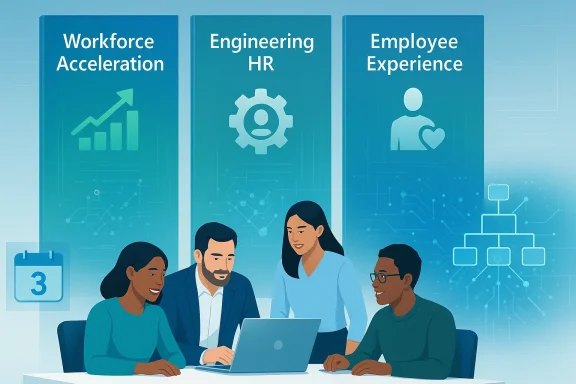
The Workforce Acceleration Team appears to be the most strategically interesting piece. If its remit includes AI readiness, skills planning, and talent development, then Microsoft is essentially turning HR into a capability engine. That would make sense in a period when AI adoption is forcing companies to reconsider which tasks should be automated, which roles need redesign, and which employees can be trained into new functions.
The Engineering HR Team is also telling. Microsoft engineering organizations have very different operating rhythms from finance, HR, or field sales, and they often need more specialized support around hiring, career ladders, org design, and manager effectiveness. By embedding HR more closely with product and technology teams, Microsoft may be trying to reduce the gap between workforce decisions and product delivery.
The Employee Experience Team suggests the company wants HR to feel more like a digital platform. If that team is tasked with internal tools and data insights, then Microsoft is likely trying to treat employee experience the way it treats customer experience: measure it, instrument it, and improve it continuously. That is a very Microsoft approach, and it could yield better service if executed well.
Microsoft has already shown that it is willing to make planned leadership changes well in advance. The company announced Jha’s retirement in March 2026, describing it as part of an organized succession process rather than a surprise exit. That matters because Microsoft tends to avoid signaling instability; when it makes leadership changes public, it usually wants to frame them as part of continuity and renewal.
Amy Coleman’s role is especially important here. She became Chief People Officer in March 2025 after years of HR leadership across Microsoft’s corporate functions and other business areas. Her background spans engineering, sales, marketing, and business development, which makes her unusually well suited to a broad transformation effort. That sort of experience is valuable in a company where HR must balance technical talent, business growth, and culture management all at once.
Leslie Lawson Sims’ reported elevation also deserves attention because leadership in workforce strategy and culture is not a ceremonial role at a company like Microsoft. Culture is not a side project there; it is part of how the organization decides who gets promoted, who gets retrained, and how aggressively performance expectations are enforced. If Sims is taking on a larger mandate, the company may be trying to centralize those decisions more tightly.
That internal experience gives Microsoft credibility when it talks about workforce transformation. If HR can use AI to triage cases, draft communications, accelerate reporting, and automate repetitive tasks, then the function becomes a living demonstration of the company’s broader product thesis. It is also a proof point for customers: Microsoft can say it uses its own tools to run its own people operations.
At a broader level, Microsoft has been pushing the notion that workers need new skills, not just new software. In 2025, the company said a skilled workforce is central to AI readiness and that many organizations were prioritizing training the people they already have. That message lines up closely with the reported role of a Workforce Acceleration Team. In effect, Microsoft is saying that AI transformation is not just about hiring more AI experts; it is about upgrading the whole organization.
This is where the real strategic challenge lives. AI adoption is often discussed as if it were a software deployment, but for a company the size of Microsoft it is actually an organizational redesign problem. People need to know how AI changes their work, what is expected of them, and how performance will be measured when tools can automate more of the routine parts of the job.
The reported HR revamp therefore feels like an extension of Microsoft’s product strategy, not a separate corporate housekeeping event. It is the people-side equivalent of platform engineering.
Still, the policy shift is part of a larger recalibration in how big tech thinks about hybrid work. During the pandemic and its aftermath, flexibility was often treated as a retention perk. In 2026, the conversation is changing. More companies are asking whether hybrid work is being used optimally, whether culture is fragmenting, and whether managers can maintain accountability when teams are highly distributed.
For Microsoft, the argument appears to be that AI-era execution needs higher-bandwidth collaboration. That may be true in some functions, especially product design, engineering, and cross-functional planning. But the impact will vary sharply across roles. A policy that improves collaboration for one team can become an inconvenience for another, especially when commuting time and family logistics are factored in.
The company’s internal HR redesign and its office policy likely reinforce each other. If Microsoft wants a more data-driven, performance-oriented culture, then office presence becomes one of the visible markers of that shift. The risk is that employees interpret the policy as a signal of distrust rather than a strategy for execution.
In the near term, the company may get some of both.
This move also makes sense in an AI-heavy environment. If AI tools can eliminate routine work and speed up analysis, then the company will expect employees to spend more time on judgment, creativity, orchestration, and cross-functional problem-solving. That means the old measurement system, which rewarded responsiveness or volume, may no longer be enough. Microsoft appears to be signaling that it wants to reward impact instead.
There is a subtle but important tension here. On one hand, Microsoft wants to encourage innovation and experimentation. On the other, it wants more rigor, more consistency, and more visible accountability. Those goals are compatible in theory, but in practice they can collide. If employees feel that the company is focusing too heavily on performance discipline, risk-taking can decline.
That tension is particularly relevant for a company pushing Copilot and agent-based workflows. If AI is supposed to reduce friction, the surrounding management system should probably do the same. The best performance frameworks are clear, fair, and actionable. The worst are opaque, overly procedural, and anxiety-inducing.
That fairness question will define whether this becomes a productive reset or a morale problem.
The comparison with rivals such as Google and Meta is especially relevant because both companies are also investing heavily in AI while managing internal pressure around performance, efficiency, and organizational focus. In this environment, leadership teams increasingly believe that companies must be shaped for faster decision cycles, leaner execution, and greater output per employee. Microsoft’s HR revamp fits that logic perfectly.
What makes Microsoft potentially distinct is its enterprise orientation. Unlike some peers, it has to serve a vast customer base of businesses that care deeply about productivity, compliance, and organizational readiness. That makes internal workforce strategy more than a cultural issue; it becomes part of the value proposition. If Microsoft can credibly show it is using AI to improve HR and employee experience at scale, it strengthens its enterprise story.
There is also a broader market signal here. When a company of Microsoft’s size reorganizes HR around AI readiness, other firms will take note. HR leaders across sectors are likely to see this as validation that people operations must become more analytical, more tech-enabled, and more directly aligned with strategic transformation. That is likely to accelerate spending on HR tech, employee experience platforms, and skills intelligence tools.
And if it works, it could become a template others copy.
For consumers, the impact is less direct but still real. When Microsoft reorganizes around AI and performance, it tends to create a stronger feedback loop between internal priorities and the products people use daily. That can influence how quickly features mature, how aggressively AI is integrated into Windows and Microsoft 365, and how the company defines the future of productivity software.
The consumer angle also matters because Microsoft’s reputation is increasingly tied to whether its AI vision feels practical rather than gimmicky. A tighter, more disciplined internal workforce strategy may help the company ship more coherent products. But if the culture becomes too rigid, the creativity that often drives consumer-facing innovation can suffer.
This is where Microsoft’s two audiences diverge. Enterprise buyers usually reward predictability, scalability, and proof. Consumers reward usefulness, simplicity, and trust. The HR restructuring is aimed at the first audience internally, but the second audience will feel the effects through the product portfolio.
Another strength is timing. Microsoft is making these moves while it already has public momentum around Copilot, workplace AI, and internal transformation, so the narrative is coherent. That coherence matters because employees, investors, and customers all tend to trust companies more when strategy, messaging, and operating changes line up. The company’s own HR transformation work also gives it a real-world testbed for what it is asking others to do.
A second risk is execution complexity. Reorganizing HR while simultaneously changing office policy, updating performance expectations, and managing leadership transitions is a lot to absorb at once. Large organizations often underestimate the amount of confusion that even “clarifying” changes create. If communication is poor, the result can be slower decision-making rather than faster execution.
Watch for whether the company keeps translating its internal transformation into public product wins. The strongest version of this strategy is one in which Microsoft’s own workforce systems become a living example of how AI changes work. If employees see better tools, clearer priorities, and more useful career pathways, the strategy will have real credibility. If they mostly see stricter rules and more process, the message will land differently.
Source: latestly.com Microsoft Revamps HR Division to Power AI Push, Announces Leadership Changes and New Workforce Strategy | LatestLY
 Overview
Microsoft has spent the last two years making a quiet but unmistakable shift: the company is no longer treating AI as a product line alone, but as a core operating philosophy. That shift has touched engineering, sales, product, and now, if the latest report is accurate, the HR function as well. The timing matters because workforce strategy is increasingly becoming a competitive differentiator in big tech, where the ability to recruit, retrain, and redeploy talent may matter as much as model quality.The reported HR revamp arrives after a series of broader internal changes that already pointed in this direction. In March 2025, Microsoft elevated Amy Coleman to Chief People Officer, placing her in charge of HR at a moment when the company was already rethinking culture, organizational design, and employee engagement. Microsoft also confirmed in September 2025 that it would move to a three-day office expectation for many employees, arguing that in-person collaboration supports stronger results and clearer coordination. Those moves provide the backdrop for the latest restructuring story.
Microsoft has also been investing heavily in the idea that HR itself can be transformed by AI. The company has documented its own use of Copilot, employee self-service tools, data analytics, and workflow automation inside HR, describing a multi-year effort to modernize human resources operations. In other words, the latest report is not occurring in a vacuum; it is the next step in a broader experiment already underway inside Microsoft’s own walls.
What makes this moment notable is not just the org-chart changes, but the strategic framing. If Microsoft is indeed reorienting HR around AI readiness, engineering alignment, and employee experience, then the company is effectively saying that workforce architecture is part of the product roadmap. That is a very different mindset from the old view of HR as a back-office support function.
Background
The modern Microsoft has long used organizational redesign as a way to force execution discipline. Under Satya Nadella, the company has repeatedly reshaped reporting lines and leadership responsibilities to reduce friction, improve speed, and align internal incentives with platform priorities. The latest reported HR changes fit that pattern, but they also reflect the unusually intense pressure of the current AI race. Unlike earlier cycles of cloud or mobile transformation, the AI wave is demanding changes not just in engineering and sales, but in how every layer of the company thinks about talent, skill-building, and productivity.A useful clue comes from Microsoft’s own workplace and HR messaging. In 2025, the company said it wanted a more consistent and intentional hybrid model, with three days a week in the office for many employees in the Puget Sound area and a phased expansion elsewhere. The stated rationale was collaboration, speed, and better results, not cost cutting. That distinction matters, because it suggests Microsoft is framing office policy as an output issue rather than a real-estate or expense issue.
Another important thread is Microsoft’s own public discussion of “frontier firms” and AI-enabled work. In 2025, Microsoft described how AI agents and human teams could be combined to scale operations, while also noting that HR and strategy functions remain human-centered decision-making domains. That concept creates an opening for HR to become a strategic interpreter between AI capability and organizational reality. It is not hard to see why Microsoft would want a more specialized HR structure in that world.
Microsoft has also been unusually candid about the messiness of HR at scale. In its own materials, the company described a fragmented internal ecosystem of tools and a heavy volume of support cases and transactions, then argued that AI could streamline support and improve the employee experience. That is a classic enterprise story: the more complex the workforce, the more value there is in automation, analytics, and better workflow design. But it also means the company is measuring HR less as a service desk and more as a productivity system.
The reported departure of long-tenured leaders such as Lindsay-Rae McIntyre and Rajesh Jha’s retirement create a generational transition at the top. Microsoft has already publicly confirmed Jha’s retirement from his role leading Experiences + Devices, with a July 1 transition date, and has described leadership succession as a planned process. That context suggests the company is not improvising a one-off shakeup; it is executing a broader handoff across business and people functions.
Why HR matters in an AI-first era
HR is one of the few corporate functions that touches every employee, every manager, and every major culture signal. In a company with more than 220,000 employees, the function becomes a strategic control surface for skills, performance, mobility, and retention. If Microsoft wants to move faster on AI, HR has to help it identify who can adapt, who needs reskilling, and where the company should invest in new capability.Why the timing is significant
This is happening while the broader tech sector is tightening discipline around performance and office attendance. That suggests Microsoft is not out of step with peers; it is part of a wider recalibration. The company appears to be betting that a more structured workforce model will help it compete, even if some employees see it as a cultural contraction.The Reported Restructuring
According to the report, Microsoft is reorganizing its HR division into three major pillars: a Workforce Acceleration Team, an Engineering HR Team, and an Employee Experience Team. That kind of structure is significant because it separates pure people strategy from engineering-adjacent HR support and from internal service design. It is a more specialized model than a traditional generalist HR setup, and it sounds built for a company that wants tighter alignment between business priorities and talent operations.The Workforce Acceleration Team appears to be the most strategically interesting piece. If its remit includes AI readiness, skills planning, and talent development, then Microsoft is essentially turning HR into a capability engine. That would make sense in a period when AI adoption is forcing companies to reconsider which tasks should be automated, which roles need redesign, and which employees can be trained into new functions.
The Engineering HR Team is also telling. Microsoft engineering organizations have very different operating rhythms from finance, HR, or field sales, and they often need more specialized support around hiring, career ladders, org design, and manager effectiveness. By embedding HR more closely with product and technology teams, Microsoft may be trying to reduce the gap between workforce decisions and product delivery.
The Employee Experience Team suggests the company wants HR to feel more like a digital platform. If that team is tasked with internal tools and data insights, then Microsoft is likely trying to treat employee experience the way it treats customer experience: measure it, instrument it, and improve it continuously. That is a very Microsoft approach, and it could yield better service if executed well.
What this structure implies
- Specialization over one-size-fits-all HR support.
- Faster decision-making across talent and engineering teams.
- More data-driven workforce planning tied to AI adoption.
- Greater emphasis on internal tooling and employee self-service.
- A stronger link between culture, performance, and execution.
The strategic trade-off
The upside is sharper execution. The downside is that employees may experience the change as more top-down and less personal. HR redesigns that optimize for speed can sometimes weaken trust if people feel the system is being tuned primarily for business efficiency rather than mutual support.Leadership Changes and Succession
Leadership transitions often reveal more about a company’s future than its press releases do. In Microsoft’s case, the reported departures and role changes suggest a deliberate reshaping of the leadership bench to match the company’s next phase. The exit of a senior leader like Lindsay-Rae McIntyre, alongside Rajesh Jha’s retirement from his large product and engineering-facing portfolio, creates room for a new operating style.Microsoft has already shown that it is willing to make planned leadership changes well in advance. The company announced Jha’s retirement in March 2026, describing it as part of an organized succession process rather than a surprise exit. That matters because Microsoft tends to avoid signaling instability; when it makes leadership changes public, it usually wants to frame them as part of continuity and renewal.
Amy Coleman’s role is especially important here. She became Chief People Officer in March 2025 after years of HR leadership across Microsoft’s corporate functions and other business areas. Her background spans engineering, sales, marketing, and business development, which makes her unusually well suited to a broad transformation effort. That sort of experience is valuable in a company where HR must balance technical talent, business growth, and culture management all at once.
Leslie Lawson Sims’ reported elevation also deserves attention because leadership in workforce strategy and culture is not a ceremonial role at a company like Microsoft. Culture is not a side project there; it is part of how the organization decides who gets promoted, who gets retrained, and how aggressively performance expectations are enforced. If Sims is taking on a larger mandate, the company may be trying to centralize those decisions more tightly.
What succession planning usually signals
- Institutional continuity despite visible change.
- A stronger role for people analytics in leadership decisions.
- More cross-functional leadership, especially near engineering.
- Reduced dependence on long-tenured silos.
- A culture reset built around new priorities.
Why this matters beyond HR
The composition of the leadership team influences how aggressively Microsoft can move on staffing, performance, and training. If the people function is tightly connected to engineering and product, workforce decisions are likely to become more tightly coupled to roadmap priorities. That can speed up AI delivery, but it also raises the stakes for every managerial decision.AI Readiness as a Workforce Strategy
The heart of this story is not the structural diagram; it is the idea of AI readiness as a corporate discipline. Microsoft has repeatedly argued in public materials that AI can reshape productivity, employee experience, and operational efficiency. The company’s own HR transformation case study describes how Copilot and related tools were used to streamline support, reduce manual work, and improve analytics.That internal experience gives Microsoft credibility when it talks about workforce transformation. If HR can use AI to triage cases, draft communications, accelerate reporting, and automate repetitive tasks, then the function becomes a living demonstration of the company’s broader product thesis. It is also a proof point for customers: Microsoft can say it uses its own tools to run its own people operations.
At a broader level, Microsoft has been pushing the notion that workers need new skills, not just new software. In 2025, the company said a skilled workforce is central to AI readiness and that many organizations were prioritizing training the people they already have. That message lines up closely with the reported role of a Workforce Acceleration Team. In effect, Microsoft is saying that AI transformation is not just about hiring more AI experts; it is about upgrading the whole organization.
This is where the real strategic challenge lives. AI adoption is often discussed as if it were a software deployment, but for a company the size of Microsoft it is actually an organizational redesign problem. People need to know how AI changes their work, what is expected of them, and how performance will be measured when tools can automate more of the routine parts of the job.
The practical meaning of AI readiness
- Role redesign so jobs reflect AI-assisted workflows.
- Skills mapping to identify talent gaps before they become bottlenecks.
- Learning pathways tied to business-critical capabilities.
- Performance expectations that reward leverage, not just busyness.
- Internal mobility for employees whose work is being automated.
Microsoft as both builder and user
Microsoft occupies a rare position: it sells AI tools to the market while also using them internally. That dual role creates accountability. If the company’s own HR organization can show gains from automation and data insights, it strengthens Microsoft’s external narrative. If it cannot, the company risks looking like it is prescribing change without fully demonstrating it.The reported HR revamp therefore feels like an extension of Microsoft’s product strategy, not a separate corporate housekeeping event. It is the people-side equivalent of platform engineering.
Workplace Culture and Return to Office
The reported tightening of workplace culture, including the three-day return-to-office policy, is an important part of the story because it shows Microsoft is not treating AI transformation as a purely digital project. The company’s public explanation for the policy was straightforward: in-person collaboration supports stronger results, and the goal is consistency and clarity rather than layoffs. That messaging is aimed at making the change sound operational, not punitive.Still, the policy shift is part of a larger recalibration in how big tech thinks about hybrid work. During the pandemic and its aftermath, flexibility was often treated as a retention perk. In 2026, the conversation is changing. More companies are asking whether hybrid work is being used optimally, whether culture is fragmenting, and whether managers can maintain accountability when teams are highly distributed.
For Microsoft, the argument appears to be that AI-era execution needs higher-bandwidth collaboration. That may be true in some functions, especially product design, engineering, and cross-functional planning. But the impact will vary sharply across roles. A policy that improves collaboration for one team can become an inconvenience for another, especially when commuting time and family logistics are factored in.
The company’s internal HR redesign and its office policy likely reinforce each other. If Microsoft wants a more data-driven, performance-oriented culture, then office presence becomes one of the visible markers of that shift. The risk is that employees interpret the policy as a signal of distrust rather than a strategy for execution.
How employees are likely to read the change
- Some will see it as a clearer operating model.
- Some will see it as a pressure mechanism.
- Managers may welcome more predictable cadence.
- Individual contributors may worry about lost flexibility.
- Hybrid teams may struggle with uneven enforcement.
Culture as an execution tool
Microsoft is betting that culture can be shaped to accelerate AI adoption. That means more direct oversight, clearer performance conversations, and a stronger link between presence and collaboration. The success of that bet will depend on whether employees feel the new expectations create momentum or merely add friction.In the near term, the company may get some of both.
Performance, Accountability, and the New Microsoft
Performance management is where strategy becomes personal. Microsoft’s reported emphasis on updated reviews and accountability suggests the company wants to raise the bar on individual contribution at the same time it is reshaping the org chart. That is a familiar pattern in tech: when companies enter a high-growth or high-pressure phase, they often tighten performance standards to reduce drift and improve output.This move also makes sense in an AI-heavy environment. If AI tools can eliminate routine work and speed up analysis, then the company will expect employees to spend more time on judgment, creativity, orchestration, and cross-functional problem-solving. That means the old measurement system, which rewarded responsiveness or volume, may no longer be enough. Microsoft appears to be signaling that it wants to reward impact instead.
There is a subtle but important tension here. On one hand, Microsoft wants to encourage innovation and experimentation. On the other, it wants more rigor, more consistency, and more visible accountability. Those goals are compatible in theory, but in practice they can collide. If employees feel that the company is focusing too heavily on performance discipline, risk-taking can decline.
That tension is particularly relevant for a company pushing Copilot and agent-based workflows. If AI is supposed to reduce friction, the surrounding management system should probably do the same. The best performance frameworks are clear, fair, and actionable. The worst are opaque, overly procedural, and anxiety-inducing.
What a performance reset usually aims to do
- Clarify what “good” looks like in the new operating model.
- Distinguish high leverage work from merely busy work.
- Encourage managers to have harder conversations earlier.
- Align rewards more closely with business outcomes.
- Reduce tolerance for low-accountability behavior.
The employee perspective
Employees often support accountability in the abstract but resist it when it arrives as abrupt scrutiny. That is why communication matters so much. If Microsoft wants its people strategy to support AI adoption, it must explain not only what is changing, but why the new system is fairer and more useful than the old one.That fairness question will define whether this becomes a productive reset or a morale problem.
Competitive Implications for Google, Meta, and the Market
Microsoft is not making these changes in isolation. The entire big-tech sector is recalibrating around AI, and workforce strategy has become part of the competitive scoreboard. If Microsoft can use HR to increase AI readiness, improve internal tooling, and tighten execution, it may gain an advantage that is harder to copy than a single product feature.The comparison with rivals such as Google and Meta is especially relevant because both companies are also investing heavily in AI while managing internal pressure around performance, efficiency, and organizational focus. In this environment, leadership teams increasingly believe that companies must be shaped for faster decision cycles, leaner execution, and greater output per employee. Microsoft’s HR revamp fits that logic perfectly.
What makes Microsoft potentially distinct is its enterprise orientation. Unlike some peers, it has to serve a vast customer base of businesses that care deeply about productivity, compliance, and organizational readiness. That makes internal workforce strategy more than a cultural issue; it becomes part of the value proposition. If Microsoft can credibly show it is using AI to improve HR and employee experience at scale, it strengthens its enterprise story.
There is also a broader market signal here. When a company of Microsoft’s size reorganizes HR around AI readiness, other firms will take note. HR leaders across sectors are likely to see this as validation that people operations must become more analytical, more tech-enabled, and more directly aligned with strategic transformation. That is likely to accelerate spending on HR tech, employee experience platforms, and skills intelligence tools.
Competitive readout
- Microsoft is framing HR as a strategic AI enabler.
- Google remains under pressure to prove organizational agility.
- Meta is balancing AI bets with efficiency and culture shifts.
- Enterprise customers may favor vendors that model the change they sell.
- The HR-tech market could benefit from renewed attention to workforce analytics.
Why this matters to rivals
The real competition is not just for code or model quality. It is for operating speed. A company that can retrain people faster, align performance more cleanly, and reduce organizational drag may out-execute a technically similar rival. That is the bet Microsoft seems to be making.And if it works, it could become a template others copy.
Enterprise versus Consumer Impact
For enterprise customers, the story is mostly about confidence. Microsoft wants businesses to believe that it understands the realities of AI transformation because it is living through them internally. That can be powerful in sales conversations, especially with HR leaders, CIOs, and operations executives who are trying to modernize their own organizations. The company’s internal use of Copilot and HR automation provides a credible narrative that can support product adoption.For consumers, the impact is less direct but still real. When Microsoft reorganizes around AI and performance, it tends to create a stronger feedback loop between internal priorities and the products people use daily. That can influence how quickly features mature, how aggressively AI is integrated into Windows and Microsoft 365, and how the company defines the future of productivity software.
The consumer angle also matters because Microsoft’s reputation is increasingly tied to whether its AI vision feels practical rather than gimmicky. A tighter, more disciplined internal workforce strategy may help the company ship more coherent products. But if the culture becomes too rigid, the creativity that often drives consumer-facing innovation can suffer.
This is where Microsoft’s two audiences diverge. Enterprise buyers usually reward predictability, scalability, and proof. Consumers reward usefulness, simplicity, and trust. The HR restructuring is aimed at the first audience internally, but the second audience will feel the effects through the product portfolio.
Different lenses, same corporate decision
- Enterprises want evidence of operational maturity.
- Consumers want better products with less friction.
- Microsoft wants both speed and trust.
- The HR revamp is a bet on internal discipline improving external outcomes.
- The success of that bet will be visible in product cadence and employee morale alike.
A useful distinction
It is easy to assume workforce strategy only affects employees. At Microsoft’s scale, it affects roadmap quality, customer confidence, and ecosystem momentum. That is why this report matters beyond the HR department.Strengths and Opportunities
Microsoft’s reported HR reset has several clear advantages if the company executes it well. The biggest is that it makes talent strategy more explicit in an era when AI is changing job design at speed. It also gives Microsoft a cleaner way to connect people analytics, internal tools, and business performance, which can improve decision quality across the company.Another strength is timing. Microsoft is making these moves while it already has public momentum around Copilot, workplace AI, and internal transformation, so the narrative is coherent. That coherence matters because employees, investors, and customers all tend to trust companies more when strategy, messaging, and operating changes line up. The company’s own HR transformation work also gives it a real-world testbed for what it is asking others to do.
- Sharper AI readiness planning across roles and functions.
- Better alignment between engineering and people operations.
- More data-driven HR decisions and employee support.
- A stronger external story for enterprise customers.
- Potential productivity gains from more consistent workflows.
- Improved succession planning during a period of leadership transition.
- A more scalable internal operating model for a 220,000-person workforce.
Risks and Concerns
The obvious risk is that a more performance-focused culture can become a more anxious culture. If employees feel the new structure is mostly about discipline, office presence, and output pressure, morale may suffer. That would be especially problematic in technical roles where retention is highly competitive and creative problem-solving depends on trust.A second risk is execution complexity. Reorganizing HR while simultaneously changing office policy, updating performance expectations, and managing leadership transitions is a lot to absorb at once. Large organizations often underestimate the amount of confusion that even “clarifying” changes create. If communication is poor, the result can be slower decision-making rather than faster execution.
- Employee resistance to tighter workplace expectations.
- Morale declines if accountability is perceived as punitive.
- Change fatigue from overlapping transformations.
- Execution risk during leadership succession.
- Inconsistent adoption across regions and business units.
- Potential retention pressure among high-demand technical talent.
- Over-optimization around metrics at the expense of creativity.
Looking Ahead
The next phase will be about proof. Microsoft will need to show that the new HR model improves hiring quality, internal mobility, manager effectiveness, and AI readiness in measurable ways. If the company can connect the dots between the restructuring and stronger execution, the move will look prescient rather than bureaucratic. If not, it may be remembered as another corporate reorg that sounded smarter than it turned out to be.Watch for whether the company keeps translating its internal transformation into public product wins. The strongest version of this strategy is one in which Microsoft’s own workforce systems become a living example of how AI changes work. If employees see better tools, clearer priorities, and more useful career pathways, the strategy will have real credibility. If they mostly see stricter rules and more process, the message will land differently.
- Progress on AI skills training and employee reskilling.
- Any follow-up details on the three HR pillars and their leaders.
- How the return-to-office policy affects retention and productivity.
- Whether performance reviews become more explicit about high-impact work.
- Signs that Microsoft is using HR data to improve internal mobility and hiring.
- Reactions from employees, managers, and competing tech firms.
- Evidence that internal changes are improving product delivery cadence.
Source: latestly.com Microsoft Revamps HR Division to Power AI Push, Announces Leadership Changes and New Workforce Strategy |
LatestLY

