
Microsoft on June 18, 2026, pitched agentic AI for plant operations as a governed, human-supervised layer for process manufacturers, using Yara’s Porsgrunn fertilizer plant and Kongsberg Digital’s Azure-based digital twin work as its showcase example of AI moving from dashboards toward decisions. The company’s argument is not that factories are ready to hand control loops to chatbots. It is that the current industrial software stack has become very good at showing problems and much less good at helping humans resolve them in time. That distinction matters, because the next industrial AI fight will be won less by model demos than by whoever earns trust at 3 a.m. during an outage.
The phrase agentic AI has already suffered the usual enterprise software fate: it means something sharper in engineering circles than it does on a conference slide. In Microsoft’s manufacturing pitch, however, the useful version is fairly concrete. An agent is not a magical plant operator; it is a software participant that can gather context, reason across systems, recommend actions, and sometimes initiate workflow steps under defined approvals.
That framing is important because process manufacturing is a hostile environment for vague autonomy. Fertilizer, chemicals, refining, food production, pharmaceuticals, mining, and utilities all operate inside constraints that cannot be talked around by a language model. Pressure limits, quality specifications, maintenance procedures, safety cases, regulatory obligations, and unionized work practices are not suggestions. They are the reality into which any AI system must fit.
So Microsoft’s strongest claim is also its most conservative one: plant AI has to be grounded before it can be useful. The real system of intelligence is not a model floating above the plant. It is the combination of operational technology data, engineering documents, work orders, asset histories, alarms, shift logs, 3D models, identity systems, and human approvals.
That is a less glamorous story than “AI runs the factory,” but it is much closer to where the money is. Manufacturing teams do not need another screen that says a pump is unhappy. They need a system that knows which pump it is, what service it is in, what work was done last week, what the operating envelope permits, which procedure applies, and who is allowed to do what next.
But visibility has a ceiling. Once every team has its own dashboard, the problem shifts from not seeing enough to seeing too much. Operators face alarm floods, engineers chase stale drawings, reliability teams argue over data quality, and maintenance planners toggle between systems that were never designed to tell one coherent story.
That is the trap Microsoft is trying to exploit. The company is effectively saying that the industrial software market has overproduced awareness and underproduced decision support. The plant floor is full of signals, but the workflow from signal to action is still fragmented.
This is where agentic AI becomes more than a branding exercise. If an AI system can retrieve the right document, reconcile it with live operating data, surface prior maintenance context, and propose a bounded next step, it can attack the expensive middle of plant operations: the time wasted finding, validating, and connecting information before the real work begins.
It is not hard to see why Microsoft wants this conversation. Azure, identity, security, data governance, digital twins, and Copilot-style interfaces all become more valuable if the industrial buyer accepts the premise that the problem is not merely analytics, but coordinated operational intelligence.
That fragmentation creates a practical tax on every abnormal situation. A team responding to a shutdown or equipment issue may have the signal quickly, but not the surrounding context. The operator knows the process symptom, the engineer knows the design, maintenance knows the recent intervention, and the documentation system knows the drawing — assuming the drawing is current and someone can find it.
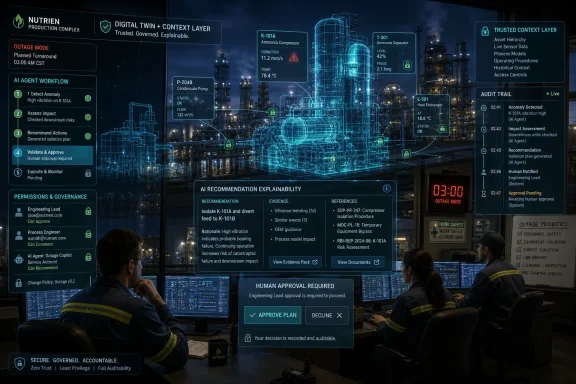
The Yara example matters because Microsoft is not presenting AI as the first step. The digital twin is the first step. The AI becomes useful only after the plant has a trusted context layer that brings together assets, documents, history, and live operational state.
That sequence is easy to miss. Many AI programs fail by starting with the model and then hunting for a workflow. The Yara story starts with a workflow problem: plant personnel needed faster access to relevant operational context. Once that context was unified, copilots and agents had something meaningful to reason over.
Microsoft says the results included up to 70 percent faster shutdown recovery, 60 percent fewer field trips, and 50 percent efficiency gains in targeted engineering tasks. Those numbers should be read as vendor-backed case-study figures, not as a universal benchmark. Still, they point to the right kind of value: fewer unnecessary trips, shorter disruptions, faster engineering work, and less time spent navigating disconnected systems.
That is a notable shift. A plant agent cannot safely infer meaning from tag names alone. It needs to know that a sensor belongs to a specific asset, that the asset sits inside a process unit, that the process unit is constrained by operating procedures, and that previous maintenance may change the interpretation of a current alarm.
This is where ontologies and semantic models stop being academic vocabulary. In industrial settings, naming consistency is not guaranteed. Different systems may describe the same asset differently, and old plants often carry decades of accumulated data habits. A semantic layer helps the AI understand relationships that raw data tables do not make obvious.
For WindowsForum readers who live closer to endpoints, identity, and infrastructure than to ammonia synthesis loops, this is the industrial equivalent of moving from file search to policy-aware enterprise knowledge. The agent must know not only what information exists, but what it means, who can access it, which version is authoritative, and what actions are permitted.
That is why Microsoft’s manufacturing story is also a Microsoft cloud story. The company wants Azure to be the connective tissue between operational data, engineering context, identity controls, governance, and AI interfaces. The plant is the use case, but the platform play is unmistakable.
That makes guardrails central rather than decorative. Permissions, approvals, audit trails, explainability, and lineage have to be designed before the agent becomes operationally important. If the system cannot explain why it made a recommendation, identify the data it used, and show the limits under which it is allowed to act, production teams will route around it.
This is also where many AI vendors will discover the difference between a compelling demo and a deployable industrial product. A model that can summarize a maintenance manual is useful. A governed assistant that can tell a technician which procedure applies, show the evidence, respect site permissions, open a work order draft, and require human approval before escalation is much more valuable.
The issue is accountability. Plants already have chains of responsibility. Operators, engineers, maintenance supervisors, safety officers, and managers all know where their decisions sit. An AI agent has to strengthen that accountability structure, not blur it.
Microsoft’s language around “human-agent teams” is therefore more than a safe talking point. It is the only politically and operationally realistic path for AI adoption in high-consequence manufacturing. The human remains accountable for judgment; the agent reduces the friction that makes good judgment slow.
Microsoft acknowledges this, and it is one of the more important parts of the pitch. Most process manufacturers are not replacing their operational stack from scratch. They are trying to add capability without stopping the plant, breaking validated processes, or forcing operators to abandon tools they trust.
That is a harder technical and organizational problem than building a new AI-native facility. It means integrating with existing historians, control systems, ERP platforms, maintenance systems, document repositories, and identity providers. It means working at the edge when latency, resilience, or data residency requires it, while still using cloud services where scale and AI tooling make sense.
The brownfield constraint also changes the economics. The winning use cases are not necessarily the flashiest. They are the repetitive, expensive frictions that occur across shifts and sites: finding drawings, preparing work packs, diagnosing common abnormal situations, recovering after shutdowns, validating equipment history, and turning expert know-how into standard practice.
This is why the Yara example is more persuasive than a generic “factory of the future” demo. It deals with the central industrial reality: the plant already exists. The task is to make its knowledge usable without pretending decades of systems and procedures can be swept away.
Operators know when a system is blind to reality. Maintenance teams know when data is stale. Engineers know when a drawing cannot be taken at face value. Site leaders know when a corporate technology program looks elegant from headquarters but adds work on the floor.
Agentic AI will run into all of that skepticism, and rightly so. A recommendation engine that ignores process limits will be dismissed. A chatbot that cites the wrong procedure will be dangerous. A system that cannot show its evidence will be treated as entertainment.
This is where the best industrial AI deployments will look less like consumer AI and more like disciplined knowledge management with a reasoning layer on top. The agent must be boring in the right ways. It must respect access controls, preserve auditability, and make uncertainty visible.
There is a lesson here for the broader enterprise AI market, too. The further AI moves from drafting text toward influencing operations, the more governance becomes a product feature. In a plant, “trust me” is not a user experience. It is a failure mode.
It is also fragile. Retirements, turnover, contractor churn, and shift boundaries all erode institutional memory. Manufacturers have been worrying about the loss of expert knowledge for years, but conventional documentation rarely captures the nuance of live operations.
Agentic AI offers a more plausible mechanism. If systems can observe workflows, capture decisions, link them to context, and standardize successful patterns, they can help turn tribal knowledge into repeatable practice. That does not replace experts. It makes their expertise less trapped in individual heads.
The danger is oversimplification. Not every expert shortcut should become a standard workflow, and not every historical action was correct. The agentic system has to preserve context, not flatten it into folklore with a search box.
Still, this may be one of the biggest long-term opportunities. The value of industrial AI is not merely faster answers. It is less variability between the best shift and the worst shift, between the flagship site and the struggling site, between the veteran operator and the new hire.
Manufacturing data can be commercially sensitive, safety-relevant, and geopolitically important. A plant’s operating patterns can reveal production capacity, supply chain dependencies, maintenance weaknesses, and intellectual property. For critical industries, the question of where data is processed is not just procurement theater.
This gives Microsoft both an opportunity and a challenge. The opportunity is that cloud-scale AI, identity, governance, and security are precisely the areas where a hyperscaler can argue for platform advantage. The challenge is that many manufacturers will not accept a simple “send everything to the cloud” story.
The likely future is hybrid by necessity. Some inference and data processing will happen near the plant. Some training, orchestration, and enterprise-scale analytics will sit in the cloud. Some environments will require sovereign controls, tenant isolation, or strict policy boundaries. Some will be constrained by regulation; others by risk appetite.
For IT pros, this is where agentic plant operations becomes familiar terrain. The architectural questions are not exotic: identity, least privilege, logging, network segmentation, lifecycle management, backup, availability, and incident response. The difference is that the workload is now tied to production, safety, and physical equipment.
Agentic AI will not erase that boundary. It will put more pressure on it. If AI-assisted workflows pull from OT data, engineering documents, maintenance records, and identity systems, then the old separation between “plant systems” and “business systems” becomes harder to maintain cleanly.
That does not mean reckless convergence. It means better-governed integration. The systems that feed an agent must be patched, inventoried, authenticated, segmented, monitored, and backed up. If the AI layer becomes a trusted operational assistant, the integrity of every connected source becomes more important.
This is a familiar story in Windows-heavy environments. A single unmanaged workstation, stale service account, or overprivileged file share can undermine an otherwise sophisticated platform. AI does not eliminate those basics. It raises the cost of ignoring them.
The irony is that the most advanced part of the stack may depend on the least glamorous administrative work. Good identity hygiene, clean asset records, consistent document control, and reliable endpoint management are not side quests. They are prerequisites for agents that can be trusted.
Manufacturers have no shortage of AI experiments. Many are impressive enough to win internal attention and limited enough to avoid operational consequences. The hard part is moving from a controlled demonstration to a production workflow that people rely on.
The pilot trap has several causes. Data quality is worse than expected. Integration takes longer than the demo implied. Operators were not involved early enough. Security review arrives late. The model performs well on familiar examples and poorly on edge cases. The business case depends on behavior change that no one owns.
Agentic AI makes that trap more dangerous because the promise is more operational. A dashboard can be ignored if it disappoints. An agent that becomes part of troubleshooting, maintenance planning, or shutdown recovery must be reliable enough to deserve that role.
The right answer is not to avoid pilots. It is to pilot like production is the destination. That means choosing a workflow with measurable friction, defining the guardrails up front, instrumenting the outcome, and planning from day one how the pattern would scale across shifts and sites.
The Yara case illustrates why. Faster shutdown recovery and fewer field trips are not abstract productivity claims. They are concrete improvements in the expensive seams between systems, people, and procedures. That is where industrial operations leak time.
The most important takeaways are therefore practical rather than futuristic:
Microsoft’s argument lands because it accepts a truth that industrial buyers already know: the plant does not need more magic; it needs less friction. If agentic AI is to earn a place in live operations, it will do so by becoming a disciplined assistant inside governed workflows, not by pretending to be the operator, engineer, planner, and safety officer at once. The next phase will be measured not by how many agents manufacturers deploy, but by whether those agents can help real teams recover faster, act safer, and carry hard-won knowledge from one shift to the next.
 Microsoft Sells an Agent, but the Product Is Really Operational Discipline
The phrase agentic AI has already suffered the usual enterprise software fate: it means something sharper in engineering circles than it does on a conference slide. In Microsoft’s manufacturing pitch, however, the useful version is fairly concrete. An agent is not a magical plant operator; it is a software participant that can gather context, reason across systems, recommend actions, and sometimes initiate workflow steps under defined approvals.That framing is important because process manufacturing is a hostile environment for vague autonomy. Fertilizer, chemicals, refining, food production, pharmaceuticals, mining, and utilities all operate inside constraints that cannot be talked around by a language model. Pressure limits, quality specifications, maintenance procedures, safety cases, regulatory obligations, and unionized work practices are not suggestions. They are the reality into which any AI system must fit.
So Microsoft’s strongest claim is also its most conservative one: plant AI has to be grounded before it can be useful. The real system of intelligence is not a model floating above the plant. It is the combination of operational technology data, engineering documents, work orders, asset histories, alarms, shift logs, 3D models, identity systems, and human approvals.
That is a less glamorous story than “AI runs the factory,” but it is much closer to where the money is. Manufacturing teams do not need another screen that says a pump is unhappy. They need a system that knows which pump it is, what service it is in, what work was done last week, what the operating envelope permits, which procedure applies, and who is allowed to do what next.
The Dashboard Era Has Reached Its Limit
For the last two decades, industrial digitization has often meant turning paper, clipboards, and isolated control-room knowledge into screens. That was not a failure. Historians, SCADA systems, manufacturing execution systems, asset performance tools, and analytics platforms made plants more visible and measurable.But visibility has a ceiling. Once every team has its own dashboard, the problem shifts from not seeing enough to seeing too much. Operators face alarm floods, engineers chase stale drawings, reliability teams argue over data quality, and maintenance planners toggle between systems that were never designed to tell one coherent story.
That is the trap Microsoft is trying to exploit. The company is effectively saying that the industrial software market has overproduced awareness and underproduced decision support. The plant floor is full of signals, but the workflow from signal to action is still fragmented.
This is where agentic AI becomes more than a branding exercise. If an AI system can retrieve the right document, reconcile it with live operating data, surface prior maintenance context, and propose a bounded next step, it can attack the expensive middle of plant operations: the time wasted finding, validating, and connecting information before the real work begins.
It is not hard to see why Microsoft wants this conversation. Azure, identity, security, data governance, digital twins, and Copilot-style interfaces all become more valuable if the industrial buyer accepts the premise that the problem is not merely analytics, but coordinated operational intelligence.
Yara’s Fertilizer Plant Is the Case Study Microsoft Needed
The centerpiece of Microsoft’s post is Yara’s Porsgrunn fertilizer plant in Norway, where Yara and Kongsberg Digital built an Azure-based operational digital twin experience. The story is familiar to anyone who has worked around industrial systems. Critical data existed, but it was distributed across engineering documents, 3D models, live operations systems, maintenance history, and field knowledge.That fragmentation creates a practical tax on every abnormal situation. A team responding to a shutdown or equipment issue may have the signal quickly, but not the surrounding context. The operator knows the process symptom, the engineer knows the design, maintenance knows the recent intervention, and the documentation system knows the drawing — assuming the drawing is current and someone can find it.
The Yara example matters because Microsoft is not presenting AI as the first step. The digital twin is the first step. The AI becomes useful only after the plant has a trusted context layer that brings together assets, documents, history, and live operational state.
That sequence is easy to miss. Many AI programs fail by starting with the model and then hunting for a workflow. The Yara story starts with a workflow problem: plant personnel needed faster access to relevant operational context. Once that context was unified, copilots and agents had something meaningful to reason over.
Microsoft says the results included up to 70 percent faster shutdown recovery, 60 percent fewer field trips, and 50 percent efficiency gains in targeted engineering tasks. Those numbers should be read as vendor-backed case-study figures, not as a universal benchmark. Still, they point to the right kind of value: fewer unnecessary trips, shorter disruptions, faster engineering work, and less time spent navigating disconnected systems.
The Digital Twin Becomes the Memory an Agent Can Use
Digital twins have had their own hype cycle, and some of it deserved skepticism. Too often, the phrase became a premium label for a 3D model, a dashboard, or a simulation that was impressive in a demo but peripheral to daily operations. Microsoft’s agentic AI pitch gives the digital twin a more practical job: it becomes the memory and map an AI agent needs to behave usefully.That is a notable shift. A plant agent cannot safely infer meaning from tag names alone. It needs to know that a sensor belongs to a specific asset, that the asset sits inside a process unit, that the process unit is constrained by operating procedures, and that previous maintenance may change the interpretation of a current alarm.
This is where ontologies and semantic models stop being academic vocabulary. In industrial settings, naming consistency is not guaranteed. Different systems may describe the same asset differently, and old plants often carry decades of accumulated data habits. A semantic layer helps the AI understand relationships that raw data tables do not make obvious.
For WindowsForum readers who live closer to endpoints, identity, and infrastructure than to ammonia synthesis loops, this is the industrial equivalent of moving from file search to policy-aware enterprise knowledge. The agent must know not only what information exists, but what it means, who can access it, which version is authoritative, and what actions are permitted.
That is why Microsoft’s manufacturing story is also a Microsoft cloud story. The company wants Azure to be the connective tissue between operational data, engineering context, identity controls, governance, and AI interfaces. The plant is the use case, but the platform play is unmistakable.
Guardrails Are Not a Compliance Footnote
The most credible part of Microsoft’s argument is its insistence that process manufacturing does not tolerate black-box autonomy. In an office workflow, a bad AI suggestion may create a draft email with the wrong tone. In a plant, a bad recommendation can waste production, damage equipment, violate quality controls, or create a safety risk.That makes guardrails central rather than decorative. Permissions, approvals, audit trails, explainability, and lineage have to be designed before the agent becomes operationally important. If the system cannot explain why it made a recommendation, identify the data it used, and show the limits under which it is allowed to act, production teams will route around it.
This is also where many AI vendors will discover the difference between a compelling demo and a deployable industrial product. A model that can summarize a maintenance manual is useful. A governed assistant that can tell a technician which procedure applies, show the evidence, respect site permissions, open a work order draft, and require human approval before escalation is much more valuable.
The issue is accountability. Plants already have chains of responsibility. Operators, engineers, maintenance supervisors, safety officers, and managers all know where their decisions sit. An AI agent has to strengthen that accountability structure, not blur it.
Microsoft’s language around “human-agent teams” is therefore more than a safe talking point. It is the only politically and operationally realistic path for AI adoption in high-consequence manufacturing. The human remains accountable for judgment; the agent reduces the friction that makes good judgment slow.
Brownfield Plants Will Decide Whether the Vision Survives
The industrial AI market will not be decided in pristine showcase factories. It will be decided in brownfield environments full of legacy systems, aging assets, partial documentation, edge constraints, and production schedules that leave little room for heroic modernization projects.Microsoft acknowledges this, and it is one of the more important parts of the pitch. Most process manufacturers are not replacing their operational stack from scratch. They are trying to add capability without stopping the plant, breaking validated processes, or forcing operators to abandon tools they trust.
That is a harder technical and organizational problem than building a new AI-native facility. It means integrating with existing historians, control systems, ERP platforms, maintenance systems, document repositories, and identity providers. It means working at the edge when latency, resilience, or data residency requires it, while still using cloud services where scale and AI tooling make sense.
The brownfield constraint also changes the economics. The winning use cases are not necessarily the flashiest. They are the repetitive, expensive frictions that occur across shifts and sites: finding drawings, preparing work packs, diagnosing common abnormal situations, recovering after shutdowns, validating equipment history, and turning expert know-how into standard practice.
This is why the Yara example is more persuasive than a generic “factory of the future” demo. It deals with the central industrial reality: the plant already exists. The task is to make its knowledge usable without pretending decades of systems and procedures can be swept away.
Trust Is an Adoption Problem Masquerading as a Technical Problem
Manufacturers do not adopt operational technology merely because it is clever. They adopt it when it can be trusted under pressure. That trust is partly technical, but it is also cultural.Operators know when a system is blind to reality. Maintenance teams know when data is stale. Engineers know when a drawing cannot be taken at face value. Site leaders know when a corporate technology program looks elegant from headquarters but adds work on the floor.
Agentic AI will run into all of that skepticism, and rightly so. A recommendation engine that ignores process limits will be dismissed. A chatbot that cites the wrong procedure will be dangerous. A system that cannot show its evidence will be treated as entertainment.
This is where the best industrial AI deployments will look less like consumer AI and more like disciplined knowledge management with a reasoning layer on top. The agent must be boring in the right ways. It must respect access controls, preserve auditability, and make uncertainty visible.
There is a lesson here for the broader enterprise AI market, too. The further AI moves from drafting text toward influencing operations, the more governance becomes a product feature. In a plant, “trust me” is not a user experience. It is a failure mode.
The Real Target Is Tribal Knowledge
Every plant has people who know how things really work. They know which alarms tend to matter, which valves are awkward, which documentation is suspect, which unit behaves differently during seasonal changes, and which troubleshooting sequence saves an hour. That knowledge is valuable precisely because it is contextual.It is also fragile. Retirements, turnover, contractor churn, and shift boundaries all erode institutional memory. Manufacturers have been worrying about the loss of expert knowledge for years, but conventional documentation rarely captures the nuance of live operations.
Agentic AI offers a more plausible mechanism. If systems can observe workflows, capture decisions, link them to context, and standardize successful patterns, they can help turn tribal knowledge into repeatable practice. That does not replace experts. It makes their expertise less trapped in individual heads.
The danger is oversimplification. Not every expert shortcut should become a standard workflow, and not every historical action was correct. The agentic system has to preserve context, not flatten it into folklore with a search box.
Still, this may be one of the biggest long-term opportunities. The value of industrial AI is not merely faster answers. It is less variability between the best shift and the worst shift, between the flagship site and the struggling site, between the veteran operator and the new hire.
Microsoft’s Manufacturing Push Is Also a Sovereignty Pitch
One of the subtler signals in Microsoft’s post is the emphasis on data residency, access, policy, and sovereignty. That is not incidental. Industrial companies are increasingly cautious about where operational data lives, who can use it, and how AI services interact with sensitive process information.Manufacturing data can be commercially sensitive, safety-relevant, and geopolitically important. A plant’s operating patterns can reveal production capacity, supply chain dependencies, maintenance weaknesses, and intellectual property. For critical industries, the question of where data is processed is not just procurement theater.
This gives Microsoft both an opportunity and a challenge. The opportunity is that cloud-scale AI, identity, governance, and security are precisely the areas where a hyperscaler can argue for platform advantage. The challenge is that many manufacturers will not accept a simple “send everything to the cloud” story.
The likely future is hybrid by necessity. Some inference and data processing will happen near the plant. Some training, orchestration, and enterprise-scale analytics will sit in the cloud. Some environments will require sovereign controls, tenant isolation, or strict policy boundaries. Some will be constrained by regulation; others by risk appetite.
For IT pros, this is where agentic plant operations becomes familiar terrain. The architectural questions are not exotic: identity, least privilege, logging, network segmentation, lifecycle management, backup, availability, and incident response. The difference is that the workload is now tied to production, safety, and physical equipment.
Windows, Edge, and the Industrial IT Backplane
Although Microsoft’s blog is framed around manufacturing and Azure, the implications reach the Windows and enterprise infrastructure world. Plants are full of Windows-based engineering workstations, HMIs, maintenance laptops, reporting terminals, and line-of-business systems that sit uncomfortably between IT and OT.Agentic AI will not erase that boundary. It will put more pressure on it. If AI-assisted workflows pull from OT data, engineering documents, maintenance records, and identity systems, then the old separation between “plant systems” and “business systems” becomes harder to maintain cleanly.
That does not mean reckless convergence. It means better-governed integration. The systems that feed an agent must be patched, inventoried, authenticated, segmented, monitored, and backed up. If the AI layer becomes a trusted operational assistant, the integrity of every connected source becomes more important.
This is a familiar story in Windows-heavy environments. A single unmanaged workstation, stale service account, or overprivileged file share can undermine an otherwise sophisticated platform. AI does not eliminate those basics. It raises the cost of ignoring them.
The irony is that the most advanced part of the stack may depend on the least glamorous administrative work. Good identity hygiene, clean asset records, consistent document control, and reliable endpoint management are not side quests. They are prerequisites for agents that can be trusted.
The Pilot Trap Is Waiting
Microsoft’s post ends with a pragmatic playbook: build a context layer, use ontologies where they add meaning, start with high-friction workflows, design guardrails early, embed intelligence where people already work, and scale through repeatable playbooks. That advice is sensible because it attacks the most common failure mode in enterprise AI: endless pilots.Manufacturers have no shortage of AI experiments. Many are impressive enough to win internal attention and limited enough to avoid operational consequences. The hard part is moving from a controlled demonstration to a production workflow that people rely on.
The pilot trap has several causes. Data quality is worse than expected. Integration takes longer than the demo implied. Operators were not involved early enough. Security review arrives late. The model performs well on familiar examples and poorly on edge cases. The business case depends on behavior change that no one owns.
Agentic AI makes that trap more dangerous because the promise is more operational. A dashboard can be ignored if it disappoints. An agent that becomes part of troubleshooting, maintenance planning, or shutdown recovery must be reliable enough to deserve that role.
The right answer is not to avoid pilots. It is to pilot like production is the destination. That means choosing a workflow with measurable friction, defining the guardrails up front, instrumenting the outcome, and planning from day one how the pattern would scale across shifts and sites.
The Plant-Floor AI Story Is Narrower, and Stronger, Than the Hype
The useful version of Microsoft’s announcement is not “AI will run factories.” It is “AI can reduce the operational drag between knowing something is wrong and doing the right thing about it.” That is narrower, but it is also far more credible.The Yara case illustrates why. Faster shutdown recovery and fewer field trips are not abstract productivity claims. They are concrete improvements in the expensive seams between systems, people, and procedures. That is where industrial operations leak time.
The most important takeaways are therefore practical rather than futuristic:
- Agentic AI in process manufacturing should be treated as a governed decision-support layer, not as black-box autonomy over plant operations.
- Digital twins and semantic context are becoming prerequisites because agents need asset relationships, documents, history, and live operating state to reason usefully.
- The first scalable use cases are likely to be high-friction workflows such as troubleshooting, shutdown recovery, work preparation, reliability triage, and quality response.
- Trust will depend on identity, access control, auditability, explainability, lineage, and clear boundaries between recommendations and executable actions.
- Brownfield integration will decide adoption because most plants must modernize around existing systems rather than replace them.
- The biggest long-term prize may be reducing variability across shifts and sites by turning expert operational knowledge into repeatable, governed practice.
Microsoft’s argument lands because it accepts a truth that industrial buyers already know: the plant does not need more magic; it needs less friction. If agentic AI is to earn a place in live operations, it will do so by becoming a disciplined assistant inside governed workflows, not by pretending to be the operator, engineer, planner, and safety officer at once. The next phase will be measured not by how many agents manufacturers deploy, but by whether those agents can help real teams recover faster, act safer, and carry hard-won knowledge from one shift to the next.
References
- Primary source: Microsoft
Published: 2026-06-18T16:10:19.250731
Agentic AI for plant operations: From dashboards to decisions | The Microsoft Cloud Blog
Discover how Microsoft is helping manufacturers apply agentic AI in plant operations to improve decision-making, reduce downtime, and scale operational efficiency.www.microsoft.com